INTRODUCTION. (continued 18)
Reading edition
The front of the pigeon-room, or cote, should have a south-west aspect; and if a room be selected for the purpose, it is usual to break a hole in the roof of the building for the passage of the pigeons, which can be closed at convenience. A platform is laid by the carpenter at the entrance, for the pigeons to alight and perch upon, with some kind of defence against strange cats, which will often depopulate a whole dove-house; cats are yet necessary, for the defence of the pigeons against rats and mice, as they will both destroy the birds and suck the eggs; thence cats of a known good breed should be trained up familiarly with the pigeons. The platform should be painted white, and renewed as the paint wears off, white being a favourite colour with pigeons, and also most conspicuous as a mark to enable them to find their home. The boxes also should be so coloured, and renewed as necessary, for which purpose lime and water will be sufficient.
Cleanliness is one of the first and most important considerations, the want of it in a dove-cote will soon render the place a nuisance not to be approached, and the birds, both young and old, will be so covered with vermin, and besmeared with their own excrement, that they can enjoy no health or comfort, and mortality is often so induced. Ours were cleaned daily; thoroughly once a week, a tub standing at hand for the reception of their dung, the floor covered with sifted gravel, often renewed. Pigeons are exceedingly fond of water, and having a prescience of rain, will wait its coming until late in the evening, upon the house-top, spreading their wings to receive the refreshing shower. When they are confined in a room, they should be allowed a wide pan of water, to be often renewed, as a bath, which cools, refreshes and assists them to keep their bodies clear of vermin. In the attendance upon pigeons, caution is necessary with respect to their fighting, to which they are more prone than might be expected, often to the destruction of eggs or young, or driving the weakest away.
The common barrel dove-cote needs no description, at the same time it is adapted to every situation in which it is desirable to keep pigeons for ordinary use. To return to the room, or loft; the shelves should be placed sufficiently high, for security against vermin, a small ladder being a necessary appendage. The usual breadth of the shelves is about twenty inches, with the allowance of eighteen between shelf and shelf, which will be sufficient not to incommode the tallest pigeons. Partitions between the shelves may be fixed at the distance of about three feet, making a blind, by a board nailed against the front of each partition, whence there will be two nests in the compass of every three feet, so that the pigeons will sit in privacy, and not liable to be disturbed. Or a partition may be fixed between each nest;—a good plan, which prevents the young from running to the hen, sitting over fresh eggs, and perhaps occasioning her to cool and addle them, for when the young are about a fortnight or three weeks old, a good hen will leave them to the care of the cock and lay again.
Some prefer breeding-holes entirely open in front, for the greater convenience in cleaning the nests; but it is from those that the squabs are likely to fall, thence a step of sufficient height is preferable. The tame pigeon seldom taking the trouble to make a nest, it is better to give her one of hay, which prevents her eggs from rolling. Or a straw basket, or unglazed earthen pan, may be placed in every nest, apportioned to the size of the pigeons you breed. A pan of three inches high, eight inches over the top, and sloping to the bottom like a basin, will be of sufficient size for a tumbler, or a small pigeon, whilst one of double those dimensions will be required for a large runt. A brick should always be placed in contiguity to the pan, to enable the cock and hen to alight with greater safety upon the eggs.
The pigeon-trap on the house-top is the well-known contrivance of those London rascals, who lie in wait, as has been said, to entrap the property of others. A trap of another description, and for a very different purpose, is sometimes used; it is an area, on the outside of a building, for the purpose of confining in the air valuable breeds of pigeons which cannot be trusted to flight. Some are erected to the extent of twenty yards long and ten yards in width, with shelves on every side for the perching of the pigeons; thus they are constantly exercised in the air, retiring at their pleasure to the room or loft within.
Very convenient baskets are now made of the cradle form, with partitions, or separate apartments. They serve for the carriage of pigeons for matching, or putting them up to fatten, or for any of the usual purposes. I have seen them lately, in the basket-shops on the Greenwich road, two or three miles from London.
Food and water should be given in such a way as to be as little as possible contaminated with the excrement, or any other impurity. Our pigeons having been constantly attended, we have never found the need of any other convenience than earthen pans; but there have been ingenious inventions for this purpose, of which the meat-box and water-bottle following are specimens. The meat-box is formed in the shape of a hopper, covered at the top to keep clean the grain, which descends into a square shallow box. Some fence this with rails or holes on each side, to keep the grain from being scattered over; others leave it quite open that the young pigeons may the more easily find their food.
The water-bottle is a large glass bottle, with a long neck, holding from one to five gallons, its belly shaped like an egg, so that the pigeons may not light and dung upon it. It is placed upon a stand or three-footed stool, made hollow above, to receive the belly of the bottle, and let the mouth into a small pan beneath: the water will so gradually descend out of the mouth of the bottle as the pigeons drink, and be sweet and clean, and always stop when the surface reaches the mouth of the bottle.
To match or pair a cock and hen, it is necessary to shut them together, or near and within reach of each other; and the connexion is generally formed in a day or two. Various rules have been laid down, by which to distinguish the cock from the hen pigeon; but the masculine forwardness and action of the cock, is for the most part distinguishable.
The following singular detection of a thief occurred on a late examination at Queen Square, Westminster:—Mr. Bepy, in the Wandsworth road, had his pigeon-house robbed. A known thief was stopped on the road with six fancy pigeons in his possession, by Sergeant Reardon of the police, and taken before the magistrates, but no evidence appearing against him, he was discharged, and suffered to take away the birds, which he claimed as having purchased them. Cooper, an officer of the court, being somewhat up to the pigeon fancy, and seeing them above the common sort, purchased them, and very commendably determined to find out the real owner, which he effected in the following ingenious mode. Selecting a fine bald-head, he attached a note to its foot, with his address, and then threw up the pigeon, which instantly flew to its own home, and was recovered by its owner, who returned it to Cooper, making him a present of the half-dozen as a reward for his sagacity.
The starling is a great enemy to pigeons, by sucking their eggs, and even destroying their young. In October, 1800, seven hundred and eighty starlings were taken in one night in a dove-cot belonging to Mr. Slater, of Chalton, near Lincoln.
In 1807, was in the possession of Mr. Knight, of Chichester, a hen pigeon of the pouter species, who, in that summer, hatched three pair of young. She is twenty-one years old, and is considered a remarkable instance of longevity, as Buffon, and other naturalists, have not allowed this bird, from the heat of its nature, above eight or nine years of life, and to be incapable of procreation after seven.
The penalty for shooting them is 20s. for each pigeon. (Under statute of 1 Jac. I.)
For shooting at pigeons, with intent to kill, the penalty would (by 2 Geo. II.) be the same as for killing one pigeon, viz. 20s. Informations for these offences must be commenced within two months.
In pigeon-shooting the most extraordinary performance was by Tupor, the gamekeeper of Sir H. Mildmay, (the same person who broke the sow to stand to game,) who, for a considerable wager, shot six pigeons out of ten with a single ball.
Tupor afterwards, to decide a bet, hit a cricket-ball, with common shot, twelve times successively, betwixt the wickets, bowled by Harris, one of the sharpest bowlers in the Hambleton Club. He is also said to have killed swallows with a single ball.
The next was effected by Mr. Elliot, at Rudgewick, in Sussex, who undertook to kill fifty pigeons at fifty shots; it was decided near Petworth, at Tillington, and notwithstanding the wind was high, he killed forty-five: it was allowed he hit every bird, and that he would have succeeded but for the above circumstance. He had but one gun, the touch-hole of which fairly melted.
Four gentlemen of Camberwell undertook, for a wager of five guineas a side, to shoot at twelve pigeons, and great bets were depending, but to the mortification of the persons present, they neither of them brought down a single bird.
Mr. Keene, of Hammersmith, killed twenty pigeons in twenty-one shots, from a trap at the regular twenty-one yards’ distance, and in March, 1811, he killed, in a match against Mr. Elliot, the same number, beating his adversary by one.
In Wiltshire, the same year, Captain Hicks shot against the gamekeeper of Mr. Maurice, at fifteen pigeons, turned off at the same distance; each killed the whole, and in shooting off the ties, the former missed his sixth bird, and lost the match, which was for two hundred guineas.—Moubray—Daniel.
Pike, s. A long lance used by the foot soldiers to keep off the horse, to which bayonets have succeeded; a fork used in husbandry; among turners, two iron springs between which anything to be turned is fastened; a large fish of prey.
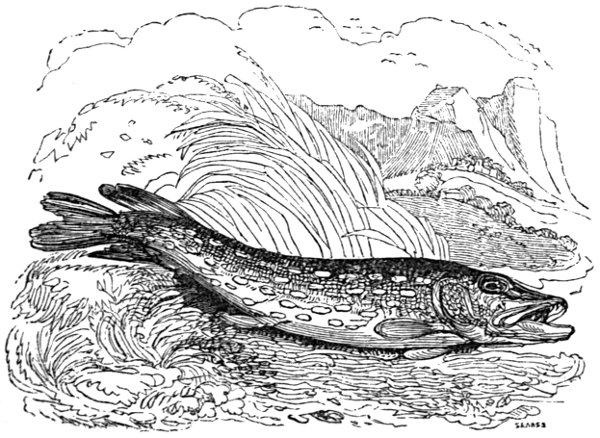
The pike, termed for its voracity the fresh-water shark, is found in most of the larger lakes and rivers of Great Britain. It grows to an immense size—is easily produced as a pond fish—and, being a bold determined biter, affords excellent sport to the lovers of the art. It is taken with natural and artificial baits, as frogs, mice, minnows or any kind of fry; and when the weather is favourable very little skill is requisite to obtain abundant sport in a well-stocked water. The best mode of pike-fishing is trolling. Vide Trolling.
The pike’s voraciousness is well known: what is here mentioned of it is singular. In 1810, a hook baited with a roach, was set in the manor-pond, at Toddington, Bedfordshire; the next morning a large pike was caught, which with difficulty was got out. It appeared that a pike of three and a half pounds weight was first caught, which was afterwards swallowed by another, weighing thirteen pounds and a half, and both were taken.
It has been before remarked, that pike are frequently shot, when floating near the surface of the water. Other sorts of fish are often so destroyed. In June, 1808, Mr. Byrne, the Earl of Lonsdale’s gamekeeper, shot in the river Eden, at Beaumont, near Carlisle, the extraordinary number of eighty-six fish, at two shots; the smallest fish was seven inches in length.
The smaller lakes, which are so profusely scattered over the surface of this county, vary in the species of fish which they respectively produce, as much as they do in their own natural size and character. Some of them afford trouts, others pike only, and many are stocked with both. That this union cannot long subsist, I should be inclined to infer from one remarkable circumstance, and it is a convincing proof of the rapid destruction which the introduction of pike into a trout lake will occasion. Within a short distance of Castlebar there is a small bog-lake, called Derreens; ten years ago it was celebrated for its numerous and well-sized trouts. Accidentally pike effected a passage into the lough from the Minola river, and now the trouts are extinct or, at least, none of them are caught or seen. Previous to the intrusion of the pikes, half-a-dozen trouts would be killed in an evening in Derreens, whose collective weight often amounted to twenty pounds.
Indeed the appetite of one of my pike was almost insatiable. One morning I threw to him, one after the other, five roach, each about four inches in length. He swallowed four of them, and kept the fifth in his mouth for about a quarter of an hour, when it also disappeared.
Fish appear, also, to be capable of entertaining affection for each other. I once caught a female pike during the spawning season, and nothing could drive the male away from the spot at which the female disappeared, whom he had followed to the very edge of the water. A person who had kept two small fish together in a glass, gave one of them away; the other refused to eat, and showed evident symptoms of uneasiness till his companion was restored to him.
The boldness of a pike is very extraordinary. I have seen one follow a bait within a foot of the spot where I have been standing; and the head keeper of Richmond Park assured me that he was once washing his hand at the side of a boat in the great pond in that Park, when a pike made a dart at it, and he had but just time to withdraw it.
A gentleman (Major Payne) now residing at Weybridge, in Surrey, informed me, that, walking one day by the side of the river Wey, near that town, he saw a large pike in a shallow creek. He immediately pulled off his coat, tucked up his shirt-sleeves, and went into the water to intercept the return of the fish to the river, and to endeavour to throw it upon the bank by getting his hands under it. During this attempt, the pike, finding he could not make his escape, seized one of the arms of the gentleman, and lacerated it so much that the wound is still very visible.
The digestion of the pike is so rapid, that, in a few hours, not a single bone of a roach which it has swallowed can be discovered. This may account for the fact of a pike, who has gorged himself to the full, holding a small fish in his mouth whilst the digestion of his previously taken prey has been going on, and swallowing it as soon as that process had been effected.
The rapid growth of some fish is very extraordinary. I saw three pikes taken out of a pond in Staffordshire belonging to the present Sir Jervoise Clark Jervoise, two of which weighed thirty-six pounds each, and the other thirty-five pounds. The pond was fished every seven years, and, supposing that store pike of six or seven pounds weight were left in it, the growth of the pike in question must have been at the rate of at least four pounds a year.
About seventeen years since, when visiting the late Marquis of Clanricarde at Portumna Castle, two gentlemen brought to the marquis an immense pike, which they had just caught in the river Shannon, on the banks of which they had been taking their evening walk. Attracted by a noise and splashing of the water, they discovered in a little creek a number of perch driven on shore, and a fish which, in pursuit of them, had so entangled himself with the ground, as to have a great part of its body exposed, and out of water. They attacked him with an oar, that by accident lay on the bank, and killed him. Never having seen any fish of this species so large, they judged it worth the observation of the marquis, who, equally surprised at its magnitude, had it weighed, and to our astonishment it exceeded the balance at ninety-two pounds; its length was such, that when carried across the oar by the two gentlemen, who were neither of them short, the head and tail touched the ground.
Now that I am speaking of pike I may observe that eagles, which were rather numerous hereabout, were not unfrequently seen to pounce on those fish whilst basking near the surface. It was said, however, that when the pike was very large, he had been known to carry the eagle under water; when, from the latter being unable to disengage his talons, he was of course drowned. Indeed, Dr. Mellerborg, a medical gentleman attached to the Uddeholm establishment when I first visited Wermeland, vouched for this being the fact, he himself having once seen an enormous pike, with an eagle fastened to his back, lying dead on a piece of ground which had been overflown, but from which the water had then retreated.
Captain Eurenius also informed me, that he himself was once an eye-witness to a similar occurrence. This was on the Götha river, and at no great distance from Wenersborg. In this instance, when the eagle first seized the pike, he was enabled to lift him a short distance into the air; but the weight of the fish, together with its struggles, soon carried them back again to the water, under which for a while they both disappeared: presently, however, the eagle again came to the surface, uttering at the same time the most piercing cries, and making apparently every endeavour to extricate his talons, but all was in vain, and, after a deal of struggling, he was finally carried under the water.
Captain Eurenius said, moreover, that pike were occasionally taken alive with only the legs and talons of the eagle attached to their backs, the body of the bird having previously rotted off. This, if true, is a curious circumstance; for one would naturally have supposed, that with such a knapsack the fish would have been unable to procure his food, and that he consequently must soon have perished.
In corroboration of these stories I may mention, that when I was in the Orkney Islands a few years ago, I was told of the eagle striking turbot and other fish at sea, when similar results to what I have just stated occasionally took place. At that time, however, I confess, I was a little incredulous on the subject.
There are no waters in Great Britain, with the exception of the river Shannon, where larger pikes are caught than those taken in Loughs Mask and Corrib. It would appear, that in these lakes the fish are commensurate to the waters they inhabit. It is no unusual event for pikes of thirty pounds weight to be sent to the landlords by their tenants; and fish of even fifty pounds have not unfrequently been caught with nets and night-lines. The trouts in those loughs are also immensely large. From five to fifteen pounds is no unusual size, and some have been found that reached the enormous weight of thirty. The perch tribe appear the smallest in the scale of relative proportion. These seldom exceed a herring size, but they too have exceptions, and perch of three or four pounds weight have been sometimes seen. Within fifty years this latter fish has increased prodigiously, and in the lakes and rivers where they abound trouts have been found to diminish in an equal ratio. If any doubt remained touching the fecundity of the perch, some of the Mayo waters would prove it satisfactorily. Half a century since, I have been assured that pike and perch were almost unknown in the rivers of Belcarra and Minola, and the chain of lakes with which they communicate, and that these waters were then second to none for trout-fishing. Within ten years, my cousin tells me that he often angled in them, and that he frequently killed from three to six dozen of beautiful middle-sized red trouts. Now, fly-fishing is seldom practised there. The trout is nearly extinct, and quantities of pike and perch infest every pool and stream. The simplest methods of taking fish will be here found successful, and the lakes of Westmeath will soon be rivalled by the loughs of Mayo.—Jesse—Lloyd—Daniel—Wild Sports.
Pilcher or Pilchard, s. A fish like a herring.
The pilchard has a general likeness to the herring, but, when comparatively described, is essentially different. The body of the pilchard is less compressed, being thicker and rounder; the back is more elevated, the belly less sharp, the nose turns up, and, as well as the under jaw, is shorter, the dorsal fin is placed exactly in the centre of gravity, so that when taken up by it, the body preserves an equilibrium; that of the herring dips at the head. The scales of the pilchard adhere closely, whereas those of the herring very easily drop off; besides the pilchard is fatter, or more full of oil.
About the middle of July, the pilchards in vast shoals approach the Cornish coasts; the beginning of winter they disappear, a few returning after Christmas. Their winter retreat, and their motives for migrating, are the same with the herring. During summer, they affect a warmer latitude, no quantities being found on any of our coasts, except those of Cornwall; namely, from Fowey harbour to the Scilly Isles, between which places, for some weeks, the shoals keep shifting.
The appearance of the pilchard is known by the birds and larger fishes attendant upon them, and persons called Huers are placed on eminences, to point to the boats stationed off the land the course of the fish, by whose directions sometimes a bay of several miles’ extent is enclosed with their nets, called seines. By the first of James I. c. 23, fishermen are empowered to go on the grounds of others to hue, without being liable to action for trespass, which before occasioned frequent law-suits. The numbers that are taken at one shooting of the nets is astonishing. Upon the fifth of October, 1767, there were at one time inclosed in St. Ive’s Bay, 7,000 hogsheads, each cask containing 35,000 fish, in all 245,000,000.
Pint, s. Half a quart; in medicine, twelve ounces; a liquid measure.
Pintado, s. Guinea fowls: before rain, the pintados, called comebacks, squall more than usual, as do peacocks.—Foster.
Pintail Duck, Lea Pheasant, Cracker, Winter Duck (Anas acuta, Linn.; Le Canard à longue Queue, Buff.), s.
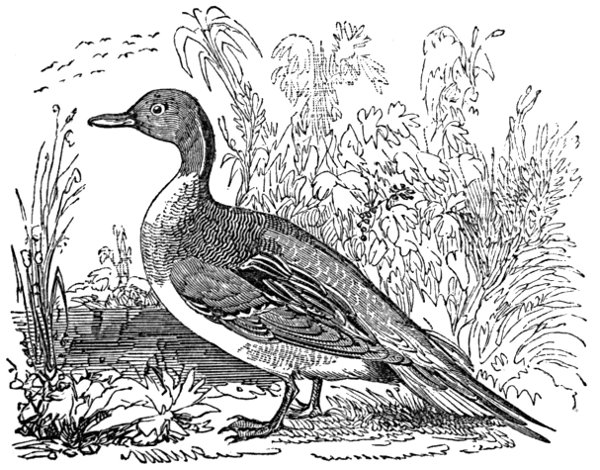
This handsome-looking bird is twenty eight inches in length, and thirty eight in breadth, and weighs about twenty four ounces. The bill is rather long, black in the middle, and blue on the edges; the irides reddish; the head and throat are of a rusty brown, mottled with small dark spots, and tinged behind the ears with purple; the nape and upper part of the neck are dusky, margined by a narrow white line, which runs down on each side, and falling into a broader stripe of the same colour, extends itself on the fore part as far as the breast; the rest of the neck, the breast, and the upper part of the back, are elegantly pencilled with black and white waved lines; the lower back and sides of the body are undulated in the same manner, but with lines more freckled, less distinct, and paler; the scapulars are long and pointed, each feather black down the middle with white edges; the coverts of the wings are ash-brown, tipped with dull orange; below these the wing is obliquely crossed by the beauty spot of glossy bronze purple green, with a lower border of black and white; this spangle is formed by the outer webs and tips of the middle quills; the rest of the quills are dusky. All the tail feathers are of a brown ash-colour, with pale edges, except the two middle ones, which are black, slightly glossed with green, considerably longer than the others, and end in a point; the belly and sides of the vent are white; under tail-coverts black; legs and feet small, and of a lead colour.
The female is less than the male, and her plumage is of a much plainer cast, all the upper parts being brown, with each feather margined more or less with white, inclining to red or yellow; the greater coverts and secondary quills are tipped with cream-colour and white which form a bar across the wings. The fore-part of the neck, the breast, and the belly to the vent, are of a dull white, obscurely spotted with brown. The tail is long and pointed, but the two middle feathers do not extend themselves beyond the rest, like those of the male.
These birds do not visit the temperate and warm climates in great numbers, except in very severe winters, the great bulk of them dropping short, and remaining during that season in various parts of the Russian dominions, Sweden, Norway, &c., and also in the same latitudes in both Asia and America. They are seldom numerous in England, but flocks of them are sometimes abundantly spread along the isles and shores of Scotland and Ireland, and on the interior lakes of those countries, as well as those of the continent as far south as Italy, and in America as far south as New York. They are esteemed excellent eating.
The pintail duck is of a taller or more lengthened shape than any of the species, and, in the opinion of the Count de Buffon, seems to form the link between the duck and the garganey.—Latham—Bewick.
Pip, s. A defluxion with which fowls are troubled; a horny pellicle that grows on the tip of their tongues; a spot on the cards.
Pipe, s. Any long hollow body, a tube; a tube of clay through which the fume of tobacco is drawn into the mouth; an instrument of wind music; the organs of voice and respiration, as the windpipe; the key of the voice; a liquid measure containing two hogsheads.
Pipe, v. To play on the pipe; to have a shrill sound as birds have.
Pipkin, s. A small earthen boiler.
Piquet, s. A game at cards.
Piquet is played by two persons, with thirty-two cards: the ace, king, queen, knave, ten, nine, eight, and seven of each suit. The ace is the superior, and equal to eleven points; the king ranks above the queen, and the queen above the knave, &c. The three court cards are each equal to ten points; the ten, ten; the nine, nine; and so of the rest, each counting for as many points as it has pips.
The game consists of 101 points. The players begin with shuffling the cards; then they are to cut; he who cuts the lowest deals, but the great advantage is in being elder hand. The dealer then shuffles the cards again, and presents them to his adversary, who may also shuffle, but the dealer must have the last shuffle. If the adversary should scatter the cards, or cut but one off, or leave but one at the bottom, the dealer may mix and shuffle them again. The dealer is to give twelve a piece, by two at a time, and the eight cards which remain must be placed upon the table, and are called the talon or stock.
In this game there are three superior chances, viz. the repique, the pique, and the capot, all which may be made in one deal, as thus: suppose one of the players to have four tierce-majors, his point to be good, and he is eldest hand: he begins by counting three for his point, then twelve for his four tierce-majors, next fourteen for the four aces, fourteen for the four kings, and fourteen for the four queens, then sixty for the repique, thirteen he gains in playing the cards; and he has forty for the capot, which make together one hundred and seventy: this stroke, perhaps, has never happened; but it is just if it ever should.
To pique the adversary, you must be elder hand; for if youngest, your adversary counts one for the first card he plays, and then you having counted only twenty-nine in hand, even if you take the first trick, it will not authorise you to count sixty, but only thirty.
The carte blanche precedes every thing, then follows the point, then the huitièmes, the septièmes, the sixièmes, the quints, the quarts, the tierces, the four aces, kings, queens, knaves, or tens; then the three aces, kings, queens, knaves, or tens; then the points gained in playing the cards; and the last is the ten for winning the cards, or the forty for the capot. After sorting the cards, the first thing to be considered is, whether you have a carte blanche, if so, let your adversary discard, and when he is going to take in lay your twelve cards on the table, counting them one after another.
The players having examined their hands, the elder hand may discard five cards or fewer as he may deem for his advantage, and, laying them aside, he takes as many from the talon or heap; the youngest hand can lay out three only, unless any of the five allotted to his adversary be left, which he may take or not, as he pleases.
In discarding, the first intention in skilful players is, to gain the cards, and to have the point, which most commonly engages them to keep in that suit, of which they have the most cards, or that which is their strongest; for it is convenient to prefer, sometimes, forty-one in one suit to forty-four in another, in which a quint is not made; sometimes, even having a quint, it is more advantageous to hold the forty-one, where, if one card only be taken in, it may make it a quint-major, and gain the point, or the cards, which could not have been done by holding the forty-four, at least, without an extraordinary take-in. Also endeavour, in laying out, to get a quatorze; that is, four aces, kings, queens, knaves, or tens, each of which counts for fourteen, and is therefore called a quatorze. The fourteen aces in your hand hinder the counting fourteen kings in the adversary’s, &c., and by this superiority you may count a lesser quatorze, as of tens, notwithstanding your adversary may have fourteen kings, &c., because the stronger (viz. the aces) annuls the weaker: and also, in the want of a lesser quatorze you may count three aces, three kings, three queens, three knaves, or three tens. Three aces are better than three kings; and he who has them may by virtue thereof count his three tens, although the adversary may have three kings; in favour of a quatorze you count not only any lesser quatorze, but also all the threes which you have, except of nines, eights, and sevens. The same is to be observed in regard to the huitièmes, septièmes, sixièmes, quints, quarts, and tierces, to which the player must have regard in his discarding, so that what he takes in may make them for him.
The point being selected, the eldest hand declares what it is, and asks if it be good: if his adversary have not so many, he answers it is good; if he have just as many, he answers it is equal; and if he have more, he answers it is not good; for whoever has the point, whether eldest or youngest, counts it first; but if the points be equal, neither can count: it is the same when the players have equal tierces, quarts, quints, &c., and whoever should hold several other sequences, either of the same goodness or lesser cannot count them.
After the elder hand has counted the point, he should examine if he have not tierce, quart, quint, &c., and then if any quatorze, or three aces, kings, &c., that he may reckon them, should his adversary not hinder him by having better.
The points, the tierces, quarts, quints, &c., are to be shown on the table, that their value may be seen and reckoned; but you are not obliged to show quatorzes, or three aces, kings, queens, knaves, or tens.
After each has examined his game, and the elder, by the questions asked, seen every thing that is good in his hand, he begins to reckon. The carte blanche is first reckoned, then the point, next the sequences, and lastly, the quatorzes, as well as threes of aces, kings, &c., after which he begins to play his cards, counting one for each, except it be a nine or an inferior card.
After the elder hand has led his first card, the younger shows his point, if it be good, also the sequences, quatorzes, or threes of aces, kings, &c., and having reckoned them all together, he takes the first trick if he can with the same suit, and counts one for it; if he cannot, the other turns the trick and continues; and when the younger hand can take the trick, he may lead what suit he pleases.
A good player is principally known from an indifferent one by his manner; and it is not possible to play well without knowing the strength of the game; that is to say, by your own hand you should know what your adversary may hold, and what he must have discarded, and great notice should be taken of what he has shown or reckoned. There are no trumps at piquet, but the highest card of the suit, if played, takes the trick.
Should the elder hand have the misfortune to hold neither point, sequence, quatorze, or threes which are good, he must begin to count by playing that card which he judges most proper, and continue until his adversary has played a superior, to gain the lead in his turn. This method must be continued till all the twelve cards are played, and he who takes the last trick counts two. Then each player counts how many tricks he has taken, and he who has the most reckons the cards; but should they be equal, neither side can count any thing for the cards.
As soon as a deal is finished, each player should mark how many points he has made, and so proceed until the game be completed; and after every deal the cards must be shuffled and cut for the next; each player taking his turn, unless the game be concluded in one deal.
When you begin another game, the cards must be cut afresh for the deal, unless it be agreed upon at first, that the deal shall go on.
TERMS USED AT PIQUET.
Capot is when either of the players makes every trick, for which he scores forty.
Cards signify the majority of tricks, which reckon for ten points.
Carte Blanche means a hand without a court card in the twelve dealt, which counts for ten, and takes place of every thing else.
Huitième, eight successive cards of the same suit, counts eighteen points.
Pique, is when the elder hand has reckoned thirty in hand, and plays before the adversary has gained one; in which case, instead of thirty it is called sixty, and he adds thereto as many points as are obtained above thirty.
Point, the greatest number on the cards of the same suit in hand, after having taken in, reckoned by their pips, scores for as many points as cards.
Quart, four cards in sequence of the same suit counts four points: there are five kinds of quarts, the first called quart-major, consisting of ace, king, queen, and knave; the second quart, of king, queen, knave, and ten; the third quart, of queen, knave, ten, and nine; the fourth quart, of knave, ten, nine, and eight; the fifth, a basse-quart or quart-minor of ten, nine, eight, and seven.
Quatorze, the four aces, kings, queens, knaves, or tens, scores fourteen points.
Quint means five cards of the same suit in sequence, and reckons fifteen points: there are four sorts of quints; a quint-major of ace, king, queen, knave, and ten, down to knave, ten, nine, eight, and seven, styled a quint-minor.
Repique signifies when one of the players counts thirty or more in hand, before the adversary obtains one, when it is called ninety, reckoning besides as many points above ninety as were gained above thirty in pique.
Sixième, or six cards of the same suit in sequence, reckons for sixteen points; there are three sorts of sixièmes, viz. sixième-major from the ace, sixième from the king, and sixième-minor from the queen.
Septième, or seven of the same suit in sequence, counts for seventeen points; there are two septièmes, one from the ace, the other from the king.
Threes of aces, &c., down to tens, reckon three points.
Talon or Stock means the eight remaining cards after twelve are dealt to each player.
Tierce or sequence of three, reckons for three: there are six kinds of tierces, tierce-major, of ace, king, queen; down to nine, eight, seven, styled tierce-minor.—Hoyle.
Piscation, s. The act or practice of fishing.
Piscatory, a. Relating to fishes.
Piscivorous, a. Fish-eating, living on fish.
Pismire, s. An ant, an emmet.
Pistol, s. A small sort of firearms.
Pistol, v. To shoot with a pistol.
We were awakened early the next morning by some of our party, who had come to Versailles for the express purpose of witnessing the great shooting match which was to take place at six o’clock in the gardens of the manufactory. Accordingly we repaired to the appointed spot, attended by M. Boute, one of the principal overseers. I naturally imagined, that the pistols to be tried on this occasion were those of the manufactory, but I found this was not the case, the locks only having been constructed there.
The first match being read, whereby Mr. Tripper had engaged that an Italian gentleman named Dance, would hit a cork of an ordinary size, at sixteen yards’ distance, four times out of five, for two hundred guineas, Mr. Dance begged leave to state, that his friend must have laboured under an error, as he never pretended to hit more than once in five shots, and consequently declined any other. The forfeit money was therefore paid to me as judge, and an elegant dinner agreed on for a subsequent day.
The second bet was between Mr. Tripper, and Mr. H—— when the former wagered twenty guineas that Mr. H—— could not hit a cork at the same distance once in ten shots. At the first trial Mr. H—— very nearly struck the cork, and bets were keenly laid on his side, but notwithstanding he made good mark he proved unsuccessful.
Mr. Dance was then matched to hit a card-wafer, twice in four shots, at sixteen yards for thirty guineas. His aim proved accurate three times, and he consequently won the wager. Mr. Boute came forward and hit the wafer four times successively, but missed in two other trials.—Thornton.
Pit, s. A hole in the ground; abyss; the area on which cocks fight; the middle part of the theatre; any hollow of the body, as the pit of the stomach, the arm-pit; a dint made by the finger.
Pitch, s. A black and impure resinous substance, used by farriers in making charges, obtained by boiling or distilling tar to the desired consistence.
Pitfall, s. A pit dug and covered, into which animals fall unexpectedly.
Plaice, s. A flat fish. Although properly a sea fish, plaice will not only live in fresh water, but thrive apace. They will take any sort of small worm, and to the sand-worm, called in Ireland the lug, they appear particularly partial.
Plain, s. Level ground, open flat.
Plash, s. A small lake or puddle of water; branch partly cut off and bound to other branches.
Plaster, s. Substance made of water and some absorbent matter, such as chalk or lime well pulverised, with which walls are overlaid; a glutinous or adhesive salve.
Plate, s. A piece of metal beat out into breadth; wrought silver; a small shallow vessel of metal or porcelain, on which meat is eaten; the prize run for by horses.
Plates, s. Light horse shoes. Vide Racing.
Platina, s. A species of metal, much used in bushing touch-holes, and generally preferred to gold for that purpose.
Play, s. Amusement, sport; game, practice of gaming; contest at a game; practice in any contest.
Pledget, s. A small mass of lint.
Plethora, s. The state in which the vessels are fuller of humours than is agreeable to a natural state of health.
Pleurisy, s. An inflammation of the pleura.
Pliers, s. An instrument by which anything is laid hold of to bend it.
Plover, s. A lapwing.
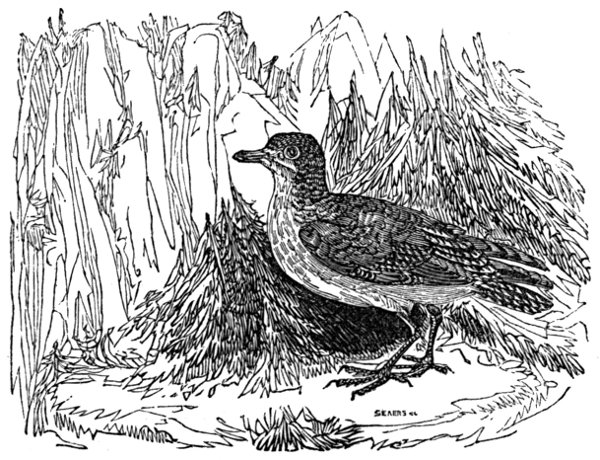
This genus is distinguished by a large full eye; the bill is straight, short, and rather swollen towards the tip; the head is large; the legs are naked above the knee; and most of the species are without the hind toe.
Although the plover has generally been classed with those birds whose business is wholly among water, we cannot help considering the greater part of them as partaking entirely of the nature of land birds. Many of them breed upon our loftiest mountains, and though they are frequently seen upon the sea coast, feeding with birds of the water kind, yet it must be observed that they are no more water birds than any of our small birds which repair thither for the same purpose. The long legged plover and the sanderling are waders, and belong more immediately to the water birds, to which we refer them; the great plover and the lapwing we consider as entirely connected with birds of the plover kind; the former has usually been classed with the bustard, and the latter with the sandpiper; but they differ very materially from both, and seem to agree in more essential points with this kind. We have therefore given them a place in this part of our work, where, with the rest of the plovers, they may be considered as connecting the two great divisions of land and water birds, to both of which they are in some degree allied.
The Great Plover, Thick-kneed, Bustard, Stone Curlew, Norfolk Plover. (Charadrius œdicnemus, Linn.; Le Grand Pluvier, Buff.)—The length of this bird is about sixteen inches. Its bill is long, yellowish at the base, and black at the tip; its irides and eyelids are pale yellow; above each eye there is a pale streak, and beneath one of the same colour extends to the bill, the throat is white, the head, neck, and all the upper parts of the body are of a pale tawny brown; down the middle of each feather there is a dark streak; the forepart of the neck and the breast are nearly of the same colour, but much paler; the belly, thighs, and vent, are of a pale yellowish white, the quills are black; the tail is short and rounded, and a dark band crosses the middle of each feather; the tips are black, the rest white: the legs are yellow, and naked above the knees, which are very thick as if swollen, hence its name, the claws are black.
This bird is found in great plenty in Norfolk and several of the southern counties, but is nowhere to be met with in the northern parts of our island; it prefers dry and stony places on the sides of sloping banks. It makes no nest: the female lays two or three eggs on the bare ground, sheltered by a stone or in a small hole formed in the sand; they are of a dirty white, marked with spots of a deep reddish colour, mixed with slight streaks. Although this bird has great power of wing, and flies with great strength, it is seldom seen during the day, except it is surprised, when it springs to some distance, and generally escapes before the sportsman comes within gun-shot; it likewise runs on the ground almost as swiftly as a dog; after running some time it stops short, holding its head and body still, and on the least noise it squats close on the ground. In the evening it comes out in quest of food and may then be heard at a great distance: its cry is singular, resembling a hoarse kind of whistle, three or four times repeated, and has been compared to the turning of a rusty handle.
Buffon endeavours to express it by the words turlui, turlui, and says it resembles the sound of a third flute, dwelling on three or four tones from a flat to a sharp. Its food consists chiefly of worms. It is said to be good eating when young, the flesh of the old ones is hard, black, and dry. Mr. White mentions them as frequenting the district of Selborne, in Hampshire. He says, that the young run immediately from the nest almost as soon as they are excluded, like partridges; that the dam leads them to some stony field where they bask, skulking among the stones, which they resemble so nearly in colour as not easily to be discovered.
Birds of this kind are migratory; they arrive in April, live with us all the spring and summer, and at the beginning of autumn prepare to take leave, by getting together in flocks: it is supposed that they retire to Spain, and frequent the sheep-walks with which that country abounds.
The Golden Plover, Yellow Plover. (Charadrius pluvialis, Linn.; Le Pluvier doré, Buff.)—The size of the turtle; bill dusky; eyes dark; all the upper parts of the plumage are marked with bright yellow spots upon a dark brown ground; the fore part of the neck and breast are the same, but much paler; the belly is almost white; the quills are dusky; the tail is marked with dusky and yellow bars; the legs are black. Birds of this species vary very much from each other; in some which we have had the breast was marked with black and white; in others it was almost black; but whether this difference arose from age or sex we are at a loss to determine.
The golden plover is common in this country and all the northern parts of Europe; it is very numerous in various parts of America, from Hudson’s Bay as far as Carolina, migrating from one place to another, according to the seasons. It breeds on high and heathy mountains; the female lays four eggs, of a pale olive colour, variegated with blackish spots. They fly in small flocks, and make a shrill whistling noise, by an imitation of which they are sometimes enticed within gun shot.
The male and female do not differ from each other. In young birds the yellow spots are not very distinguishable, as the plumage inclines more to grey.
The Grey Plover. (Tringa squaturola, Linn.; Le Vanneau Pluvier, Buff.)—The length of this bird is about twelve inches; its bill is black; the head, back, and wing coverts, are of a dusky brown, edged with greenish ash-colour, and some with white; the cheeks and throat are white, marked with oblong dusky spots; the belly, sides, and rump, are white: the sides are marked with a few dusky spots; the outer webs of the quills are black; the lower parts of the inner webs of the first four are white; the tail is marked with alternate bars of black and white; the legs are of a dull green; the hind toe is small. In the Planches Enluminées this bird is represented with eyes of an orange colour; there is likewise a dusky line extending from the bill underneath each eye, and a white one above it.
We have placed this bird with the plovers, as agreeing with them in every other respect but that of having a very small hind toe; but this is so slight a difference as not to render it necessary to exclude it from a place in the plover family, to which it evidently belongs. The grey plover is not very common in Britain; it appears sometimes in small flocks on the sea coasts. It is somewhat larger than the golden plover. Its flesh is said to be very delicate.
Long-legged Plover, Long-shanks, or Long-leg. (Charadrius himantopus, Linn. L’Echasse, Buff.)—Its slender black bill is two inches and a half long, from the tip of which to the end of the tail it measures only about thirteen inches, but to the toes a foot and a half; the wings are long, measuring from tip to tip twenty-nine inches; irides red; the crown of the head, back, and wings, a glossy black; tail light grey, except the two outside feathers, which are white, as are all the other parts of its plumage, except a few dusky spots on the back of the neck. Its long, weak, and disproportionate legs are of a blood red, and measure from the foot to the upper naked part of the thigh about eight inches; the toes are short, and the outer and middle ones are connected by a membrane at the base.
Ornithologists mention only a few instances of this singular looking species having been met with in Great Britain, but it is common in other countries.
Latham says it is common in Egypt, being found there in the marshes in October; its food is said to consist principally of flies. It is likewise plentiful about the salt lakes, and is often seen on the shores of the Caspian Sea, as well as by the rivers which empty themselves into it, and in the southern deserts of Independent Tartary. We have also seen it on Chinese paintings, and it is known at Madras in the East Indies. It is also often met with in the warmer parts of America; is sometimes seen as far north as Connecticut, and also in Jamaica.
Plover Shooting.—There is, in shooting plovers, a common remark made by sportsmen that the second is always the more productive barrel. The rapidity with which they vary their position when on the ground, seldom admits of a grand combination for a sitting, or rather a running-shot. But when on the wing, their mode of flight is most favourable for permitting the shot to tell; and it is by no means unusual to bring down a number. When disturbed, they frequently wheel back directly above the fowler, and offer a tempting mark if he should have a barrel in reserve; and even when too high for the shot to take effect, I have often thrown away a random fire; for the plovers, on hearing the report, directly make a sweep downwards on the wing, and I have by this means brought them within range of the second barrel.
Golden plovers were formerly killed in great plenty by means of a stalking-horse. If you fire at these birds as they fly over you, they will dart down for the moment, and spread in every direction; so that by taking a random shot with your first barrel, you may often bring down the birds to a fair one for your second.—Bewick.
Pluck, v. To pull with nimbleness or force; to snatch, to pull, to draw; to strip off feathers.
Pluck, s. A pull, a draw, a single act of plucking; the heart, liver, and lights of an animal.
Plumage, s. Feathers, suit of feathers.
I believe that no attention has been paid to the effects of different kinds of food on the colours of birds. The linnet and redpole, in confinement, lose, after the first moult, their red colour, and it does not return. Is this owing to the want of the peculiar food they would take in the spring, if at liberty, or to their being less exposed to the sunshine? I once saw the English white water-lily blow of a pale rose colour, after a week of unusual heat in July. Birds that change their colours at different seasons, always put on their bright garb in the warm season. I have repeatedly observed, in a splendid nondescript finch which I possess, that, although it moults partially twice in the year, the colour of the larger feathers on the wings and back changes gradually from yellowish brown to scarlet, and fades again at the approach of winter. In this bird, the change to grey red is very clearly occasioned by the increase of temperature. I have observed, in the spring, that the supervention of cold weather stops its progress. In the Whidah bird, the mutation of dress is rapid, accompanying the moult in June and July. The American blue bird pushes brown feathers in its summer moult, which are very suddenly turned to blue. There is a mystery in these mutations which we do not understand.
It is not easy to account for the variation we sometimes perceive in the plumage of birds of the same species. I have observed a rook with one white wing, during the last three years, in the rookery in Hampton Court park; and I saw a sparrow nearly white, amongst a flock of those birds, at West Molesey. A linnet was shot and brought to me from the same place, which was beautifully mottled with white and brown. Some years ago I was shown some white blackbirds, in the grounds of a nobleman at Blackheath, which had been bred there; and what showed this was not an accidental circumstance, they produced young of the same colour as themselves.—White of Selborne—Jesse.
Plume, s. Feather of birds; feather worn as an ornament; the colour of a hawk’s feathers, by which her age and condition are ascertained.
Plume, v. To pick and adjust feathers; to strip off feathers.
Pluming, p. The hawk in the act of tearing feathers from her prey.
Plumipede, s. A fowl that has feathers on the foot.
Plummet, s. A weight of lead hung to a string, by which depths are sounded, and perpendicularity is discerned. A plummet and line will be very serviceable to the bait fisher, in ascertaining the depth of the water, and enabling him thus to regulate the position of the float.
Plump, a. Somewhat flat, sleek, full, and smooth.
Plunge, v. To sink suddenly in water; to dive.
Poach, v. To steal game; to carry off game privately in a bag.
Poacher, s. One who steals game.
Pochard, Poker, Dunbird, Great-headed Wigeon, (Anas Ferina, Linn.; Penelope, La Millouin, Buff.) s.
The pochard is nineteen inches in length, and two feet and a half in breadth, and weighs about one pound thirteen ounces. The bill is of a dark lead-colour, with the tip and sides near the nostrils, black: irides fine deep yellow: the head and neck are of a glossy chestnut, joined to a large space of sooty black, which covers the breast, and is spread over the shoulders: the lower part of the back, rump, tail-coverts, and vent, are also black: the rest of the plumage, both above and below, is wholly covered with prettily freckled, slender, dusky threads, disposed transversely in close-set zig-zag lines, on a pale ground, more or less shaded off with ash, and deepest on the wing-coverts. The primary quills are brown, with dusky tips; the secondaries lead-colour, tinged with brown, and slightly tipped with dull white. The tail consists of twelve short feathers, of a dark-brownish ash, which have also a hoary grey appearance: the legs and toes are lead-colour, shaded and dashed with black. This species is without the beauty-spot on the wings, and has altogether a more plain and half-mourning kind of look than others of this tribe. The specimen from which the above figure was drawn, was shot at Axwell-park, in the county of Durham: the description was taken from one shot in January, near Holy Island. The former differed from the latter in wanting the black on the rump and vent, and in some other slight variations in the shadings of its colours.
The head of the female is of a pale reddish-brown; the breast is of rather a deeper colour; the coverts of the wings plain ash-colour; the back marked like that of the male; the belly ash-coloured.
These birds leave the north on the approach of winter, and migrate southward as far, it is said, as Egypt, in Africa, and Carolina and Louisiana, in America. They arrive in the marshes of France about the end of October, in tolerably numerous flocks; and considerable numbers of them are caught in the fens of Lincolnshire during the winter season, and sold in the London markets, where they and the female wigeons are indiscriminately called dunbirds, and esteemed excellent eating. It has not yet been discovered whether any of them remain to breed in England.
The pochard is of a plump, round shape, and its walk is heavy, ungraceful, and waddling; but when on the wing they fly with greater rapidity than the mallard, and in flocks of from twenty to forty, commonly in a close compact body, whereby they may be easily distinguished from the triangular-shaped flocks of the wild duck, as well as by the difference of the noise of their wings.
The few attempts which have been made to domesticate this species have failed of success. They do pretty well where they have plenty of water, but it is said that they cannot bear walking about on hard, pebbly ground.—Bewick.
Pock, s. A pustule raised by the small pox.
Pod, s. The capsule of legumes, the case of seeds.
Point, s. The sharp end of any instrument; a string with a tag; headland, promontory.
Point, v. To sharpen, to forge or grind to a point; to indicate, as dogs do to sportsmen; to show.
Pointer, s. Anything that points; a dog that points out game to sportsmen.
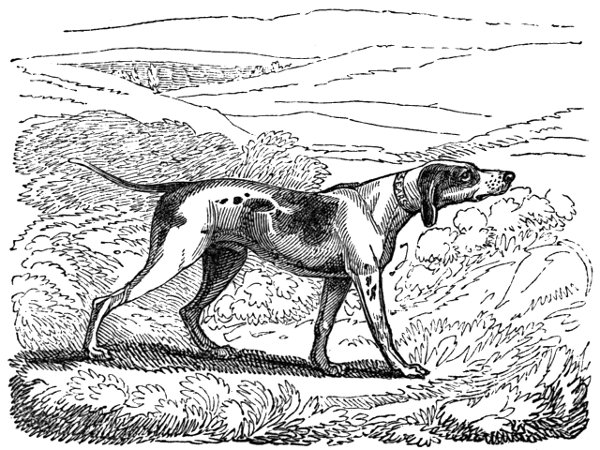
The Spanish Pointer. (Canis Avicularis, variety α, Linn.)—This dog, as his name implies, is a native of the Peninsula, and was introduced into this country at a very early period. Great attention was paid by sportsmen for a long series of years to preserve, in purity, this important breed; but lately it has in a great measure been set aside in field sports, a more improved race having been produced by crossing, usually called the English pointer.
The Spanish pointer is much larger and stronger than the English, and is also more steady. He seems to have an inherent aptness for receiving instruction. Indeed it requires but little tuition to render him fit for the field; as, in most instances, young dogs of this breed will point of their own accord, whilst the more improved kinds require considerable drilling to initiate them, and make them do their work steadily.
The Spanish breed is the most staunch of all dogs, and if they had speed and activity in proportion to their steadiness, they would excel all others which are auxiliary to man in the sports of the field. From their weight, however, they are not so well suited for an extensive range, nor are they so hardy as the English dog, on which account they are ill adapted for the laborious amusement of grouse-shooting. They are now chiefly used by those who confine their sport to the pheasant and partridge.
The English Pointer (Canis Avicularis, variety β.)—This dog is sprung from the Spanish pointer, but is of a much lighter form, and much more rapid in his movements. He was obtained originally by a cross of the latter and the fox-hound, and has since been recrossed with the harrier. The English pointer is of a great variety of sizes, being in this particular bred according to the taste of the sportsman.
This dog possesses a beautiful symmetry of frame, and in this respect is, perhaps, the most elegant of all the canine tribe. His docility and pliability of temper, too, are truly astonishing, and he enjoys, at the same time, the sense of smelling in an exquisite degree.
About sixty years ago, the breed of pointers was nearly white, or mostly variegated with liver-coloured spots, except the celebrated dogs of the then Duke of Kingston, whose black pointers were considered superior to all others in the kingdom, and sold for immense sums after his death. Since that time they have been bred of all sizes and colours, and have at length attained that degree of perfection for which they are now so justly prized all over Europe.
Dogs of the middle size are now generally considered the best by experienced sportsmen; the larger kinds, like the Spanish pointer, are too heavy, and soon tire in warm weather, although they are best adapted for hunting in the high turnips, heath, and broomfields.
In proportion as the breed of pointers diverges in blood from their Spanish original, the difficulty of training them, and rendering them staunch for the field, increases, as they seem to lose a quality inherent in the latter dog.
Pointers are never considered complete in training, unless they are perfectly staunch to bird, dog, and gun, which implies, first, standing singly to a bird or covey; secondly, to backing or pointing the moment he perceives another dog to stand at game; and, thirdly, not to stir from his own point at the rising of any bird, or the firing of any gun in the field, provided the game is neither sprung nor started at which he himself originally pointed.
The pointer possesses a degree of mildness and pliability of disposition most admirably adapted for receiving instruction, and his mental faculties are extremely acute. He is most susceptible of impressions; serene in his general habits, and unwearied in his attachments. With all these good points, he is well qualified to secure the esteem and confidence of man, whom he is always solicitous to please, and obedient to all that is inculcated upon him. Whenever he is conscious of his own powers and education, he makes it his whole business to serve and amuse his master. At the same time, he will also perform his work to others to whom he may be lent, and is sensible of the duty required of him the moment he enters the field.
Pointers are seldom used in any other kind of shooting than that of grouse, partridge, and snipe; in the two last of which sports their merits are the more conspicuous.
Mr. Daniel informs us, that he once had a pointer that would always go round close to the hedges of a field before he would quarter his ground; the dog being sensible that he most frequently found his game in the course of this circuit, and therefore very naturally took the middle road to discover it.
The Small Pointer (Canis Avicularis, minor variety, γ.)—I have just seen an extremely small pointer, in the possession of C. G. Stewart Menteath, Esq. of Closeburn. His length, from the tip of the nose to the point of the tail, is only two feet and half an inch; from the one fore-foot to the other, across the shoulders, two feet; length of the head, six inches; round the chest, one foot three inches. He is an exquisite miniature of the English pointer, being in all respects similar to him. His colour is white, with dark liver-coloured patches on each side of the head, extending half down the neck; the ears, with some patches on the back, are also of the same colour; and numerous small dark brown spots appear over his whole body and legs. This beautiful little animal has an exquisite sense of smell; and it is said that some of the same variety, possessed by the Earl of Lauderdale, have been broken in, and make excellent pointers; although, from their minute size, it cannot be expected that they will be able to do much work. When intent on any object, the dog assumes the same attitude as other pointers, holding up one of his feet.
I have not been able to ascertain the native county of this variety, although I have been informed it is common in the south of Germany.
Sir James Colquhoun has a dog of the same breed, which is even smaller than that belonging to Mr. Menteath.
The Russian Pointer (Canis Avicularis, variety δ.)—This variety seems only to be a descendant of the Spanish pointer, which he strongly resembles in shape, with rough wiry hair all over his body, probably arising from the coldness of the climate, as nature seems to provide all the dogs of boreal regions with a covering fitted to resist the inclemency of the sky. Even his legs are invested with hair, which is generally of a uniform black colour, or of a dark umber brown. There is one peculiarity about him, which is, that his nose is so deeply cleft that it appears to be split in two; on which account he is termed, in Russia, the double-nosed pointer. His scent is said to be superior to that of the smooth dogs. His cleft nose is found to be inconvenient when he is beating in cover, as the face is apt to be torn where the brushwood is thick.
Russian sportsmen generally feed their pointers on oatmeal boiled, and they are kept about their houses.
Colour of Pointers.—Respecting the colour of pointers (as before observed), a great deal depends entirely on fancy, but that most esteemed is the liver and white, although there are as good dogs of every other colour, indeed there is hardly a colour but some reason may be assigned for its being either good or bad. A white dog is to be preferred on two accounts; the first is, being all white, he is void of any thing phlegmatic in his constitution, which does not hinder him from retaining the lesson he has been taught, and prevent his being obedient; besides, he has always a good nose: secondly, in grouse shooting, he can be discerned at any distance, whereas a brown one cannot. A white pointer, if good, is a treasure to a keen sportsman. Pointers of lemon, or setters of a red or chestnut colour, are always the most difficult to be brought to obedience, by reason of the bilious humour which prevails in them, and which causes this irregularity. The white pointer is full of stratagems and cunning, and is not so easily tired as dogs of the lemon colour, which are very giddy and impatient, as choler is the most predominant humour in them it in some measure accounts for their being so; they are very uneasy under correction, and are certainly more subject to diseases than any other dogs. Pointers of a brown colour are generally good ones; but one great objection to this colour is, they are difficult to be seen on a mountain, and are sometimes lost, which gives the sportsman a vast deal of trouble before he can discover them; but let any sportsman be asked, if he has not remarked that a brown-coloured dog will bring him closer to game than any other, by reason that they are not so easily perceived by the birds or game, as one of a white or any other colour. The compiler, from many years’ experience, is confident a sportsman will get more shots with a brown dog than one of any other colour, and has found him very useful when birds become shy, and the season is far advanced.—Thornhill.
Poison, s. That which destroys or injures life by a small quantity, and by means not obvious to the senses, venom.
Corrosive sublimate, or oxymuriate of quicksilver, is a most deadly and unmanageable poison to dogs, in doses as small even as five or six grains. Its effects are observed soon after it is taken, by the distress of the animal, by his frequent retchings, insatiable thirst, panting, and anxiety for a cool situation. The mouth becomes swollen; if the dose has been large, it appears ulcerated also, and emits a very fœtid odour, which circumstance forms a very strong characteristic, both with regard to the animal’s having been poisoned, and also to the article employed for the purpose. As the symptoms advance the retchings are tinged with blood; the stools become liquid and bloody also; the heart beats faintly, but with rapidity; the extremities become cold; violent tremblings, paralysis, or convulsions follow, and death relieves the sufferer. On examination of the body afterwards, the whole alimentary canal, beginning at the mouth and proceeding backwards, exhibits marks of the corrosive nature of the matter taken. The stomach, on being opened, will appear covered with highly inflamed patches, and the villous folds of its inner and rugose surface will present gangrenous and ulcerated spots, and a ready separation of the mucous from the muscular coat, with blood often suffused between them; which circumstances only take place when a most acrid poison has been swallowed. The intestines also show appearances of great inflammation, particularly of their inner surface, which will be found sprinkled with gangrenous specks, and, moreover, frequently filled with a thick bloody mucus. Such are the usual morbid appearances; but satisfactorily to detect the presence of a poison, and the immediate nature of it, some of the liquid contents of the stomach and bowels, both before and after death, should be saved, and undergo a rigid chemical analysis. In general cases the addition of potash to some of these liquid contents will occasion a light yellow precipitate when corrosive sublimate has been the poisonous agent; but a practical chemist will employ many other tests.
The medical treatment to be pursued in these cases consists in both endeavouring to envelope and to neutralise the acrid matter: the former may be attempted by means of a glairy fluid, for which purpose the whites of eggs have proved the most effectual remedies, beaten into a liquid, given in large quantities, and repeated as often as they have been ejected; when these are not immediately at hand, milk may be substituted. Mild clysters should also be thrown up. When the stomach is somewhat appeased, give an opiate and castor oil. Large doses of soap, dissolved in water, have been recommended as a counter poison to corrosive minerals, or their preparations, and, in the absence of eggs, should be tried.
Arsenic.—This powerful oxide is often given to dogs, and not unfrequently they find it for themselves in a state of mixture with other matters placed to poison rats. The effects produced by it resemble those occasioned by corrosive sublimate, except that, although they prove equally fatal, they are not apparently so intense. The mouth, likewise, is not usually affected, in an equal degree, by this poison as by the other. Dissection, also, detects similar morbid appearances to those above detailed; but, unless a very large dose has been taken, there is not such complete lesion of the coats of the stomach and intestines, but the gangrenous spots and the excess of inflammation are fully sufficient to detect the disorganising action of a mineral poison. Instead of subjecting the liquid contents of the stomach and bowels to the action of potash, as directed when corrosive sublimate is looked for, it is usual to detect arsenic by applying the blue ammoniacal sulphate of copper, which will produce a lively green if arsenic is present. A red hot iron will also occasion these contents to give out a garlic-like smell under similar circumstances.
The treatment proper, in cases of arsenical poisoning, is to give sugar dissolved in milk, in considerable quantities, until it may be supposed that all the poison is evacuated from the stomach, when a similar treatment is to be pursued to that before recommended.
In speaking of poisons White makes the following curious remark.—I once gave two drachms of stavesacre to a glandered horse; he died in great pain the following night. It is probable that more horses have been killed by aloes, than by any other vegetable preparation. That is to say, by strong physic, or by neglecting the horse during its operation. The best antidote in this case, is gruel made of arrow-root or fine wheat flour. The animal poisons are the stings of venomous reptiles, for which stimulating embrocations seem to be better remedies than fomentations. The matter which flows from the nose of a glandered horse is a strong poison, whether applied to a recent scratch in the skin, or swallowed with food or water. The saliva of a mad dog is a dreadful poison to man, and to all animals.—Blaine—White.
Poison, v. To infect with poison; to injure, or kill by poison given; to taint.
Poisonous, a. Venomous, having the qualities of poison.
Pole, s. A long staff; a tall piece of timber erected; a measure of length containing five yards and a half; an instrument of measuring.
Poleaxe, s. An axe fixed to a long pole.
Polecat, s. The fitchew; it is of the weasel tribe, and emits a most fetid smell.
This animal is known by various names or local appellations. In some parts of the country it is called a fitchet, in others a foumart, in others again a fillemark. The polecat is larger than the ferret, which, however, it very much resembles in appearance and disposition. But, according to the accounts which have been given us by naturalists, there are, it seems, internal differences which distinctly mark these two animals: the polecat has but fourteen ribs; whereas the ferret has fifteen; and it also wants one of the breast bones which is found in the ferret. The ferret is more slender and elongated than the polecat, and has also a more pointed or sharper snout. It is, for the most part, of a deep chocolate colour; it is white about the mouth; the ears are short, rounded, and tipped with white; a little beyond the corners of the mouth a stripe commences, which runs backward, partly white and partly yellow. Its hair is of two sorts, the long and the furry, and the two kinds are of different colours: the longer is black, and the shorter a dull or dirty yellow, which produces the general chocolate colour already mentioned; the feet and tail are blacker than any other parts: the claws are white underneath and brown above; and its tail is about two inches and a half long.
The polecat, like the fox, avoids as much as possible the human countenance; and, like the fox too, possesses the most undaunted courage. However, in comparing these two animals, though they happen to agree in the two particulars just mentioned, yet they are enemies to each other: or, in other words, the fox will not fail to kill the polecat whenever they meet; in fact, the fox may be regarded as the unrelenting enemy of all the smaller vermin. Reynard will kill and eat the wild cat, or any other cat which might happen to come in his way; as well as the polecat, the weasel, the stoat, the rat, &c.
The polecat evinces an insatiate thirst for blood, and is very destructive to all kinds of young game; and if it is not openly so to that which is full grown, it is because it is not so easily caught: it will surprise hares on their seats, will seize partridges or pheasants on the nest; and is incredibly destructive in a rabbit warren: it will, like all the other animals of the weasel tribe, kill much more than it can devour; in fact, so fond are these animals of sucking the blood of their victims, that, in a place like a rabbit warren, or wherever their food is presented in such abundance, the polecat (and the same of the weasel and stoat) would continue destroying, if undisturbed, merely for the sake of the blood.
The polecat is particularly destructive among pigeons, when it happens to get into a dove-house:—it despatches each bird with a single wound near to, or in, the head; and, after killing all it can, and sucking their blood, will convey them to its retreat. This the animal will carefully perform, going and returning, and bringing them one by one to its hole; but if it should happen that the opening by which it got into the dove-house be not large enough for the body of the pigeon to pass through, this mischievous animal contents itself with carrying away the heads, and makes a most delicious feast upon the brains.
The polecat is also fond of honey, frequently robbing the bee hives in winter, a period when its prey is not so easily found in the woods and fields.
Their retreat is generally in banks well sheltered with brambles or underwood, or amongst brakes or woods, or other similar situations. They burrow in the ground, making a tolerably large hole, about two feet deep, which may easily be known by any one who has once noticed the hole of a polecat. In winter, they will frequently approach houses or buildings, and will rob the hen-roost, the pigeon-house, or even the dairy, when pressed by hunger: on these occasions, they contrive to form a retreat in or under some of the walls; and if they are unable to secure an asylum of this sort, they will make their way under the corn stacks, and whenever this happens to be the case, all the rats in the immediate vicinity remove to a greater distance; the polecat is a deadly enemy to the rat, and of this the latter is very well aware; and yet it would appear that the polecat (from its size) is unable to follow it through its burrows or runs; and the rat, as if conscious of this incapacity in the former, removes no further from the presence of its enemy than what may suit its convenience. The writer witnessed an instance, where a great number of rats were found in a stack of wheat, but all of them in the upper part; for several feet from the ground not a rat was to be met with, which excited some surprise; but the circumstance developed itself on reaching the bottom, where it was found an enormous polecat had taken up its abode.
The female brings forth her young in the spring, to the number of from four to six. To “stink like a polecat” is a common observation in some parts; and indeed so impregnated does every part of the animal appear to be with a very offensive fetid matter, that even the fur, which is soft and warm, can scarcely be divested of it. Whenever the polecat happens to be killed, the fetid matter just mentioned issues from the pores of its body in great quantities, forming a very unpleasant effluvium, which is perceptible even at some distance.
There are farmers to be met with who, whenever a polecat approaches their barns, buildings, or houses, afford it every possible protection, on account of its enmity to rats; but as its chief propensities are in direct opposition to the views of the sportsman, so gamekeepers should be careful to destroy it wherever it is to be met with.
If taken young, the polecat is not difficult to tame; nor in a domestic state is it offensive to the human olfactory organs; as although it is impregnated with a fetid matter, yet it would seem that the effluvium which thence arises is only thrown off when the animal is killed or very much alarmed.
The polecat is seldom seen during the day, unless compelled by hunger to quit its retreat; but, as soon as night sets in, it leaves its hole in quest of prey, when it may be pursued and killed by terriers. In the midland counties hunting the polecat by moonlight forms a diversion for schoolboys and the younger branches. After night-fall, when the polecat rambles abroad, its hole (if known) is stopped, the terriers are thrown off, one of which, upon whom the greatest dependence can be placed, has a small bell fastened round his neck, in order that the hunters may know where the dogs are questing. When they hit upon the scent, the terriers give tongue; and as soon as the polecat finds himself pursued, he makes directly for his hole, which, if stopped, he cannot of course enter, and is compelled to seek some other retreat, during which he is perhaps killed; if run to ground, he is very unceremoniously dug out and worried on the spot, it being a general opinion amongst the vulgar (in Leicestershire for instance), that whenever or wherever a polecat is run to ground, they have a right to dig him out.
The above method, however, is not the mode in which I would recommend gamekeepers to destroy the polecat; for the accomplishment of their purpose, they can go a much shorter and surer way to work: this animal seems possessed of little cunning, and is trapped with little difficulty. The steel trap is generally used for this animal; but it may be taken in the following manner:—box traps may be set in the bottom of ditches, or under walls or pales, with the ends of the traps fenced up to, for four or five yards aslant, and two or three yards wide at the entrance, with earth, bushes, or broken pales, so that the animal cannot pass without entering the trap. A trail of red herrings, half broiled, should be drawn from one trap to another, and the traps should be baited with the same material, with which also the ends of the traps may be rubbed. By having both ends of box-traps painted white, and rubbed with herrings or the entrails of any animal, hares will be deterred from entering. This mode is well calculated to catch the wild cat, or indeed any kind of quadrupedal vermin. Therefore, when any of the traps are sprung, a bag sufficiently large to admit an end of the trap is to be provided and slipped over it; and by rattling at the other end of the trap, the creature will spring into the bag; for, without some such precaution, should a wild cat be caught, the moment the light is admitted it will fly in the face of the person opening it This is the method generally adopted by warreners.
The steel-trap, however, is by far the best and surest method of taking the polecat—and indeed the best method of catching all kinds of vermin. It is more portable, more easily prepared, and very rarely fails in its operation.—Gamekeeper’s Directory.
Polish, v. To smooth, to brighten by attrition.
Polish, s. Artificial gloss, brightness given by attrition.
Polisher, s. The person or instrument that gives a gloss.
Poll, s. The head; a fish called generally a chub, a cheven.
Pollard, s. A tree lopped; the chub fish.
Pollen, s. A fine powder, commonly understood by the word farina, as also a sort of fine bran.
Pollevil, s. Pollevil is a large swelling, inflammation, or imposthume in the horse’s poll or nape of the neck.
Pollock, s. A kind of fish. This species is abundant on the British coasts.
Polygon, s. A figure of many angles.
Pommel, s. A round ball or knob; the knob that balances the blade of the sword; the protuberant part of the saddle before.
Pond, s. A small pool or lake of water, a basin, a water not running or emitting any stream.
Very little is known of the habits and economy of fish, from the nature of the element in which they live. When I resided in Bushy Park, I caused the sides and bottom of a place to be bricked, through which a stream of very clear water ran, and stocked it with most of the varieties of our English fresh-water fish, supplying them abundantly with food; but though I constantly watched them, and could see all they did at any time of the day, the result of my observations was far from being satisfactory. The perch were the boldest and most familiar of any of the fish, as I found no difficulty in soon getting them to come with eagerness to take a worm out of my hand. The barbel were the shyest, and seemed most impatient of observation, although in the spring, when they could not perceive any one watching them, they would roll about and rub themselves against the brickwork, and show considerable playfulness. There were some large stones in my piscatorium, round which they would wind their spawn in considerable quantities. The trout appeared to bear their confinement with less philosophy than any of the others, making high leaps against the grating which admitted the water, and seeming at all times out of sorts and out of condition. The chub were also very restless, being continually on the move, but they never could resist a cockchafer when thrown to them. My flounders only moved at night, and the eels always made their escape, but in what way I never could conjecture, except, indeed, they had the power of crawling up the brick-work, which was about five feet from top to bottom, and generally two feet above the edge of the water. They certainly could not get through the grating, which was sufficiently close to confine bleak and gudgeons; and some of the eels were of a large size. The pike, of which I had eight of about five pounds’ weight each, kept up their character for voracity. Out of 800 gudgeons which were brought to me by a Thames fisherman, and which I saw counted into the reservoir—some few of which, however, died—there were scarcely any to be seen at the end of three weeks; though I should mention, that three large barbel I had, and six good-sized perch, probably partook of them.
Jesse, p. 86, says, I will now give an account published by Mr. Neill, in the Scots’ Magazine, of some sea-fish kept in a small pond into which sea-water could be introduced. This pond was from time to time replenished with fish. The following fishes were in it:—
1. Cod.—They were lively, and caught greedily at shell-fish which were thrown into the pond. They kept chiefly, however, in the deep water, and, after approaching with a circular sweep, and making a snatch at the prey, descended out of sight to devour it.
2. Haddock.—These, contrary to expectation, were found to be the tamest fishes in the pond. At ebb tide they came to the inner margin, and ate limpets from the hand of a little boy, the son of a keeper. They appeared white, and rather sickly.
3. Coalfish.—Some of these were of a large size, exceeding in dimensions the largest cod in the pond. They were bold and familiar, floating about slowly and majestically, till some food was thrown to them; this they seized voraciously, whether it consisted of shell-fish or ship biscuit. They would also occasionally approach the margin, and take their food from the keeper’s hand.
4. Whiting.—These were scarce in the pond, and very shy.
5. Pollack.—This was pretty common, and has been found to answer well as a pond fish.
6. Salmon.—This was the wildest and quickest in its motions of all the inhabitants. When a muscle or limpet, freed from the shell, was thrown on the surface of the water, the salmon very often darted forward and took the prey from all the competitors, disappearing with a sudden jerk and turn of the body.
7. Flat fish or flounders, of two sorts, were also in the pond, but they naturally kept at the bottom, and were not seen.
The food given to the fishes consisted chiefly of sand-eels and of shell-fish, particularly limpets and muscles. In the herring-fishery season, herrings were cut in pieces for this purpose.
It is remarkable that all the kinds of sea-fish above enumerated, seemed to agree very well together. No fighting had ever been observed by the keeper, and seldom any chasing of one species by another. None of the fish ever bred.
Dr. Fleming has remarked, that when a salt-water fish is put into fresh water, its motions speedily become irregular, its respiration appears to be affected, and, unless released, it soon dies; and that the same consequences follow when a fresh-water fish is suddenly immersed in salt water.
This is not, however, the case with all fish. A cod will not only live, but thrive well in fresh water, if properly fed. A respectable fishmonger assured me that he had tried the experiment, and succeeded, and offered to send me some live cod in a well-boat, for my piscatorium in Bushy Park.
Immense value of pond fish.—The fish in the ponds of Lucullus, sold, after his decease, for 3,000,000 of sesterces (24,218l. 15s. sterling). Caius Hirtus first introduced the keeping of lampreys in stews, and lent Cæsar, during the time of his triumph, 600 of these fish, for which he would receive no equivalent in money, nor any other commodity, but conditioned the repayment to be the same number and weight of lampreys. His ponds and fish about his house, which was itself extremely small, were sold for one million more than the above sum (32,291l. 13s. 4d.)
In August 1799, the Earl of Essex fished a large pond near Radnor Forest, which had been stocked fifty-eight years. Carp and eels were the only fish found in it; of the former, 100 brace were taken that weighed from fourteen to fifteen pounds each carp; of the latter, the largest exceeded eight pounds.—Jesse—Daniel.
Pony, s. A small horse.
Poodle (Canis aquaticus minor), s. Vide Water Dog.
A friend of mine had a poodle-dog possessed of more than ordinary sagacity; but he was, however, under little command. In order to keep him in better order, my friend purchased a small whip, with which he corrected the dog once or twice during a walk. On his return the whip was put on a table in the hall, and the next morning it was missing. It was soon afterwards found concealed in an out-building, and again made use of in correcting the dog. It was, however, again lost, but found hidden in another place. On watching the dog, who was suspected of being the culprit, he was seen to take the whip from the hall-table, and run away with it, in order again to hide it. The late James Cumming, Esq. was the owner of the dog, and related this anecdote to me.—Jesse.
Pooka, s. A mode of fishing sometimes used in the Irish lakes.
By mesh-nets immense numbers of pike are annually taken; and with night-lines, and a very simple contrivance, called the pooka, these fish, with the largest trout and perch, are constantly killed.
This latter implement is formed of a piece of flat board, having a little mast and sail erected on it. Its use is to carry out the extremity of a long line, of considerable stoutness, to which, at regulated distances, an infinity of droppers or links are suspended, each armed with a hook and a bait. Corks are affixed to the principal line or back, to keep it buoyant on the surface; and from a weather-shore, if there be a tolerable breeze, any quantity of hooks and baits can be floated easily across the water. The corks indicate to the fisherman when a fish is on the dropper, and in a small punt, or curragh, he attends to remove the spoil and renew the baits when necessary. Two hundred hooks may be used on the same line, and the pooka at times affords much amusement, and often a well-filled pannier.—Wild Sports.
Pool, s. A lake of standing water.
Pore, s. A spiracle of the skin, the passage of perspiration; any narrow spiracle or passage.
Pork, s. Swine’s flesh.
Porker, s. A hog, a pig.
Porous, a. Having small spiracles or passages.
Porridge, s. Food made by boiling meat and other ingredients in water.
Port, s. A harbour, a safe station for ships; the aperture in a ship at which the gun is run out; carriage, air, mien; the name of the wine of Oporto in Portugal.
Portable, a. Manageable by the hand; such as may be borne along with one; such as is transported or carried from one place to another.
Posthaste, s. Haste like that of a courier.
Posthorse, s. A horse stationed for the use of couriers.
Pot, s. A vessel in which meat is boiled on the fire; vessel to hold liquids; a vessel made of earth; a pewter vessel or mug, holding a quart or pint of beer.
Potato, s. An esculent root. Potatoes are given very much in Ireland to fatten lean horses. When only given in small quantities they are not objectionable for horses who do but little work.
Pouch, s. A small bag; a pocket.
Poult, s. A young chicken, particularly of a turkey or grouse.
Poulterer, s. One whose trade is to sell fowls ready for the table.
Poultice, s. A cataplasm, a soft mollifying application.
Poultices or cataplasms are used for promoting suppuration in inflamed tumours, and in grease, scratches, cracks, &c. The poultices commonly employed on those occasions are of the emollient kind.
EMOLLIENT POULTICES.
No. 1. Linseed meal ½ lb.
Bran 3 quarts.
Hogs’ lard 4 oz.
Boiling water enough to make a soft poultice.
No. 2. Turnips thoroughly boiled and mashed; any quantity. Linseed meal enough to form the poultice.
Either of the simple poultices may be converted into an anodyne poultice by the addition of opium; into a fomenting poultice, by the addition of yeast, and by substituting oatmeal for linseed meal: into an astringent poultice, by the addition of Goulard’s extract, sugar of lead, or powdered alum; and into a detergent poultice, by the addition of white or blue vitriol.
In obstinate cases of virulent grease, where there is much pain, and a stinking dark-coloured discharge, and especially when emollients are found ineffectual, the detergent poultice has quickly cured the disease, and in such cases even a solution of corrosive sublimate has been used with the best effect.—White.
Poultice, v. To apply a poultice or cataplasm.
Poultry, s. Domestic fowls.
Pounce, s. The claw or talon of a bird of prey; the powder of gum sandarach.
Pound, s. A certain weight, consisting, in Troy weight, of twelve, in Avoirdupoise, of sixteen ounces; the sum of twenty shillings; a penfold, an enclosure, a prison in which beasts are enclosed.
Powder, s. Dust, any body comminuted; gunpowder.
Powder Flask, s. A flask to hold powder.
To obviate the danger of the powder being inflamed and communicated to that in the flask whilst loading, have a brass top made to go over that which screws on the flask, and which the opening of the spring supplies from it; by putting the charge of powder into the detached brass covering, and from that pouring it into the barrel; should there be any tow, after cleaning and flashing off some powder, or, after discharging, any wadding remaining on fire within, (which last may happen when paper, but never can when hat or leather wadding is used,) the whole of the powder that can explode will be the single charge in the brass covering.