INTRODUCTION. (continued 24)
Reading edition
There are cases of flatulent colic, however, which are in their nature incurable, that is, first, when there is such a quantity of food taken into the stomach, and the digestive power of the organ has been so depressed by previous disorder, that no effort it can make, however powerfully it may be excited, can enable it to get rid of its contents. Secondly, when the horse is put to work, and into quick exercise in that state: such cases are by no means uncommon in post and coach horses, and rupture of the stomach is sometimes the consequence. When this happens, the horse breaks out into a profuse, but very cold perspiration, is extremely depressed, breathes quickly; the pulse can scarcely be felt, but is very quick. It is soon followed by death. The distension of the small intestines sometimes forces a portion of them through the mesentery, in such a manner that one coil of it becomes so completely tied that the included air cannot escape.
ANODYNE CARMINATIVE TINCTURES, RECOMMENDED
FOR RELIEVING COLIC.
Turkey opium 1 oz.
Cloves, bruised 2 oz.
Ginger, ditto 3 oz.
Brandy, rum, or gin 1 quart.
Or,
Turkey opium, cloves, and ginger, of each 1 oz.
The best old brandy, rum, or gin 1 quart.
Let them be digested together in a well-corked bottle, and shaken several times a day for three or four weeks. It is then to be strained through blotting paper, and is fit for use. The medium dose is two ounces, which may be given in a little mild ale, or an infusion of some aromatic herb, such as peppermint, pennyroyal, camomile, &c. Mr. Bracey Clarke recommends a tincture made with allspice, bruised, half a pound; brandy, gin, or rum, two quarts. The following mixture has been found effectual.
Camphor ½ oz.
Oil of turpentine 6 oz. Mix.
One half of this is a dose, and if the first dose does not afford relief, the second, it is said, has always been found effectual.
I am inclined to believe that flatulent colic is sometimes brought on by drinking largely of cold pump water, or hard water, in hot weather.
Stomach staggers, or sleepy staggers—Paralysis of the stomach.—The symptoms of this disorder are great heaviness and drowsiness, resting the nose in the manger, or inclining the head, and resting the cheek, or bearing against the wall. The head is forced against the manger, or rack, or the nose between the rack staves. In this way the eyes and face are often much bruised and swollen. The horse stands with his fore leg much under him, appearing to give way every now and then, as if he would fall. There is an appearance of convulsive twitching of the muscles of the neck and chest. There is, too, a great degree of yellowness, approaching to orange-colour, of the membranes of the eyes, and often a yellowness of the mouth also. Urine scarcely any, and high-coloured; sometimes none is voided, and sometimes it is discharged by a convulsive effort. Sometimes the disorder is attended with locked jaw, ending in paralysis and death. In the early stage of the disorder the horse is sometimes suddenly roused by opening the stable door, he lifts up his head, and sometimes neighs; but this is only a momentary effort. When the disease happens at grass, the animal is generally found forcing his head against the hedge, or a gate, or moving about in a state of stupor and apparent insensibility. Sometimes he is found struggling in a ditch, and in that situation he often dies.
As soon as stomach staggers are observed, the horse should be bled, in order to relieve the head in some degree; but the principal object is to enable the stomach to get rid of the load which oppresses it. Various remedies have been proposed for this purpose. The best I believe are purgatives joined with cordials and stimulants, and small quantities of warm water frequently, in order to soften the contents of the stomach. Clysters of salt and water are useful also, and should be thrown up several times a day. The disease is often incurable, probably from a want of early attention.
When medicine cannot be readily procured, two or three tablespoonfuls of flower of mustard, and three or four ounces of common salt may be tried.
DRENCH FOR THE STAGGERS.
No. 1.
Barbadoes aloes 6 dr. to 1 oz.
Calomel 2 dr.
Oil of peppermint 20 drops.
Warm water 1 pint.
Tincture of Cardamoms 2 oz.
Mix for one dose.
No. 2.
Common salt 4 oz.
Ginger 2 dr. or 2 teaspoonfuls.
Carbonate of soda 1 oz.
Water 1 quart.
Mix for one dose.
About a quart of water may be given every now and then with a horn; and if a teaspoonful or two of compound spirit of ammonia (sal volatile) be added to it, the effect will be promoted. A tablespoonful or two of common salt may also be added three or four times a day. The horse should be drenched and clystered during the night as well as the day; in short, without unremitting attention success must not be expected.—Montagu—White.
Stomachic, s. A medicine for the stomach.
Stone, s. Stones are bodies insipid, hard, not ductile or malleable, not soluble in water; calculous concretion in the kidneys or bladder.
Stonechatter, s. A bird; the wheatear.
Stonefly, s. An insect.
Stonehawk, s. obs. A kind of hawk.
Stonehorse, s. A horse not castrated; a stallion.
Stoneplover, s. A bird, commonly called the red godwit.
Stoolball, s. obs. A play where balls are driven from stool to stool.
Stoop, v. To bend down; to bend forward; to submit; to descend from rank or dignity; to come down on prey as a falcon: to alight from the wing.
Stoop, s. Act of stooping; fall of a bird upon his prey.
Stop, v. To hinder from progressive motion; to teach dogs to stand to game.
Stopping for the Feet.—A mixture of clay and cowdung, or either of these separately, is commonly used for this purpose; and, by keeping the bottoms or soles of the feet moist and cool, often does good. In soles that are too thin and soft, or for the frogs when in that state, the following composition is more proper:
Tallow and tar, of each 1 lb.
To be mixed by melting together.
Mr. Goodwin has contrived a kind of boot for keeping the feet cool and moist, as well as for applying the above composition.—White.
Stork, s. A bird of passage, famous for the regularity of its departure.
Straggler, s. A wanderer; a rover; anything that separates from the rest, or stands singly.
Strain, v. To squeeze through something; to purify by filtration; to sprain, to weaken by too much violence; to put to its utmost strength.
Strain, s. An injury by too much violence; race, generation, descent.
Strand, s. The verge of the sea or of any water; a division or portion of a rope.
Strangles, s. A disease incident to young horses.
The treatment of strangles is very simple. As the essence of the disease consists in the formation and suppuration of the tumour under the jaw, the principal, or almost the sole attention of the practitioner should be directed to the hastening of these processes; therefore, as soon as the tumour of strangles evidently appears, the part should be actively blistered. Old practitioners used to recommend poultices, which, from the thickness of the horse’s skin, must have very little effect, even if they could be confined on the part; and from the difficulty and almost impossibility of this, and their getting cold and hard, they must weaken the energies of nature, and delay the ripening of the tumour. Fomentations are little more effectual. A blister will not only secure the completion of the process, but hasten it by many days, and save the patient much pain and exhaustion; and it will produce another good effect—it will, previous to the opening of the tumour, abate the internal inflammation and soreness of the throat, and thus lessen the cough and wheezing.
If there is much fever, and evident affection of the chest, and which should carefully be distinguished from the oppression and choaking occasioned by the pressure of the tumour, it will be proper to bleed.
A few cooling medicines, as nitre, emetic tartar, and perhaps digitalis, may be given, as the case requires. The appetite, or rather the ability to eat, will return with the opening of the abscess. Bran-mashes, or fresh cut grass or tares, should be liberally supplied; which will not only afford sufficient nourishment to recruit the strength of the animal, but keep the bowels gently open. If the weakness be not great, no further medicine will be wanted, except a dose of mild physic, to prevent the swellings or eruptions which sometimes succeed to strangles. In cases of debility, a small quantity of tonic medicine, as camomile, and gentian with ginger, in doses of a couple of drachms, may be administered.—The Horse.
Strangury, s. A difficulty of urine, attended with pain.
Strap, s. A narrow long slip of cloth or leather.
Straw, s. The stalk on which corn grows, and from which it is threshed.
Strawcoloured, a. Of a light yellow.
Stream, s. A running water; the course of running water; current.
Stretcher, s. Anything used for extension; the timber against which the rower plants his feet.
Stride, s. A long step, a wide stretch of the legs; the pace of a horse.
Stringhalt, s. A sudden twitching and snatching up of the hinder leg of a horse much higher than the other.
Stripe, s. A lineary variation of colour; a shred of a different colour; a weal, or discoloration made by a lash or blow; a blow, a lash.
Structure, s. Act of building, form, make; edifice, building.
Under the term Structure of the Eye, Mr. White, describing its anatomy and physiology, divides the subject into two parts, that is, the eye itself and its appendages. Under the latter head, he comprehends the eyelids, the muscles which move it, the eyelashes, the lachrymal gland, the puncta lachrymalia, and lachrymal duct, the caruncle of the eye, the haw, and the membrane named conjunctiva, and the muscles by which the eye is moved.
He then proceeds:—Having described the appendages, as they are termed, I shall proceed to a description of the eye itself, the structure and economy of which is most curious and interesting. It is said to be composed of coats and humours, and this perhaps is the best manner of considering it. The first coat that appears is the cornea, or glass of the eye, which forms the anterior part, and is beautifully transparent. It is not of a circular form, as in man, but of an irregular oval, or rather oblong form, when examined out of the socket; but in its natural situation in the living horse, that part which projects beyond the eyelids is of a regular oval, or rather of an oblong form, and corresponding in some degree with the form of the pupil. It forms a larger portion of the globe of the eye than in man, and, by its convexity, causes the rays of light which pass through it to converge towards the pupil. This convexity may be too great or too little, and in either case render vision somewhat imperfect, and cause starting. The convexity of the cornea is preserved by the fluid which it incloses, named aqueous humour. On puncturing the cornea this fluid escapes, and then the cornea becomes flat and wrinkled. On removing the cornea the iris appears, which is a thin delicate brown or blackish muscle, with an oblong hole in the centre, named pupil. The iris is composed of two orders of fibres; the one circular, which, by contracting, diminishes, and even closes the aperture in the centre, named pupil; the other radiated, which by contracting, opens or enlarges the aperture or pupil. The second humour of the eye is situated immediately behind the pupil, and is named crystalline humour, or crystalline lens. On taking it out it appears to be a solid and beautifully transparent double convex lens, the posterior surface of which is more convex than the anterior one. It is found to become denser and denser from the circumference to the centre, and the slightest pressure so deranges it as to lessen or destroy its transparency.
The crystalline humour may be considered as composed of numerous concavo-convex lenses, admirably fitted to each other; those of the largest size having their circumference or edge opposed to and nicely joined to each other, thus forming altogether a double convex lens. The point of union between the two largest lenses is embraced by a band of muscular fibres, disposed in a circular direction, and named the ciliary ligament. These, by contracting, assisted probably by the muscles of the eye, increase the convexity of the crystalline lens, or rather of the series of concavo-convex lenses, of which the eye is composed, in a manner so just and equal, as to adapt it to the distance of the object at which the animal is looking, while, by the relaxation of these muscular fibres, the convexity of the lens is diminished by its own elasticity. These changes take place with inconceivable rapidity and accuracy. There are other muscular fibres proceeding from the band of circular fibres named ciliary processes, in a straight, or rather radiated, direction, towards the second coat of the eye, named tunica choroides; these are so arranged as to be drawn into folds, by which disposition they are enabled to perform their office more easily, which is that of drawing the lens towards the optic nerve, and thereby increasing the intensity of vision, whereby the animal is enabled to see small objects distinctly. The crystalline lens is inclosed in a transparent capsule, which is not in contact with it, there being about one drop, as it is computed, of a transparent liquid interposed, which, from the anatomist’s name who first observed it, has been called ‘liquor Morgagnii.’
I have seen a case where the convexity of the lens has been so increased, by an unusual degree of contraction of the circular fibres, named ciliary ligament, that it burst the capsule, and was forced out of its situation. I found it lying with its posterior convex surface on the inferior margin of the iris; about half of it appearing in the anterior chamber of the eye, as it is termed. The transparency of the lens was not affected, at least, it appeared so to me, and I rather think the accident had occurred, just at the time I observed it, from twitching the horse violently. In cataract, a disorder in which the crystalline lens becomes opaque, it always becomes globular in its form from an irritable state of the band of circular fibres; the same effect may be observed in the circular fibres of the iris, causing the pupil to be small, even in a moderate light, while the inflammation is going on, which occasions the cataract; but when the opacity is such as to exclude the light from the posterior part of the eye, which contains the third or vitreous humour, with the choroid coat, retina, and optic nerve, then the circular fibres relax, and the radiated fibres draw up the iris somewhat irregularly, which adhering to the capsule of the opaque lens, the pupil remains permanently open.
All that part of the eye which is posterior to the iris, is chiefly occupied by the third, or vitreous humour, and it is in this humour that the crystalline lens is imbedded. The vitreous humour is perfectly transparent, and consists of a fluid, inclosed in numerous small transparent cells, all of which appear to be inclosed in one delicate transparent membrane, named tunica arachnoidea. If the vitreous humour is cut, by snipping it with scissors, a fluid, like water, drops from it freely, so that it appears to be nothing more than water, probably holding a little salt in solution, which escapes when the transparent cells are thus cut open.
That part of the vitreous humour in which the lens is imbedded is different from the other parts, and of the consistence of jelly. Immediately behind the ciliary ligament, as it is termed, the arachnoid coat may be inflated with a small blowpipe, and made to resemble a circular canal; this has been called from the name of the person who first observed it, the circular canal of Petit. It is supposed to be connected with the radiated fibres of the iris. I have seen the whole of this humour in the eye of a sheep that had an hydatid in the right ventricle of the brain, of the consistence of jelly.
It is now time to speak of the optic nerve, and its appendage, the retina, with the third coat of the eye, named tunica choroides. The retina is a delicate transparent membrane, which embraces the vitreous humour, and is supposed to be an expansion or production of the optic nerve, serving to receive the impressions of objects, in order that they may be conveyed by the optic nerve to the organ of vision, named thalamus nervi optici, or speaking of both organs, thalami nervorum opticorum. After death, the retina becomes opaque, and of a light grey colour. It is so delicate a membrane, that there is some difficulty in preserving it for exhibition unless the eye is quite fresh. Under the retina lies the choroid coat, which is nothing more than a plexus of blood vessels, covered with a mucus substance of different colours. In the human eye it is black, which is the cause of the human pupil, or apple of the eye, appearing black; but in the horse it is variegated with mucus of a purple, a blue, a green, and a black colour, which, blending together, causes the pupil to appear of a dark blue colour. This mixture of colours in the bottom of the eye, or choroid coat, has been named tappetum lucidum.
The last and most considerable coat of the eye is the sclerotic coat, which is a very strong thick membrane, including all the other coats and humours, except the cornea. The sclerotic coat forms the greater portion of the globe of the eye, and is intimately united towards the anterior part with the cornea, which may be viewed as bearing the same relation to the sclerotic coat, as the glass of a watch does to the case. By maceration in water the cornea separates from the sclerotic coat completely.
Diseases of the eye.—Though the horse’s eye is commonly supposed to be subject to a variety of diseases, they may, without impropriety, be comprehended under two heads. That is, disorders which arise from internal causes, and such as are occasioned by blows, bites, and other accidents. The former are generally, I may say almost always, incurable; that is, they are incapable of a perfect cure, or, in other words, the eye is very rarely perfectly restored after being so affected, unless a complete cataract, or total blindness, takes place in one eye.—White.
Stub, s. A thick short stock left when the rest is cut off; a log, a horse nail.
Stub-barrel, s. Vide Barrel.
Stubble, s. The stalks of corn left in the field by the reaper.
Stubborn, a. Obstinate, stiff, inflexible; harsh, rough, rugged.
Stub-net, s.
Stub-nets are very useful in catching carp or trout, when they flee to the banks. They should be made of very strong twine, inch and quarter mesh, be nine feet long, with cork and lead line; upon which there should be plenty of each: a few widenings should be thrown into the middle, so that there may be a little appearance of a bag; the net is then to be firmly fastened (so that it stands from lead to cork, three or four feet deep) to two ash pitchfork handles, shod with iron spikes at one end. In surrounding a stub, one spike is to remain fixed in the ground, whilst the other is thrust underneath the stub: the fish, thus annoyed, try to regain the deep water, and strike into the bosom of the net, which is then hoisted up, the fish taken out, and the net put down for other trials. If the stubs are very jagged, both spikes are to be stuck in the ground as close as possible to the harbour, and the parties grope with their hands, and those fish which escape their fingers are caught in the stub-net.
Stud, s. A post, a stake; a nail with a large head driven for ornament; a collection of breeding horses and mares.
Stumble, v. To make to trip or stop.
Stumble, s. A trip in walking.
Stump, s. The part of any solid body remaining after the rest is taken away.
Stunt, v. To hinder from growth.
Stupe, s. Cloth or flax dipped in warm medicaments, applied to a hurt or sore.
Stupe, v. To foment, to dress with stupes.
Sturgeon, s. A sea fish.
Sturk, s. A young ox or heifer.
Sturnidæ (Vigors), s. Starlings, a family of perchers (Insessores, Vigors).
Sturnus (Linn.) s. Starling, a genus thus characterised.
Bill strait, depressed, rather obtuse, and slightly awl-shaped, the base of the upper mandible advancing upon the front; the point depressed; nostrils at the sides of the base, and partly closed by a prominent rim; wings long, the first feather very short, the second and third the longest in the wing, and of nearly equal length; feet with three toes before and one behind, the middle toe being united to the outer one as far as the first joint.—Montagu.
Sty, s. A cabin to keep hogs in; any place of low debauchery.
Sty, v. To shut up in a sty.
Styptic, a. The same as astringent, but generally expresses the most efficacious sort of astringents, or those which are applied to stop hæmorrhages.
Styptics are medicines which constringe the blood-vessels when wounded, so as to stop an effusion of blood. Many preparations have been recommended for this purpose: but when the size of the wounded vessel is at all considerable, an adequate degree of pressure by means of bolsters and bandages is alone to be depended upon; and when that cannot be done, the vessel must be tied up above the wound and below, by which the bleeding will be effectually suppressed. No danger is to be apprehended from slight bleedings in the horse, as they always cease spontaneously.
The styptics commonly employed are oil of turpentine, diluted vitriolic acid, muriate of iron, absorbent earths, and flour.—White.
Sublimate, s. Anything raised by fire in the retort; quicksilver raised in the retort.
Suck, s. The act of sucking; milk given by females.
Sudatory, s. Sweating.
Sudorific, s. A medicine provoking sweat.
Suet, s. A hard fat, particularly that about the kidneys.
Sulphur, s. Brimstone.
Sulphurous, a. Made of brimstone, having the qualities of brimstone; containing sulphur.
Summed, s. A term in falconry to describe the hawk’s condition when fully feathered, and ready to leave the mew.
Summer, s. The season in which the sun arrives at the hither solstice.
Summering Hunters.—Lest it should be supposed that I am averse to turning hunters out at all in the summer months, it will be better, perhaps, not to proceed farther without explaining myself on that head. So far from being averse to it, I would strongly recommend it, under favourable circumstances. In case of having recourse to blistering, it is most serviceable; and after firing, almost necessary; but then they should be turned out only at night, and into a place where there is but little grass, and have two, if not three feeds of corn a day, but nothing else to eat till they go out, unless it be a few vetches, for four or five days at a time, when they are young and tender, in the months of May or June; but this should not be repeated more than three or four times, as they tend to make horses very foul, and when in pod are most injurious to them. It is not every one who keeps hunters that has paddocks to turn them into; nor, indeed, do they fall to the lot of many; but when they are to be had the advantage is great, as a horse is safe in them, and the smaller they are, within reason, the better; for it is not the grass that we want, but the exercise and the moisture of the ground for their feet, and the bracing effects of the pure air. If only one or two hunters are turned into a large paddock, and the grass grows upon them, some sheep should be put in with them to keep it down. Their bite also sweetens the herbage, and makes it more nutritious; but paddocks should never be mown. Paddocks, however, are always to be made, and at a trifling expense. A small piece of ground—say thirty square yards—is sufficient. Let it be hurdled round, and then lined with fagots reared up from seven to eight feet high. A stallion may be kept in these places with the greatest safety as to his breaking out of them, for he will never attempt it so long as he cannot see through or over the fence. The fagots, so far from being worse, are better for the use they are put to; and they are within the reach of every one who resides in the country, at five shillings a score, if he do not grow them himself. The hurdle that lets the horse in and out should often be changed, and then he will be still less inclined to attempt to break out.
However beneficial this turning out a horse in the summer may be, it is comparatively trifling with the advantages that are reaped by a winter’s run. I have seen horses, as it were, renovated in their constitution, by being turned out for a winter; and, as far as relates to their legs and feet, it is, I think, the only time when anything effectual can be done for them, when the injury has been considerable.—
It is said that the Earl of Plymouth first tried the plan of summering his hunters altogether within the stable, with little variation in their treatment; by which it is asserted their condition was fully preserved, and that, by this means, his horses entered on their hunting season in full wind, speed, and bottom. Others, to avoid this extreme, have soiled their hunters in the stable, or have given carrots; and some have gone a step further, and have pursued the in-door summering, not in stables, but in loose boxes. Still, in all these cases, regular exercise is required, or the feet must suffer, or the horses are apt to become pursy, thick-winded, roarers, or broken-winded. This exercise is apt to be severe, and then the wear on the limbs continues the deterioration which the hunting season had brought on. But if a sportsman had one, two, or three hunters only, and would use them gently every day as hacks, he might then summer them in this way without injury to the horses, provided they had not suffered much from strains or foot lamenesses; in which case absolute rest would of course be requisite. It would therefore seem from all this, that a medium plan, which should combine the renovating effects of air, mild exercise, moisture to the feet, and the relaxent effects of grass, might be followed with much more propriety and hope of general advantage than either total turning out on grass, or total confining within on hay.
The box summering of hunters, in my opinion, is of this kind, and consists in allowing each hunter his liberty in a loose box, having fly wire casements and closed doors during the day, in which he is to be moderately fed with corn and hay. At night, unless it be stormy or very cold, he is to be turned out into a small sheltered paddock, which affords only a short bite of upland grass, of which an acre is sufficient for each horse; but not more than three should be together, to avoid violent racing about amongst them, and other accidents. When the field is eaten quite bare, a similar plot may be substituted; but, in all cases, an open shed within each field, independent of the boxes, should afford a refuge against accidental storms and rain. At an early hour every morning the hunter should be taken to his box, from whence he is not again to come out till the evening, unless a very favourable gloomy day offers itself. Carrots may be substituted for part of the corn and hay with advantage in stable summering; which variation, and many others, will present themselves, and prove beneficial, when the true principles on which the subject should be considered form the basis of the determination. The treatment of the feet during this period must be regulated by circumstances; one or two quiet horses, used to each other, may be allowed to range together without removing the hinder shoes; but it is always a safer plan to take them off, unless the ground be very hard, or the box be paved. This latter circumstance can always be obviated, by allowing these boxes to be covered over either with tan, sod, or other soft matter; but boxes expressly built for this particular purpose would be better altogether unpaved; in which case, to avoid dust, and to keep the flooring cool, it might be moderately watered every morning. The fore feet may be tipped, particularly if at all inclined to contraction; or should they become hard, hot, and dry, such means must be made use of as the medical parts of the work direct, under diseases of the feet. The general state of the horse ought also be attended to, as his bowels, that they do not become costive; and the skin, that it do not become hide-bound or eruptive, or that a short dry cough may not steal a march unobserved on him. The careful and intelligent groom must watch over the health of his in-door summered horses with vigilance, and alter his plan according to circumstances; but the still more prudent owner would do well to have them inspected weekly by a well-informed veterinary surgeon.—Nimrod—Blaine.
Supple, a. Pliant, flexible; fawning, bending.
Suppurate, v. To grow to pus.
Suppuration, s. The ripening of the matter of a tumour into pus.
Surcingle, s. A girth with which the saddle or sheet is secured.
Surefooted, a. Treading firmly, not stumbling.
Surfeit, v. To feed with meat or drink to satiety and sickness.
Surfeit, s. A disease incident to horses and dogs.
Large pimples or lumps often suddenly appear on the skin of the horse, and especially in the spring; and occasionally they disappear as quickly as they come. Sometimes they seem to be attended with great itching, but in others they appear not in the least to annoy the animal. When they have remained a few days, the cuticle frequently peels off, and a small scaly spot, though rarely a sore, is left. This is called a surfeit, from its resemblance to some eruptions on the skin of the human being, when indigestible or unwholesome food has been taken. These lumps are, in some cases, confined to the neck; but they oftener spread over the sides, back, loins, and quarters.
Bleeding will always be beneficial—from three to five quarts may be taken, according to the strength of the horse, the extent of the eruption, and the degree of fever. Physic never does good. Alteratives will be found useful—and particularly the alterative which was recommended for hide-bound, and in the same doses. These should be given on several successive nights. The night is better than the morning, because the warmth of the stable will cause the antimony and sulphur to act more powerfully on the skin. The horse should be warmly clothed—half an hour’s walking exercise should be given, an additional rug having been thrown over him—such green meat as can be procured should be used in moderate quantities, and the chill should be taken from the water.
A cuticular eruption, called surfeit, is a fourth appearance that mange frequently assumes. It seems, in many cases, the consequence of some active inflammatory state of the constitution, frequently of some great local internal inflammation; in which cases it puts on something of an acute form. It sometimes breaks out suddenly in bitches after pupping; and in dogs newly recovered from distemper; in fact, any great vascular excitement may produce it; thus, when a dog travels during a great part of a very hot day, and becomes afterwards exposed to cold, a surfeit is oftentimes the consequence. It is usually seen in the form of partial blotches, it being seldom that it extends universally over the body. In some cases there is little appearance of elevated scab; but large patches show themselves, from which the hair has fallen, and left the skin bare and rough from the branny scaly eruption, which itches with more or less violence. Some sportsmen allege that a surfeit is sometimes occasioned by giving food in a hot state. Salt provisions have certainly brought it on; and long-continued feeding on oat or barley meal has done the same.—The Horse—Blaine.
Surgery, s. The art of curing by manual operations.
Suture, s. A manner of sewing or stitching, particularly wounds.
Swallow (Hirundo, Auctores), s. A genus of perchers (Insessores, Vigors), of which we have three species natives—the bank, the chimney, and the window swallow.
Swallow, s. A small bird of passage, or, as some say, a bird that lies hid and sleeps in winter.
Swallows are found in every country of the known world, but seldom remain the whole year in the same climate; the times of their appearance and departure in this country are well known: they are the constant harbingers of Spring, and on their arrival all nature assumes a more cheerful aspect. The bill of this genus is short, very broad at the base, and a little bent: the head is flat, and the neck scarcely visible; the tongue is short, broad, and cloven; tail mostly forked; wings, legs short.
Of all the various families of birds, which resort to this island for food and shelter, there is none which has occasioned so many conjectures respecting its appearance and departure as the swallow tribe. The habits and modes of living of this tribe are perhaps more conspicuous than those of any other. From the time of their arrival to that of their departure they seem continually before our eyes.
The swallow lives habitually in the air, and performs its various functions in that element; and whether it pursues its fluttering prey, and follows the devious windings of the insects on which it feeds, or endeavours to escape the birds of prey by the quickness of its motion, it describes lines so mutable, so varied, so interwoven, and so confused, that they hardly can be pictured by words.
Not many attempts have been made to preserve swallows alive during the winter, and of these few have succeeded. The following experiments, by Mr. James Pearson of London, we shall give nearly in his own words.
Five or six of these birds were taken about the latter end of August, 1784, in a bat fowling-net, at night; they were put separately into small cages, and fed with nightingales’ food; in about a week or ten days they took food of themselves; they were then put altogether into a deep cage, four feet long, with gravel at the bottom; a broad shallow pan with water was placed in it, in which they sometimes washed themselves, and seemed much strengthened by it. One day Mr. Pearson observed that they went into the water with unusual eagerness, hurrying in and out again repeatedly, with such swiftness as if they had been suddenly seized with a frenzy. Being anxious to see the result, he left them to themselves about half an hour, and on going to the cage again, found them all huddled together in a corner, apparently dead; the cage was then placed at a proper distance from the fire, when only two of them recovered, and were as healthy as before; the rest died. The two remaining ones were allowed to wash themselves occasionally for a short time only; but their feet soon after became swelled and inflamed, which Mr. P. attributed to their perching, and they died about Christmas; thus the first year’s experiment was in some measure lost. Not discouraged by the failure of this, Mr. P. determined to make a second trial the succeeding year, from a strong desire of being convinced of the truth respecting their going into a state of torpidity. Accordingly, the next season, having taken some more birds, he put them into the cage, and in every respect pursued the same methods as with the last; but to guard their feet from the bad effects of damp and cold, he covered the perches with flannel, and had the pleasure to observe that the birds throve extremely well; they sung their song through the winter, and soon after Christmas began to moult, which they got through without any difficulty, and lived three or four years, regularly moulting every year at the usual time. On the renewal of their feathers, it appeared that their tails were forked exactly the same as in those birds which return hither in the spring, and in every respect their appearance was the same. These birds, says Mr. Pearson, were exhibited to the Society for promoting Natural History, on the 14th day of February, 1786, at the time they were in a deep moult, during a severe frost, when the snow was on the ground. Minutes of this circumstance was entered in the books of the society. These birds died at last from neglect, during a long illness which Mr. Pearson had; they died in the summer. Mr. Pearson concludes his very interesting account in these words:—January 20, 1797. I have now in my house, No. 21, Great Newport-street, Long Acre, four swallows in moult, in as perfect health as any birds ever appeared to be when moulting.—Bewick.
Swallow, v. To take down the throat; to ingulf.
Swamp, s. A marsh, a bog, a fen.
Swampy, a. Boggy, fenny.
Swan, s. A large waterfowl.
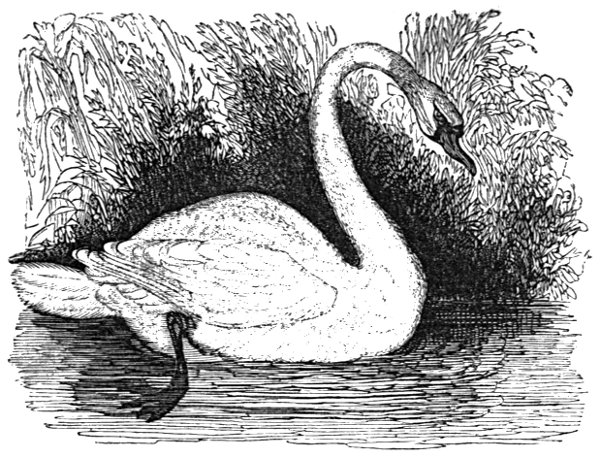
Mute Swan. (Anas Cygnus Mansuetus, Linn.; Le Cygne, Buff.)—The plumage of this species is of the same snowy whiteness as that of the wild swan, and the bird is covered next the body with the same kind of fine close down; but it greatly exceeds the wild swan in size, weighing about twenty-five pounds, and measuring more in the length of the body and extent of the wings. This also differs in being furnished with a projecting callous black tubercle, or knob, on the base of the upper mandible, and in the colour of the bill, which in this is red, with black edges and tips: the naked skin between the bill and the eyes is also of the latter colour: in the wild swan this bare space is yellow.
The manners and habits are much the same in both kinds, particularly when they are in a wild state; for indeed this species cannot properly be called domesticated; they are only as it were partly reclaimed from a state of nature, and invited by the friendly and protecting hand of man to decorate and embellish the artificial lakes and pools which beautify his pleasure grounds. On these the swan cannot be accounted a captive, for he enjoys all the sweets of liberty. Placed there, as they are the largest of all the British birds, so are they to the eye the most pleasing and elegant.
The swan, although possessed of the power to rule, yet molests none of the other water birds, and is singularly social and attentive to those of his own family, which he protects from every insult. While they are employed with the cares of the young brood, it is not safe to approach near them, for they will fly upon any stranger, whom they often beat to the ground by repeated blows, and they have been known by a stroke of the wing to break a man’s leg. But, however powerful they are with their wings, yet a slight blow on the head will kill them.
The swan for ages past has been protected on the Thames as royal property, and it continues at this day to be accounted felony to steal their eggs. By this means their increase is secured, and they prove a delightful ornament to that noble river. Latham says, in the reign of Edward IV. the estimation they were held in was such, that no one who possessed a freehold of less than the clear yearly value of five marks, was permitted even to keep any. In those times hardly a piece of water was left unoccupied by these birds, as well on account of the gratification they gave to the eye of their lordly owners, as that which they also afforded when they graced the sumptuous board at the splendid feasts of that period; but the fashion of those days is passed away, and swans are not nearly so common now as they were formerly, being by most people accounted a coarse kind of food, and consequently held in little estimation; but the cygnets (so the young swans are called) are still fattened for the table, and are sold very high, commonly for a guinea each, and sometimes for more: hence it may be presumed they are better food than is generally imagined.
The female makes her nest, concealed among the rough herbage, near the water’s edge; she lays from six to eight large white eggs, and sits on them about six weeks (some say eight weeks) before they are hatched. The young do not acquire their full plumage till the second year.
It is found by experience that the swan will not thrive if kept out of the water; confined in a court-yard he makes an awkward figure, and soon becomes dirty, tawdry, dull, and spiritless.
At the setting in of frosty weather the wild swans are said to associate in prodigious multitudes, and thus united, to use every effort to prevent the water from freezing: this they accomplish by the continual stir kept up amongst them; and by constantly dashing it with their extended wings, they are enabled to remain as long as it suits their convenience, in some favourite part of a lake or river which abounds with their food.
The swan is very properly entitled the peaceful monarch of the lake: conscious of his superior strength, he fears no enemy, nor suffers any bird, however powerful, to molest him; neither does he prey upon any one. His vigorous wing is as a shield against the attacks even of the eagle, and the blows of it are said to be so powerful as to stun or kill the fiercest of his foes. The wolf or the fox may surprise him in the dark, but their efforts are vain in the day. His food consists of the grasses and weeds, and the seeds and roots of plants which grow on the margin of the water, and of the myriads of insects which skim over, or float on its surface; also occasionally of the slimy inhabitants within its bosom.
The female makes her nest of the withered leaves and stalks of reeds and rushes, and lays commonly six or seven thick-shelled white eggs: she is said to sit upon them six weeks before they are hatched. Both male and female are very attentive to their young, and will suffer no enemy to approach them.
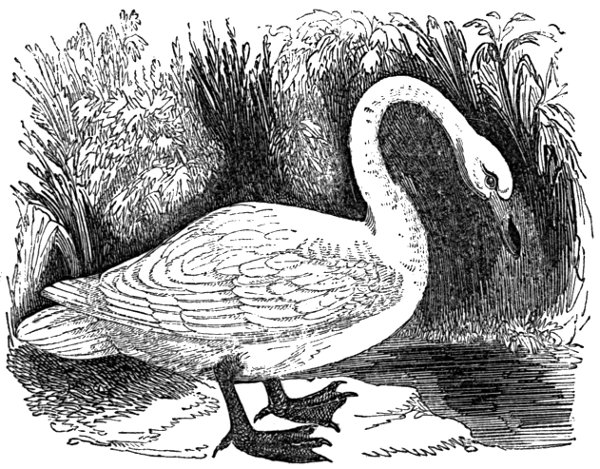
Wild Swan. (Anas Cygnus ferus, Linn.; Le Cygne Sauvage, Buff.)—Measures five feet in length, and above seven in breadth, and weighs from thirteen to sixteen pounds. The bill is three inches long, of a yellowish white from the case to the middle, and thence to the tip, black; the bare space from the bill over the eye and eyelids is yellow; the whole plumage in adult birds is of a pure white, and, next to the skin, they are clothed with a thick fine down; the legs are black.
This species generally keep together in small flocks, or families, except in the pairing season, and in the setting in of winter. At the latter period they assemble in immense multitudes, particularly on the large rivers and lakes of the thinly inhabited northern parts of Europe, Asia, and America: but when the extremity of the weather threatens to become insupportable, in order to shun the gathering storm, they shape their course high in air, in divided and diminished numbers, in search of milder climates. In such seasons they are not uncommonly seen in various parts of the British isles, and in other more southern countries of Europe. The same is observed of them in the North American states. They do not, however, remain longer than till the approaching of the spring, when they again retire northward to the arctic regions to breed. A few, indeed, drop short, and perform that office by the way, for they are known to breed in some of the Hebrides, the Orkney, Shetland, and other solitary isles; but these are hardly worth notice: the great bodies of them are met with in the large rivers and lakes near Hudson’s Bay, and those of Kamtschatka, Lapland, and Iceland. They are said to return to the latter place in flocks of about a hundred at a time in the spring, and also to pour in upon that island from the north, in nearly the same manner, on their way southward in the autumn.
Swan-Goose. (Anas Cygnoides, Linn.; L’Oie de Guinée, Buff.)—This species is more than a yard in length, and is of a size between the swan and the common-goose; it is distinguished from others of the goose tribe by its upright and stately deportment, by having a large knob on the root of the upper mandible, and a skin, almost bare of feathers, hanging down like a pouch, or a wattle, under the throat; a white line or fillet is extended from the corners of the mouth over the front of the brow; the base of the bill is orange; irides reddish-brown; a dark-brown or black stripe runs down the hinder part of the neck, from the head to the back; the fore part of the neck, and the breast, are yellowish-brown; the back, and all the upper parts, brownish-grey, edged with a lighter colour; the sides, and the feathers which cover the thighs, are clouded with nearly the same colours as the back, and edged with white; belly white; legs orange.
It is said that these birds originally were found in Guinea only; the breed has, however, now become pretty common, and they are widely dispersed, in a wild as well as a domesticated state, over various parts of the world, both in warm and in cold climates.
They are found wild about the lake Baikal, in the east of Siberia, and in Kamtschatka; and they are kept tame in most parts of the Russian empire.
These geese, like others of the tame kind, vary much both in colour of the bill, legs, and plumage, as well as in size; but they all retain the knob on the base of the upper mandible, and the pouch or wattle under the gullet.
They are kept by the curious in various parts of England, and are more noisy than the common goose; nothing can stir either in the night or in the day, without their sounding the alarm, by their hoarse cacklings, and loud shrill cries. They breed with the common goose, and their offspring are as prolific as those of any other kind. The female is of a smaller size than the male; the head, neck, and breast are fulvous; paler on the upper part; the back, wings, and tail, dull brown, with pale edges; belly white; in other respects they are like the male, but the knob over the bill is smaller.—Bewick.
Sward, s. The skin of bacon; the surface of the ground.
Swarm, s. A great body or number of bees or other small animals; a multitude, a crowd.
Swart or Swarth, a. Black, darkly brown, tawny.
Sweepnet, s. A net that takes in a great compass.
Sweepstake, s. A man that wins all; a prize at a race.
Swift, a. Moving far in a short time, quick, fleet, speedy.
Swift, (Cypselus murarius, Temminck,) s. A bird like a swallow.
This species is nearly an ounce in weight: length near eight inches: breadth about eighteen; the bill is black; irides dusky; the whole plumage is black, except the chin, which is whitish; the wings are extremely long in proportion, and the legs so short that it rises from the ground with difficulty; the tail is forked; legs and toes black. It has four toes, all placed forward. In this particular it deviates from one of the characters of the swallow genus.
In very warm weather these birds soar to a great height, but in cold or moist weather fly low in search of flies and other winged insects, which at that time cannot ascend.—Montagu.
Swiftness, s. Speed, rapidity, velocity.
Swim, v. To float on the water, not to sink; to move progressively in the water by the motion of the limbs; to be conveyed by the stream; to glide along with a smooth or dizzy motion; to be dizzy.
An accidental fall into water may be most dangerous to those ignorant of the art of swimming, by observing the directions here given, a person may save himself from drowning. If he falls into deep water, he will rise to the surface by floating, and will continue there if he does not elevate his hands, and the keeping them down is essential to his safety. If he moves his hands under the water, in any way he pleases, his head will rise so high as to allow him free liberty to breathe. And if, in addition, he moves his legs exactly as in the action of walking up stairs, his shoulders will rise above the water, so that he may use less exertion with his hands, or apply them to other purposes.
Swimming of Birds.—The superior velocity with which aquatic birds swim under water has not wholly escaped notice; but it is not entirely produced by the action of the wings, which are sometimes used as fins to accelerate the motion, but is occasioned by the pressure of the water above. In swimming on the surface a bird has two motions; one upward, the other forward, at every stroke of the feet; so that when covered with water, that force which was lost by the upward motion is all directed to the progressive, by which it is enabled to pursue its prey, or to escape an enemy with incredible speed. The otter and water rat swim much faster under water than they do upon the surface.—Montagu.
Swine, s. A hog, a pig, a sow.
Swoop, v. To fall at once as a hawk upon its prey; to prey upon; to catch up.
Swoop, s. Fall of a bird of prey upon his quarry.
Sycamore, s. A tree.
Sylvan, a. Woody, shady.
Sylvia (Latham), s. Warbler, a genus thus characterised:—
Bill slender, rather awl-shaped, and straight; but with the point of the upper mandible slightly bent and notched; lower mandible straight; base more high than broad; nostrils at the sides of the base oval, and partly covered with a membrane: legs having the shank longer than the middle toe; toes three before and one behind, the outer toe being joined at its base to the middle one; wings with the first quill very short, sometimes indeed wanting; the second and third nearly of equal length; wing coverts and scapulars short.—Montagu.
Sympathetic, a. Having mutual sensation, being affected by what happens to the other.
Sympathy, s. Fellow feeling, mutual sensibility, the quality of being affected by the affection of another.
Animals which are unable to associate with their own species will sometimes form most strange attachments. I had last year a solitary pigeon, who, being unable to procure a mate, attached itself to an old barn-door fowl, whose side it seldom left at night, roosting by him in the hen-house. The cock seemed sensible of the attachment of the pigeon, and never molested it, or drove it from him.
At Aston Hall, in Warwickshire, I remember to have seen a cat and a large fierce bloodhound, who were always together, the cat following the dog about the yard, and never seeming tired of his society. They fed together, and slept in the same kennel.
Some animals of the same species form also strong attachments for each other. This was shown in the case of two Hanoverian horses, who had long served together during the peninsular war, in the German brigade of artillery. They had assisted in drawing the same gun, and had been inseparable companions in many battles. One of them was at last killed; and after the engagement the survivor was picqueted as usual, and his food brought to him. He refused, however, to eat, and was constantly turning round his head to look for his companion, sometimes neighing, as if to call him. All the care that was bestowed upon him was of no avail. He was surrounded by other horses, but he did not notice them; and he shortly afterwards died, not having once tasted food from the time his former associate was killed. A gentleman who witnessed the circumstance assured me that nothing could be more affecting than the whole demeanour of this poor horse.—Jesse.
Symptomatic, a. Happening concurrently; betokening.
Syringe, s. A pipe through which any liquor is squirted.
Syringe, v. To spout by a syringe; to wash with a syringe.
Tabby, a. Brinded, brindled; term applied to a cat.
Tadpole, s. A young shapeless frog or toad, consisting only of a body and a tail.
Tagtail, s. A worm which has the tail of another colour.
Tail, s. That which terminates the animal behind, the continuation of the vertebræ of the back hanging loose behind; the lower part; the hinder part of anything; to turn tail, to run away.
When a dog is cropped, it is usual also to cut off a portion of the tail. Dog fanciers, as they are termed, commonly bite it off; but it were to be wished that a larger portion was added to both their knowledge and humanity. The tail does not grow materially after cutting, therefore the length may be previously determined on with sufficient accuracy, and cut off with a pair of sharp scissors. If the ears and tail are cut off at the same time, it is prudent to tie a ligature about the tail, to prevent the effusion of blood, as sometimes the bleeding, from both ears and tail together, will weaken the animal too much, and early distemper may follow; but when the tail alone is cut, no ligature is necessary. When a ligature is used, neither tie it too tight, nor suffer it to remain more than twelve hours. On the twisting off either the ears or tail, I will waste no invective; for if the cruelty does not strike the performer, I am sure no assertion of mine, that it is far inferior in every point of view to excision, and has for ever deafened many it has been practised on, will be attended to.—Blaine.
Tallow, s. The grease or fat of an animal, suet.
Talon, s. The claw of a bird of prey.
Tame, a. Not wild, domestic; crushed, subdued, depressed, spiritless, unanimated.
Tame, v. To reduce from wildness, to reclaim, to make gentle; to conquer.
Tan, v. To impregnate or imbue with bark; to imbrown by the sun.
Tan, s. A dark brown colour: the marks of a terrier.
Tansy, s. A plant.
This plant grows abundantly about the borders of fields; it has a strong bitter taste, and rather a pleasant odour. It may be employed in the form of a decoction as a vehicle for tonic or stomachic medicines. It has been said to possess an anthelmintic quality, but I believe there is no foundation for this opinion. It is used also in fomentations.—White.
Tar, s. Liquid pitch.
Tar Ointment.—This is a good remedy for thrushes, and other diseases of the frog. It appears to promote the growth of horn by gently stimulating the secretory vessels of that part.
The rotten parts of the frog having been carefully removed with a knife, and the rest well cleansed, the tar is to be melted and poured into the cleft or cavity; a pledget of tow is then to be laid on the part, and confined by some proper contrivance. In bad cases a small proportion of sulphuric acid should be carefully mixed with the tar; and when a thrush has degenerated into the disease termed canker, a larger proportion of the acid should be employed.
Tar mixed with oil of turpentine and cantharides forms a strong blister. Farriers sometimes employ tar as a remedy for cough; but it more frequently aggravates than relieves the complaint.
Tar, when mixed with verdigris, or finely powdered blue, or white vitriol, forms a good liniment or ointment for canker or thrushes. It may be occasionally employed also with alum. Tar is an excellent stopping for flat thin soles, mixed with tallow: in the latter form it makes a good hoof ointment, and when rubbed about the coronet and hoof, is said to render the hoof tough.—White.
Target, s. A kind of buckler or shield borne on the left arm.
Tarpawling, s. Hempen cloth smeared with tar.
Tarrier, s. A sort of small dog that hunts the fox or otter out of his hole. In this sense it ought to be written and pronounced Terrier, which see.
Teal (Anas Crecca, Linn.; La Petite Sarcelle, Buff.), s. A wild fowl.
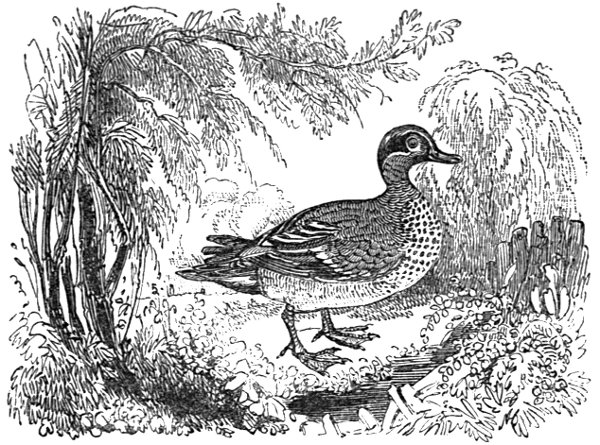
THE TEAL.
This beautiful little duck seldom exceeds eleven ounces in weight, or measures more, stretched out, than fourteen inches and a half in length, and twenty-three and a half in breadth.
The bill is a dark lead colour, tipped with black; irides pale hazel; a glossy bottle green patch, edged on the upper side with pale brown, and beneath with cream-coloured white, covers each eye, and extends to the nape of the neck: the rest of the head, and the upper part of the neck, are of a deep reddish chestnut, darkest on the forehead, and freckled on the chin and about the eyes with cream-coloured spots: the hinder part of the neck, the shoulders, part of the scapulars, sides under the wings, and lower belly, towards the vent, are elegantly pencilled with black, ash-brown, and white transverse waved lines; the breast, greatly resembling the beautifully spotted appearance of an India shell, is of a pale brown or reddish yellow, and each feather is tipped with a roundish heart-shaped black-spot: the belly is a cream-coloured white: back and rump brown, each feather edged with a pale colour: vent black: the primary quills, lesser and greater coverts, are brown; the last deeply tipped with white, which forms a bar across the wings; the first six of the secondary quills are of a fine velvet black; those next to them, towards the scapulars, are of a most resplendent glossy green, and both are tipped with white, forming the divided black and green bar or beauty spot of the wings.
The tail consists of fourteen feathers, of a hoary brown colour; with pale edges: the legs and feet are of a dirty lead colour. The female, which is less than the male, is prettily freckled about the head and neck with brown and white. She has not the green patch behind the eyes, but a brown streak there, which extends itself to the nape of the neck; the crown of the head is dark brown; the upper mandible yellow on the edges, olive green on the sides, and olive brown on the ridge; nail black, and the under bill yellow; breast, belly, and vent glossy yellowish white, spotted on the latter parts with brown; the upper plumage is dark brown, each feather bordered with rusty brown, and edged with grey: the wings and legs nearly the same as those of the male.
The teal is common in England in the winter months, but it is uncertain whether or not they remain throughout the year to breed, as is the case in France. The female makes a large nest, composed of soft dried grasses, (and, it is said, the pith of rushes) lined with feathers, cunningly concealed in a hole among the roots of reeds and bulrushes near the edge of the water, and some assert that it rests on the surface of the water, so as to rise and fall with it. The eggs are of the size of those of a pigeon, six or seven in number, and of a dull white colour, marked with small brownish spots; but it appears that they sometimes lay ten or twelve eggs, for Buffon remarks that that number of young ones are seen in clusters on the pools, feeding on cresses, wild chervil, &c., and no doubt, as they grow up, they feed, like other ducks, on the various seeds, grasses, and water plants, as well as upon the smaller animated beings with which all stagnant waters are so abundantly stored. The teal is highly esteemed for the excellent flavour of its flesh: it is known to breed, and remain throughout the year in various temperate climates of the world, and is met with as far northward as Iceland in the summer.
Of all the prizes that a wildfowl shooter could wish to meet with, a flock of teal is the very first. Independently of their being by far the best birds of the whole anas tribe, they are so much easier of access, and require such a slight blow, that no matter whether you are prepared for wild fowl, partridges, or snipes, you may at most times with very little trouble contrive to get near them; and this being once done, you have only to shoot straight to be pretty sure of killing.
I have seen teal “duck the flash,” though never but once, and then I had rather a slow shooting gun.
If you spring a teal, he will not soar up and leave the country like a wild duck, but most probably keep along the brook, like a sharp flying woodcock, and then drop suddenly down; but you must keep your eye on the place, as he is very apt to get up again and fly to another before he will quietly settle. He will frequently, too, swim down the stream the moment after he drops, so that if you do not quickly cast your eye that way, instead of continuing to look for him in one spot, he will probably catch sight of you and fly up, while your attention is directed to the wrong place. If the brook in which you find him is obscured by many trees, you had better direct your follower to make a large circle, and get a head of, and watch him, in case he should slily skim away down the brook, and by this means escape from you altogether. You should avoid firing at random, as this may drive him quite away from your beat.—Bewick—Hawker.
Tench, s. A small pond-fish.
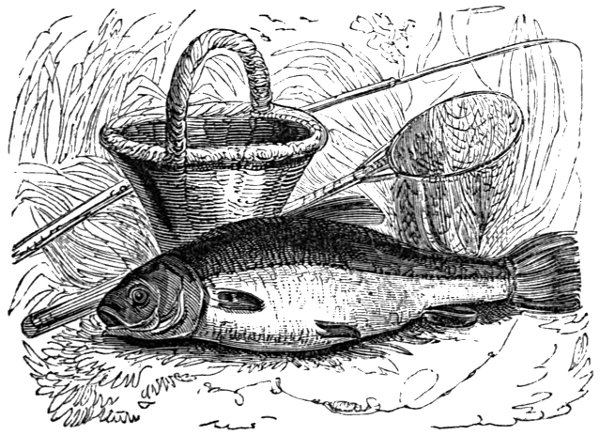
The tench is generally prized as a fine rich fish in England, but it is not so much esteemed on the continent: the Germans, in derision, call it the Shoemaker. They take red worms best in the spring; and gentles, not too much scoured, or sweet paste, in the hot months. Use a fine gut-line, quill-float, and No. 9 or 10 hook; fish close to the bottom, and ground-bait with small pellets of bread, or chewed bread, or bread and bran mixed; or throw in about half-a-dozen gentles, or pieces of worms, frequently, close to your float. When the large tench take a bait, especially in still waters, they take or suck it in slowly, and generally draw the float straight down; strike immediately it disappears.
The tench will breed in rivers, lakes, and ponds, but they thrive best in those ponds where the bottom is composed of loamy clay, or mud, and in foul and weedy waters; they will sometimes bite very free all day in summer, during warm, close, dark weather, particularly while small, misty rain descends; at other times, only late in the evening, or early in the morning.—Salter.
Tendon, s. A sinew, a ligature by which the joints are moved.
Tennis, s. A play at which a ball is driven with a racket.
A tennis court is usually ninety-six or ninety-seven feet long, by thirty-three or four in breadth. A net hangs across the middle, over which the ball must be struck, to make any stroke good. At the entrance of a tennis-court there is a long covered passage before the dedans, the place where spectators usually are, into which, whenever a ball is played, it counts for a certain stroke. This long passage is divided into different apartments, which are called galleries, viz. from the line towards the dedans, is the first gallery; door, second gallery; and the last gallery, is what is called the service-side. From the dedans to the last gallery are the figures, 1, 2, 3, 4, 5, 6, each at a yard distance, marking the chaces, one of the most essential parts of this game. On the other side of the line is the first gallery; door, second gallery; and last gallery, what is called the hazard-side; every ball played into the last gallery on this side tells for a certain stroke, the same as into the dedans. Between the second and this last gallery are the figures 1, 2, marking the chaces on the hazard-side. Over this long gallery is the pent-house, on which the ball is played from the service-side to begin a set of tennis, and if the player should fail striking the ball (so as to rebound from the pent-house) over a certain line on the service-side, it is reckoned a fault; and two such faults following are counted for a stroke. If the ball pass round the pent-house, on the opposite side of the court, and fall beyond a particular described line, it is called passe, goes for nothing, and the player is to serve again.
On the right hand of the court from the dedans, a part of the wall projects more than the rest, in order to make a variety in the stroke, and render it more difficult to be returned by the adversary, and is called the tambour: the grill is the last thing on the right hand, in which if the ball be struck, it is reckoned 15, or a certain stroke.
A set of tennis consists of six games, but if what is called an advantage set be played, two successive games above five games must be won to decide; or in case it should be six games all, two games must still be won on one side to conclude the set.
When the player gives his service in order to begin the set, his adversary is supposed to return the ball, wherever it falls after the first rebound, untouched; for example: if at the figure 1, the chace is called at a yard, that is to say, at a yard from the dedans; this chace remains till a second service is given, and if the player on the service side should let the ball go after his adversary returns it, and the ball fall on or between any one of these figures, they must change sides, for he will be then on the hazard-side to play for the first chace, which if he win by striking the ball so as to fall, after its first rebound, nearer to the dedans than the figure 1, without his adversary being able to return it from its first rebound, he wins a stroke, and then proceeds in like manner to win a second stroke, &c. If a ball fall on a line with the first gallery, door, second gallery, or last gallery, the chace is likewise called at such or such a place, naming the gallery, &c. When it is just put over the line, it is called a chace at the line. If the player on the service-side return a ball with such force as to strike the wall on the hazard-side, so as to rebound, after the first hop, over the line, it is also called a chace at the line.
The chaces on the hazard-side proceed from the ball being returned either too hard, or not hard enough: so that the ball, after its first rebound, falls on this side the line which describes the hazard-side chaces, in which case it is a chace at 1, 2, &c. provided there be no chace depending, and according to the spot where it exactly falls. When they change sides, the player, in order to win this chace, must put the ball over the line, any where, so that his adversary does not return it. When there is no chace on the hazard-side, all balls put over the line from the service-side, without being returned, reckon.
The game, instead of being marked one, two, three, four, is called for the first stroke, fifteen; for the second, thirty; for the third, forty; and for the fourth, game, unless the players get four strokes each; then, instead of calling it forty all, it is called deuce, after which, as soon as any stroke is got, it is called advantage; and in case the strokes become equal again, deuce again; till one or the other gets two strokes following, to win the game.
The odds at this game are very uncertain, on account of the chances: and various methods of giving odds have been used to render a match equal.
At the time when tennis play was taken up seriously by the nobility, new regulations were made in the game, and covered courts erected, wherein it might be practised without any interruption from the weather. In the sixteenth century tennis-courts were common in England, and the establishment of such places countenanced by the example of the monarchs.
We have undoubted authority to prove that Henry VII. was a tennis player. In a MS. register of his expenditures made in the thirteenth year of his reign, and preserved in the remembrancer’s office, this entry occurs:—“Item, for the king’s loss at tennis, twelve-pence; for the loss of balls, three-pence.” Hence one may infer, that the game was played abroad, for the loss of the balls would hardly have happened in a tennis court. His son Henry, who succeeded him, in the early part of his reign was much attached to this diversion; which propensity, as Hall assures us, “being perceived by certayne craftie persons about him, they brought in Frenchmen and Lombards to make wagers with hym, and so he lost muche money; but when he perceyved theyr crafte, he eschued the company and let them go.” He did not however give up the amusement, for we find him, according to the same historian, in the thirteenth year of his reign, playing at tennis with the Emperor Maximilian for his partner, against the prince of Orange and the marquis of Brandenborow: “the earl of Devonshire stopped on the prince’s side, and the lord Edmond on the other side; and they departed even handes on both sides, after eleven games fully played.”
James I., if not himself a tennis player, speaks of the pastime with commendation, and recommends it to his son as a species of exercise becoming a prince. Charles II. frequently diverted himself with playing at tennis, and had particular kind of dresses made for that purpose. So had Henry VIII. In the wardrobe rolls we meet with tenes-cotes for the king, also tennis-drawers and tennis-slippers.
A French writer speaks of a damsel Margot, who resided at Paris in 1424, and played at hand-tennis with the palm, and also with the back of her hand, better than any man; and what is most surprising, adds my author, at that time the game was played with the naked hand, or at best with a double glove.—Hoyle—Strutt.
Tent, s. A soldier’s movable lodging place, commonly made of canvass extended upon poles; any temporary habitation, a pavilion; a roll of lint put into a sore; a species of wine deeply red.
Terebinthine, a. Consisting of turpentine, mixed with turpentine.
Terrier, s. A dog that follows his game underground.
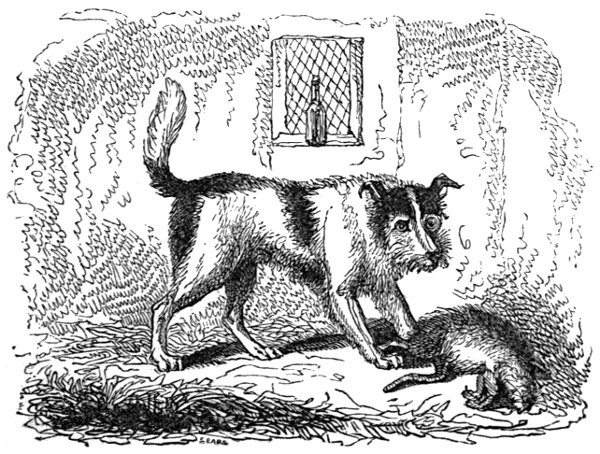
The Scotch Terrier. (Canis terrarius, variety α.)—It is now impossible to trace the origin of the terrier, but from the many characteristics peculiar to itself, we would almost be induced to consider it a primitive race. Certain it is, that this dog has been for many ages assiduously cultivated and trained to the particular sports to which nature seems to have so well adapted him. To the fox, hare, rabbit, badger, polecat, weasel, rat, mouse, and all other kinds of vermin, he is a most implacable enemy; he has also a strong natural antipathy to the domestic cat.
The name terrier seems to be derived from the avidity with which he takes the earth in pursuit of all those animals which burrow.
There are two kinds of terriers,—the rough haired Scotch and the smooth English.
The Scotch terrier is certainly the purest in point of breed, and the English seems to have been produced by a cross from him.
The Scotch terrier is generally low in stature, seldom more than twelve or fourteen inches in height, with a strong muscular body and short and stout legs; his ears small and half pricked; his head is rather large in proportion to the size of his body, and the muzzle considerably pointed; his scent is extremely acute; so that he can trace the footsteps of all other animals with certainty; he is generally of a sand colour or black; dogs of these colours are certainly the most hardy, and more to be depended upon; when white or pied, it is a sure mark of the impurity of the breed. The hair of the terrier is long, matted, and hard, over almost every part of his body. His bite is extremely keen.
There are three distinct varieties of the Scotch terrier, viz. the one above described; another about the same size as the former, but with the hair much longer and somewhat flowing, which gives his legs the appearance of being very short. This is the prevailing breed of the western islands of Scotland. The third variety is much larger than the former two, being generally from fifteen to eighteen inches in height, with the hair very hard and wiry, and much shorter than that of the others. It is from this breed that the best bull-terriers have been produced.
The terrier, amongst the higher order of sportsmen, is preserved in its greatest purity, and with the most assiduous attention; and it seems of the utmost importance not to increase its size, which would render him unsuitable for the purpose in which he is employed, that of entering the earth to drive out other animals from their burrows, for which his make, strength, and invincible ardour, peculiarly fit him. On this account he is the universal attendant upon a pack of fox hounds, and though last in the pursuit he is not the least in value. Indeed a brace of these dogs is considered indispensable in a complete fox-hunting establishment, and they are generally of different sizes, so that the smallest may enter an earth which will not admit the other. As soon as the hounds are thrown into covert, the terrier becomes the busiest in the field when endeavouring to find the fox; whenever the game is started, and the hounds running breast high, and at their utmost speed, this active little animal is seldom far behind, and is sure to be up at the first check. It is when the fox is supposed to have earthed, that the services of the terrier are most essentially required; he enters with the utmost eagerness, and soon informs the ear of the sportsman whether or not he is in, and at what distance from the mouth, when he is speedily dug out.
The principal objection to the reddish coloured terrier in a pack is, that by juvenile sportsmen, in the clamour of the chase, they are frequently hallooed off for a fox.
The English Terrier. (Canis terrarius, variety β.)—This is a handsome sprightly dog, and generally black on the back, sides, and upper part of the head, neck, and tail; the belly and the throat are of a very bright reddish brown with a spot of the same colour over each eye. The hair is short and somewhat glossy; the tail rather truncated, and carried slightly upwards; the ears are small, somewhat erect, and reflected at the tips; the head is little in proportion to the size of the body, and the snout is moderately elongated. This dog, though but small, is very resolute, and is a determined enemy to all kinds of game and vermin, in the pursuit and destruction of which he evinces an extraordinary and untaught alacrity. Some of the larger English terriers will even draw a badger from his hole. He varies considerably in size and strength, and is to be met with from ten to eighteen inches in height.
This dog, or the wire-haired Scotch terrier, is indispensably necessary to a pack of fox-hounds, for the purpose of unearthing the game. From the greater length of leg, from his general lightness, and the elegant construction of his body, he is more adapted for running, and of course better enabled to keep up with the pack than the Scotch terrier.
Mr. Daniel, in his Rural Sports, mentions a match against time with a terrier, which took place in 1794, in which a small dog ran six miles: the first mile in two minutes, the second in four, the third in six, the fourth in eight, and the fifth and sixth in eighteen minutes,—an immense falling off, considering his wonderful speed, and the known stoutness of the terrier. We doubt there has been some unsteadiness either in the watch or watch-holder. He afterwards ran six miles in thirty-two minutes.—Brown.
Testacea, s. Shell-fish, the third order of the class Vermes.
Testaceous, a. Consisting of shells, composed of shells; having continuous, not jointed shells, opposed to crustaceous.
Tether, s. A string by which cattle are held from pasturing too wide.
Thames’ Yachts, s. Small vessels of pleasure used by members of the river clubs.
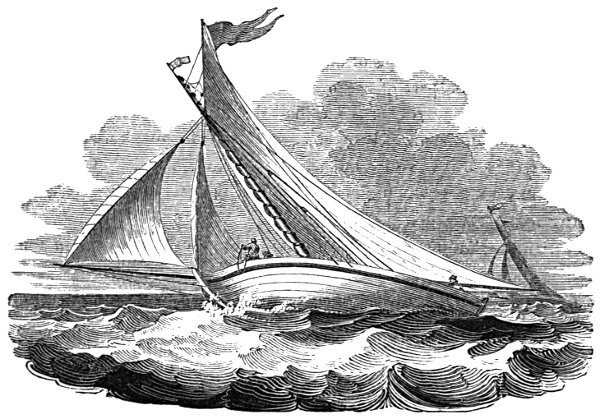
The sailing clubs upon the Thames, comprise the Royal Sailing Society—the Royal Thames’ Yacht-club—the Clarence—British—Royal Yacht, and several minor associations. Throughout the season several cups and prizes are annually given; and the severe and spirited contests between the beautiful small craft which form these fancy fleets, are highly interesting.
The sailing matches on the river are divided into two classes—one above, and the other below the bridges. The smaller yachts, ranging from six to twenty-six tons, are commonly entered for the former, while a larger class contend for prizes sailed for between Greenwich and Gravesend.
These elegant and truly national amusements, appear to be rapidly gaining a prominent place in the list of fashionable recreations; and aquatic sports now occupy that dull and sombre season, from the period hunting ends, till russet autumn summons the sportsman to the field.
Thigh, s. The thigh includes all between the buttock and the knee.
Thill, s. The shafts of a wagon.
Thillhorse or Thiller, s. The last horse that goes between the shafts.
Thirst, s. The pain suffered for want of drink, want of drink; eagerness, vehement desire.
Thoroughbred, a. Completely educated, completely taught; in sporting parlance, applied to racehorses of unblemished pedigree.
Thoroughpin, s. A swelling of the capsular ligament attendant on bog spavin.
There are placed in the neighbourhood of joints certain bags, containing a mucous fluid for the purpose of lubricating the parts, and these sometimes become inflamed and enlarge. A similar enlargement is found above the hock, between the tendons of the flexor of the foot, and the extensor of the hock. As from its situation it must necessarily project on both sides of the hock, in the form of a round swelling, it is called a thorough-pin. It is an indication of considerable work, but, except it be of very great size, it is rarely attended by lameness. The mode of treatment must resemble that recommended for wind-galls. Although thorough-pin cannot be pronounced to be unsoundness, yet it behoves the buyer to examine well a horse with thoroughpin, and to ascertain whether undue work may not have injured him in other respects.—The Horse.
Thowl, s. The pin or piece of timber by which the oar is kept steady in rowing.
Thrapple, s. The windpipe of any animal.
Throat, s. The forepart of the neck; the main road of any place.
Throstle, s. A species of thrush, a small singing bird. It is said to have the breast darker and the tail shorter than this bird; but there are not sufficient grounds to believe it is distinct from the thrush.
Throttle, s. The windpipe.
Throttle, v. To choke.
Throw, v. To perform the act of casting; to cast dice; to cast a horse.
Horses are thrown down by means of hobbles. The hobble is about two feet in length, two inches and five-eighths in width, and about a quarter of an inch thick. It is formed by a strong piece of leather, about four feet in length, which, being doubled, has a strong iron buckle included at one end, and firmly sewed in. About four inches and a half further back, a large iron ring is to be sewed in, in the same manner, for the purpose of allowing a strong rope to pass through it easily. The ring, or rather the part so named, may be made straight where it is sewed into the leather, and the rest may be rounded. The remaining part of the leather is to be strongly sewed together, which will make the thickness of it what we have before described. Several holes are to be punched at this end of the hobble, to admit the tongue of the buckle when it is put round the horse’s leg. On the under side of the hobble, a piece of thinner and wider leather is to be fixed, extending from the part where the ring is attached to about half an inch beyond the extremity of the buckle; this is intended to prevent the latter from galling the horse’s leg. The rope should be strong, not twisted tight, but made flexible, like a bell-rope, and about six yards in length. One end of the rope is to be firmly and permanently attached to the ring of one of the hobbles, and this hobble must be placed on the fore-leg, opposite to the side on which the horse is to be thrown. If the hobble to which the rope is attached is placed on the left fore-leg, the other end of the rope is to be passed first through the ring of that on the left hind-leg, then through that on the right hind-leg, next through that on the right fore-leg, and lastly, through the ring, where the rope is attached, that is, the left fore-leg hobble.
By this contrivance it will be readily seen that the legs of the horse may be drawn together, so that if pushed or forced towards the right side, he must of necessity fall. Three men are generally required to pull the rope, in order to draw the legs together; and to render this more easy, the hind-legs should be placed under him as much as possible before any attempt is made to pull the rope. The horse should have blinds, or have his eyes covered with a piece of rug, before the hobbles are put on; it may be necessary, also, to twitch him, and hold up the fore-leg while the hind-leg hobble is putting on. But the twitch must be removed before he is thrown, and not used unless absolutely necessary. The men who are to pull the rope should stand within two yards of the horse, as they then pull with double the force they would at a distance of four yards, their power then having a tendency to draw the legs off the ground, and upwards, which causes him to fall more quickly. One man should stand at the rump, on the left side, to push him when the legs are drawn up together; and one man should hold him steadily by the head, standing in front of him; and as soon as the horse is down, that man should throw himself on the neck, and incline the nose upward, by lifting the halter; thus he can keep the head and neck down without difficulty.
M. Girard, in his Traité du Pied, has proposed an improvement in throwing horses, which is very simple, and should always be employed: but it requires an additional assistant, or two would still be better. If the horse is to be thrown on the right side, a long piece of web, or a rope, is to be fastened round the right fore arm, close up to the elbow. The other end is then to be passed over the withers, and held at a little distance by one or two men. The force which is applied in this way will cause the horse to fall more readily, and with more certainty, and exactly in the situation where he is required to be thrown. This contrivance, therefore, is extremely useful in confined places, where there is just room enough to throw a horse, and no more. The horse being thrown down, and his legs closely drawn together, the end of the hobble rope is to be passed under the hobble rings, between the fore and hind legs, and secured with a hitch, as it is termed, so that he cannot separate them again until the hobbles are unbuckled, and then they all may be taken away at once, and the horse suffered to get up.
In letting the horse get up again, the hobbles must be unbuckled cautiously, beginning with the under fore and hind one. These should be unbuckled gently, and not jerked, as that would cause the horse to struggle, and render it difficult to take them off, or the leg might get loose, and he may thus hurt one of the assistants, who happens to be standing incautiously within the stroke of his fore or hind leg. I have seen hobbles in which the tongues were movable, so that by drawing them out with a pair of pincers the hobbles were all taken off at once.
In performing operations upon the horse, it is not only necessary to throw him down as I have described, but in firing the outside of the fore leg, for example, in the pastern, the hobble must be taken off, and the leg secured by means of a web passed round the leg above the knee, and secured to the upper hind leg, immediately above the hock, or it may be secured to the under fore leg; perhaps both these contrivances would be found useful in strong horses that struggle much. In firing the inside of the fore leg, that is, the under fore leg, nothing more is necessary than to take it out of the hobble, and draw it forwards by means of a web passed round the hoof, or the pastern.
Horses, however, have sufficient power to extend even the under fore leg considerably, unless a man lies on the shoulder, which should always be avoided. It is better to restrain the leg, by passing a web round it above the knee, and fastening the other end to the hind leg above the hock. If then the other three legs are drawn backward, by means of the hobble rope, the under fore leg will be sufficiently exposed for any operation that may be required. In firing the upper hind leg in the pastern, it is necessary to take off the hobble; but the leg must first be secured by means of a web, fastened above the hock, and the other end brought forward, and, under a collar of web, passed round the neck, close to the shoulder. The leg may thus be effectually restrained; but, as an additional restraint, it may be tied also to the under hind leg.—White.
Thrush, Throstle, Grey Bird, or Mavis, (Turdus musicus, Linn.; La Grive, Buff.) s. A small singing bird.
This is larger than the redwing, but much less than the missel, to which it bears a strong resemblance both in form and colours. A small notch is observable at the end of the bill, which belongs to this and every bird of the thrush kind; the throat is white, and the spots on the breast more regularly formed than those of the missel thrush, being of a conical shape; the inside of the wings and the mouth are yellow, as are also the legs; the claws are strong and black.
The throstle is distinguished among our singing birds by the clearness and fulness of its note; it charms us not only with the sweetness, but variety of its song; which it begins early in the spring, and continues during part of the summer. This bold and pleasing songster, from his high station, seems to command the concert of the grove, whilst in the beautiful language of the poet,
“The jay, the rook, the daw,
And each harsh pipe (discordant heard alone)
Aid the full concert, while the stock-dove breathes
A melancholy murmur through the whole.”
The female builds her nest generally in bushes; it is composed of dried grass, with a little earth or clay intermixed, and lined with rotten wood; she lays five or six eggs of a pale-blue colour, marked with dusky spots. Although this species is not considered with us as migratory, it has, nevertheless, been observed in some places in great numbers during the spring and summer, where not one was to be seen in the winter, which has induced an opinion that they either shift their quarters entirely, or take shelter in the more retired parts of the woods. The throstle is migratory in France. M. de Buffon says that it appears in Burgundy about the end of September, before the redwing and fieldfare, and that it feeds upon the ripe grapes, and sometimes does much damage to the vineyard. The females of all the thrush kind are very similar to the males, and differ chiefly in a less degree of brilliancy in the colours.
Opposite my study windows at Lee, I observed last summer, a missel thrush fly boldly at a carrion-crow, and persecute him with bill and wing till he seemed glad to leave the field. This, however, is far outdone by the account M. Le Vaillant gives of a party of missel thrushes attacking and actually vanquishing an eagle.—Bewick—Rennie—Montagu.
Thrush, s. Small, round, superficial ulcerations, which appear first in the mouth; they may affect every part of the alimentary duct, except the thick guts; a disease in a horse’s foot.
This is a disease of the frog, causing a discharge of matter from its division or cleft, not often productive of lameness, especially in the hind feet, where it is always a consequence of negligence in the groom, in permitting a horse to stand in his dung, or upon foul wet litter. This softens and rots the horny frog, the putrid and acrid fluids penetrate through the soaked and rotten horn, and inflame the sensible frog, causing it to discharge a fetid acrimonious matter, instead of secreting horn for its own defence, as it does in the healthy state.
Thrushes in the fore-feet are sometimes occasioned by contraction of the heels, but more frequently by the horny box or hoof, considered all together, becoming too thick, and consequently inelastic. In this case, the blood is principally distributed to the sensible frog; the arteries that supply this not being liable to compression, being lodged in that elastic substance of fatty membrane and cartilage, of which the body of the sensible frog is composed. This Lafosse supposes to be destitute of nerves, and that its covering or skin only is endued with sensibility. I believe this opinion is correct; for in this part sensibility is not only unnecessary, but would be injurious. This part forms a very curious spring, and is constructed in a manner that is truly wonderful. It is composed of fatty matter and cartilage, which are so distributed, that the more the frog is compressed, the nearer the cartilages approach each other; thus the frog becomes denser and denser, while its elasticity increases in a similar ratio. When it is compressed to the greatest degree, the effect is imparted to the lateral cartilages, and these bodies impart it to the heels, and quarters or sides of the hoof, and thus it is that the motions of the hoof are produced. To admit of this motion of the hoof, which is the only one that takes place, the elastic membranes yield in a very slight degree, which diminishes from the heel to the toe, but is sufficient for the economy of the foot. The treatment of thrush must depend altogether upon the cause which produces it. When in the hind foot, and occasioned by filthiness, the cause must be removed, and then the disorder may cease; but this is not always the case, for the thrush sometimes has proceeded so far as to produce ulceration of the sensible frog, which then requires to be dressed with a solution of blue vitriol, or oxymel of verdigris. Before this is done, the cleft of the frog should be thoroughly cleansed to the bottom by means of tow; and if there is any ragged horn covering a diseased part, it should be completely removed. One of these dressings, when it is properly done, is sufficient for the cure. Some tar, or hoof-ointment, such as has been prescribed in the chapter on contracted heels, may be applied hot, to promote the regeneration of horn, and to defend it from moisture. In cases where the frog has become very tender or rotten, I have found it necessary to apply a mixture of tar and sulphuric acid, which is made by adding one ounce, by weight, of sulphuric acid to one pound of melted tar, and stirring the mixture for some time. As to the thrush in the fore-feet, the treatment is different. Here also the cause must be first removed, which is, an undue determination of blood to the frog, in consequence of the compression the sensible foot suffers from a contraction of the heels; or from a superabundance of horny matter generally in the crust, and often in the sole also. The motion which I have described as constantly going on in the hoof, will now appear to be an essential provision in that part; for the heels, as they contract, become deficient in, and at length totally lose, their elasticity. When the frog, under this circumstance, comes down upon the ground and receives pressure, the pain the animal feels from the ineffectual attempt thus made to expand the inelastic and inflexible heels, causes him to lift the frog a little, and go principally on the toe; hence the stumbling and falling so common in this case. This kind of thrush then is to be considered rather as useful than otherwise; and by attempting to stop it by those preparations which are usually employed, the lameness is often increased. The only thing to be done is to rasp the heels and quarters, thin the soles, cover the frog with tar ointment, and wrap the foot in an emollient poultice; in slight cases, complete and permanent relief will be thus afforded. Should the thrush continue after the hoof has been well soaked with the poultice, and especially if the frog is very tender and rotten, apply the mixture of tar and sulphuric acid. Egyptiacum, either alone or with a small portion (a few drops to two ounces) of sulphuric acid, has been recommended. In old thrushes, physic may be useful, and some alterative medicine. Sometimes a run at grass is necessary in moist ground, and a horse may often be worked while he is thus kept. In bad cases, palliation only can be expected, unless a new hoof be obtained of a better kind, by rasping the quarters and thinning the sole, until spots of blood appear; and then, after stopping the feet with tar-ointment, turning the horse to grass.