INTRODUCTION. (continued 2)
Reading edition
Arsenic, s. A mineral, the preparations for which are sometimes used in veterinary practice.
There are two kinds, white and yellow: white arsenic is a powerful tonic, and has been given with success in glanders and farcy. Yellow arsenic, mixed with lard, is used to remove warts, and in fistula and poll-evil.
Arsenical, a. Containing arsenic.
Arterial, a. That which relates to the artery; that which is contained in the artery.
Artery, s. An artery is a conical vessel, conveying the blood from the heart to all parts of the body.
Articular, a. Belonging to the joints.
Asafœtida, s. A very offensive-smelling gum. It has antispasmodic qualities; and in veterinary practice is said to be serviceable in coughs, thick wind, and lock-jaw.
Ascarides, s. Little worms generally found in the rectum.
Ascites, s. For this disease in horses and dogs, see White, Blaine, &c.—Vide Anasarca.
Ash-colour, s. A colour between brown and gray.
Ash colour, pearl colour, or golden cinnamon.—Take some walnut roots and boil till your stuff begins to strike, then add some galls; boil till it comes up near to what you want, and then add some copperas, but very sparingly.
ANOTHER METHOD.
Take a little fresh black-thorn bark and a few young tops of briar; boil them in water, and when you think all the dye is extracted, take them out, and put in a small bit of your stuff for trial, and, if you like the colour, put in the whole when boiling, and boil till it comes to your liking. Bush-thorn bark, when ground, if fresh, will, in turmeric, give a rich golden cinnamon.
Ash-coloured Falcon, s. This bird is smaller than the Hen Harrier or Ringtail, with which it is frequently confounded. It is a scarce bird, though Selby says he has taken it in Northumberland, where it breeds on the open moors. Pennant calls it a variety of the Ringtail.
Asinine, a. Belonging to an ass.
Ass, s. An animal of burden.
This animal, though now so common in all parts of these islands, was entirely lost among us during the reign of Queen Elizabeth, for Hollingshed informs us, that in his time “our lande did yield no asses.” Yet we are not to suppose that so useful an animal was unknown here before that period; in fact, mention is made of them as early as the time of King Ethelred, above five hundred years preceding, and again in the reign of Henry III., so that it must have been owing to some accident that the race was extinct during the reign of Elizabeth. We are not certain as to the time it was again introduced, probably in the succeeding reign, when our intercourse with Spain was renewed, in which country this animal was greatly used.
Their constitution is so hardy, that even in the depth of winter, the most wretched hovel is sufficient for them from the cold; and so temperate are they with respect to food, that they can subsist on such vegetables as almost any other animal would refuse to eat. The thistle and plantain, which generally grow in abundance on waste lands and along the sides of roads, afford them a sufficient feast after their day of toil is concluded.
When young they are sprightly, handsome, light, and even graceful; but they soon lose those qualities, either from age or bad treatment, and become slow, stubborn, and headstrong. The ass is strongly attached to his master, notwithstanding he is usually ill-treated; he will scent him at a great distance, and distinguish him from any other person. Of all the animals covered with hair he is the least subject to vermin, which apparently proceeds from the peculiar hardness and dryness of the skin; and for the same reason he is less sensible than the horse to the whip, and to the stinging of flies.
The milk of the ass is the lightest of all milks, and is recommended by medical men to persons of delicate stomachs.
The age of the ass is equal to that of the horse, and even in some instances, exceeds it. One which died in 1782 had been employed in turning the water-wheel at a deep well in Carisbrook Castle for forty years.
By far the largest breed of asses at this time known in the world is in Spain; they are large, strong, elegant, and stately animals, often fifteen hands or more in height. The best of this breed sell there at very high prices, sometimes for as much as a hundred guineas each, and upwards. In other countries of Europe the ass is nearly as much neglected as it is in Great Britain. In Sardinia there is a race of asses that are very little larger than dogs; they seldom exceed two feet in height, and are in all respects proportionately small.
As the skin of the ass is very hard, and very elastic, it is used for different purposes, such as to make drums, shoes, and thick parchment for pocket-books, which latter is slightly varnished over. It is also of ass’s skin that the orientals make their sagri, or, as we call it, shagreen. Probably, too, the bones of asses are harder than those of other animals, since the ancients made their best-sounding flutes of them. In proportion to his size, the ass can carry a greater weight than any other animal; he sleeps much less than the horse, and never lies down for that purpose, unless very much tired.—Le Keux.
Asthma, s. A frequent, difficult, and short respiration, joined with a hissing sound and a cough.
Asthma in Dogs.
The Canine Asthma is hardly ever observed to attack any but old dogs, or those who, by confinement, too full living, and want of exercise, may be supposed to have become diseased by these deviations from a state of nature. It is hardly possible to keep a dog very fat, for any great length of time, without bringing it on. This cough is frequently confounded with the cough that precedes and accompanies distemper; but it may be readily distinguished from this, by an attention to circumstances—as the age of the animal, its not affecting the general health, nor producing immediate emaciation, and its less readily giving way to medicine. The cure is often very difficult, because the disease has in general been long neglected before it is sufficiently noticed by the owners. As it is in general brought on by confinement, too much warmth, and over-feeding, so it is evident the cure must be begun by a steady persevering alteration in these particulars. The medicines most useful are alteratives, and of those, occasionally, emetics are the best. One grain of tartarised antimony (i. e. tartar emetic), with two, three, or four grains of calomel, is a very useful and valuable emetic. This dose is sufficient for a small dog, and may be repeated twice a week with great success—always with palliation.
It derives its origin from the artificial mode of life forced on pet and fancy dogs, whose close confinement and over-feeding lead to an extraordinary accumulation of fat: and according to the degree in which these predisposing causes have been applied, the disease appears earlier or later in life. In some it comes on at three or four years old: in others, rather less artificially treated, it may not appear until seven or eight.
In some cases, the irritation of the cough, and the accompanying hectic, emaciates and wears down the animal: in others, the pulmonary congestion stops respiration, and kills by a sudden suffocation; or the obstruction the blood meets with in its passage through the heart, occasions accumulation in the head, and convulsive fits are the precursors of death. Now and then a rupture of the heart, or of some large blood-vessel, suddenly destroys: but by far the most common termination of the complaint is in dropsy, or serous collections within the chest or belly, or both, but most frequently of the latter. In these cases, the limbs and external parts of the body waste, but the belly increases in its size; the legs also swell; the hair stares; the breathing becomes very laborious; and, in the end, suffocation ensues.
Of the various remedial plans I have pursued, none have appeared more uniformly beneficial than a course of emetics, steadily persisted in twice a week. In the intermediate days alteratives were administered, with the occasional use of a purgative, provided the dog was strong, fat, and plethoric; otherwise this was dispensed with: but it should be remembered, that this remedial plan must be uniformly and long continued, to ensure permanent benefit. The alterative is as follows:—
Calomel (submuriate of mercury) ½ gr.
Nitre (nitrate of potash) 5 gr.
Cream of tartar (supertartrate of potash) 10 gr.
Antimonial powder 2 gr.—Mix.
This may be given either as a powder, or it may be made into a ball with honey; this dose being repeated once or twice a day, according to the urgency of the case: the quantities may be also lessened or increased according to the effect produced; the recipe is intended for a dog of middling size. On the morning that the emetic is given, the alterative should be omitted; and where the alterative is repeated night and morning, it will be prudent to watch the mouth, that salivation may not unexpectedly come on. If this should happen, discontinue the medicine for some days. Where also the calomel has been found to disagree, I have substituted the following alterative with benefit:—
Nitre (nitrate of potash) 2 gr.
Tartar emetic (tartarised antimony) ¼ gr.
Powdered Foxglove (digitalis) ½ gr.—Mix.
This may be given as the other, and alternated with the emetic also, watching the effect of the foxglove, through the medium of the pulse, that they may not be too violent. In some cases of long standing, where the attendant cough has been very harsh, noisy, and distressing, I have added ten, twenty, or thirty drops of tincture of opium (laudanum), or the eighth, sixth, or fourth part of a grain of opium, to each alterative with advantage. In other instances, the cough has been best allayed by an evening opiate of double the strength before prescribed. I have, now and then, experienced benefit also from the use of the balsamic gums, which may be all tried, therefore, in obstinate cases. Relief has been obtained likewise from the following, given every morning:—
Powdered squill ½ gr.
Gum ammoniacum, powdered 5 gr.
Balsam Peru 3 gr.
Benzoic acid 1 gr.
Anisated balsam of sulphur to form a ball.
Or,
Inspissated juice of the white garden lettuce ½ dr.
Tincture of balsam of Tolu 1 dr.
Powdered gum arabic and extract of liquorice 1 oz. each
Make into balls, and give one night and morning.
The following I have found to mitigate the severity of several cases, and it deserves a trial:—
Extract of cicuta ½ dr.
Extract of hyoscyamus 10 gr.
Powdered digitalis a scruple
Conserve of roses to make 10, 8, or 6 balls, according to the size of the dog; of which one may be given night and morning; increasing the dose if it occasions no disturbance in the system. Mr. Youatt has, I believe, found benefit in asthmatic cases from the exhibition of prussic acid: but the powerful nature of this remedy requires professional assistance when it is administered.—Blaine.
Astringent, a. Binding, contracting.
Astringents are useful in suppressing unnatural evacuations in diarrhœa, diabetes, &c. Opium, bark, and preparations of copper, iron, lead, and zinc, are principally employed in combining astringent preparations.
ASTRINGENT RECIPES.
No. 1.— For diarrhœa, diabetes, &c.
Opium ½ to 1 dr.
Ginger 1½ drs.
Prepared chalk 3 dr.
Flour 2 dr.
Mix into a ball with treacle, syrup, or honey for one dose.
No. 2.— Gum kino 2 dr.
Aromatic powder 1½ dr.
Or, Veterinary aromatic powder 6 dr.
Carbonate of soda 2 dr.
Treacle enough to form the mass.
No. 3.— Powdered catechu 2 to 4 dr.
Alum 2 to 4 dr.
Powdered opium ½ to 1 dr.
————— ginger 1 to 2 dr.
Oil of cloves 10 drops.
Treacle enough to form the ball.
Astringent Drench for diabetes.
Opium ½ dr.
Powdered ginger 2 dr.
Powdered oak bark 1 oz.
To be given in a pint of oak bark decoction.
External Astringents.
POWDERS.
No. 1.— Powdered alum 4 oz.
Armenian bole 1 oz.—Mix.
No. 2.— White vitriol 2 oz.
Flowers of zinc 1 oz.—Mix.
LOTIONS.
No. 3.— A strong goulard mixture.
No. 4.— A solution of blue vitriol, white vitriol, or alum.
No. 5.— Muriate of iron 1 oz.
Water 8 oz.—Mix.
OINTMENTS.
No. 1.— Venice turpentine 4 oz.
Bees’ wax 1 oz.
Hog’s lard 4 oz.
To be melted over a slow fire; and when rather cool, but while it is liquid, add sugar of lead 1 oz. or alum finely powdered, 2 oz. Stir the mixture until it is cold.
No. 2.— Ointment of yellow resin 4 oz.
Oil of turpentine 1 oz.
Sulphate of copper finely powdered ½ oz.—Mix.
No. 3.— Red nitrated mercury, commonly named red precipitate, rubbed down to a very fine powder 1 dr.
Calamine cerate, commonly named Turner’s cerate 2 oz.—Mix.
Astringent powders and ointments are designed chiefly as remedies for grease, after the inflammation of the part has been in great measure removed by proper poultices: but the ointment is applicable only to those ulcerations or cracks which are effects of that disease, or occurring from other causes.
ADDITIONAL RECIPES FOR INTERNAL ASTRINGENTS.
For diabetes, or an excessive discharge of urine:
No. 1.— Catechu, or kino, 2 to 4 dr.
Powdered ginger 1 to 2 dr.
————— gentian 2 to 3 dr.
Opium ½ dr.
Oil of caraways 20 drops.
Syrup enough to form the ball. One dose.
No. 2.— Opium ½ to 1 dr.
Ginger 1 to 2 dr.
Cinchona, or Peruvian bark, or when that cannot be had, powdered oak bark 1 oz. or more.
To be mixed with a decoction of oak bark, or a strong infusion of camomile flowers, and given as a drench. Either of these may be given early in the morning, and repeated at night, should it be found necessary.—White.
Athletic, a. Belonging to wrestling; strong of body, vigorous, lusty, robust.
Auburn, a. Brown, of a tan colour.
Aucupation, s. obs. Fowling, bird-catching.
Auk, s. (Alca impennis, Linnæus).
This species appears to have become extremely rare on the north coast of Britain. The natives in the Orkneys informed Mr. Bullock, in his late tour through those islands, that one male only had made his appearance for a long time, which had regularly visited Papa Westra for several years. The female (which the natives call the Queen of the Auks) was killed just before Mr. Bullock’s arrival. The King, or male, Mr. Bullock had the pleasure of chasing for several hours, in a six-oared boat, but without being able to kill him, for though he frequently got near him, so expert was the bird in its natural element, that it appeared impossible to shoot him. The rapidity with which he pursued his course under water was almost incredible.
The length is three feet. The bill is black, very strong, compressed, and marked with several furrows. The base of the upper mandible is covered with short velvet-like feathers; between the bill and the eye is a large patch of white; the head, neck, back, and wings, glossy black; lesser quill-feathers tipped with white; legs black.
The smallness of the wings renders them useless for flight, the longest quill-feather not exceeding four inches in length. These, however, are admirably adapted to its mode of life, and are of peculiar use in diving under water, where they act as fins; by which means it pursues its prey with astonishing velocity.
This bird is only found in the most northern parts of the kingdom; it is said to breed in the isle of St. Kilda, from which Dr. Fleming had one in 1822. Like the rest of this genus it lays only one egg, white, sometimes irregularly marked with purplish lines, or blotched with ferruginous and black at the larger end: length six inches. It feeds on fish, but the young birds will eat rose root (Rhodiola rosea), or other plants.—Montagu.
Auriculars, s. (In Ornithology). Feathers which cover the ears.
Avoirdupois, a. A kind of weight, of which a pound contains sixteen ounces, and is in proportion to a pound Troy as 17 to 14.
Avoset, Scooper, Crooked-Bill, or Yelper. s. (Recurvirostra Avosetta, Linnæus. L’Avosette, Buffon.)
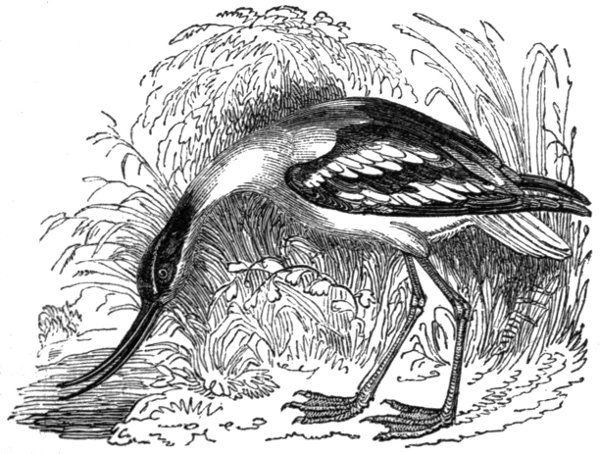
This bird, which is the only British species of Avosets, does not much exceed the lapwing in the bulk of its body; but from the length of its legs it is much taller. It measures about eighteen inches in length, to the end of the toes twenty-two, and from tip to tip thirty; and weighs from twelve to fourteen ounces. The bill is black, about three inches and a half long, and of a singular conformation; looking not unlike flexible flat pieces of whalebone, curved upwards to the tip: the irides are hazel; the head round, black on the upper part to below the nape of the neck: above and beneath each eye, in most specimens, there are small white spots; but in the one from which the above figure was taken, a streak of that colour passed over each eye towards the hinder part of the head. The thighs are naked, and, as well as the legs and feet, are of a fine pale blue colour. The whole plumage of the Avoset is white, intersected with black; and, like most of the variegated or piebald birds, the patches of these colours are not placed exactly the same in every individual; therefore, as the bird cannot be mistaken, a more minute description is unnecessary.
These birds are common in the winter about the lakes, mouths of rivers, and marshes, in the southern parts of England; and they assemble in large flocks on the fens, in the breeding season. When the female is frightened off her nest she counterfeits lameness; and when a flock is disturbed they fly with their necks stretched out, and their legs extended behind over the head of the spectator, much in the same way as the peewit or lapwing, making a shrill noise, and uttering a yelping cry of twit, twit, all the time. The places where they have been feeding may be traced out by the semicircular marks left in the mud or sand by their bills, in scooping out their food, which consists of spawn, worms, insects, &c. Latham says, “They lay two eggs, the size of those of a pigeon, an inch and three quarters in length, of a cinereous grey, singularly marked with deep brownish dark patches, of irregular sizes and shapes, besides some under markings of a dusky hue.” They keep near the shore, wading about, up to the belly in the water, and sometimes swimming. In all their motions they are smart, lively, and volatile, and do not remain long stationary in one spot.
The Scooper is the only species found in England. It breeds in the fens of Lincolnshire, and on Romney Marsh in Kent. It does not migrate, like other birds of similar habits, but is found at all seasons, though in winter it chiefly frequents the sea-shore; and, besides on the coast of Kent, it is found about the mouth of the Severn, in Gloucestershire, as well as on the eastern coasts of Norfolk and Suffolk, and sometimes in Shropshire. During the breeding season, the Avosets are seen in considerable numbers near Fossdike, in Lincolnshire, and also in the fens of Cambridgeshire, and similar localities. Temminck says it is common in North Holland. It seems, indeed, to be very widely diffused, being found in Denmark, Sweden, Russia, Siberia, the Caspian Sea, and particularly about the Salt Lakes in the deserts of Tartary.—Bewick—Latham—Montagu.
Awning, s. A cover spread over a boat or vessel to keep off the weather.
Axle, Axle-tree, s. The pin which passes through the midst of the wheel, on which the circumvolutions of the wheel are performed.
Azure, a. Blue, faint blue.
Babble, v. To open on a false scent.
Babillard, s. (Curruca garrula, Brisson.)
A species confounded by British naturalists with the white-throat. (Vide Montagu.)
The babillard does not appear to be a plentiful species in this country, and is confined to the western parts of the kingdom, from Gloucestershire and Wiltshire, in both which counties we have found them, and is probably in part of Somersetshire, but not in Devonshire or Cornwall. Selby even doubts its existence; but Sweet has kept them in a cage for years.
In some seasons it is very plentiful about London; at other times much scarcer. I am confident I have seen it in Ayrshire, and at Musselburgh Haugh, near Edinburgh.—Rennie.
Back, s. The hinder part of the body; the outer part of the hand when it is shut; the rear; the place behind; the part of any thing out of sight; the thick part of any tool, opposed to the edge.
Back, v. To mount a horse; to break a horse; to place upon the back; to maintain; to support; to bet on.
Backgammon, s. A play or game with dice and tables.
The game of tables is better known at present by the name of Backgammon. This pastime is said to have been discovered about the tenth century, and the name derived from two Welsh words signifying “little battle.” But the derivation may be found nearer home. The words are perfectly Saxon, as Bac, or Bæc, and Zamen, that is, Back Game; so denominated because the performance consists in the players bringing their men back from their antagonist’s tables into their own; or because the pieces are sometimes taken up and obliged to go back, that is, re-enter at the table they came from.
The most material circumstances in which the game differed, at this remote period, from the present method of playing it, was, first, in having three dice instead of two, or reckoning a certain number for the third; and secondly, in placing all the men within the antagonist’s table, which, says an ancient writer, must be put upon his ace point. There is also another game upon the tables, called Paume Carie, which is played with two dice, and requires four players, that is, two on either side; or six, and then three are opposed to three. The same authority then speaks of a third game, called Ludus Lombardorum, the Game of Lombardy, and thus played: he who sits on the side marked 13—24 has his men at 6, and his antagonist has his men at 19; which is changing the ace point in the English game for the size point: and this alteration probably shortened the game. He mentions the five following variations by name only; the Imperial game, the Provincial game, the games called Baralie, Mylys, and Faylis.
At the commencement of the last century, backgammon was a very favourite amusement, and pursued at leisure times by most persons of opulence, and especially by the clergy; which occasioned Dean Swift, when writing to a friend of his in the country, sarcastically to ask the following question: “In what esteem are you with the vicar of the parish: can you play with him at backgammon?” But of late years this pastime is become unfashionable, and of course not so much practised.
This game is played with dice upon a table by two persons, upon which there are twenty-four black and white spaces, called points. Each adversary has fifteen men, black and white, to distinguish them, and they are disposed of in the following manner. Supposing the game to be played into the right hand table, two are placed upon the ace point in the adversary’s table, five upon the six point in the opposite table, three upon the cinque point in the hithermost table, and five on the sixth point in the right hand table. The grand object in this game is for each player to bring the men round into his right hand table, by throwing with a pair of dice those throws that contribute towards it, and at the same time prevent the adversary doing the like. The first best throw upon the dice is esteemed aces, because it stops the six point in the outer table, and secures the cinque in the thrower’s table, whereby the adversary’s two men upon the thrower’s ace point cannot get out with either quatre, cinque, or six. This throw is an advantage often given to the antagonist by the superior player. When he carries his men home in order to lose no point, he is to carry the most distant man to his adversary’s bar point, that being the first stage he is to place it on; the next stage is six points farther, viz. in the place where the adversary’s five men are first placed out of his tables. He must go on this method till all his men are brought home, except two, when, by losing a point, he may often save the gammon, by throwing two fours or two fives. When a hit is only played for, he should endeavour to gain either his own or adversary’s cinque point, and if that fails by his being hit by the adversary, and he finds him forwarder than himself, in that case he must throw more men into the adversary’s tables, which is done in this manner: he must put a man upon his cinque or bar point, and if the adversary fails to hit it, he may then gain a forward game instead of a back game; but if the adversary hit him, he should play for a back game, and then the greater number of men which are taken up makes his game the better, because by these means he will preserve his game at home, and then he should endeavour to gain both his adversary’s ace and trois points, and take care to keep three men upon the adversary’s ace point, that, in case he hits him from thence, that point may remain still secure to himself. A back game should not be played for at the beginning of a set, because it would be a great disadvantage, the player running the risk of a gammon to win a single hit.
A variety of instructions with regard to this curious game are given by Mr. Hoyle, who calculates the odds of the game with great accuracy. The following particulars, however, may be of use to the generality of players. If a player has taken up two of the adversary’s men, and happens to have two, three, or more points made in his own tables, he should spread his own men, that he may either take a new point in his tables, or be ready to hit the man which the adversary may happen to enter. If he finds upon the adversary’s entering, that the game is upon a par, or that the advantage is on his own side, he should take the adversary’s man up whenever he can, it being twenty-five to eleven that he is not hit, except when he is playing for a single hit only, then, if playing, the throw otherwise gives him a better chance for it, he ought to do it. As it is five to one against his being hit with double dice, he should never be deterred from taking up any one man of the adversary’s. If he has taken up one of the adversary’s men, and should happen to have five points in his own tables, and forced to leave a blot out of his tables, he should endeavour to leave it upon doublets preferable to any other chance; because the odds are thirty-five to one that he is not hit, whereas it is only seventeen to one but he is hit upon another chance. When the adversary is very forward, a player should never move a man from his own quatre, trois, or deuce points, thinking to bear that man from the point where he put it, as nothing but high doublets can give him any chance for the hit. Instead of playing an ace or a deuce from any of these points, he should play them from his own size or highest points, so that throwing two fives or two fours, his size and cinque points being eased, would be a considerable advantage to him, whereas, had they been loaded, he must have been obliged to play otherwise. It is the interest of the adversary to take up the player as soon as he enters. The blot should be left on the adversary’s lowest point, that is to say, upon his deuce point, rather than upon his trois point, or upon his trois point rather than upon his quatre point, or upon his quatre point preferable to his cinque point, for a reason before-mentioned; all the men the adversary plays upon his trois or his deuce points are deemed lost, being greatly out of play, so that those men not having it in their power to make his cinque point, and his game being crowded in on one point, and open in another, the adversary must be greatly annoyed by the player. If the player has two of his adversary’s men in his tables, he has a better chance for a hit than if he had more, provided his game is forwarder than that of his antagonist, for if he had three or more of his adversary’s men in his tables, he would stand a worse chance to be hit. When a player is running to save the gammon, if he should have two men upon his ace point, and several men abroad, although he should lose one point or two in his putting his men into his tables, it is his interest to leave a man upon his adversary’s ace point, because it will prevent his adversary from bearing his men to the best advantage, and at the same time the player will have a chance of the adversary’s making a blot which he may chance to hit. However, if a player finds, upon a throw, that he has a probability of saving his gammon, he should never wait for a blot, as the odds are greatly against his hitting it, but should embrace that opportunity.
The following are directions for calculating the odds of saving or winning the gammon:—Suppose the adversary has so many men abroad as require three throws to bring them into his tables, and at the same time that the players’ tables are made up, and that he has taken up one of the adversary’s men, in this case it is about an equal wager that the adversary is gammoned. For, in all probability, the player has borne two men before he opens his tables, and when he bears the third man, he will be obliged to open his size or cinque point. It is then probable, that the adversary is obliged to throw twice before he enters his men in the player’s tables, twice before he puts that man into his own tables, and three throws more to put the men which are abroad into his own tables, in all seven throws. Now the player having twelve men to bear, he may be forced to make an ace or a deuce twice before he can bear all his men, and consequently will require seven throws in bearing them; so that, upon the whole, it is about equal whether the adversary is gammoned or not. Suppose a player has three men upon his adversary’s ace point, and five points on his own tables, and that the adversary has all his men in his tables, three upon each of his five highest points, has the player a probability of gammoning his adversary or not?
POINTS.
For bearing three men from his sixth point is 18
From his fifth point 15
From his fourth point 12
From his third point 9
From his second point 6
——
In all 60
Bringing his three men from the adversary’s ace point, to his size point in his own tables, being eighteen points each, and making together 54
——
There must remain 6
It is plain from this calculation, that the player has much the best of the probability of the gammon, exclusive of one or more blots which the adversary is liable to make in bearing his men, supposing at the same time the throws to be upon an equality. Suppose two blots are left, either of which cannot be hit but by double dice, one must be hit by throwing eight, and the other by throwing nine, so that the adversary has only one die to hit either of them.
The chances of two dice, being in all 36
The chances to hit six, are six and two twice 2
Five and three twice 2
Two deuces 1
Two fours 1
The chances to hit nine are six and three twice 2
Five and four twice 2
Two trois 1
——
For hitting in all 11
Chances for not hitting, remain 25
So that the odds are twenty-five to eleven against hitting either of these blots.
This method may be taken to find out the odds of hitting three, four, or five blots upon double dice, or blots made upon double or single dice at the same time. After knowing how many chances there are to hit any of those blots, they must be added together, and then subtracted from the number thirty-six, which are the chances of the two dices, and the question is solved.
The laws of backgammon are, first, If a man is taken from any point, it must be played, if two men are taken from it they also must be played. Second, A man is not supposed to be played till it is placed upon a point and quitted. Third, If a player has only fourteen men in play, there is no penalty inflicted; because by his playing with a less number than he is entitled to, he plays to a disadvantage for want of the deficient man to make up his tables. Fourth, If he bears any number of men before he has entered a man taken up, and which of course he was obliged to enter, such men so borne must be entered again in the adversary’s tables, as well as the man taken up. Fifth, If he has mistaken his throw and played it, and his adversary has thrown, it is not in the choice of either of the players to alter it, unless they both agree so to do.
The probable method of prolonging a hit at backgammon, affords a case of instruction as well as curiosity; for there is a probability of making the hit last by one of the players for many hours, although they shall both play as fast as usual. Suppose B to have borne thirteen men, and that A has his fifteen men in B’s tables, viz. three men upon his size point, as many upon his cinque, quatre, and trois points, two upon his deuce point, and one upon his ace point. A in this situation can prolong it by bringing his fifteen men home, always securing six close points till B has entered his two men, and brought them upon any certain point; as soon as B has gained that point A will open an ace, deuce, or trois point, or all of them, which done, B hits one of them, and A taking care to have two or three men in B’s tables, is ready to hit that man, and also he being certain of taking up the other man, has it in his power to prolong the hit almost to any length, provided he takes care not to open such points as two fours, two fives, or two sixes, but always to open the ace, deuce, or trois points, for B to hit him. We add the following two critical cases for a back game. First, suppose the fore game to be played by A, and that all his men are placed as usual, B has fourteen of his men placed upon his adversary’s ace point, and one man upon his adversary’s deuce point, and B is to throw who has the best of the hit; answer, A has the best of it, gold to silver, because, if B does not throw an ace to take his adversary’s deuce point, which is twenty-five to eleven against him, A will take up B’s men in his tables either singly or make points, and then if B secures either A’s deuce or trois point, A will put as many men down as possible, in order to hit and thereby get a back game. It is evident that the back game is powerful, consequently, whoever practises it must become a greater proficient at the game than he could by any other means. Second, Suppose A to have five men placed upon his size point, as many upon his quatre point, and the same number upon his deuce point, all in his own tables. At the same time let us suppose B to have three men placed upon A’s ace point, as many upon A’s trois point, and the same number upon A’s cinque point, in his own tables, and three men placed as usual out of his tables, who has the best of the hit? Answer—The game is equal till B has gained his cinque and quatre points in his own tables, which, if he can effect, and by playing two men from A’s cinque point, in order to force his adversary to blot by throwing a cane, which should B hit, he will have the best of the hit.—Strutt—Ency. Lon.—Hoyle.
Backside, s. The hinder part of any thing; the hind part of an animal.
Back-sinews, strains in.
The symptoms are swelling, heat, and proportionate degree of lameness. Bleeding and rest are absolutely necessary, assisted by an emollient poultice from the hoof to the knee. A flannel bag, or large woollen stocking, secured above the shoulder by a tape, is the best mode of applying the poultice. All movement of the knee should be avoided.
Bacon, s. The flesh of a hog salted and dried.
Badger, s. A brock, an animal.
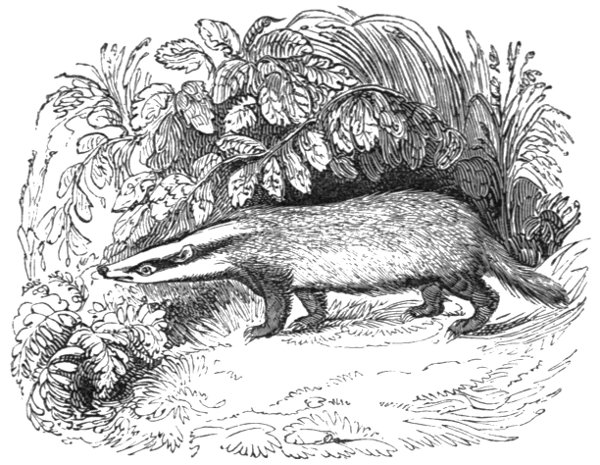
THE BADGER.
The usual length of the badger is two feet six inches, exclusive of the tail, which is barely six inches long, and covered with long hair, the same as those of the body; the weight from fifteen to thirty-four pounds—the last is rare, but in the winter of 1779, Mr. Pennant had a male badger of that weight; the eyes are very small, the ears short and rounded; the neck thick, and the whole shape of the body clumsy, and which being covered with long coarse hairs, like bristles, adds to its awkward appearance; each hair next the root is of a dirty, yellowish white, the middle is black, and the extremity grey; hence arose the old saying, “As grey as a badger.” It has thirty-four teeth, six cutting and two canine teeth in each jaw—the lower and upper have each five grinders; the nose, chin, and lower sides of the cheeks are white; each ear and eye is inclosed in a pyramidal bed of black, the base of which incloses the former,—this point extends beyond the eye to the nose; the throat and under parts of the body are black. This is a singularity in the badger, for all other animals have hair of a lighter colour upon their bellies, than upon their backs. The legs and feet of the badger are black, very short, and strong; each foot is divided into five toes, those in the fore feet are armed with long claws, well adapted for digging its subterraneous habitation, where, although there is but one entrance from the surface, it forms several apartments, and in the breeding season carries in grass in his mouth, to form a bed for its young. It confines itself to its hole during the day, feeding only at night. It is so cleanly as never to obey the calls of nature in its own burrow. It is said the fox takes advantage of this niceness, and uses an obvious method to make the badger’s home unpleasant, of which he by this means possesses himself. In walking, the badger treads on his whole heel, like the bear, which brings the belly very near the ground. Immediately below the tail, between that and the anus, there is a narrow transverse orifice, from whence continually exudes a white substance of a very fœtid smell: this seems peculiar to the badger and the hyæna.
Badger-Hunting, s.
Few creatures defend themselves better, or bite with greater keenness, than the badger: on that account it is frequently baited with dogs trained for that purpose, and defends itself from their attacks with astonishing agility and success. Its motions are so quick, that a dog is often desperately wounded in the moment of assault, and obliged to fly. The thickness of the badger’s skin, and the length and coarseness of its hair, are an excellent defence against the bites of the dogs; its skin is so loose as to resist the impression of their teeth, and gives the animal an opportunity of turning itself round, and wounding its adversaries in their tenderest parts. In this manner this singular creature is able to resist repeated attacks both of men and dogs, from all quarters, till, being overpowered with numbers, and enfeebled by many desperate wounds, it is at last obliged to yield.
In hunting the badger, you must seek the earths and burrows where he lies, and, in a clear moonlight night, go and stop all the burrows except one or two, and therein place some sacks, fastened with drawing strings, which may shut him in as soon as he strains the bag. Some only place a hoop in the mouth of the sack, and so put it into the hole; and as soon as the badger is in the sack, and strains it, the sack slips from the hoop, and secures him in it, where he lies trembling till he is taken from his prison.
The sacks or bags being thus set, cast off the hounds, beating about all the woods, hedges, and tufts round about, for the compass of a mile or two, and what badgers are abroad, being alarmed by the hounds, will soon betake themselves to their burrows. Observe that the person who is placed to watch the sacks, must stand close, and upon a clear wind, otherwise the badger will discover him, and immediately fly some other way into his burrow.
But if the dogs can encounter him before he can take his sanctuary, he will then stand at bay like a boar, and make good sport, vigorously biting and clawing the dogs. In general, when they fight, they lie on their backs, using both teeth and nails; and, by blowing up their skins, defend themselves against the bites of the dogs and the blows given by the men. When the badger finds that the terriers yearn him in his burrow, he will stop the hole between him and the terriers; and if they still continue baying, he will remove his couch into another chamber or part of the burrow, and so from one to another, barricading the way before them as he retreats, till he can go no farther.
If you intend to dig the badger out of his burrow, you must be provided with such tools as are used for digging out a fox: you should also have a pail of water ready to refresh the terriers when they come out of the earth to take breath and cool themselves.
It is no unusual thing to put some small bells about the necks of the terriers, which, making a noise, will cause the badger to bolt out.
In digging, the situation of the ground must be observed and considered; or instead of advancing the work, you probably may hinder it. In this order you may besiege them in their holds, or castles, and break their platforms, parapets, and casemates, and work to them with mines and countermines, till you have overcome them.
We must do this animal the justice to observe, that, though nature has furnished it with formidable weapons of offence, and has besides given it strength sufficient to use them with great effect, it is, notwithstanding, very harmless and inoffensive, and, unless attacked, employs them only for its support.
The badger is an indolent animal, and sleeps much: it confines itself to its hole during the whole day, and feeds only in the night. It is so cleanly as never to defile its habitation with its ordure. Immediately below the tail, between that and the anus, there is a narrow transverse orifice, from whence a white substance, of a very fœtid smell, constantly exudes. The skin, when dressed with the hair on, is used for pistol furniture. Its flesh is eaten: the hind quarters are sometimes made into hams, which, when cured, are not inferior in goodness to the best bacon. The hairs are made into brushes, which are used by painters to soften and harmonise their shades.
In walking, the badger treads on its whole heel, like the bear, which brings its belly very near the ground.
Extraordinary Affection in the Badger.—Two persons were on a short journey, and passing through a hollow way, a dog which was with them, started a badger, which he attacked, and pursued, till he took shelter in a burrow under a tree. With some pains they hunted him out, and killed him. Being a very few miles from a village, called Chapellatiere, they agreed to drag him there, as the commune gave a reward for every one which was destroyed; besides, they purposed selling the skin. Not having a rope, they twisted some twigs, and drew him along the road by turns. They had not proceeded far, when they heard a cry of an animal in seeming distress, and stopping to see from whence it proceeded, another badger approached them slowly. They at first threw stones at it, notwithstanding which it drew near, came up to the dead animal, began to lick it, and continued its mournful cry. The men, surprised at this, desisted from offering any further injury to it, and again drew the dead one along as before; when the living badger, determining not to quit its dead companion, lay down on it, taking it gently by one ear, and in that manner was drawn into the midst of the village; nor could dogs, boys, or men, induce it to quit its situation by any means, and, to their shame be it said, they had the inhumanity to kill it, and afterwards to burn it, declaring it could be no other than a witch.—Buffon—Daniel.
Bag, s. A sack, a pouch; that part of animals in which some particular juices are contained, as the poison of vipers.
Bag, v. To put into a bag. In sporting parlance, to kill.
Bagatelle, s. A trifle; a game.
Bait, v. To put meat to tempt animals.
Bait, s. Meat set to allure animals to a snare; a temptation; an enticement; a refreshment on a journey. In Fishing, worms, paste, &c.
Balance, s. A pair of scales; the overplus of weight; equipoise.
Balance, v. To weigh in a balance; to counterpoise.
Bald, a. Without hair; without natural covering.
Balk, s. A ridge of land left unploughed; disappointment when least expected. In Hunting, a term used when a horse refuses his leap.
Balk, v. To disappoint; to frustrate. In Hunting, to swerve off from a fence; to refuse a jump.
Ball, s. Anything made in a round form; a round thing to play with, a hand-ball, a billiard-ball.
Balls (in farriery) are boluses given to horses, and should not exceed in size a hen’s egg. Though named balls, they are generally rolled up in a cylindrical form, about one inch in diameter, and two and a half in length; but the form of an egg is preferable. There is sometimes difficulty in giving balls, without using a balling iron; and there are horses that will not take a ball by any other means. In giving it, the horse’s tongue is drawn out on the off or right side, and held firmly with the left hand, while with the right the ball is passed over the tongue into the pharynx, or top of the gullet. The hand should be kept as near to the roof of the mouth as possible; there will then be much less danger of being wounded by the teeth. The moment the right hand is withdrawn from the mouth, the tongue is let loose, and the ball generally swallowed.
Balls should be made at the time they are wanted; as by keeping they become so hard as to be insoluble in the stomach, and pass through the intestines unchanged. By keeping they also lose much of their strength, particularly when the ingredients are evaporable in the common temperature of the atmosphere, which is the case with camphor, ammonia, essential oils, &c. But the most serious inconvenience which arises from giving balls that have been kept until they become very hard, is, that they are liable to stick in the throat or gullet, and thereby endanger the horse’s life.
Balls cannot be conveniently given unless wrapped up in paper: but for this purpose the softest and thinnest should be chosen.
In holding the tongue with the left hand while the ball is introduced, great care is required, as the rough and violent manner in which this is sometimes done, injures the tongue or lacerates the under part of it, named the bridle. The muscles by which swallowing is effected may also be seriously injured in this way. In violent colds, strangles, &c. there is so much soreness of the throat as to render swallowing very painful and difficult; in such cases neither balls nor drenches should be given, as they are sure to do mischief by irritating the throat, and may even suffocate the animal by getting into the wind-pipe.
When a ball is found to exceed the proper size, it should be divided and given at twice, as much injury has been done by giving balls too large, especially when they have become dry and hard, or been wrapped in thick paper. In making balls, the dry ingredients should be finely powdered and well mixed, and the liquid for forming them should be adapted to the nature of the other ingredients. When a ball contains any acrid, or very powerful ingredient, such as sublimate or arsenic, flour and paste may be employed for mixing it up, and a small bran mash should be given a little before or after it. After giving a ball, grooms sometimes press or pinch the throat for the purpose of making the horse swallow it; but this should never be done, as it is apt to excite coughing, by which swallowing is prevented. The only thing necessary after the hand is withdrawn is to keep the mouth shut, and press the nose downwards, in a moderate degree, towards the chest.—White.
Balling-Iron, s. An instrument used in administering balls to horses. It is intended to keep the mouth open while the ball is being introduced, and answers the double purpose of assisting the groom in the operation, and saving his hand from injury from the horse’s teeth. In its use, it should be carefully covered with cloth, to prevent the tongue of the animal from being lacerated.
Balm, s. The sap or juice of a shrub, remarkably odoriferous, and of healing qualities; any valuable or fragrant ointment; anything that soothes or mitigates pain.
Balsam, s. A thick fluid soluble in spirit of wine.
Balsams are a kind of resinous juice, united with some of the extractive matter of the various plants they are obtained from, in combination with an essential oil. All the balsams are occasionally in use in veterinary medicine, and were formerly in very high estimation, for their supposed salutary action in chronic diseases of the lungs. They were also considered as a sovereign vulnerary for abraded urinary passages. It is the modern doctrine to think their efficacy overrated, and which is probably in some respects true, particularly as regards their expectorant qualities: nevertheless they are far from being inert; on the contrary, they appear to act favourably in some instances, as a warm terebinthinated stimulant. The principal balsams dispensed in veterinary practice are these:—
Balsam of Canada.—A strong diuretic, used in chronic cough and diseases of the lungs.
Balsam of Copaiba, or Capivi.—Possesses similar properties to that of Canada.
Balsam of Friars.—Now called Tincture of Benjamin, an excellent traumatic.
Balsam of Gilead.—Similar in its properties to Copaiba.
Balsam of Peru.—A stimulant; used externally to irritable ulcers.
Balsam of Tolu.—Same properties and uses as Peru.
Balsam of Sulphur.—An expectorant; in inflammatory coughs, however, its use is dangerous.—Outlines of Vet. Art.—White.
Balsamic, a. Unctuous, mitigating.
Bamboo, s. An Indian plant of the reed kind.
Bandaleers, s. Small wooden cases covered with leather, each of them containing powder that is a sufficient charge for a musket. Obs.
Bandog, (Canis Villaticus,) s. A mastiff.
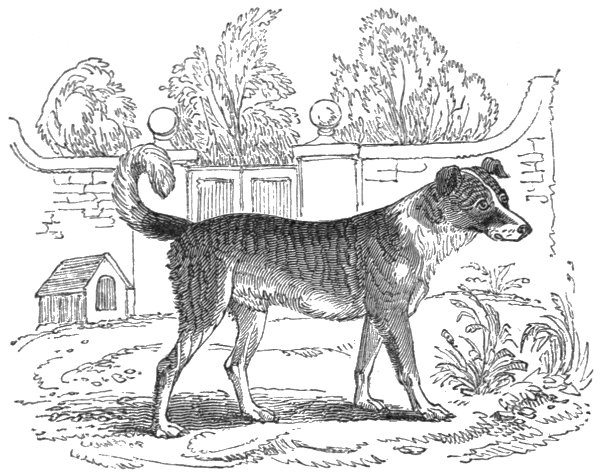
This variety is lighter, smaller, and more active than the mastiff, from which he is descended by a cross with the foxhound. He is not near so powerful a dog as the former, but is more fierce in his natural disposition. From his descent, he possesses a finer sense of smelling than that dog. His hair is rougher, generally of yellowish or sandy grey, streaked with shades of black or brown, and semi-curled almost over his whole body; his legs, however, are smooth. Although he generally attacks his adversary in front, like the mastiff and bull dog, it is not his invariable practice, for he is sometimes seen to seize cattle by the flank. His bite is said to be severe and dangerous.—Brown.
Bandy, s. A club turned round at bottom for striking a ball.
Bandy-leg, s. A crooked leg.
Bane, s. Poison, mischief.
Bank Swallow, River Swallow, Bank Martin, or Sand Swallow, s. This is the smallest species of British Swallow; length four inches and three quarters. The whole upper parts of the plumage are of a mouse-coloured brown; the under parts white, except across the breast, which is brown; legs dusky, a little feathered behind; bill dusky; irides hazel. The Bank Swallow is not near so plentiful, and is more local than the other species.—Montagu.
Bantam, s.
The Bantam, a well-known small breed, originally from India, is chiefly valued for its grotesque figure and delicate flesh.
There has been lately obtained a variety of bantams, extremely small, and as smooth legged as a game fowl. From their size and delicacy, they are very convenient, as they may always stand in the place of chickens, when small ones are not otherwise to be had. They are also particularly used for sitting upon the eggs of partridges and pheasants, being good nurses, as well as good layers. Sir John Sebright, M.P. for Herts, is one of the chief amateurs of this breed. Sir John’s breed are beautifully striped and variegated.
In addition, there is a South American variety, either from Brazil or Buenos Ayres, which will roost in trees. They are very beautiful, partridge-spotted and streaked; the eggs small, and coloured like those of the pheasant; both the flesh and eggs are fine flavoured and delicate.—Moubray.
Bar, s. A piece of wood laid across a passage to hinder entrance; a bolt to fasten a door; any obstacle; a rock or bank at the entrance of a harbour; anything used for prevention; a moveable piece of timber used in the menage to teach horses to leap.
Barb, s. Anything that grows in the place of the beard; the points that stand backward in an arrow.
Barb, s. A Barbary horse. Vide Arab and Horse.
Barb, v. To jag arrows and fishing-hooks.
Barbadoes Tar, s. A bituminous substance of strong diuretic power. It is used in chronic coughs, and externally employed in strains and bruises.
Barbecue, s. A hog dressed whole.
Barbed, a. Bearded; jagged with hooks.
Barbel, s. A kind of fish found in rivers.
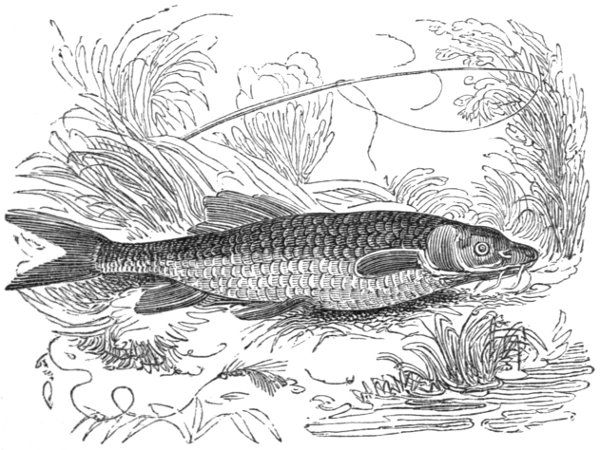
The Barbel is one of the coarsest fishes. In England they are deemed the worst of fresh-water fish, and seldom eaten but by the poorest sort of people, who sometimes boil them with a piece of bacon to give them a relish. The roe is very noxious, affecting those unwarily eating it with a vomiting, purging, and a slight swelling.
The Barbel takes its name from the barbs, or wattels, at his mouth. They begin to run up the rivers in March and April. When they spawn, they keep together in companies, making holes in the gravel wherein they cast it.
The head of the barbel is smooth, the nostrils are near the eyes; it has a leather mouth, which is placed below; on each corner is a single beard, and another on each side of the nose; the shape is long, round, and handsome; the dorsal fin is armed with a remarkably strong spine, sharply serrated; with which it can inflict a severe wound on the uncautious handler, and do much damage to the net. The side fin is straight; the scales are not large, and of a pale gold colour, edged with black; the belly white, the tail is a little bifurcated, and of a deep purple. It is sometimes found three feet in length, and weighing eighteen pounds. According to the accounts in the Elements of Natural History, it is met with from two to fifteen feet long, grows quickly, is very tenacious of life, and lives to a great age.
If there be any difference in the taste of their flesh, they are most in season the latter end of the summer; but in fact they are not worth noticing, except for the sport the angler derives from the catching of them, and which, from their being so strong and determined a fish when hooked, is very great.—Daniel.
Barge, s. A boat for pleasure; a boat for burthen.
Barger, s. A river-keeper; the manager of a barge.
Bark, s. The rind or covering of a tree; a small ship.
Bark, v. To strip trees of their bark; to make the noise which a dog makes.
Bark, Peruvian, or Cinchona, s. A tonic and febrifuge medicine. Its effects upon the horse are trifling; it is useful chiefly in diabetes. There are three qualities, pale, red, and yellow. The first is best.
Bark, Oak, s. An excellent substitute for Peruvian.
Barley, s. A grain of which malt is made.
Barm, s. Yeast; the ferment put into drink to make it work.
Barn, s. A place or house for laying up any sort of grain, hay, or straw.
Barnacle, s. A kind of shellfish which attaches itself to timber floating at sea; a bird, vide Bernacle.
Barometer, s. A machine for measuring the weight of the atmosphere, and the variations in it, in order chiefly to determine the changes of the weather.
Barometer.—There is no instrument now more generally used for ascertaining the coming weather than the barometer. It may however be remarked, that it is more from its rising or falling, than from its height or lowness that we are to infer fair or foul weather. Generally speaking, the rising of the mercury presages clear fair weather, and its falling, foul weather; as rain, snow, high winds, and storms.
In very hot weather, the falling of the mercury indicates thunder.
In winter the rising indicates frost, and in frosty weather, if the mercury fall three or four divisions, there will follow a thaw; but in a continued frost, if the mercury rise, it will snow.
When foul weather happens soon after the falling of the mercury, expect but little of it; and, on the contrary, expect but little fair weather when it proves fair shortly after the mercury has risen.
In foul weather, when the mercury rises much and high, and so continues for two or three days before the foul weather is over, then expect a continuance of fair weather to follow.
In fair weather, when the mercury falls much and low, and thus continues for two or three days before the rain comes, then expect a great deal of wet, and probably high winds.
The unsettled motion of the mercury denotes uncertain and changeable weather.
The words engraved on the register plate of the barometer, it may be observed, cannot be strictly relied upon to correspond exactly with the state of the weather; though it will in general agree with them as to the mercury rising and falling.
When the thermometer and barometer rise together in summer, with rain in large drops, a wholesome state of the atmosphere is at hand.
A great and sudden rising of the barometer, that is to say, a great accession of atmospherical pressure, will, in some persons, occasion a slight temporary difficulty of hearing and tingling in the ears, similar to that which is experienced in descending from high mountains, or from the air in balloons.—Foster.
Barrel, s. A round wooden vessel to be stopped close; a vessel containing liquor; anything hollow, as the barrel of a gun; a cylinder.
Barrel-making has occupied the attention of gun manufacturers from the first invention of fire-arms to the present time. Experiments in the material as well as the construction of barrels, have been extensively tried by the artists of every country. A gradual and progressive improvement was the result, until the slub-barrel of the present day has superseded every other kind, and seems to have reached the utmost perfection that human ingenuity can accomplish.
The peculiar formation of barrels at different periods, and by different artists, will be interesting to sportsmen generally.
Spanish barrels have always been held in great esteem, as well on account of the quality of the iron—which is generally considered the best in Europe—as because they possess the reputation of being forged and bored more perfectly than any others. It should be observed, however, that of the Spanish barrels, those only that are made in the capital are accounted truly valuable; in consequence of which a great many have been made at other places, especially in Catalonia and Biscay, with the names and marks of the Madrid gunsmiths. They are also counterfeited at Liege, Munich, &c.; and a person must be a good judge not to be deceived by these spurious barrels.
These barrels were formerly in such high repute, that the price of them was enormous. Those of Belen, Fernandez, and Bez, sold in France for a thousand livres, or 43l. 15s.; while the barrels of artists of lesser name produced three hundred, or 13l. sterling.
After the barrels of Madrid, those of Bustindui and St. Olabe, at Placentia, in Biscay, and of Jean and Clement Pedroesteva, Eudal Pous, and Martin Marechal, at Barcelona, are the most esteemed; these usually sell in France for eighty French livres, or 3l. 10s. sterling.
Almost all the barrels made at Madrid are composed of the old shoes of horses and mules, collected for the purpose. They are all welded longitudinally, but instead of being forged in one plate or piece, as in other countries, they are made, like the English twisted barrels, in five or six detached portions, which are afterwards welded one to the end of another, two of them forming the breech or reinforced part of the barrel. We may form some idea of the very great purity to which the iron is brought in the course of the operation, when we are told, that to make a barrel, which, rough from the forge, weighs only six or seven pounds, they employ a mass of mule-shoe iron, weighing from forty to forty-five pounds; so that from thirty-four to thirty-eight pounds are lost in the heatings and hammerings it is made to undergo before it is forged into a barrel.
Notwithstanding the great reputation of the Spanish barrels, however, they are little used in France, and still less in England, their awkward form and their great length and weight being strong objections to them, especially since they have begun to make their pieces so very light and short in these countries; and from our own experience of the Spanish barrels, we are convinced that the avidity with which they are sought after by some persons, and the extravagant prices that are given for them, proceed more from a fancied than from any real superiority they possess over those made in this country.
The Spanish gunsmiths pique themselves upon the very high polish they give to the inside of their barrels. We have our doubts about the advantage derived from this, and are still of opinion that if a barrel is so smooth as not to lead, it is better to take it as it comes from the hand of the manufacturer, than allow the gunsmith to practise any farther operation upon it. In support of this opinion, Mons. de Marolles informs us, that he has seen a barrel rough from the borer throw a charge of shot deeper into a quire of paper, than another barrel that was highly polished within, although the length, the bore, and the charge, were the same in both.
The canons a ruban, or riband barrels of the French, very much resemble the English twisted barrels. The process pursued in their formation is very troublesome, and seems to possess no countervailing advantage. A plate of iron about the twelfth part of an inch in thickness is turned round a mandril, and welded its whole length in the same manner as a plain barrel: upon this small and light barrel, which is called lining, a stripe or plate of iron, about an inch in breadth, and bevelled off at the edges, is rolled in a spiral direction, by means of successive heats—this spiral is termed the riband, and its thickness must correspond with the part of the barrel it is to constitute. As a riband of sufficient length to cover the lining from one end to the other would be very difficult to manage, it is formed in several pieces, and so soon as one piece is nearly rolled on, another is welded to the end of it, and the operation continued until the whole of the lining is covered. The edges are bevelled so much, that one edge overlaps the other about a quarter of an inch. When the riband is all rolled on, the barrel is heated by two or three inches at a time, and the turns of the spiral united to each other and to the lining, by being welded in the same manner as a twisted or plain barrel, but requiring more care and accuracy in the operation. It is afterwards bored, so that almost the whole of the lining is cut out, and scarcely anything left except the riband with which it was covered.
Lazarini Barrels, so called after the maker, were formerly celebrated throughout the greatest part of Europe. They were very long, and of a very small calibre. Lazarini lived at Brescia, about a hundred and fifty years ago. He did not forge these barrels himself, but he finished them with great accuracy, and ornamented them in a rich and elegant manner. At the time, however, when these barrels were in high estimation, there were numerous counterfeits bearing the name and mark of Cominazzo, and it requires some acquaintance with the genuine barrels not to be deceived by the spurious ones. The true Lazarini are now to be found only in the repositories of the curious.
The vanity of possessing something that is singularly curious, the false idea that whatever is expensive must necessarily be good, and sometimes, though rarely, the laudable desire of improvement, have all in their turns been the causes of a variety of experiments made in the manufacture of barrels. An artist in London, who wrought a great deal of Spanish iron, forged barrels from old scythes, from wire, from needles, and a great many other articles suggested by the whim of the customers—who made barrels with a lining of steel, and formed others with a double spiral of steel and iron alternately—confessed after these numerous trials, that “stub iron wrought into a twisted barrel is superior to every other.” Whenever steel was employed, he found that the barrel neither welded nor bored so perfectly as when iron alone was used.
The English stub barrels are deservedly celebrated for their superior elegance and strength, as well as for the accuracy with which they throw their ball or shot. The iron employed in them is formed of stubs, which are old horse-shoe nails, procured from country farriers, and from poor people who gain a subsistence by picking them up on the great roads leading to the metropolis. These are originally formed from the softest, toughest iron that can be had, and this is still farther purified by the numerous heatings and hammerings it has undergone in being reduced from a bar into the size and form of nails. They cost about ten shillings the hundred weight, and twenty-eight pounds are required to make a single barrel of the ordinary size. A hoop of iron about an inch broad, or six or seven inches diameter, is placed perpendicularly, and the stubs, previously freed from dirt by washing, are neatly piled in it, with their heads outermost on each side, until the hoop is quite filled and wedged tight with them, the whole resembling a rough circular cake of iron. This is put into the fire, until it has acquired a white heat, when it is hammered either by the strength of the arm, or by the force of machinery, until it coalesces, and becomes one solid mass of iron. The hoop is then removed, and the heatings and hammerings repeated, until the iron, by being thus wrought and kneaded, is freed from every impurity, and rendered very tough and close in the grain. The workmen then proceeds to draw it out into pieces of about twenty-four inches in length, half an inch or more in breadth, and half an inch in thickness.
Damascus barrels are thus described by Hawker:—“I saw the process of making them, the mixture of iron and steel for which is beat out in long bars, and then, previously to being wound round the anvil, twisted by a kind of turning lathe, (similar to wringing clothes when wet), and then beat flat again. Although these are by far the dearest barrels that are made, yet the price of one in Birmingham is very trifling, viz.:—
Forging £1 10 0
Boring and grinding 0 5 0
Filing and patent breech 0 11 0
Proof 0 1 6
————————
£2 7 6
The stub barrels, which are generally used for best guns, cost about sixteen shillings each.”
The Damascene barrels are now unfashionable, and never had anything to recommend them, but as being a pretty novelty.
On boring of barrels there has been much diversity of opinion; and if Colonel Hawker’s theory be correct, the bore should not be perfectly cylindrical.
With respect to the common sized guns, which are usually made for the sports of the field, there are two good ways of boring; the one is, to leave a cylinder for about three-fourths of the barrel, (always taking care, however, to preserve a tightness for a little friction just where the shot first moves), and let the remaining part be gradually relieved to the muzzle. For instance; suppose a barrel to be two feet eight inches long, we would say (beginning at the breech end) about six inches tight, twenty-one inches a cylinder, and the remaining five inches relieved to the muzzle. All this must be done with the most delicate possible gradation, and in so small a degree, that even some gun-makers could scarcely discover it. How natural, then, is it, that many sporting authors should be so far deceived, as to fancy the best guns are bored a true cylinder, and therefore, argue in its favour. This relief has the effect of making the gun shoot as close as it can do, compatibly with the strength and quickness required, which should, however, be increased as much as possible by the best constructed breechings.
The other plan is, to make the barrel regularly tighter all the way down, so that, in firing, the shot goes progressively easier as it approaches the muzzle. All this relief must be given in a very trifling degree, because, should the barrel be too much opened in any part, it would admit of the powder escaping between the wadding and the sides of the calibre, by which the shooting of the gun would be rendered weak. For this reason, I should even object to having a hole through the wadding that covers the powder, which many do to prevent the confined air from resisting the ramrod.
The imperfections to which a barrel is liable in forging, are of three kinds, viz., the chink, the crack, and the flaw. The chink is a solution of continuity running lengthwise of the barrel. The crack is a solution of continuity more irregular in its form than the chink, and running in a transverse direction, or across the barrel. The flaw differs from both; it is a small plate or scale, which adheres to the barrel by a narrow base, from which it spreads out as the head of a nail does from its shank, and, when separated, leaves a pit or hollow in the metal.
With regard to the soundness of the barrel, the chink and flaw are of much greater importance than the crack, as the effort of the powder is exerted upon the circumference, and not upon the length of the barrel. In a sword or bow, the very reverse of this takes place, for if a crack, though but of a slight depth, occurs in either, it will break at that place, when bent but very little, because the effort is made upon the fibres disposed longitudinally, whereas, if the fault be a chink, or even a slight flaw, the sword or bow will not give way. The flaw is much more frequent than the chink, the latter scarcely ever occurring but in barrels forged as above, in which the fibres of the metal run longitudinally. When external and superficial, they are all defects in point of neatness only, but when situated within the barrel, they are of material disadvantage, by affording a lodgment to moisture and foulness that corrode the iron, and thus continually enlarge the excavation, until the barrel bursts, or becomes dangerous to use.
Colonel Hawker says, “that a barrel may be pretty good, and perfectly safe, and yet not able to bear the scientific inspection of a first-rate maker or judge. That is, to hold the barrel up to the window, and gradually raise it, till the shade from above the window runs along its surface, by which inspection you will easily discover the most trifling want of finish.”—Essay on Shooting.
Basilicon, s. An ointment; called also tetrapharmacon. It is now called ointment of yellow resin; it is a digestive.
Basin, s. A small pond; a part of the sea enclosed in rocks; a dock for repairing and building ships.
Basket-hilt, s. A hilt of a weapon, so made as to contain the whole hand.
Basset, s. A game at cards.
Bastard, s. Any thing spurious.
Bastard, a. Spurious, supposititious, adulterate.
Bat, s. A heavy stick; an implement used in playing cricket; an animal having the body of a mouse, and the wings of a bird; not with feathers, but with a sort of skin which is extended. It brings forth its young as mice do, and suckles them.
Bats flitting about late in the evening, in spring and autumn—at which seasons they are most commonly seen—foretel a fine day on the morrow; as do door-beetles, and some other insects. On the contrary, when bats return soon to their hiding-places, and send forth loud cries, bad weather may be expected.—Foster.
Bat-fowling, s. Bird-catching in the night time.
This sport we call in England, most commonly bird-batting, and some call it low-belling; and the use of it is to go with a great light of cressets, or rags of linen dipped in tallow, which will make a good light; and you must have a pan or plate made like a lantern, to carry your light in, which must have a great socket to hold the light, and carry it before you, on your breast, with a bell in your other hand, and of a great bigness, made in the manner of a cow-bell, but still larger; and you must ring it always after one order.—If you carry the bell, you must have two companions with nets, one on each side of you; and what with the bell, and what with the light, the birds will be so amazed, that when you come near them, they will turn up their white bellies: your companions shall then lay their nets quietly upon them, and take them. But you must continue to ring the bell; for if the sound shall cease, the other birds, if there be any more near at hand, will rise up and fly away.—This is an excellent method to catch larks, woodcocks, partridges, and all other land-birds.—Burton.
Bath, s. A bath is either hot or cold, either of art or nature; a vessel of hot water, in which another is placed that requires a softer heat than the naked fire.
Bathe, v. To wash in a bath; to supple or soften by the outward application of warm liquors; to wash with any thing.
Both the warm and the cold bathings of dogs are attended, in many cases, with the happiest effects. When a warm bath is used for a dog, the heat should be regulated according to the case. In inflammations it should be considerable, and in rheumatisms also; but it must be remembered that, from habit, many persons can bear, without inconvenience, a heat that would be most distressing to a dog; consequently, when it is attempted to ascertain the heat by the hand alone, this circumstance should be considered.
The water bath should come all over the animal, except the head; and when any one particular part is more especially affected, that part ought to be rubbed during the bathing, with the hand. The dog being removed from the water, the utmost care should be observed to avoid his taking cold by exposure. He should be first rubbed as dry as may be by a change of cloths, and then be put into a clothes-basket, wrapped up in a blanket, and there confined till thoroughly dry.
Cold bathing is also, in some instances, very useful, particularly in the spasmodic twitchings that succeed distemper; and in some other cases of habitual weakness, as rickets, &c.: but for dogs in health, I am convinced that bathing is not so salutary as is often supposed.—Blaine.
In Falconry.—Hawks should bathe every five or six days, in a clear stream, or pool, of water, that is shallow at the edge; but when these are not at hand, eyesses may be made to bathe in pans sufficiently large for the purpose.
A moderate quantity of food is to be given to the hawk, before he is taken to the stream; a creance is to be tied to the leash, and fastened to the ground; he is then to be unhooded, and placed near the water. The falconer must then retire to a distance. When the hawk has bathed, he should be left to plume himself on the beach, as long as he remains quiet, but he must be cautiously taken up the moment he shows signs of uneasiness, lest he should bait in the creance with a full crop, which is always to be prevented by every possible precaution.—Sebright.
Batoon, s. A staff or club.
Battle-door, s. An instrument with a round handle and a flat blade, to strike a ball or shuttlecock.
Battu, s. The shooting of preserved game by a numerous company.
Those huntsmen who are so fond of unnecessarily getting blood and wasting foxes, would doubtless have been much gratified at the hunting match given by the Prince Esterhazy, Regent of Hungary, upon the signing the treaty of peace with France—a day’s sport that bids fair to vie, in point of blood (if the King of Naples’ slaughter be excepted), with any of those recorded in modern history; as there were killed, 160 deer, 100 wild boars, 300 hares, and 80 foxes. The king had a larger extent, and a longer period for the exercise of his talents, and it was proved that during his journey to Vienna, in Austria, Bohemia, and Moravia, he killed 5 bears, 1820 boars, 1960 deer, 1145 does, 1625 roebucks, 1121 rabbits, 13 wolves, 17 badgers, 16,354 hares, and 354 foxes; the monarch had likewise the pleasure of doing a little in the bird way, by killing, upon the same expedition, 15,350 pheasants, and 12,335 partridges.
After leaving Lucknow, we directed our course towards Baraeech; our kafeela consisted of about 40,000 men, and 20,000 beasts, composed of 10,000 soldiers, 1000 cavalry, and near 150 pieces of cannon; 1500 elephants, 3000 hackeries, and an innumerable train of camels, horses, and bullocks; a great number of ruts, filled with the Nawalis women; many large and small boats carried on carts, drawn by fifty, forty, thirty, or twenty bullocks; tigers, leopards, hawks, fighting-cocks, quails, and nightingales; pigeons, dancing-women, and boys; singers, players, buffoons, and mountebanks. In short, his excellency had everything, every object which could please or surprise, cause a smile, or raise a sneer, attract admiration, fix with wonder, or convulse with laughter; captivate the eye, lull the ear, or tickle the palate. Above five hundred coolies were employed to carry his shooting apparatus, guns, powder, shot, and et ceteras; he had above a thousand double-barrelled guns, the finest that Manton and Nock could make, and single-barrels, pistols, swords, and spears, without number.
After a gay scene of every species of oriental amusement and dissipation, we returned to this place, having killed in our excursion eight tigers, six elephants, and caught twenty-one. To enumerate the other kinds of game would require a sheet as ample as the petition which was presented to Yenghis Khan, and might perhaps be treated by you in the manner that conqueror treated the petition.—
Ashbridge Castle, Hertfordshire, the seat of the Earl of Bridgewater, was lately a scene of great gaiety. The sports of the field, on the three days of the Duke of York’s sojourn, were never before equalled. The Duke of Wellington’s double-barrelled gun brought down everything before it. During the last four days, a party of gentlemen killed 623 head of game. Killed from eight guns, in three days, 1093 head of game:—
1st day, 7 guns, 627 shots, 326 killed.
2nd .. 9 .. 956 .. 511 ..
3rd .. 8 .. 388 .. 251 ..
The best shots were, the Duke of York, the Duke of Wellington, Lord Bridgewater, and Lord Verulam. The Duke of York killed, on the first day, forty-seven head of game.
In October, 1807, at Up Park, Sussex, the seat of Sir H. Featherstonhaugh, the extraordinary quantity of five hundred and one brace of game was shot, from Wednesday morning, the 7th, to Saturday night, the 10th instant, by a party visiting at the above mansion.
Lord Rendlesham and party killed three thousand seven hundred and seventy-five head of game, during the last week in the season of 1807.
On the day before one of the annual parties at Clumber broke up, two sets went out, each consisting of three persons, and a bet was laid which should kill most game. It was computed that, on an average, each man of the six got sixty shots; total, three hundred and sixty. The winning triumvirate killed three birds! The shooters were, Lord Lincoln, General Philips, Captain (afterwards General) Lascelles, Reverend Mr. Lascelles, Mr. Cotton, and Lieutenant Colonel Stricland. Here the game had a complete triumph over their adversaries.—Daniel—Sporting Anecdotes.
Bawrel, s. A kind of hawk. Obs.
Bawsin, s. A badger. Obs.
Bay, a. A colour.
Of the bays, there are many varieties, and they include the very best of our horses of every description. The bright yellow bay, although very beautiful, and especially if his mane and tail are black, is the least valuable, because the lightness of his colour seems to give him some tenderness of constitution. The proper bay, with no white about him, and black from the knees and the hocks to the feet, is the most desirable of all colours; he has generally a good constitution, naturally good feet, and, if his conformation is not faulty, will turn out a valuable horse for almost every purpose.—The Horse.
Bay, s. An opening in the land; the state of anything surrounded by enemies; a tree.
Bay, v. To bark, as a dog, at the moon; to shut in.
Bay Salt, s. Salt made of sea water, which receives its consistence from the heat of the sun, and is so called from its brown colour.
Bayard, s. A bay horse.
Beach, s. The shore; the strand.
Beadle, s. In forestry, is an officer that warns all the courts of the forest, executes process, makes all proclamations, &c. &c.
Beagle, s. A small hound, with which hares are hunted.
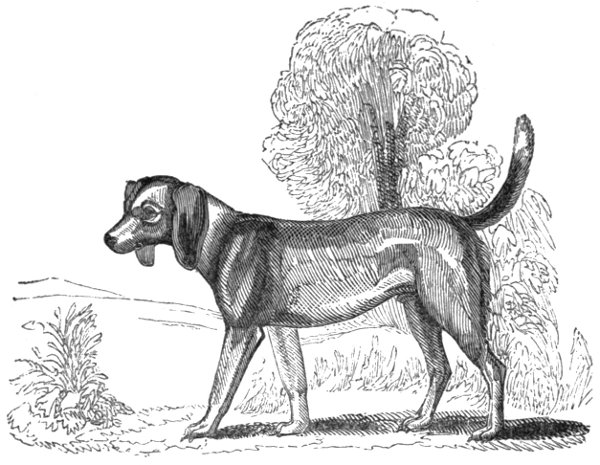
This is the smallest of the dogs of the chase which go under the general denomination of hound; meaning that kind which have the innate property of finding their game and pursuing it by what sportsmen call scent, which seems to be an impregnation of the atmosphere with certain effluvia issuing from the pores of the skin, and acting upon the olfactory membrane of the dog’s nose.
Although the beagle is far inferior in point of speed to the harrier, yet his sense of smelling a hare is equally exquisite, and he pursues her with indefatigable vigilance, energy, and perseverance. Every winding and all the mazes are traced by him with a degree of exactness which must be seen to be properly understood and justly estimated, while the soft and melodious tones of his voice afford ecstatic pleasure to the lovers of the chase, and is thus finely described by Somerville:—
“Hark! from yon covert, where those towering oaks
Above the humble copse aspiring rise,
What glorious triumphs burst in every gale
Upon our ravish’d ears! The hunters shout,
The clanging horns swell their sweet winding notes,
The pack wide opening load the trembling air
With various melody; from tree to tree
The propagated cry redoubling bounds,
And winged zephyrs waft the floating joy
Through all the regions near.
The puzzling pack unravel, wile by wile,
Maze within maze.”
Much emulation prevailed in former times among sportsmen in the breeding of beagles, and it was then the greatest merit to rear dogs of the smallest growth. Amongst amateurs of hunting, beagles were so carefully selected in point of size, that they seldom exceeded ten or eleven inches in height; and they were so well matched with respect to speed, that during the chase a good pack might be covered with a sheet. This is with all kinds of hounds a sure mark of excellence.
Although beagles are slow in speed, they are uncommonly eager; for, if the scent lies well, a hare has little chance of escape from them. Their slowness, however, is the principal reason of their being almost totally discontinued in packs, and that they are now seldom to be met with beyond a few couples, used in some of the southern counties of England to ensure finding more certainly in greyhound coursing.
Hunting with the beagle was admirably adapted for ladies and gentlemen up in years; and, besides, afforded much amusement to rustics, and other pedestrian hunters; for there were few male persons of any activity who could not keep up with them.
The late Colonel Hardy once had a pack of beagles amounting to ten or twelve couples, and so diminutive in size, that they were always carried to and from the sporting field in a large pair of panniers slung across a horse. This curious pack was lost to the colonel in a rather singular manner. It was kept in a barn which was one night broken open, when all the hounds and the panniers were stolen; and, notwithstanding the most diligent search, no trace of either could ever be discovered.—Brown.
Beak, s. The bill or horny mouth of a bird.
Bean, s. The common garden bean; the horse bean.
Beans contain but five hundred and seventy parts of nutritive matter, yet they add materially to the vigour of the horse. There are many horses that will not stand hard work without beans being mingled with their food, and these not horses whose tendency to purge it may be necessary to restrain by the astringency of the bean. There is no traveller who is not aware of the difference in the spirit and continuance of his horse if he allows or denies him beans on his journey. They afford not merely a temporary stimulus, but they may be daily used without losing their power, or producing exhaustion. Two pounds of beans may, with advantage, be mixed with the chaff of the agricultural horse, during the winter. In summer, the quantity may be lessened, or the beans altogether discontinued. Beans are generally given whole. This is very absurd; for the young horse, whose teeth are strong, seldom requires them; while the old horse, to whom they are in a manner necessary, is scarcely able to masticate them, swallows many of them whole which he is unable to break, and drops much corn from his mouth in the ineffectual attempt to break them. Beans should not be merely split, but crushed; they will even then give sufficient employment to the grinders of the animal. Some postmasters use chaff with beans instead of oats. With hardly-worked horses they may possibly be allowed; but in general cases, the beans, without oats, would be too binding and stimulating, and would produce costiveness, and probably megrims or staggers.—The Horse.
Bean Goose, s.
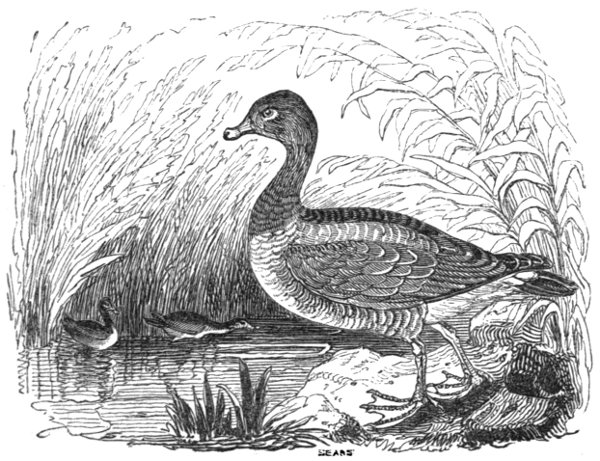
This species differs very little in its general appearance from the grey lag goose, the chief distinction between them being in the bill; which in this is small, much compressed near the end, whitish, and sometimes of a pale red in the middle, and black at the base and nail: the latter is shaped somewhat like a horse-bean, from which it has obtained the name of Bean Goose.
These birds arrive in the fen counties in the autumn, and take their departure in May. They are said to alight in the corn-fields, and to feed much upon the green wheat while they remain in England.
They are reported to breed in great numbers in the Isle of Lewis, and no doubt on others of the Hebrides, and also at Hudson’s Bay.—Bewick.
Bear, s. A rough savage animal.
Bearward, s. A keeper of bears. Obs.
Beard, s. The hair that grows on the lips and chin; sharp prickles growing upon the ears of corn; a barb of an arrow.
Beast, s. An animal distinguished from birds, insects, fishes, and man; an irrational animal, opposed to man. In forestry, there are five beasts which are properly beasts of forest, or venery; viz. the hart, hind, hare, boar, and wolf.
Beat, s. A stroke, or a striking. In sporting phraseology, it means the place or country a man passes over in pursuit of game.
Beat, v. To move in a pulsatory manner; to dash, as a flood or storm. To look for game.
Beater, s. An instrument with which any thing is beaten; a person attending a sportsman, as in pheasant or cock-shooting, to beat the covers and flush the birds.
Bee, s. The insect that makes honey.
Bee-Eater, s. (Merops apiaster, Linn.) A bird that feeds upon bees. Of this genus only one species is British.—Montagu.
Bee-Hive, s. The case or box in which bees are kept.
Bees-Wax, s. Much used in forming ointment.
Beech, s. A tree. Beechen, a. Consisting of the wood of the beech.
Beef, s. The flesh of black cattle prepared for food; an ox, bull, or cow.
Beer, s. Liquor made of malt and hops; a useful vehicle for tonics and cordials. When good it is an excellent restorative for a fatigued horse. Heated with spirits and ginger it relieves colic, gripes, &c.
Beet, s. The name of a plant.
Beetle, s. An insect distinguished by having hard cases, or sheaths, under which he folds his wings; a heavy mallet. Beetles flying about late in an evening often foretel a fine day on the morrow.—Foster.
Belladonna, s. Nightshade; a powerful narcotic.
Mr. Youatt considers this to have some prophylactic powers against rabies, but particularly when in union with the scutellaria, or skull-cap. He begins “with a drachm ball to a moderate-sized dog, containing two scruples of the scutellaria, and about two and a half grains of the belladonna, to be given night and morning: on the second week two balls are given; on the third, three; and this continued for six weeks.” The nightshade is also a general sedative.—The Horse.
Bellmetal, s. The metal of which bells are made.
Bellow, v. To make a noise as a bull; to make any loud and violent outcry.
Bellwether, s. A sheep which leads the flock with a bell hung on his neck.
Belly, s. That part of the body which reaches from the breast to the thighs, containing the bowels.
Belly-bound, a. Costive.
Belt, s. A girdle; a cincture.
Benzoin, s. Called also Gum Benjamin. It is a yellow resinous substance, and from it Flowers of Benjamin are extracted. It is used as an ingredient in Friar’s Balsam and Paregoric Elixir.
Bernacle, s. A bird like a goose, fabulously supposed to grow on trees.
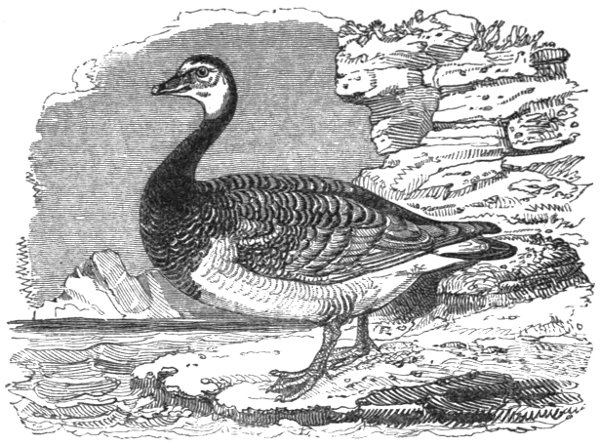
The Bernacle, (Anas Erythropus, Linn. La Bernacle, Buff.) weighs about five pounds, and measures more than two feet in length, and nearly four and a half in breadth. The bill, from the tip to the corners of the mouth, is scarcely an inch and a half long, black, and crossed with a pale reddish streak on each side; a narrow black line passes from the bill to the eyes, the irides of which are brown; the head is small, and, as far as the crown, together with the cheeks and throat, white; the rest of the head and neck, to the breast and shoulders, is black; the upper part of the plumage is prettily marbled or barred with blue, grey, black, and white; the feathers of the back are black, edged with white, and those of the wing coverts and scapulars, blue grey, bordered with black near the margins, and edged with white; the quills black, edged a little way from the tips with blue grey; the under parts and tail coverts white; the thighs are marked with dusky lines or spots, and are black near the knees; the tail is black, and five inches and a half long; the legs and feet dusky, very thick and short, and have a stumpy appearance.
In severe winters these birds are not uncommon in this kingdom, particularly on the northern and western parts, where, however, they remain only a short time, and depart early in the spring to their northern wilds, to breed and spend the summer.—Bewick.