Dōchū no koto oyobi tsuki-dashi no koto. (The procession of yūjo and the first appearance of “recruits” in the Yoshiwara.)
Reading edition
The procession, or promenade, of yūjo has been considered as, par excellence, the most splendid spectacle and important ceremony of the Yoshiwara. Once in the earlier years of Meiji, and once again in 1887, when the cherry-blossoms were in full bloom, this wonderful procession took place, but since then no attempt has been made to revive the time-honoured custom. Even on the two occasions referred to, the affair was not carried out in strict accordance with the ancient style, but in a far simpler fashion.
The best account of this procession of yūjo ever written is given in Mr. Henry Norman’s “The Real Japan,” and it is therefore quoted here.
“The most extraordinary spectacle of the Yoshiwara takes place for a few afternoons at five o’clock three times a year, when the flowers in the long street gardens are changed. First in spring comes the pink glory of the cherry-blossoms; then in summer the purple of the iris; then in autumn the hundred colours of the chrysanthemum, the national flower of Japan. When the new flowers are planted the yūjo pay them a state visit. From each of the principal houses half a dozen of the most beautiful are chosen and arrayed in gorgeous clothes, their hair dressed monumentally, combs three feet long stuck in from side to side, and then they are mounted upon black lacquered geta or pattens a foot high. When they are ready to start a score of servants accompany them; two or three precede them to put the crowd away; one holds the hand of each yūjo upon either side, and solemnly and very slowly, a step a minute, the wonderful procession moves round the garden. Other processions issue from the houses and meet and pass, and by and by the whole main street of the Yoshiwara is packed with an open-mouthed crowd, over whose heads the faces of the processionists can be seen here and there.
“The walking upon the tall heavy geta is itself an accomplishment and girls are specially trained to it. One foot is put out a little way and planted firmly, then the other geta is lifted by the toes tightly grasping the strap which passes between the first and second toes, and swung round in front of the other and across it. The first is then lifted and placed on the other side of the second—exactly in fact like a skater doing the outside edge. The Japanese call it hachimonji ni aruku—‘figure of eight walking.’ It is difficult to give in words an adequate notion of the extraordinary effect of this procession. The costly and gorgeous clothes of the yūjo, silks of marvellous richness, and brocades blazing with scarlet and gold; the exaggerated bow of her obi tied in front (the courtesan is compelled by law to distinguish herself in this way),40 the pyramidal coiffure, the face as white as snow, the eyelashes black, the lips vermillion and even the toe-nails stained pink; the men-servants respectfully holding the tips of her fingers on each side and giving as much heed to every step as an acolyte might give to an aged Pope, her several women servants walking solemnly behind: a footman pushing back the crowd and another removing every twig or dead leaf from her path; her slow and painful hachimonji; her stony gaze straight before her, half contemptuous and half timid; the dense and silent crowd; the religious aspect of the vicious ceremony,—all these go to make a spectacle apart from anything one has ever seen—an event outside all one’s standard of comparison—a reminiscence of phallic ceremonial—a persistence of Priapus.”
In the “Yoshiwara Taizen” (吉原大全 The Complete Book of the Yoshiwara) reference is made to the effect that
“The term dōchū (道中 a journey; travelling) meant the going out of a prostitute to an age-ya, or to promenade in the Naka-no-chō. It was used in the sense of travelling to a distant part of the country because, for instance, when a yūjo of Yedo-chō started out to go to Kyō-machi she was supposed to be going on a journey.
“It requires some considerable training to enable a yūjo to make a dōchū as it is a most difficult thing to lift the lower portion of her clothes in such a manner as to move with graceful dignity.
“Though there are no age-ya to be found at present, the custom is still preserved, and the appearance of yūjo in the Naka-no-chō is called the dōchū.”
In the days when there were age-ya in the Yoshiwara it was the custom for a tayū to go out to the age-ya to which she was called to meet her guest, and on these occasions she was escorted by her shinzō, yarite, kamuro, and wakaimono. With reference to this subject, the Dōbō Go-en (洞房語園) says that
“In the Moto Yoshiwara (prior to its removal to the present site), yūjo used to be carried to age-ya on the backs of servants when it rained. These men-servants (called roku-shaku), by placing their hands behind their backs made a seat, by means of their palms, on which the tayū sat—or rather knelt—carefully wrapping her underwear around her feet and leaving her outside dress hanging loosely down. The tayū’s hands were not employed in holding any part of her bearer’s body, but engaged in adjusting her garments, etc. From behind, a servant covered her with a long-handled oil-paper umbrella, and in this position the tayū is said to have looked very stylish.”
Since the removal of the old brothel quarter to the present Yoshiwara, it is said that tayū sometimes went out to age-ya riding in palanquins, as this was considered to be a convenient mode of transit.
In the “Dōbō Go-en I-hon Kō-i” (洞房語園異本考異) it is stated that
“Up to the era of Keichō the ladies of noble families were usually borne on the backs of men-servants in rainy weather, palanquins being but every seldom used. These ladies wore a kind of veil-like hood (katsugi) on their heads, and on the backs of the bearers were fastened wooden rests on which the women could sit. The custom of prostitutes being carried on the backs of men-servants appears to have arisen through a desire to ape the higher classes.”
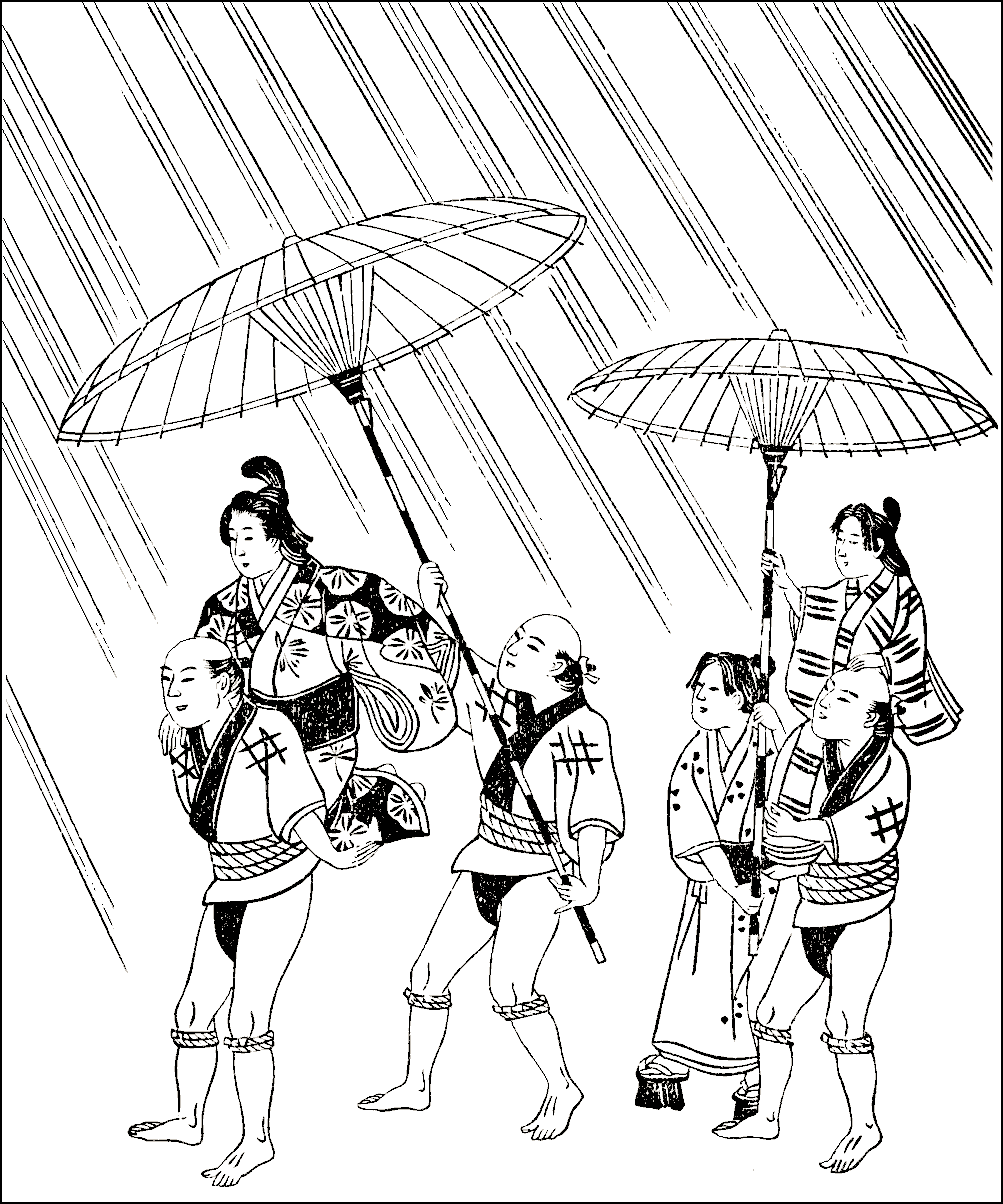
Courtesans being carried to
age-ya
—
vide
pages
192–193
.
“Since their removal to the Shin Yoshiwara, palanquins were often used, but later on were dispensed with, and yūjo preferred to walk to their destination even in rainy weather. * * * As stated above, better-class yūjo went out in palanquins when the weather was rainy, or the roads dirty, but shin-zō used to walk, wearing sandals called “tsume-kakushi” (nail hiders): these tsume-kakushi were more particularly in use in the Mi-ura-ya of Kyō-machi.”
The reason that the promenading of yūjo became one of the most splendid spectacles of the Yoshiwara in later days was because (though the women ceased to pass to and from the age-ya after the disappearance of the latter) they used to be in the habit of showing themselves gorgeously apparelled in the Naka-no-chō and holding an exhibition of themselves in the tea-houses there. The custom of the dōchū is therefore a relic of a prevailing fashion of those times.
As already stated, a yūjo who went out walking in rainy weather was covered by a long-handled umbrella held over her head from behind. This umbrella was usually employed by persons of gentle birth, but its use by yūjo was permitted on the supposition that the latter were Court ladies.41
To see the procession of a yūjo at night passing through the brilliantly lighted streets surrounded by her shinzō, kamuro, yarite and wakaimono, proceeded by a great lantern emblazoned with her crest, and followed by a crowd of tea-house and funa-yadō people each carrying a lighted chōchin, was a very imposing sight indeed, and one which probably was unique of its kind and without a parallel in any other country.
In ancient times all yūjo wore sandals, but later on a woman named Fuyō (in the employ of Hishiya Gonzaemon of Sumi-chō), who was an open-handed extravagant person and fond of ostentatious display, began to wear koma-geta (a kind of matted clog) even on fine days. The charming manner in which this woman minced along on her koma-geta, artfully disclosing the scarlet lining of her clothes as she walked, and the general grace of her demeanour, evoked universal admiration. Imitation, it is said, is the sincerest form of flattery, and the people must have been very much fascinated with Fuyō’s koma-geta, for they all began to gradually imitate this style of foot-gear, until it became the popular fashion of the Yoshiwara. On New Year’s day, and on other holidays, no koma-geta were used by the women belonging to the house of Matsubaya Hanzaemon of Yedo-chō, and it therefore seems that even at this period something of the simplicity of old-time customs was retained, and that the community had not as yet fallen into the luxurious habits of later days. The extravagance manifested in wearing apparel used in promenading appears to have reached its climax about the 11th year of Kwansei (1799), for it is mentioned in the “Kyaku Monogatari” (客物語 = written by Samba—a noted humourous writer), that the outer garment was of deep blue coloured satin, the skirt being embroidered with a pattern composed of lobsters: the underclothes were of green coloured mōru (a kind of thick cloth woven with raised figure’s) secured by a shigoki (loose girdle) of grey-coloured satin lined with red crêpe. The hair was done in the Hyōyo-musubi style and was ornamented with two combs and eight hair-pins, this having been the regular custom of the time.
In the Bunkwa (1804–1817) and Bunsen (1818–1829) eras the shikake (loose robes) worn when promenading were either black or green in colour and were, as a rule, richly embroidered in gold and silver thread and silk thread of various hues. The patterns most in vogue were unriū (dragons and clouds), hiriū (flying dragons), gan-ka no botan (peony flowers below a rocky cliff), mōshi kyō-hon (raging lion), etc.; and the general effect of these gorgeous embroideries, glittering with gold and blazing with all the colours of the rainbow worked in harmonious blendings, was indeed striking and unique. Under the shikake were worn three white rinzu (figured satin) kosode (one over the other) each bearing five large crests dyed upon them.
Their manner of walking was known as uchi-hachi-mon-ji, because each step was taken with the toes pointed inwards (uchi) like the Chinese character (monji) eight (hachi 八). There are but very few persons who now understand this Style of walking. Later on, the custom of wearing geta (clogs) was introduced by the yūjo Fuyō, (already mentioned) who was vainly fond of finery, as she initiated the practice of wearing three-legged geta, with straw sandals attached to them. There were certain fixed ceremonial dresses which were worn according to the season, and special costumes for the New Year’s holidays and the 1st day of the 8th month. It is stated in the Kita-zato Bun-ken-roku (北里聞見錄) that on the 3rd day of the 1st month of the 11th year of Bunkwa (February, 1814) among the yūjo who were out walking in their brand new geta and magnificent gala dresses, astonishing the spectators with the dazzling splendour of their gay apparel, was a woman named Ariwara (belonging to the house of Tsuru-ya Ichisaburō of Kyō-machi It-chōme) who became the centre of attraction owing to the novelty of her costume. She wore robes made in imitation of those worn by certain military officers of the Imperial Court (Ō-uchi bu-kan). From the waist upwards the material was of a pale blue tint and on it were embroidered three corded lines in silver thread. On the left shoulder was embroidered a bundle of kiri-fu no ya (arrows winged with the spotted feathers of a falcon) worked in gold, silver, and coloured threads. This upper garment represented the naoshi (a kind of robe worn by nobles). The lower portion was dyed a deep purple and embroidered with yatsu-busa no fuji (eight-petalled wistaria flowers) in silver: this apparently was intended for sashi-nuki (a kind of silk trousers worn by warriors.)
Her obi (girdle) was of crimson worked with elaborate embroideries in gold, silver, and coloured threads. Her hair was done in the karawa (osa-fune) style. The whole “get up” was that of a Court warrior, and it is said that the idea of dressing herself in this manner occurred to Ariwara owing to her family name being similar to that of the noted warrior and poet of ancient day—Ariwara Narihira Ason. This instance of the extravagant nature of a yūjo’s dress in those days is merely given to illustrate the quaint costumes adopted, and the lavish manner in which the women spent their money in their endeavours to show themselves off in novel and costly habiliments. It is curious that notwithstanding the magnificence of their costume the yūjo ceased to wear tabi (socks) in the Kwansei (1789–1800) and Bunkwa (1804–1817) eras, although they had worn them prior to the Tenna era (1681–1683). In ancient times the tabi were of leather, stained purple.
When an ane-jōro (elder-sister-harlot) initiated her imōto-jōro (younger-sister-harlot), and allowed her to appear in the misé for the first time, the act of thus furthering the interests of the younger woman was called tsuki-dashi (to push out and forward). It was the bounden duty of an ane-jōro to arrange everything connected with this tsuki-kashi ceremony at the request of the brothel-keeper, and this act of duty was known as “o yaku.”
The tsuki-dashi proper lasted for a week, and during that time the debutante, accompanied by her ane-jōro, used to promenade the streets of the Yoshiwara by way of introduction, in the same manner as if she were performing a regular dōchū. Every day, both the debutante and the ane-jōro appeared in different costumes. The hair of the ane-jōro was done either in the Hyōgo, osa-fune, sage-gami, or shimada styles, but the coiffure of the debutante was invariably made in the shimada style. [Since the advent of the Meiji era this custom has disappeared, but according to the narrative of a person who once saw such a ceremony, the debutante wore yellow clothes, and the clothes of her retinue of yarite, kamuro, and wakaimono, were all of a similar hue].
During the week of introduction, the new-comer was engaged by her fellow yūjo in turn, and to the latter presents were made by way of reciprocity.
The expenditure involved in connection with the appearance of a new yūjo was roughly estimated at from 300 to 500 ryō. Then there were expenses connected with the tsumi-yagu (bedding), usually ordered from “Dai-maru” and “Echigo-ya.” Of course in all these matters there were wheels “within wheels,” and, although the tsuki-dashi expenses were nominally defrayed by the ane-jōro, as a matter of fact the latter tapped the pockets of her guests to meet the bill. Generally an ane-jōro would have a number of admirers who could well afford to be generous, such as officials of the Government treasure godowns, wealthy saké merchants of Shinkawa, etc., and on these occasions the astute lady would not fail to wheedle out of them all the cash she wanted. The classes of yūjo who anciently participated in promenading were the Chūsan and Yobi-dashi, and though the system of going to age-ya when called by guests no longer existed, the women continued to walk in the Naka-no-chō after dusk for the purpose of showing themselves to the spectators and as a means of attracting guests. The procession was proceeded by a couple of firemen (tobi-no-mono) carrying a kanabō (an iron staff fitted with rings), which they struck on the ground as they walked, producing a sharp metallic jingle and thus warning the crowds of the approach of the oiran.
With them walked a wakaimono (man-servant), lighting the way with a big lantern (dai-hari) on which was emblazoned the crest of the yūjo. The yūjo herself walked slowly along escorted by two furi-shin (furi-sode shinzō), two kamuro, one ban-shin (ban-tō-shinzō) and six wakaimono. They never returned the same way they went out: it was a rule that when a procession walked on the right side of the street on its way out, it should return on the left side. While the procession moved, the proprietors of tea-houses came out to the front of their establishments, saluted the passing beauty, and urged her to sit down and rest there; but she would merely smile graciously and walk on, placidly smoking her handsome pipe the while. Yūjo were formerly well-trained in their special manner of walking in procession, and though they wore very high clogs, accidents but rarely happened. To stumble was considered a sad disgrace, and if a yūjo accidentally tripped up in front of a tea-house custom demanded that she should enter the establishment and entertain all the inmates at her expense. The sight of a lovely and bewitching yūjo clad in rich silk brocades glittering with gold and polychromatic tints; of her wonderful pyramidal coiffure ornamented with numerous tortoise-shell and coral hair-pins so closely thrust together as to suggest a halo of light encircling her head; and her stately graceful movements as she swept slowly and majestically through the Naka-no-chō, must indeed have appeared magnificent and awe-inspiring to the uninitiated. Indeed we are told by ancient writers that the spectacle fairly entranced the country-folk and “robbed them of their very souls”, and from such remarks we may gather that these processions of yūjo were by no means conducive to the elevation of the moral tone of the crowds of persons who flocked to see the Yoshiwara with gaping mouths and upturned eyes.