Tōrō no koto. (Lanterns.)
Reading edition
At present, in the month of August every year, a large lantern, on which is a painting from the brush of some well-known artist, is exhibited in the centre of the Yoshiwara at Naka-no-chō for the purpose of attracting people. Besides this show-piece, revolving and other lanterns of various shapes and designs are hung in front of the tea-houses and lit up nightly. Under these circumstances many persons—not excepting women—flock into the Yoshiwara to witness the brilliant spectacle, and many a prodigal is induced to squander money there by reason of the lanterns which apparently only serve to dazzle his eyes and obscure his reason instead of enlightening him and guiding his footsteps. The general style of lantern is vertically long but narrow in breadth, it being made of silk stretched on black-lacquered frames. It is supported by a pair of cedar poles covered with an ichimatsu shōji by way of a roof. Each house is provided with a pair of these lanterns, one facing the street and the other the interior of the building, so that one can be seen from either side: this arrangement has nullified the old saying “tōrō wa ura kara miro, niwaka wa mae kara miro” “(look at the lanterns from behind and the niwaka dance from the front”). One writer observes that as late as the 20th year of Meiji (1887) the lanterns placed in front of tea-houses faced the streets, and were therefore only seen to advantage by pedestrians, while actual guests who went up into the second story of a tea-house had to content themselves with looking at the rear of these lanterns. The present day fashion would seem to be of very modern origin indeed. After the 10th year of Meiji (1877) the tea-houses in the Naka-no-chō hit upon the novel idea of putting up white cloths at the entrance and making displays by means of magic-lanterns, but as this made the Yoshiwara practically a dark world it occasioned great inconvenience to the guests. From time to time the tea-house-keepers have shown themselves very ingenious in getting up new schemes to attract visitors, and on one occasion they displayed an artificial moon on a screen so contrived as to show the movement of clouds flitting across its face: all these displays are reckoned as making up one of the notable events which take place in the Yoshiwara yearly.
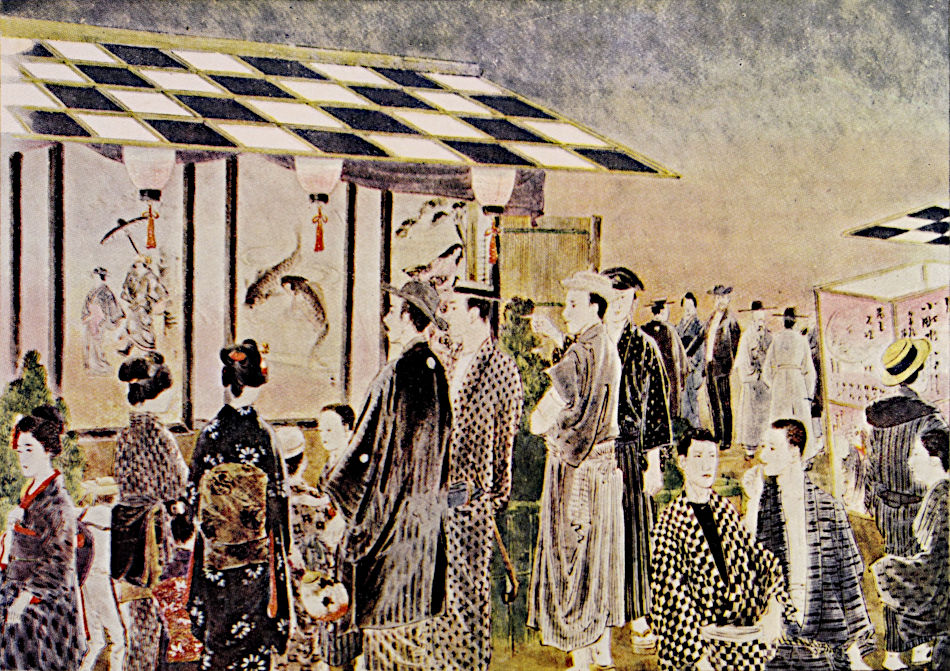
Illuminated lanterns in the
Naka-no-chō
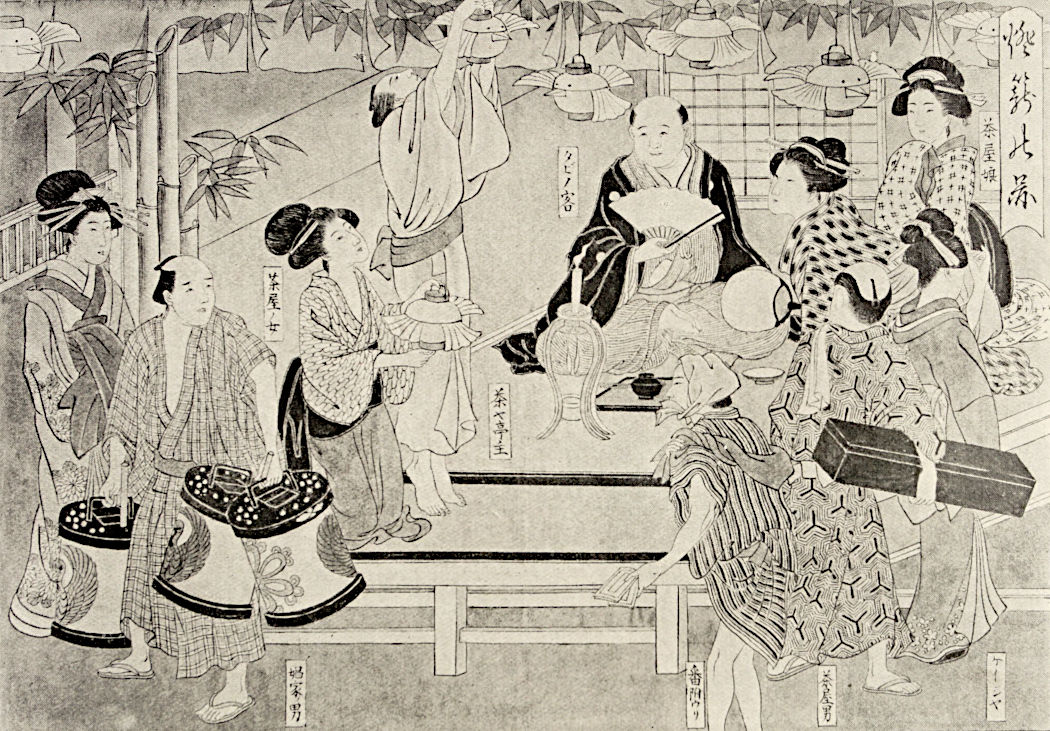
Illuminating Tea-houses with Lanterns in the Kiōwa period (1801 to 1803).
(
After the Picture by Kitagawa Utamaro.
)
According to the old custom, every year, from the last day of the sixth month to the last day of the seventh month, bon-dōrō (lanterns erected at the festival of the dead) were shown by all the tea-houses in the Naka-no-chō, but they were not exhibited in front of the small brothels in side streets as at present. The exhibition was suspended on the 13th and 14th days, and after the 15th day new lanterns called ni no kaeri-dōrō were substituted. The lighting of lanterns in the 7th month of the year, during the festival of the dead, was a universal custom in Japan from olden times, and therefore lanterns of various shapes and sizes were used in the Yoshiwara also. The “Yoshiwara Taizen” (吉原大全) says that one summer a popular yūjo named Tamagiku was taken suddenly ill, and that after lingering for a little while she passed away at the beginning of the 7th month.
In order to console her spirit, and as a sacrifice to the manes of the dead, the tea-houses who had been friendly with her hung up before their doors lanterns which were called “kiriko-dōrō” (a lantern of a cubical form with its corners squared). This illumination attracted considerable attention and drew many guests, so “business” flourished exceedingly that season, and accordingly in the following year (1716) the practice was followed by all the tea-houses. About that time an expert in fancy hand-work, named Ha-ryū, made a prettily contrived fantastic lantern which he gave to a certain tea-house, and this drew a large number of interested and admiring spectators. In this connection a story is told to the effect that on the 4th day of the 7th month of the 1st year of Gembun (10th August, 1736) a teacher of the samisen, named Kayei, who lived in Ageya-chō, held a service in his house in memory of Tamagiku and at the same time a new tune named midzu-chōshi (水調子) was played. In the room were hung a number of lanterns bearing the kaimyō (posthumous name) of Tamagiku, and every guest was presented with one on his return home. As it was considered as unlucky to have lanterns inside the houses bearing the Buddhistic name of a dead person they were hung up outside the tea-houses. [It is said that on the lower part of these lanterns lines of a green colour were traced.] A request to be allowed to exhibit these lanterns was preferred by the tea-houses to the monthly managers of the Yoshiwara, but as the latter refused their consent the tea-house keepers carried out the idea without obtaining permission. Dōjo of Yedo-chō, and Tamaya Dōkaku, who were then monthly managers, were greatly enraged at the independent action of the tea-house-keepers, and struck down the lanterns of Sumiyoshi-ya and three or four other establishments. The matter was however settled up quite amicably by the tea-house-keepers apologizing, and the authorities granting permission, so after the next year the lantern show commenced and has been continued down to this very day, though the religious aspect of the observance has been completely lost sight of. In former days it seems that besides the lantern show, acting by boys, circus-feats, juggling, etc., took place, but they ceased later. In some years the lanterns displayed have been very fine artistic creations, bearing pictures painted by well-known painters; and anyone who saw the Yoshiwara between the middle of July and the middle of August 1886 will never forget the historical drawings of Hōnen and Eitaku then exhibited on the lanterns.
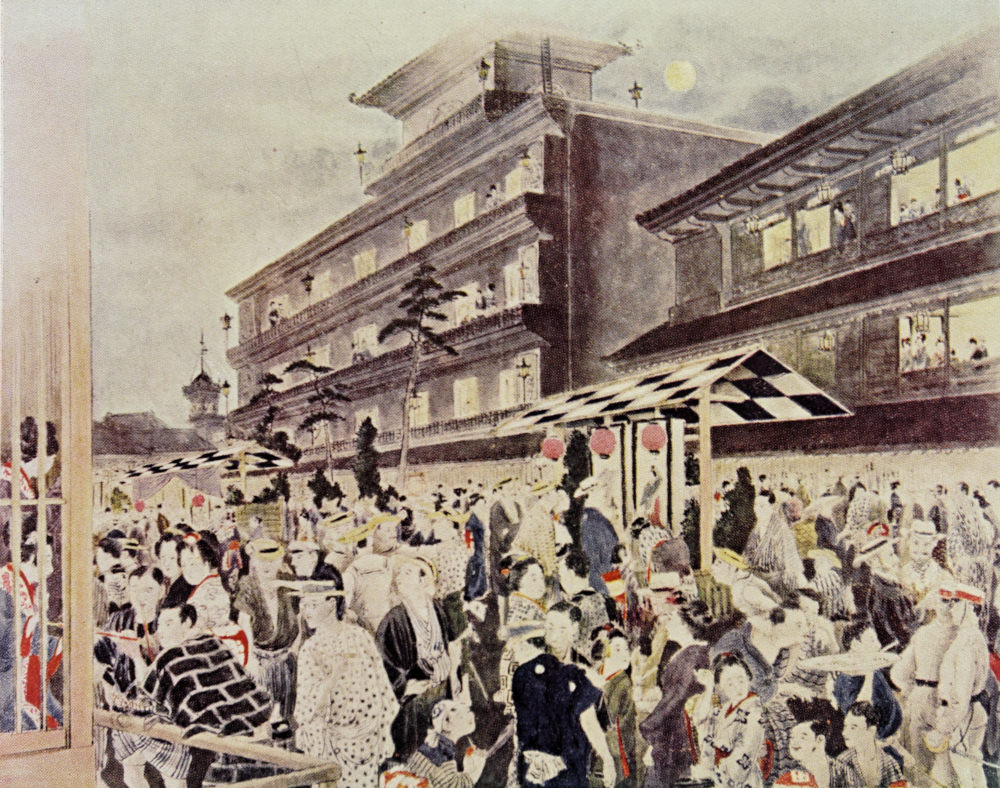
Night scene in the Yoshiwara during the “
Feast of Lanterns
”