San-gyō chōmen no tsuke-kata. (The system of book-keeping employed by brothels, tea-houses, and courtesans.)
Reading edition
In former days there were no fixed rules as to the system of making entries in books kept by brothels and tea-houses, and, in consequence, considerable inconvenience was experienced by the authorities when they found it necessary to examine the accounts. In February, 1884, the “Controller of the Three Professions” fixed a uniform system of entries to be made in the account-books of brothels and tea-houses, instructing the proprietors of such establishment to adhere to the same in future. The system thus inaugurated in 1884 is still in force, and the following is a description of the ledgers, etc., used.
On the cover of a brothel ledger—right in the very centre—are written the words “Kashizashiki Motochō,” on the right “Meiji nan nen nan gatsu nan nichi yori, nan nen nan gatsu nan nichi made” (From the _______ day of _______, to the _______ day of _______, 189__); and on the left the name of the house and its proprietor. The book is to consist of upwards of 200 sheets of Nishi-no-uchi or Ōban-shi (paper), and the following particulars are to be printed in it:—
1.— Name of the brothel.
2.— That the book is to be preserved for at least four years.
3.— That taxes are to be paid daily in accordance with the regulations.
4.— That in this book are to be entered in detail the names of every guest, names of the shōgi engaged, names of geisha called, names of the hikite-jaya concerned, the fees of shōgi and geisha, amounts spend by guests, advances made, etc. [These items may be expressed by signs (in cypher) but their total must be written in ordinary characters.]
5.— That in the first page of this book the signs (cyphers) to be used in a brothel in describing various items shall be shown, and that in case of alteration of such cyphers due notice shall be given to the manager’s office.
6.— That besides this ledger the use of two memorandum books (one for the proprieter of the house and one for the shōgi herself) shall be allowed, but that such memorandum books shall be stamped with the stamp of the manager and be kept at least for one year.
7.— That the payment of taxes shall be made in accordance with this ledger, and that daily accounts shall be made up in the following form. (The monthly accounts shall be made up in the same manner.)
(See over.)
(ACCOUNT FORM.)
Number of guests
Number of women engaged
Total gross receiptsYen.
ITEMIZED ACCOUNT. Yen. Sen.
Shōgi age-dai (Courtesan’s fees)
Sekiryō nan ko (Hire of rooms)
Shu-kō-han ko-mono-dai (Saké, food and sundries)
Geigi age-dai (Geisha-fees)
Shūgi sono hoka tate-kae (Gratuities and advances)
Total receipts of the brothel
Taxes due thereon
Total receipts of the courtesans
Taxes due thereon
Total taxes due
The foregoing rules are issued by the Metropolitan Police Board and are to be strictly complied with.
(Date) ______
Controller of the Shin-Yoshiwara.
(The number of pages in this book are ______)
The signs used in this book are as follows:—
◯ Fee of courtesan ____ sen
⬤ Ditto.
☐ Ditto.
▉ Ditto.
△ Geisha’s fee ____ sen.
Food.

▯ Ditto.
Saké, 1 bottle ____ sen.

Saké, 2 bottles ____ sen.

EXAMPLE OF THE USE OF ABOVE CYPHER.
Date _________________
Name of hikite-jaya.
◯ Name of guest.
“ “ courtesan.
◯ “ “ guest.
“ “ courtesan.
◯ “ “ guest.
“ “ courtesan.
. Total _________________

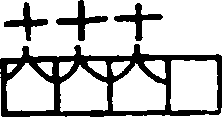
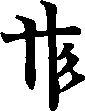
The above example shows that a party of three guests engaged three shōgi and one geisha, the latter having been employed during the burning of four joss-sticks (senkō). It also shows that they were supposed to have ordered three sets of ō-dai (large dishes) and one set of nami-dai (small-dishes) and consumed four bottles of saké. It is superfluous to give an example of the system of book-keeping employed in hikite-jaya because it is practically the same.
There is another small book (te-bikae) kept by each shōgi which is commonly known as the “gyoku-chō” and in which the number of her engagements is noted. As to the mode of entering up this gyoku-chō, there appears to be no fixed rule, but according to the regulations each shōgi must make up an account of her earnings every ten days and get the entry certified by the stamp of the brothel-keeper. This book must be kept as long as she remains in the business.
Mr. Norman, in his “The Real Japan,” observes with regard to the book-keeping methods of the Yoshiwara:—“It goes without saying that no Solomon could devise theoretical safeguards which would practically protect a girl under such circumstances from unscrupulous greed. For instance, every person in Japan has a private seal corresponding to a signature with us, with which all documents, even down to private letters, are attested, and to counterfeit or reproduce such a seal is forgery. Now the keeper of every kashi-zashihi is compelled by law to keep a big ledger in which all money transactions between himself and the shōgi are entered, and the shōgi is compelled to keep a similar smaller book in which the keeper makes identical entries, each of which must be attested by her private seal. This book is regularly inspected by the police with a view to prevent extortion, and it is expressly forbidden by law for the keeper to take away the girl’s seal. On one occasion I visited the largest and best kashi-zashiki in the Yoshiwara in company with my official interpreter. The keeper was a sharp-looking woman of fifty, who had 45 shōgi in her house, which she had just built at a cost of 45,000 dollars. We were taking tea ceremoniously in her private apartments, and after a while I inquired if I might put a special question to her. “Certainly,” she replied. “Any question?” “Certainly.” “Then,” I said to the old lady through my official interpreter, “will you be so kind as to show me some of the seals belonging to your ladies, that you have at this moment in your possession.” She winced visibly and turned several colours, but after a minute got up without a word, trotted off and returned immediately with the private seal of a certain Miss Man, and I took an impression of it in my note-book, to her evident great alarm. This meant, of course, that she was in the habit of entering the accounts in all the books, attesting them herself with the seals of all her yūjo, and thus the police would be shown an immaculate record, while the shōgi themselves would never even see the books, or know with how much they were debited and credited from week to week.”
By the way, a hypothetical specimen of the entries made in a book kept by courtesans is given in the “Share-bon” (洒落本) written by Jippensha Ikku—the ancient Mark Twain of Japan.
HOW A VISITOR’S BOOK SHOULD BE KEPT.
1st • (first) Dearly beloved one. Oh! how I love you! come—do come! Hamanoya.
2nd ◦• Vexing and horribly irritating. Kichisama.
3rd • As he does not know my real mind it is very irritating. Ryūsama.
4th • (second) Oh! you sickeningly ugly brute! Your face is like that of Heisaku the Octapus! Sumiya.
5th • (first) The fellow looks just like Hachibei of Tamachi. (i.e. “an ass.”) Iseya
6th ◦• (first) I love you! Come quickly! Sumiya.
7th • (first) Yes you are handsome: if you want to come then come. Minatoya.
8th ◦• Ah! what joy and gladness! Minatoya (and) Yasu Sama.