Naka-no-chō no Hana-ue. (Flower-planting in the Naka-no-chō.)
Reading edition
Every year, on and after the 3rd day of the 3rd month (old style), notice of the opening of the flower season (hana-biraki no fuda) is posted at the ō-mon (great gateway), and in the middle of Naka-no-chō fences of green bamboo are constructed within which are planted blooming cherry-trees. The commingling cherry-blossoms, blending together into one dense mass of soft fleecy rolling cloud which braids the trees with visible poetry and transforms the avenue into a veritable fairy bower of pink and white florescence, the dazzling glory of the electric lights, and the flashing brilliance of thousands of crested lanterns, makes up a sight which baffles description and must be seen to be appreciated. The garish splendour and blazing radiance of the Yoshiwara at this time is such as to have earned for it the appropriate name of Fuyajō (不夜城 = “Nightless castle”).54 Besides the actual flowers, artificial is added to natural beauty, and curtains with a cherry pattern dyed upon them are hung up in the second story of the tea-houses. There they gently wave in the soft spring zephyr, beckoning the passer-by alluringly and enticing him to exploit the secrets of dreamland which they veil so cunningly and suggestively. Of late years plum-trees are planted in the second month, iris in the 5th month, and chrysanthemums in the 9th month (old calendar), and on one occasion the figures of well-known actors made of chrysanthemum flowers—the work of the noted Yasumoto Kamehachi—were also shown. But of all the flowers planted none can equal those of Naka-no-chō “Yo-zakura” (“night-cherries”) which have become famous throughout the length and breadth of Japan, and whose praises have been sung in song and told in story generation after generation by enthusiastic poets and writers during more than fifteen decades.55 The origin of flower-planting was that in the second year of Kwampō (1742) cherry-flowers in pots were exhibited in front of the tea-houses, and this having been noised about the city of Yedo, multitudes of persons visited the Yoshiwara nightly in consequence. The Yoshiwara people were not slow at taking the hint, and the following year several hundred cherry-trees were planted at Naka-no-chō.
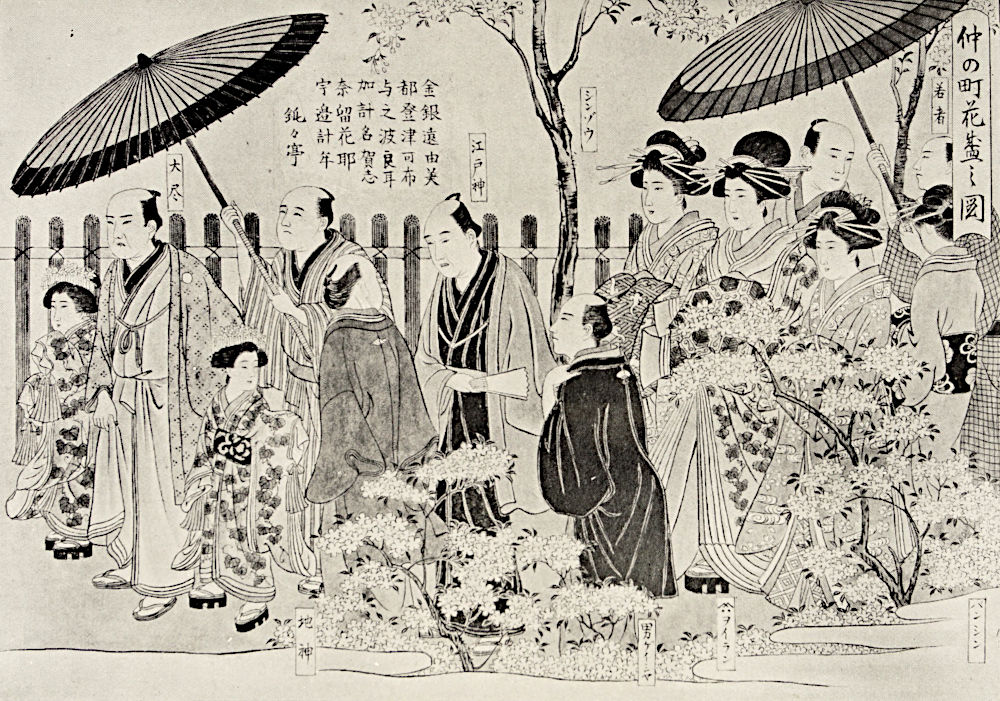
仲の町花盛之圖
Courtesans and Guests viewing the Cherry-blossoms in the Naka-no-chō. Period of Kiōwa (1801 to 1803).
(
After the Picture by Kitagawa Utamaro.
)
Later, in the 2nd year of En-kyō (1745), cherry-trees were planted between the ōmon and Suido-jiri, bamboo fences being built around and bright lanterns being lit under them to enhance the effect. This departure attracted a large number of persons to the quarter.
In those times the expense of the enterprise was fixed at 150 ryō every year, 40 per cent being paid by the Kembansho, 40 per cent by the miscellaneous traders in the Yoshiwara, and 20 per cent by the tea-houses. The subscriptions were made in the shape of daily or monthly deposits by those interested, and it appears that this practice is still in vogue.
In front of the tea-houses on either side of the street curtains dyed with fantastic designs were hung, and in the front rooms red carpets were placed, these practices being observed even at the present day.
In ancient times, kamuro and shinzō were allowed to visit Ueno, Asuka-yama, Mukōjima, and other places to view the cherry-blossoms during this month; and another holiday was taken by the inmates of brothels, including yūjo, wakaimono, etc., who spent a day in giving saké parties and viewing the blossoms in the Naka-no-chō. One year the following song was composed by Ki-no-kuni-ya Bunzaemon and Kikaku conjointly:—“Like silvery haze the cherry-blossoms reflect the setting sun; they are like a mountain strewn with golden flowers.”
The prosperity of the Yoshiwara was at its zenith at this period, and the quarter was counted as one of the places in Yedo which was “worth a thousand ryō per day.”