“Niwaka” Dancing.
Reading edition
The performance of “Niwaka” dancing is considered to be one of the most interesting features in the life of the Yoshiwara. It consists of a kind of dramatic representation given by the professional buffoons (hōkan) and singing girls (geisha) of the quarter, and it takes place about August or September each year. When this comic dance takes place the performers visit all the tea-houses giving an exhibition of their buffoonery, and it is said that this entertainment is given in return for the patronage all the members of the troupe usually receive from chaya (tea-houses) and kashi-zashiki (brothels). During the continuance of the “Niwaka” dancing wooden railings are put up on both sides of the Naka-no-chō for the purpose of demarkation, and in front of the tea-houses lanterns shaped like asagao (“morning glory”), bearing the respective house names, are hung up and lit. On either side of the Ō-mon are placed a pair of very large lanterns (takahari-chōchin) on which are written the letters 全盛遊 (Zensei-asobi = Magnificent Entertainment). To carry out this dance involves considerable trouble and much preparation, and the very first step which has to be taken is to obtain the permission of the police authorities. After official sanction has been granted preparations are commenced, and the hōkan and geisha all repair to the manager’s office where they draw lots as to whether they shall take part in the first fifteen days’ performances or the second fifteen days’ dances.
Those older geisha who undertake the “lion” dancing and “kiyari” songs draw special lots for that purpose, but unless a geisha is a masculine looking woman she will not be admitted into this company, and admittance is earnestly desired by many of the professional singers who compete strenuously for the honour. The performance of “lion” dancing and “kiyari” singing is limited to the first half month, and the geisha who are picked out for this coveted company are experts in their line: those who are new to the quarter give way to their predecessors in order of precedence. When their order has been fixed, by means of lots, a dozen women are formed into a troupe, and for ten days the “hiyari” is practiced from morning till evening. For many years a man named “Kichi” (who was also known in the Yoshiwara by the nick-name of Chigeinei no Kichi San) acted as a teacher of the “Kiyari” songs, but at present one of his pupils, named Chō is undertaking the task of tuition. The mode of training is for the first half dozen geisha to start a song and the remaining half dozen to follow them under the direction of the teacher.
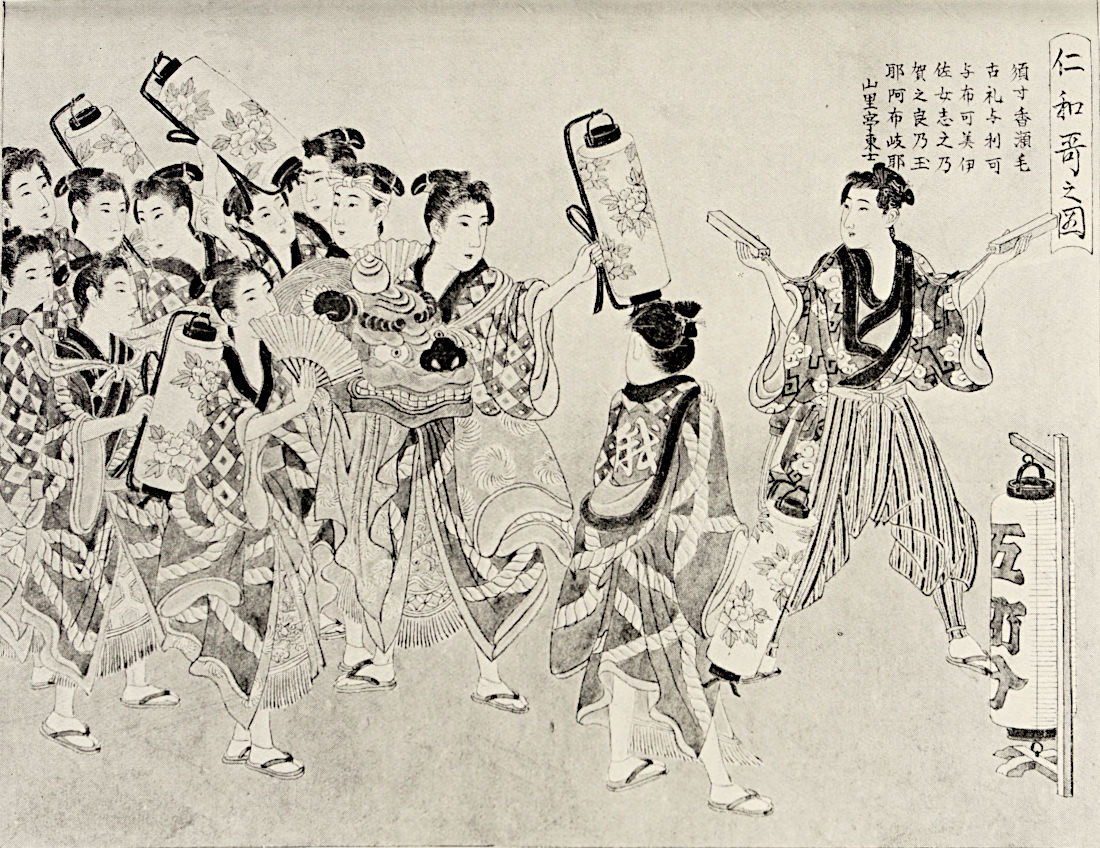
仁和哥之圖
The “
Niwaka-odori
” (Dance) in the Kiōwa period (1801 to 1803).
(
After the Picture by Kitagawa Utamaro.
)
The dancers of dramatic representations also place themselves under a teacher and train continuously for ten days. It is agreed between the performers that during the training period they will not respond to the invitation of any guest, and no one has ever been found to infringe this rule. It is also a custom—if we may be allowed to mention a mere gastronomic detail—for the performers to eat unagi no domburi-meshi (boiled rice and pieces of roasted eels served up in a deep bowl) at tiffin every day during of the period of rehearsal.
The dramatic representations played by the company include several new pieces, and the training of the dancers is confided to Hanayanagi Jūsuke. This man was born and brought up in the Yoshiwara, and so the duty of directing the dances is entrusted to him. It appears that new pieces are specially written by playwrights at the request of Jūsuke, and that all such productions are of a comic nature, because the hōkan generally aim at exciting the hearty laughter of spectators by means of droll extravaganzas. When the training is finished a grand dress-rehearsal is given in one of the tea-houses, and on this occasion the proper costumes are worn. This dress-rehearsal is known as nari-mono-iri (鳴物入り). Then what is known as kwai-sho-iri (會所入り) takes place in the kensa-jō (檢查塲 = inspecting office), each person entering the room in the order determined by drawing lots. The singers and musicians who participate in the meeting are all professionals. The shishi-ren (獅子連 = “lion” party) goes into the office first, as it is considered the most important part of the company. At this stage the police make an examination of the persons in the building, as nobody is allowed to enter it unless possessed of a special ticket.
On the first day of the “niwaka” dancing the kwaisho (office) sends out people with a drum (shitaku-daiko), which is beaten as they perambulate the Naka-no-chō, to announce the performance. If the weather be rainy, or the roads muddy and slushy, no performance takes place; when this is decided no drum is beaten and no lantern is hung before the Ō-mon (great gateway). The “lion” party (shishi-ren) and the niwaka no ya-tai (a kind of car, fixed up as a stage, on which the “niwaka” dance is performed) are started out from a certain fixed point at 7 o’clock in the evening, and go up and down the Naka-no-chō every night: if the car and the party go up the left side of the street this evening they will come down the opposite side to-morrow evening, and the show ends at 11 o’clock each night, when its members are recalled to the office. A “niwaka” stage-car consists of a wheeled stage about 18 feet square and proportionately high, and it is so made as to be separated into two sections, each of which is fitted with its own wheels. The stage is fitted up like a regular theatre, provided with scenery painted on silk and paper, and lighted by means of lanterns.
This stage-car is brought to a standstill just between two tea-houses in order that the performance may be equally well seen by both from their upper floors: the idea of placing the stage in such a position was originated by dancing-master Hanayanagi, whose great experience taught him that this scheme was the best for everybody concerned. Next come the geisha who play the samisen, riding in a car fitted with benches made to accommodate them.
To the left and right of the benches uprights are placed and covered with lattice-work shōji, curtains of white and red colours are stretched across the top, and the whole car is lighted by means of three lanterns.
Then follows a soko-nuke ya-tai (a bottomless car), which is a kind of square paper-box, without cover or bottom, in front of which is hung a yoko-naga no andō (a horizontal lantern) on which is written the names of players, singers, dancers, and the name of the owner of the car. Inside this car are placed the hayashi-kata (orchestra). The coolies who drag these cars from place to place are usually hired (through a contractor) in the vicinity of Matsuba-chō, Asakusa district, and are paid daily by the owner of the cars. The costumes of the geisha who play the samisen are of grey crêpe (dyed with their crests) trimmed at the bottom of the skirt with scarlet crêpe, white collars, black satin obi, and white socks. Their coiffure is in the Shimada style, and it is kept in place by a hair-pin decorated with the design of susuki grass.
The older geisha attire themselves even more strikingly than the younger girls, and make use of loud colours—such as blue and scarlet—in their costumes, thus attracting considerable attention by the incongruity displayed. The male players and singers wear blue cotton clothes dyed with their respective crests. The geisha who take part in the “kiyari” dress their hair after the manner of the top-knot style of men, intentionally spreading out their forelocks, and the whole get-up is like that of a teko-mai dancer. They wear three or even five jiban (loose shirts) a hara-gake (a cloth shield for the abdomen) and an upper garment called a Yoshiwara-gaku. The right arm and shoulder is thrust out of the jiban, on which latter an elaborate design is usually dyed.
The girls all compete among each other in the matter of dress, and the result is that some exquisite patterns are adopted. They wear fine leggings, blue cotton tabi (socks) and straw sandals, while across their breasts, depending from the right shoulder, dangle silver chains to which are attached little kake-mamori (hanging charms): in their hands they hold fans (with black lacquered frames) on which are painted peony flowers, and besides these they carry teppō-chōchin (cylindrical lanterns) on which some of the girls boldly and unblushingly inscribe the names of their paramours. This custom was started in 1894 and led to a good deal of amusement, as their friends solemnly imposed upon both the girls and their sweethearts a mock fine of ten sen as a punishment for publicly advertising such love affairs! Thus equipped, they sing the kiyari to the sound of the drum as they move on. A drummer, a wooden-block striker, a drum-carrier, and another person who carries the “lion’s head” mask, accompany the party. When one kiyari song is finished the leader lifts his fan as a signal for the hyōshigi to be struck, and the company moves on to the next house after shouting a farewell “o yaka-mashū” (“we’ve troubled you greatly”). The beginning and finish of the female, as well as the male niwaka, is announced by the striking of hyōshigi. In former times what was called the “amefuri niwaka” (niwaka after rain) was in vogue. After the rain had cleared, men went about the tea-houses performing impromptu farces which often elicited applause by the ready wit displayed, but this practice has now ceased. About 10 o’clock an announcement is made by the kwaisho people that a recess will be taken, and forthwith all the members of the company stop to drink tea which is provided by the house in front of which they may happen to be: on this occasion they also eat such food as may have been sent as presents by intimate friends among the yūjo or their guests. During the period of these performances the company is open to engagement only in the day-time, and after 11 o’clock at night, as at the latter hour the public entertainment is finished. When the company receives a notice of engagement from a tea-house, the paper on which such notice is written is fastened on to the hair-pin of the leading geisha after being numbered, and after 11 o’clock the whole troupe go around to the tea-houses by whom they were invited in the order of the arrival of such notices. Needless to say, the company is elated in proportion to the number of these notice-papers. In ancient days the entertainments were often kept up through the night owing to the large number of engagements made.
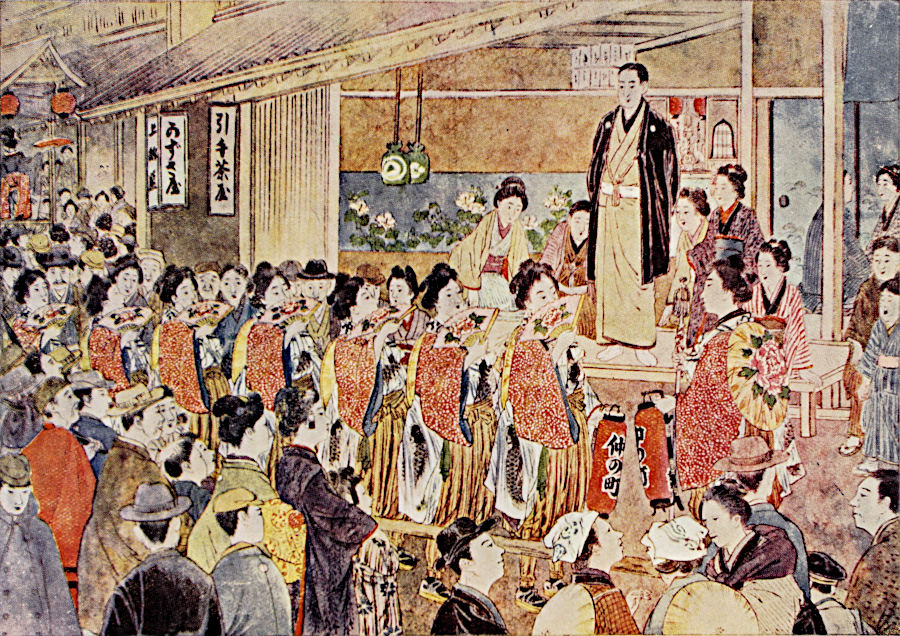
Niwaka-odori
procession passing by a tea-house.
On the first night of the niwaka the company’s engagements are generally arranged in advance, for the reason that it is considered a disgrace to have no such appointments on the opening day. When the company obtains tips and gratuities from guests in tea-houses, etc., all such monies are divided among the persons taking part in the entertainment, not forgetting even the coolies. The engagement fees of the niwaka company are charged at the rate of 12-1⁄2 sen per geisha per joss-stick (ip-pon) for each guest, and a tip of 20 sen each is also expected. Of course these rates are for first-class geisha only, and the fees of other inferior artistes are proportionately lower.
Strictly speaking, the company should go through its performances for the benefit of each contributing guest separately, but as a matter of fact the more convenient method of performing before several guests collectively is adopted. The niwaka entails considerable expense on the geisha taking part, and the means of defraying it are too often raised by yielding to the immoral desires of guests who are positively repulsive to them in every respect.
During the performance of the niwaka, every tea-house engages firemen to attend to miscellaneous duties, and the kwaisho people wearing hakama (bifurcated petticoat), and carrying lanterns, constantly go round through the streets to see if everything is in order. The “wakai-mono” (“young-men”) of the Naka-no-chō are also out on duty with lanterns (called daihari), and iron staffs to prevent overcrowding by the spectators. The dai-hari carried by these men are placed in front of the tea-house by which the company has been engaged while the dancing is being performed: these great lanterns are intended as signals.
All the expenses connected with the niwaka are defrayed by the brothels, tea-houses, etc.
Originally niwaka meant an impromptu farce, but about the era of Tenna (1681–1683) the character was changed though the meaning remains practically the same. The “Kiyū Shōran (嬉遊笑覽) says that the niwaka seems to be an imitation of the Gion festival of Kyōto, and the festival cars (nerimono) of Shimabara and Sumiyoshi. It originated in the festival of the Kurosuke Inari which took place in the 8th month of the 19th year of Kyōhō (August 1734) on the occasion of that deity obtaining the title of shō-ichi-i (first rank.) Owing to this fact, until recently, whenever a niwaka dance took place, a bamboo tree, bearing leaves, was set up on either side of the Ō-mon (gateway) and a straw rope was hung across in order to sanctify the place within: this practice has now ceased. From the 1st of this month the festival of the Kurosuke Inari at Suidō-jiri took place, festival cars were drawn about the streets, and the Yoshiwara was much crowded by sight-seers. The custom of erecting bamboos at the Ō-mon (above referred to) appears to have been in vogue until the Bunkwa era (1804–1817). Again, from the 1st day of the 8th month the yūjo who were proficient in singing and dancing performed niwaka dances for the entertainment of the public every fine day for thirty days. The origin of this dance is stated to have been the visit of young yūjo to the Mazaki Tenjin in the 4th year of Meiwa (1767) but anyway, judging from the style of the present niwaka, the dancing in the Meiwa era appears to have been the origin of this dance.
Mention is made in the “Kwagai Yenkaku-shi” (花街沿革誌) that in a picture of niwaka dancing drawn in the era of Meiwa (1764–1771) was written:—
“Ōtsuye shosagoto hayashi kata, ō-deki, ō-deki!” (Dramatic representation of the ō-tsuye musicians, splendid, splendid!). A drawing of a car-stage and of an elevated shōji was depicted, and around this wistaria flowers were hung: inside were the musicians.
The geisha O Ishi, O Kume, O Yuki, and O Nami, who wore clothes with long sleeves, and hōkamuri (handkerchief covering the head and cheeks) played the samisen. Yūjo Taneko (of Shinkana-ya) and Masuno (of Ō-Ebisuya) also in long-sleeved clothes and lacquered hats danced bearing wistaria flowers in their hands. Next there were lantern bearers of Kyōmachi It-chōme which were acted by more than ten kamuro. The five leading yūjo were dressed in five-fold robes and red hakama, wore yōraku (crowns) upon their heads and held hishaku (sceptres) made of hinoki wood: in their hands. As the women walked along they were kept carefully covered by means of a special umbrella held over their heads from behind.
In the programmes of niwaka dances given in the Kyōwa era, (1801–1803) as well as in the pictures of the Bunkwa era (1854–1859) are to be seen men playing a farce before the railings of a brothel. At that period no stage car was used, but the pantomimic dance was performed in the open, the players being made visible by means of candles placed on stands in front of the persons taking part in the performance. The players appear to have been gifted with a considerable fund of ready wit and humour, as nearly every word and gesture excited roars of laughter from the lookers-on. The latter day niwaka seems to have been derived from the dancing of yūjo. The famous “lion-dancing” and kiyari songs which form the chief feature of the niwaka, were originated during the Ansei era (1854–1859) by a geisha named O Ichi, who was very popular in her day by reason of her being an expert in these matters. It is stated that in the year 1898 the niwaka scheme was abandoned owing perhaps to the fact that the result to the Yoshiwara was not commensurate with the large outlay involved in getting up the entertainments, but on making a careful investigation we find that the police authorities declined to sanction the dance even for half the usual time. The proprietor of one of the largest establishments states that he and his confrères are greatly concerned about this attempt to abolish such an old custom, and that a supreme effort will be made to obtain the sanction of the police to produce the niwaka as usual. His argument was that such an exhibition is not inimical to the morals of the public, and that persons who visit the Yoshiwara go there with the express purpose of amusing themselves with such spectacles!