APPENDIX.
Reading edition
THE GOVERNMENT OF THE NIGHTLESS CITY.
Since the first edition of the “Nightless City” was published in June 1899, many changes tending to ameliorate the condition of prostitutes have been made in the Japanese laws, and the writer believes it may be of more than a passing interest to foreign readers to be presented with a brief digest of the minute regulations at present governing the Yoshiwara in Tōkyō.
One word of warning is, however, essential as a preliminary to what follows. Taken as a whole, the rules are apparently well drafted and seemingly just, but let not the reader be deceived by their plausible provisions!
It must be remembered that, in a place inhabited by those whose business is the unholy trade in human flesh and human honour, there cannot be, broadly speaking, much room for benevolent sentiments and deeds of mercy! Be assured that in the so-called “Nightless City,” populated as it is by heartless bestial men and abandoned shameless women, and frequented by bully, habitual criminal, and the scum of creation, no laws or regulations, however wise or humane, can be made completely effective! Notwithstanding all that has been, and is being done, the Yoshiwara is a very inferno of black despair, for it is the common resort of the most wicked and depraved of the male part of the community who hold high carnival within its precincts. Once entrapped in this grave of modesty and virtue—this home of concentrated debauchery and sexual perversion—a woman becomes a virtual slave to the brothel-keepers, many of whom set the law at defiance within the four walls of their unhallowed dens, and, aided by toadying satellites, terrorize and oppress the unfortunate females doomed to spend years of misery with none but shameless libertines and strumpets for their associates! Someone may ask—“If these women have legal rights, why don’t they appeal to the police or to the Courts?” The question is easily answered. Some few do, and out of these a certain number obtain relief; but the majority suffer in silence owing to the very force of circumstances and environment. Most are—naturally—quite uneducated, do not know their rights, and are moreover possessed with a vague indefinable sense of terror which prevents them from making a struggle for independence. Others again, from a false sense of duty towards relatives and friends (who have made themselves liable for debts contracted with the brothel-keepers), refrain from making complaints or raising trouble; and above all, the ancient customs of the quarter die hard and hold the victims in their relentless clutches. The police, from their familiarity with this class of women, are more or less harsh and unsympathetic, and, to crown all, even the Supreme Court of the Empire—to the unspeakable disgrace, of the judges—has decided that debts incurred by prostitutes, although based upon a clearly immoral consideration, are binding upon the women and their guarantors! With the above preface, we will proceed to describe the present system of control in force in the Yoshiwara, which is the largest and most important of the brothel-quarters in the Tōkyō Urban Prefecture, and therefore a typical institution.
The general status of persons engaged in the practice of prostitution is defined in detail by Notification No. 44 “Regulations for the Control of Prostitutes” issued by the Home Office on the 2nd October, 1900, under the signature of the late Marquis Saigo Tsugumichi, then Minister of State for Home Affairs. This Notification applies to the whole Empire, but various supplementary rules ancillary thereto provide for the control of prostitute quarters in the different prefectures. The regulations prescribe (inter alia) that no female under eighteen years of age can either become a licensed prostitute or pursue her calling until her name has been actually inscribed on a “Register of Prostitutes” (Shōgi Meibō) to be kept in the Police Station having jurisdiction within the locality, and that all women thus registered are subject to the control of the Police authorities.
In order to safeguard inexperienced applicants as far as possible, females desirous to prostitute themselves are required to appear personally at the Police Station, where they are closely interrogated and warned against taking the fatal step. They are then required to file a document giving full details as to the following matters, viz:—
(1) The reason and necessity for becoming a prostitute.
(2) The date of birth.
(3) As to whether the consent of her nearest ascendant relative, or the head of her family, has been obtained.
(4) As to whether (in the case of a minor) the consent of her real father, or failing him the consent of either her (a) real mother, (b) real grandfather, or (c) real grandmother (in the preferential order given) has been obtained.
(5) The place where she proposes to engage in prostitution.
(6) Residence subsequent to registration.
(7) Present means of livelihood; and if supported by some other person, the facts.
(8) As to whether she has previously practised prostitution or not, and, if so, the date of commencement and relinquishment; the place, her former residence, and the reason for her having discontinued the business.
(9) Special name to be adopted by the prostitute while in the brothel.
(10) The proposed term of service.
(11) Any supplementary details specially demanded by the Authorities in the various Prefectures.
To further guard against fraud and forgery, the above application must, in every case, be accompanied by:—
(1) A copy of personal registration (koseki-tōhon) certified to by the Registrar.
(2) Documents of consent (shōdaku-sho) signed and sealed by the proper parties.
(3) Certificates of the seals of the consenting parties (shōdaku-sha no inkan shōmei-sho) duly verified by the heads of cities (shi), districts (ku), towns (chō) or villages (son).
The Police may, in the exercise of their free discretion, refuse to enroll any applicant, but, when the application is granted, the woman is bound to submit to a preliminary medical examination at the hands of the physician on duty in accordance with the rules in force in the various administrative districts.
Women who have been prohibited from carrying on business as prostitutes, or giving up the life, have their name obliterated from the Police Registers. In the case of voluntary retirement, the applicant is, as a general rule, required to attend personally and prefer her request either in writing or orally, but the Police have discretion to dispense with personal attendance if they deem such attendance to be unnecessary under certain circumstances. No person can object to the cancellation of a registration, and any person proved guilty of causing entries to be made in the registers against the will of a woman is punishable with fine or imprisonment.
Once enrolled on the register of prostitutes, the woman’s freedom of action is naturally much circumscribed, as she is neither allowed to exercise her calling except in a licensed brothel, nor to reside outside the district assigned to houses of ill-fame by the various Prefectural Governments. Moreover, she cannot leave the appointed precincts for any purpose other than that of attending at a Police Station, unless, indeed, she has received permission from the police, or is acting in accordance with some law or regulation, or in conformity with some official order. When, however, the local laws allow her freedom within certain fixed limits, the above restrictions are varied mutatis mutandis.
To prevent coercion and unwarranted interference with the private concerns of women inhabiting brothels, Article 12 of the Notification provides that it is unlawful for any person to prevent them from enjoying the rights of free communication and interviews with friends, freely receiving and perusing letters and papers, owning and possessing articles, making purchases, and other rights of personal liberty. Persons infringing these provisions are liable to major imprisonment for a term not exceeding 25 days, or a fine of not exceeding Yen 25 (say U. S. $12.50 or £2 10/- sterling).
All women whose names are inscribed on the Police Registers are obliged to submit to periodical physical inspection, and if found suffering from any contagious disease, or any sickness incapacitating them, they are suspended, under pain of fine or imprisonment, from continuing their business pending treatment and the obtaining of a certificate of complete recovery.
As previously stated, the Police Authorities have discretion in the matter of granting or withholding licenses. Prefectural Governors may either suspend or prohibit the trade of prostitution, and the various Prefectural Governments are empowered to issue further detailed regulations within the scope of the Notification.
Women who were actually engaged in public prostitution when the new regulations came into effect in 1900, were registered without being required to make any of the formal applications hereinbefore mentioned.
There are several penal clauses in the Notification, imposing fines or major imprisonment on persons infringing the various regulations.
Brothels (kashi-zashiki), introducing-tea-houses (hikite-jaya) and prostitutes (shōgi) are further governed in the Tōkyō Urban Prefecture by Notification No. 37 issued on the 6th September, 1900, by the Tōkyō Metropolitan Police Board, under the signature of Mr. Ōura Kanetake, Commissary of Police. This Notification, which superseded Notification No. 40 issued in July 1896, provides (inter alia) that brothel-keeping, the keeping of introducing-tea-houses, and public prostitution can only be carried on within the limits of certain quarters (yūkwaku) determined by the Metropolitan Police Board; but an exception to this rule is made in favour of persons who up to the time of the promulgation of the Notification had carried on business outside such quarters, and of the successors (sōzoku-nin) of such persons.
Persons desirous of engaging in the businesses of brothel-keeping or “tea-house-keeping” are required to submit plans and all details of the buildings to the Police, and to obtain a license. The same applies when any change is made in the buildings. As a precaution against accidents, staircases of a certain width have to be provided, and for every 1080 (30 tsubos) feet increase in the superficial area an extra staircase is required. The legal maximum width of these staircases is four feet, and the minimum three feet.
No building can be used until officially inspected, approved, and licensed, and no buildings of three-stories and upwards, calculated to attract the public gaze, can be erected outside the brothel-quarters.
Buildings at present existing are to be made to conform to these requirements upon the occasion of extensive repairing or rebuilding.
Brothel-keepers are only allowed to attend to their own particular business, and are absolutely forbidden, under pain of having their licenses cancelled or suspended, to further engage in the businesses of restaurant-keepers or geisha (singing girl) keepers. The carrying on of such secondary businesses was stopped on the 1st October, 1900.
Licenses will be cancelled if business is not commenced within three months, or if suspended for twelve months, and all changes of personal status, change of domicile, etc., etc., are to be reported to the Police within three days.
Dancing, singing, music, etc., is forbidden after midnight in brothels and tea-houses outside the actual brothel districts; and such establishments are forbidden to display attractive sign-boards, bright lamps and lanterns, etc., which produce a showy appearance in the road.
Keepers of brothels and tea-houses are bound to provide guest registers (yūkyaku-jin-meibō) and to enter therein a minute description of all guests. These registers have to be stamped by the Police, and if lost or damaged the Police must be notified within three days.
In order to check the movements of employees, brothel-keepers and tea-house-keepers are prohibited from engaging employees who possess no “Employee’s Book” (“yatoinin-meibō”), and when engaging or discharging persons, the Police have to be notified, within three days, of the status, domiciles, names, and ages, etc., of such parties.
To prevent secret prostitution in brothels, brothel-keepers are bound to report to the Police, within twenty-four hours, the presence of any woman lodging in their houses.
For the protection of the public, brothel-keepers and “introducing tea-houses” are strictly enjoined; (1) not to force guests to consume food and drink not voluntarily ordered; (2) not to send out touts (kyaku-hiki) or to induce people to dissipate either by means of advertisements or other means; (3) not to harbour persons under age or students and pupils wearing the insignia of schools or colleges; (4) not to conceal the presence of guests or deny persons interviews with guests; (5) not to accept clothes or other articles from guests in lieu of cash payment, or in pledge, except the guest has accompanied the keeper to the Police Station, and consented to such transaction in the presence of a Police Officer.
In order to prevent brothel or tea-house keepers from evading responsibility, they are required to obey all instructions given by the Police in connection with the control of their businesses; and they are moreover held personally responsible for the laches and torts of their servants, or members of their household, in regard to business matters.
For the purpose of maintaining public order in the streets of the brothel quarters, the planting of flowering trees and shrubs, organized decorations, and spectacular shows are forbidden unless the sanction of the Police has first been obtained. Outside the quarters the Police absolutely prohibit any public displays connected with the brothels or tea-houses; and in the case of outside brothels the regulations require the rooms to be so screened as to be practically invisible from the public road. Such houses are also forbidden to expose their bedding65 to public view.
To protect women from harsh treatment, brothel-keepers are strictly prohibited from treating inmates in a cruel manner, and forbidden to compel them to incur needless expenditure. In case of sickness, the brothel-keepers are bound to provide medicine and medical attendance; and in order that the girls may be made aware of their rights under the law, it is provided that a copy of the regulations shall be posted up in each brothel in a conspicuous place where it can be easily seen and read by all whom it may concern. While the law is thus solicitous for the welfare of the women, they are by no means allowed too much license, for the regulations provide that any infringement thereof by the prostitutes shall be notified to the Police by the brothel-keepers obtaining knowledge of such infringement.
For the purpose of localizing prostitution as far as possible, introducing tea-houses are forbidden to allow either guests, public women, or geisha (singing and dancing girls) to lodge or sleep therein.
To simplify the work of the Police and to ensure a more efficient control over these haunts of vice, the regulations provide for an elaborate system of what might be termed “local self-government,” in which all classes concerned participate in a greater or lesser degree. Article 26 of Notification No. 37 of the Metropolitan Police Board says:—“Brothel-keepers, introducing tea-house keepers, and prostitutes, belonging to each and every brothel-district, shall form a Guild (Kumi-ai) and frame a constitution66 therefor. Notice thereof shall be given to the Metropolitan Police Board through the Police Station having jurisdiction, and permission obtained in respect thereto. When the constitution is revised or altered, the same rule applies.”
The Guilds are required to elect a director (tori-shimari) and a vice-director (fuku-tori-shimari), but the Police possess the power of vetoing such appointments, may cancel their approval of appointments, or may order fresh election. Directors of Guilds attend to the collective interests of the members, and are bound to notify the members of all changes in the laws and regulations, and of the purport of any special instructions issued by the authorities.
Articles 30 to 39 (inclusive) of Notification No. 37 deal in detail with the status of prostitutes, and provide (inter alia) that in case of an alteration of the term of service the same must be registered in the Police Station; that no woman may live or practice outside licenced houses; that if she changes her house such change must be notified to the Police under the joint signatures of herself and the keeper of the brothel in which she is presently staying; that changes of residence must be registered at the Police Station; that when a woman removes to a brothel situated in another jurisdiction, the change must be notified through the Police having jurisdiction over her former residence; that all changes of names, status, pseudonyms, fees charged (age-dai), suspensions and resumptions of business must be notified to the Police within three days. The regulations further provide that prostitutes may only hire as servants such persons as are possessed of “Employee’s Books,” and that when employees are engaged or discharged the facts are to be notified to the Police within three days; that they shall submit to certain physical inspections prescribed as necessary to prevent the communication of venereal disease; that they shall not leave the brothel-quarters without official permission, and that they shall respect all special orders of the Police. The women are also forbidden to appear outside the quarters dressed in a loud or showy manner, or to loiter about in the public road or a place visible from a public road.
Articles 40 to 46 (inclusive) of Notification No. 37 provide for a complete system of control over employees of brothels, tea-houses, and prostitutes. Such persons are required to carry with them pass-books wherein are set down particulars of their service record, and details of any punishments they may have undergone. All the movements of employees are thus known to the Police, who inspect and seal the books from time to time, and who have power to confiscate the books and thus prevent the subsequent employment of persons offending against the regulations. If a book be damaged or lost, application for a new book must be made within three days, and, should the bearer of a book entirely quit his employment, an application for cancellation of the same must also be made within three days.
In case the proprietor of a brothel or introducing tea-house is a minor of less than twelve years, or an incompetent person (kinji-san-sha) his legal representative (hōtei dairi-nin) may be held responsible for his acts. In the case of a quasi-incompetent person (jun-kinji-san-sha), his curator (hosa-nin) may be held responsible.
In case of an infringement of the regulations by a juridical person (corporation) the managing member (gyōmu-tantō-nin) may be punished by a police fine.
Details of “Employees” Books.
These are made of strong Japanese “Mino” paper, folded in four, and contain at least six such sheets. The cover is made of stout paper and the whole is bound together with an extra sheet at the back which is pasted securely to both covers (fukuro-toji). Remarks which should properly be entered by the Police cannot be entered by the holder. Roughly speaking, the books are divided into two portions; (a) entries re employer, employment, discharge, and date; (b) re changes in personal registration, domicile, or name; also re actions of the authorities.
The form of the books is as follows:—
(Front)
Date ______________
EMPLOYEE’S BOOK.
Name ___________________ Of No ______________ (name of village, town, district, county, prefecture, or urban
Lodging at c/o _______________ No _______________ (name of village, town, district, county, prefecture, or urban prefecture).
(Back)
Caution to employee carrying this book.
1.—Changes in registration of citizenship, domicile, or name, the date, and details of such changes must be personally entered.
2.—When employed or discharged, the date, house-name, and name of the employer, as well as all facts concerning such engagement and discharge, must be personally entered.
3.—This book must be constantly carried with you.
Date _______________
No ___________ Seal of the Police Station having jurisdiction.
Specimen entries in an Employee’s book.
Changes in registration of citizenship, personal status, domicile, and name. Employer and date of being engaged and discharged.
Removed on the _____ day of the ___ month of the ____ year, to No. ____ (name of village, prefecture.) Employed on the (___date___) engaged and discharged. by (____name____) of the (name of brothel or tea-house) of No. ___(ward) Shin-Yoshiwara.
Removed on the ______ day of (same as above.) Discharged on the (___date___) by the aforesaid (____name____) upon the expiration of the term of service.
Matter of Disposition. Punished by the imposition of a police-fine of (amount) on account of (offence). Date _________ _____________ Police-Station.
The Medical Inspection of Prostitutes.
Notification No. 39 of the Metropolitan Police Board, issued on the 10th October, 1900, under the signature of Ōura Kanetake, Commissary of Police, which superseded Notification No. 22 of March, 1894, provides for the medical inspection of public women as follows:
All prostitutes are to undergo both regular and special inspections. Regular inspection is to take place once a week, and the days appointed in Tōkyō are:—
District. Inspection Days.
Shin-Yoshiwara Monday, Tuesday, Wednesday and Thursday.
Susaki Friday and Saturday.
Shinagawa Monday.
Natiō Shinjuku Wednesday.
Senju-machi and Minami Senju-machi Thursday.
Itabashi-machi Saturday.
Hachiōji-machi Friday.
Fuchū-machi Tuesday.
Chōfu-machi Tuesday.
Special Inspection takes Place:—
(1) When a woman becomes a prostitute.
(2) When a woman has been resting outside the brothel to which she is attached, and is going to resume her calling after the lapse of seven days.
(3) When a patient is about to be discharged from a hospital.
(4) When a patient who has been sick has recovered her health and is about to resume her calling.
(5) When a woman discovers that she is infected.
(6) When a special inspection is considered necessary or expedient by the physicians.
The special inspection days in Tōkyō are:—
District. Inspection Days.
Shin-Yoshiwara Every day except Sunday.
Susaki Every day except Sunday.
Shinagawa-machi Monday, Wednesday, Friday and Saturday.
Natiō Shinjuku Monday, Tuesday, Wednesday and Friday.
Senju-machi and Minami Senju-machi Tuesday, Thursday, Friday and Saturday.
Itabashi-machi Monday, Tuesday, Thursday and Saturday.
Hachiōji-machi Monday, Thursday, Friday and Saturday.
Fuchū-machi Monday, Tuesday, Thursday and Saturday.
Chōfu-machi Monday, Tuesday, Thursday and Saturday.
Upon being inscribed upon the Registers of Prostitutes, new-comers are to be examined, on one of the special inspection days, by the surgeons of the Inspection Office (Kensa-jo). Special provisions are made to meet all cases needing inspection, and the regulations require all infected women to enter the Lock Hospital for proper treatment under penalty of a fine of not exceeding Yen 1.95 (U.S. $0.97-1⁄2, or a little under 4/-s sterling.) Patients intending to leave the hospital must procure a certificate (shindan-sho) from the President of the hospital. As a regular thing, examinations are to be conducted between the hours of 10 a.m. and 3 p.m., and at the close of each such examination the woman is to procure a sealed certificate of inspection (juken-shōsho) from the surgeon.
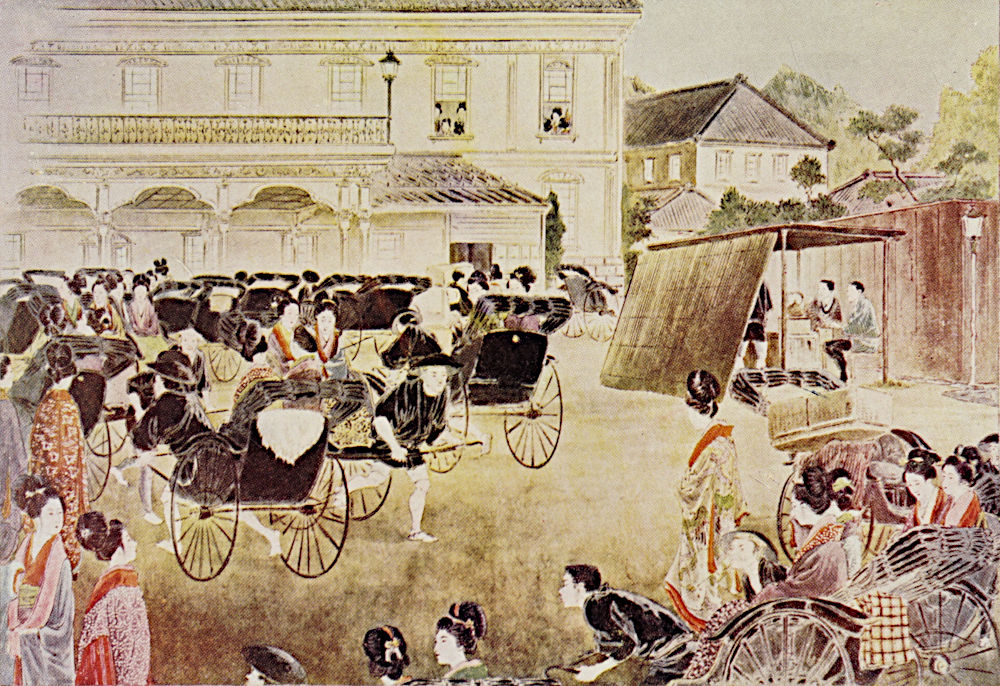
Outside the Yoshiwara Lock Hospital on “Inspection Day.”
Hospital Regulations.
Various regulations exist, but those of the great Yoshiwara Lock Hospital are typical of the others. They were revised in March 1900, and provide substantially as follows:—
Object of the Hospital.—The hospital is established for the purpose of treating prostitutes who are suffering from venereal diseases, consumption, and other contagious maladies contracted or developed in the Yoshiwara brothel-quarters.
Staff.—The permanent staff consists of about fifty people, including several surgeons, a secretary, four pharmacists, nurses, clerks, servants, etc., and is presided over by a chief doctor. The hospital arrangements are subject to Police supervision.
Medical Staff.—The patients must be visited at least twice a day, and on each occasion details of their condition and treatment entered in a report sheet (byōshō nis-shi) for the information of the President. In case of serious illness or slow recovery the matter must be reported to the President, and should the symptoms denote immediate danger, the brothel-keeper of the woman’s house must be notified forthwith. Upon recovery, the report sheet has to be signed by the attendant physician, after which the President himself has to examine the patient. It is the duty of the doctors to prescribe the diet of patients, to instruct and supervise the nurse to see that all necessary instruments are provided and kept in proper condition; and each of the doctors are bound to take night-duty alternately. To prevent scandal and collusion, the doctors are prohibited from entering the wards unless accompanied by a nurse, and, as a precaution against incurring unnecessary risks in treatment, surgical operations can only be performed with the approval of the President. When not otherwise engaged, the hospital doctors may employ their leisure time in making medical investigations, and may, subject to the permission of the President, publish the results of their labours in this direction.
Records, Accounts, Statistics and Reports.—Proper records must be kept of the work and accounts of the hospital, the admissions and discharges, and a monthly and yearly report prepared containing detailed statistics. Monthly reports must be prepared by the 5th of the following month, and the annual report by the 10th of January of the following year. The chief pharmacist is also bound to prepare a daily report of all drugs dispensed and to submit same to the President.
Sundry.—Detailed rules are laid down for keeping the bedding and premises in a clean and sanitary condition, for disinfection, etc.; and for the control of the nurses.
Salaries.—That the staff of the hospital is very much underpaid will be recognized upon perusal of the following scale of monthly salaries:
Yen. U.S. $ £ Sterling.
President 80 to 150 40 to 75 8 to 15
Vice-President 50 “ 80 25 “ 40 5 “ 8
Physicians 25 “ 50 12-1⁄2 “ 25 2.10/- “ 5
Secretary 20 “ 30 10 “ 15 2 “ 3
Chief Pharmacist 25 “ 50 12-1⁄2 “ 25 2.10/- “ 5
Pharmacist 10 “ 25 5 “ 12-1⁄2 1 “ 2.10/-
Clerks 10 “ 25 5 “ 12-1⁄2 1 “ 2.10/-
Chief Nurse 10 “ 20 5 “ 10 1 “ 2
Nurses 3 “ 10 1-1⁄2 “ 5 0.6/- “ 1
Servants 4 “ 10 2 “ 5 0.8/- “ 1
P.S.—If absent for upwards of two weeks, no salary is paid for the current month, and if absent for upwards of one month they may be discharged from the service. The rules do not, however, apply in cases of sickness.
Financial.—Funds for the support of the hospital are raised by way of forced contributions from the brothel-keepers of the Yoshiwara, and the basis of the annual expenditure is a written estimate prepared prior to the 20th March every year by the President of the institution and the Director of the Brothel-keepers Guild, and approved by the Police authorities. In case of a deficiency occurring, steps may be taken to make good the same by the President and Director acting in concert.
Alteration of Hospital Regulations.—When necessary, the regulations may be altered by the President of the hospital and the Director and Vice-Director of the Guild acting in concert, provided that the consent of the Police authorities has been obtained to the proposed changes.
Sick-Rooms and Sanitary Precautions.—The regulations require that separate wards67 be provided for various classes of patients, and that contagious cases be properly segregated; also that the premises be kept swept and clean, and all infected matter be destroyed by fire. Bedding and towels are not to be used promiscuously, sheets are to be disinfected by means of hot steam, spittoons containing a 5% solution of carbolic acid are to be provided, table utensils are to be washed in hot water containing corrosive sublimate (1 in a 1000), infected waste paper must be burnt, and even waste paper which is not infected must not be sold until properly disinfected. Patients who have obtained permission from the physicians are bound to take a bath every morning before the periodical examination.
Visitors.—Are not allowed in the wards or rooms unless the patient is unable to move and special permission has been obtained from the physician in attendance. Visitors may, however, under certain conditions, see patients between 9 a.m. and 3 p.m. in a room (ōsetsu-jo) set apart for that purpose.
Rules for Patients.—While under treatment, patients are required to be civil and respectful in their language and demeanour towards the members of the hospital staff, to wear the regular cotton dresses worn by all inmates, and to observe the regulations governing the institution. No patient is allowed to leave the hospital while under treatment. Patients are required to do their hair up in a simple style, to refrain from entering other wards or rooms except for proper reasons, to refrain from wearing the thick-soled high sandals (takazōri) ordinarily worn in brothels, to carefully place all waste-paper in the receptacles provided, to refrain from creating noise or disorder, singing, quarreling, and scribbling nonsense on the walls or furniture. They are also prohibited from lending or borrowing money, gambling, etc.; and (except with the permission of the physicians) from taking food and drugs brought in from outside. In case of wishing to make purchases outside the hospital, permission must be obtained from the physicians through the nurses.
Exercise.—Exercise may be taken daily in the hospital gardens within prescribed hours.
Complaints.—Complaints against the nurses or other persons must be made direct to the physicians in attendance.
As to the actual working of the Yoshiwara Hospital, some caustic remarks, contained in a book entitled Yūkiwaku no Rimen (遊廓の裏面 “Behind the scenes in the brothel-quarters”) published in Tōkyō in 1903, are appended. In the course of an exceedingly severe arraignment, the author says substantially as follows:—
“The filthy state of the Yoshiwara Hospital, and its utter lack of proper appointments, is so notorious that it is hardly necessary for us to dwell upon this particular phase of the subject; but we propose to enquire into some of the details of the institution. When we try to picture to ourselves what a hospital is, or should be like, we naturally imagine a fine lofty building surrounded by beautiful green trees, grateful shrubs and flowering plants, containing well-ventilated wards kept scrupulously neat and clean and furnished with beds covered with snowy-white counterpanes free from even a suspicion of stain or dirt; but the Yoshiwara Hospital is indeed far from being like that. We are tempted to compare it to a prison, but, as a matter of fact, a prison like the Sugamo Gaol is far more clean and complete, so from the point of general dirtiness and disorder the comparison would be quite inappropriate! The sick rooms have an area of from about 144 to 180 square feet, and as many as twelve or thirteen people are sometimes collected together in such stuffy chambers. The inmates often sleep two in a bed, and women belonging to different brothels, who are indeed entire strangers to each other, share the same couch. As to their treatment, they are medically examined twice a day, they have to pay for their own food, and although attendance and medicine is supposed to be supplied by the brothel-keepers, the patients have to get the money from their masters in the form of a loan and repay it in due course. Even in these expensive times, when living is far dearer than formerly, it appears that the cost of the regular hospital food is only estimated at from 7 to 8 sen (3-1⁄2 to 4 cents U.S. money or say 2d in sterling), so that for the women to be supplied with appetizing or nourishing food is simply impossible. The food they actually get three times a day is far worse than good prison fare, and consists of:—
(1) In morning: boiled barley and rice mixed (baku-han).
(2) At noon: boiled barley and rice mixed (baku-han), some vegetables or a small fish.
(3) In the evening: boiled barley and rice mixed (baku-han) and some indigestible malodorous pickled vegetables (kō-no-mono).
“Periodical examination of all prostitutes takes place once a week, the different streets each having special days. For instance if Edo-chō It-chō-me has its inspection on Friday, the inspection of Ageya-machi will be on a Wednesday. When the inspection time arrives, the name of each prostitute is called by turn, and one by one each undergoes a local examination. If a woman is visibly infected, the doctor orders her into hospital, but prior to her entering the establishment she is permitted to temporarily return to her brothel, where she makes up a bundle of such little things as she needs and, accompanied by a servant of the house, proceeds to the hospital and applies for admission. In the hospital several nurses are in attendance, but while the name ‘nurse’ sounds fine enough in itself, the women who bear this title are terrible females, something like the old brothel hags (yarite) themselves, and are ready to do anything for a consideration. For this reason, the prostitutes need some pocket-money when entering the hospital, and if they only are provided with this they have very little trouble in getting their whims gratified in every respect. After a prostitute has been in the hospital three or four days, if she happens to be a popular woman, the brothel-keeper, and others who lose by her absence, do their best, by judicious presents, to get her discharged as soon as possible, so she is not put to any great inconvenience. On the other hand, if the woman is an unknown new comer, or unpopular, she is treated in a manner painful to witness, only getting what may be given to her out of sheer pity by one of the senior prostitutes of the brothel to which she belongs. The moment they hear the signal for dinner, these wretched girls rush into the dining hall, and scrambling for food devour it in the same greedy wolfish manner as we can imagine the hungry spirits doing in the Buddhist hell! As to the condition of the inmates of the hospital, most of them spend their time in reading obscene novels and stories, but this does not last long, and they begin to discuss their guests and the men they know, to talk about their lovers, to sing, and to make abusive remarks about their masters and the servants in their respective brothels. Or they dance and skip about, play cards, write begging letters, and generally raise a pandemonium as if the institution was a low-class boarding-house. Such being the conditions of this horrible place, with the exception perhaps of a few disappointed women, or women who get on badly with the brothel-keeper, the prostitutes regard with dread the ordeal of entering the hospital. The majority of the public place considerable faith in the efficacy of the medical examination, but they are woefully mistaken in thinking that immunity from disease is secured by such inspection, because many of the doctors of the prostitute quarters are miserable quacks, apparently regardless of their conduct, and so venal that they receive bribes from the brothel-keepers to deliberately pass unchallenged women who are plainly affected with venereal diseases—an act as dangerous as letting loose wild tigers to prey upon the public! Not only that, but some of the youngster assistant doctors who, though of course licensed, are still in the course of perfecting their medical knowledge by practical training, often intentionally overlook serious cases which, unless treated in the hospital, are incurable and likely to spread infection. This is done partly out of sympathy and partly for the sake of winning popularity with some of these ill-famed wenches who know so well exactly how to bewitch the impressionable young men with their sidelong looks and amorous glances. No doubt it is very wrong, but then what a potent influence for good or bad there is in the eye of a young and pretty woman! Moreover, many of the girls are in collusion with their masters for the purpose of hoodwinking the examiners. These girls employ some of the low quacks who haunt the quarters to make preliminary inspections, and if they are found infected and likely to be ordered into hospital on the examination day, they get ‘fixed up’ for the official inspection by having the inflamed parts treated with medicinal applications which temporarily, but effectually, conceal all visible symptoms of disease. For those reasons, it is by no means safe to put one’s trust in the medical inspection. But these are not the only tricks of the trade. It sometimes happens that the quacks discover cases which it is impossible to conceal from the examiners by any known method of ‘fixing,’ and when this happens, the brothel-keepers often request the mercenary charlatans to prepare false certificates stating that a change of air is necessary. Armed with these certificates, keepers pretend that the patient has gone into the country, whereas she is carefully hidden in the house and secretly treated by the quacks. The consequence of this is that many women who are actually in attendance on guests, and apparently healthy, are a frightful menace to society and dangerous as the sharp points of poisoned needles concealed in a bag, whose awful pricks spread death and desolation in the paths of those with whom they come into contact. As to the sanitary conditions of the quarters, the laws of hygiene are utterly defied, for notwithstanding the exterior splendour of the palaces of vice in the Yoshiwara, filthiness is the order of the day, and in unseen corners, and dirty yards and alleys, lie heaps of festering garbage containing the germs of every imaginable form of virulent disease. While some attempt is made to detect venereal maladies by means of periodical inspections, internal diseases are practically left uncared for, therefore the callous and selfish brothel-keepers, taking advantage of this fact, are apt to force girls (who are really ill and ought to be inmates of a hospital ward) to wait on guests, and allow women suffering from such sicknesses as consumption and syphilitic eye diseases to continue their calling. Partly owing to the heartlessness of the masters, and partly owing to their carelessness in matters of sanitation, many instances have occurred where women have not only communicated to their guests the most loathsome diseases, but actually died from illness while sleeping beside their patrons. Decency forbids a too close description of all the horrors of these brothels, but one or two more instances of the terrible inattention to sanitary precautions may be pardoned. In some of the smaller houses the keepers are too mean to provide daily baths, so it often happens that the women appear before their guests innocent of the use of soap and water. In these houses the girls are treated like veritable dogs and cats, and remain year in and year out in cramped unclean chambers, known as kwambeya, furnished with dirty ragged bedding which is so filthy that it gives off a strong sweaty effluvium! In these dens, owing to the absence of hot water, the inmates are supposed to wash in cold water, but in the winter-time the low temperature causes them to dread their ablutions, and so the risk of infection to themselves and guests is materially increased. On the other hand, when they do cleanse themselves as expected, the frequent application of cold water results in bringing on various forms of uterine affections and dooming the unfortunate wretches to life-long misery. In the alleys where the restaurants (daiya) stand, lie piles of mouldy fish-bones, rejected articles of food in a high state of putrefaction, and even heaps of excrement, all vieing with each other in the exhalation of offensive and poisonous odours, and advertising far and wide the ‘sanitary’ ideas of the charming residents of this sink of corruption. Thus are the laws of hygiene observed in the great Yoshiwara of Tōkyō!”
Whether the author’s scathing denunciations of the medical staff of the Yoshiwara are justified or otherwise is not known, but, collating the results of enquiries instituted, the writer is of the opinion that the allegations are somewhat sensational, although of course scandals may occasionally arise, and it must be remembered that the miserable salaries paid are not likely to tempt high-class practitioners to remain in the service for any great length of time. That a host of shady quacks haunt the quarters and assist the brothel-keepers to enable the women to hoodwink the regular examiners is, the writer is informed on reliable authority, a sober fact, and it is probable that in some cases the official doctors have to bear the opprobium of sins committed by these unscrupulous outside charlatans.
As to the gross inattention to sanitary methods charged against the denizens of this immense social sewer, it is probably impossible to exaggerate the mephitic abominations of the disgusting place, or to overestimate the danger of infection run by its thoughtless frequenters in consequence of the virulent disease-germs which are incubated in and infest every hole and corner of the unclean stews, vitiating the atmosphere and spreading the seeds of sickness and death far and near.
The monthly report sheets of the hospital contain blanks analysing the various forms of disease as follows:—
INFECTIOUS DISEASES.
Syphilis:
1 Primary sclerosis and ulcers.
2 Painless buboes.
3 Disease of the lymphatic glands.
4 Skin diseases.
5 Diseases of the mucous membranes.
6 Opthalmia.
7 Diseases of the bones and periosts.
8 Diseases of the joints.
9 Diseases of the muscles.
10 Diseases of the viscera and brain.
11 Soft chancres.
12 Acute buboes.
13 Gonorrhœa.
14 Itch.
15 Tuberculosis.
16 Unenumerated.
NON-INFECTIOUS DISEASES.
17 Diseases of the digestive organs.
18 Diseases of the respiratory organs.
19 Diseases of the circulatory organs.
20 Diseases of the urinary organs.
21 Diseases of the generative organs.
22 Diseases of the nerves and sensitive organs.
23 Diseases affecting the general development and nutrition of the body.
24 Diseases of the skin and muscles.
25 Diseases of the bones and joints.
26 Surgical diseases.
27 Unenumerated.
Medical Statistics.
The medical statistics of the Yoshiwara for seven years (1898 to 1904 inclusive) are as follows:—
Year. Number of inspections. Number of infected cases. Infected per 100. Number of guests entertained.
1898 134,602 7,506 5.58 1,237,885
1899 108,268 5,333 4.95 1,367,639
1900 108,109 5,117 4.76 1,428,136
1901 108,572 4,864 4.48 1,157,492
1902 107,260 4,635 4.33 1,065,674
1903 106,121 5,006 4.74 1,167,969
1904 119,148 8,592 7.22 1,285,424
The figures show that during seven years the average ratio of infection was 5.18 per 100, but whether these show the true facts of the case is hard to determine. However, they have the merit of being “official” even if somewhat erroneous.
Taking into consideration the above results, it appears that the figures for the whole Empire given in the “Annual Report of the Central Sanitary Bureau of the Home Department” (published in 1905) must be misleading, as they show the ratio in 1901 to range from only 0.43 in Kōchi Prefecture to 6.20 in Kagoshima Prefecture. In Hyōgo Prefecture, Iwate Prefecture and Aomori Prefecture the ratio is stated to be 9.69, 13.75 and 14.52, respectively, and the average for the whole country works out as only 2.75 for all the forty-six prefectures enumerated. It is hard to reconcile these differences except on the assumption that the severity of the examination varies according to the localities.
The following table shows the alleged results of examination of prostitutes throughout Japan for ten years, the average ratio being 3.31 per 100.
EXAMINATION OF PROSTITUTES FOR SYPHILIS, IN EACH OF THE LAST TEN YEARS.
Years. Places of examination at the end of each year. Each day’s average of the total number of prostitutes.
1892 484 30,687
1893 487 31,253
1894 476 34,023
1895 471 37,518
1896 472 39,079
1897 498 43,570
1898 495 48,780
1899 518 49,553
1900 536 52,305
1901 530 40,855
Average. Average.
Total. 496.7 40762.3
Years. Affected. Unaffected. Total. Number of affected per 100 examined.
True. False. True cases per 100 affected.
1892 8,364 43,237 16.21 1,379,598 1,431,199 3.61
1893 9,339 40,858 18.60 1,408,813 1,459,010 3.44
1894 6,327 52,963 10.67 1,553,422 1,612,712 3.68
1895 5,937 50,056 10.60 1,644,110 1,700,103 3.29
1896 7,231 65,049 10.00 1,707,565 1,779,845 4.06
1897 8,856 61,004 12.68 1,960,407 2,030,267 3.44
1898 11,692 56,816 12.07 2,190,325 2,258,833 3.03
1899 8,650 52,508 14.14 2,171,964 2,233,122 2.74
1900 11,493 59,406 16.21 2,249,276 2,320,175 3.06
1901 9,117 50,493 13.29 2,427,909 2,496,518 2.75
Average. Average. Average. Average. Average. Average.
Total. 8700.5 54139.0 13.45% 1869338.9 1932178.4 3.31%
Digest of the Regulations of the Yoshiwara Guild.
General.—In December 1901, in accordance with Article 26 of the Metropolitan Police Board Notification No 37, issued in 1900, the brothel-keepers, introducing-tea-house-keepers, and prostitutes of the Yoshiwara established a Guild, and in February 1904 the rules of this Guild were revised.
Object.—The object of the association is to secure and maintain intimate relations between its members, to protect the common interests of the “trade,” and to preserve ancient picturesque customs of the quarter.
Director.—The Guild, which has its office at No. 462 Ni-chō-me, Senzoku-machi, Asakusa district, Tōkyō City, is governed by a Director (tori-shimari) and a Vice-Director (fukutori-shimari) both of whom are elected, by means of an open ballot, by the members, all of whom enjoy the “franchise.”
When the number of votes is equal the individual who is senior in birth is deemed to be elected, and when the dates of birth are identical the vote is decided by lot. The term of office is two years, and in case of a vacancy occurring a by-election is held. The Director has a staff of clerks and other employees under his control.
Undertaking by Members.—Persons joining the Guild are required to subscribe to the articles of association and to give a written promise to observe the same. Moreover the new member has to provide a guarantor who will actually make performance of his duties should he himself fail to do so. Guarantors must be persons in the same line of “business,” and the brothel-keepers have to guarantee the prostitutes belonging to their respective houses.
Contracts to be Submitted to Director.—All financial arrangements relative to contracts entered into between the brothel-keepers and prostitutes have to be reported to the Director under the joint signatures of the parties.
Pass-Books.—The brothel-keepers and the women are required to prepare and keep pass-books in the following form, and to send in the same (duly entered up) for the approval of the Director before the 10th of every month:—
Entries in this book are to be made for one year from the _______________ 19__ to the _______________ 19__.

Name of prostitute _______________
Date __________________________
Total Yen
Fee for one entertainment out of which Yen
(1) Portion of the Keeper “
(2) Portion of the woman “
Agreement relative to the income of the woman of ____________ out of the fee for one entertainment as shown in the above division, has been duly notified to the Police Station.
As to the pocket-money ____________ for each entertainment fee, it will be paid at the time of accounting.
Number of entertainments ____________
Yen Sen
Entertainment fees
Actual amount to be paid to the woman
To be applied to the interest on loan for (name of month)
Pocket money of the woman
Applied to repayment of debit balance in books
Balance is as follows:—
Loan
Advance in current a/c on the books
Total
Changes in Membership, Etc.—All changes in regard to membership and movements of employees are notified to the members generally through the Director, and the members are bound not to engage discharged employees except with the consent of the former employers.
Precautions Against Fire.—To guard against fire, periodical examinations are made by an expert (appointed by the Director) of the kerosene oil used in lighting, and the use of oil of under 70° (C) is forbidden.
Power to Expel.—Persons infringing the rules of the Guild may be expelled by a resolution of a general meeting.
Revision of Articles.—The articles of association of the Guild may be revised by a general meeting called by the Director at the request of thirty members.
Brothel-Keepers Consultation Committee.—To protect their mutual benefit the brothel-keepers appoint a consultation committee (kyōgi-in) the members of which are elected in the same manner as the Directors. This committee may request the Director to call a meeting at any time.
Reports of Income.—Every day each brothel keeper is obliged to report his gross income, and number of guests entertained, to the Director.
Charges.—An entertainments tariff, legibly written, must be conspicuously displayed in every guest-chamber. This table must also include the prices of various refreshments provided. Persons who accompany guests, but who do not engage a woman, are charged half the amount of the highest fee charged for a woman.
Exhibition of Women.—Women may not be publicly exhibited in the “cages” after 1 o’clock a.m. from November to April, or after 2 o’clock a.m. from May to October; and in case of pregnancy are forbidden to practice their calling for three months before and after parturition.
Medical Expenses.—Brothel-keepers are required to pay daily to the accountant of the Guild for transmission to the hospital the charges incurred in consequence of any of their women undergoing medical treatment.
Brothels who may use Tea-Houses.—Brothels employing women whose fee is Yen 1.50 (U.S. $.75 or 3/- sterling) may do their business through tea-houses, but they are obliged to pay a commission to the latter.
Insurance of Accounts.—As an insurance against loss the brothel-keepers pay to a separately organized office, called the “Uke-harai-jo” one per cent of the amount of money received from tea-houses, and in return for this premium the “Uke-harai-jo” guarantees the tea-house accounts. All monies due to the brothels by tea-houses are paid to the “Uke-harai-jo” and not direct, and should any tea-house fail to meet its liabilities all business with such defaulting establishment is discontinued until settlement is made. In case of the tea-house people having committed any improper act, the brothel-keepers may boycott the tea-house and refuse to do business with its proprietors.
Expenses to be Defrayed by Brothel-Keepers.—Brothel-keepers have to bear the following expenses: (1) of the Yoshiwara Hospital; (2) of the office for the inspection of venereal diseases; (3) of the Director’s office; (4) of emergencies; (5) of displays and shows; (6) of meetings; (7) of salaries of Director and employees; (8) reserve fund. These expenses are estimated and passed by the Consulting Committee in May and November each year, and notified to the brothel-keepers through the Director. In January and July of every year the Director prepares and submits accounts for the previous term. A supplementary budget may be passed by the Consulting Committee, but if the expenditure is for an object not contemplated in the eight items mentioned above, the sanction of a general meeting of brothel-keepers must be obtained.
Accounts for Medicines.—Accounts for medicine must be settled at the latest by the 25th of each following month, but these drugs are supplied to members at half-price as compared with the prices charged by ordinary physicians to the general public.
Tea-house-keepers.—Introducing-tea-house-keepers appoint by ballot a Consulting Committee, two accountants and several nemban (“year guards.”) General meetings of tea-house-keepers are convened by the Director in accordance with resolutions of the Consulting Committee. Members of the tea-house fraternity deposit Yen 50 as a guarantee that they will pay accounts due to the brothels with whom they deal. The members must join the Uke-harai-jo or “clearing house” of the Guild, and all monies are paid to the brothels through its medium, and not direct. A commission of 10 (ten)% is charged to brothel-keepers on the gross sums of money paid to the latter by the tea-houses, but this is subject to alteration by agreement between the Committee and the brothel-keepers. Monthly statements of accounts relative to the number of guests, money received for refreshments and geisha fees, etc., must be sent to the Director by the 3rd of each following month. When tea-houses fail to meet their liabilities in respect to brothel accounts, the “clearing-house” (uke-harai-jo) makes good the amount, and the defaulter is either suspended or expelled.
Duties of Prostitutes.—Prostitutes belonging to the Guild are required to “take care of their health, be economical, and use their leisure time in study, sewing, etc., to the end that they may be prepared to resume their normal position in society.” They are expected to dress like ordinary women when outside the brothel-quarter, to maintain good relations with their comrades, to treat their guests fairly and show proper respect towards them, and not to refuse acceptance of guests unless for “valid reasons.”
The Validity of Debts.
At present, debts contracted by prostitutes are held to be valid and legally recoverable, although contracts binding women to serve in brothels in consideration of a loan would probably be held illegal. The leading case on the question is Ōkuma Kin (and two others) v. Watanabe Mase decided in the First Civil Division of the Supreme Court of Japan (Case “O” 398 of 1901) on the 6th February, 1902. The principles enunciated are thus stated in the digests:—“Prostitution being a publicly recognized business, it is not in the least contrary to public order or good morals for a prostitute to enter into an agreement with her creditors to devote the profits arising from her own business to the satisfaction of her debt towards them.” It is the writer’s strong opinion that the Judges have committed a very serious blunder in interpreting the law as stated above, as they appear to have overlooked the distinct intention of the legislature. Prostitution, even in Japan, is not intended to be authorized as a legitimate business, and, while it is tolerated by the law, this toleration is the outcome of a desire to control and regulate the evil for considerations of public policy. Public and personal safety require a constant inspection, and Japanese experience has shown that such inspection can be best enforced when the brothels are all gathered together in one central locality, but to dignify the infamous and ruinous calling by placing it upon a level with other permitted callings is tantamount to protecting the business itself by affording the security of the law to persons engaged in earning money by means of leading and encouraging a notoriously profligate course of life. There can be no doubt but that the Japanese system is excellent so far as it goes, but for the courts to virtually hold that the mere fact that brothel-keepers and prostitutes are tolerated and taxed entitles them to be ranked as ordinary worthy citizens, and their disgusting transactions protected by the Imperial laws, suggests a somewhat loose idea of morality in the Judges, and a wrong perception of the proper status of a class of persons whose professed business is to foster vice and pander to the libidinous desires of the multitude. Eradicate the evil we cannot, regulate it we can and ought, but surely the law goes far enough when it imposes certain obligations upon the unholy trade without going to the length of upholding claims based upon what is—no matter how plausibly you argue it—an immoral consideration!
Yarō. “Peccatum illud horribile, inter Christianos non nominandum.”
The subject is so horribly repulsive and distasteful that the writer would have preferred to close his eyes to the existence of this awful phase of human depravity and pass it by in silence, but friends, in whose judgment he places entire confidence, have pointed out that the very nature of this work demands at least a passing allusion to one terrible form of venery which prevailed in Japan in the later Middle Ages.
In the early part of the Yedo period (commenced 1587,) traces of the surviving customs of the preceding civil wars lingered on, and as unnatural practices (which had grown up in armed camps) had been introduced into the metropolis, and were rife in the city, there were, of course depraved persons who provided accommodation to gratify the infamous tastes of the times. Among the play-actors were a number of vicious and wholly abandoned characters who did not hesitate to pander to their patrons and submit to outrageous physical indignities for hire.
After the performance of theatrical representations in the province of Idzumo, female actors became all the rage, and, as society was corrupted and injured in consequence, the authorities forbade actresses to appear on the stage in future. This interdiction brought young men-actors into vogue, and the performances of these handsome looking young fellows also fascinated and charmed the minds of the public and captivated a large class of voluptuaries. The fearful evil which subsequently developed having become prevalent, male actors were also prohibited in the 1st year of Shō-ō (1652), but in the 2nd year of the same period (1653) in accordance with the petition of certain persons, permission was granted for dramatic performances to be held under the name of mono-mané-kyōgen-zukushi (various comic plays).
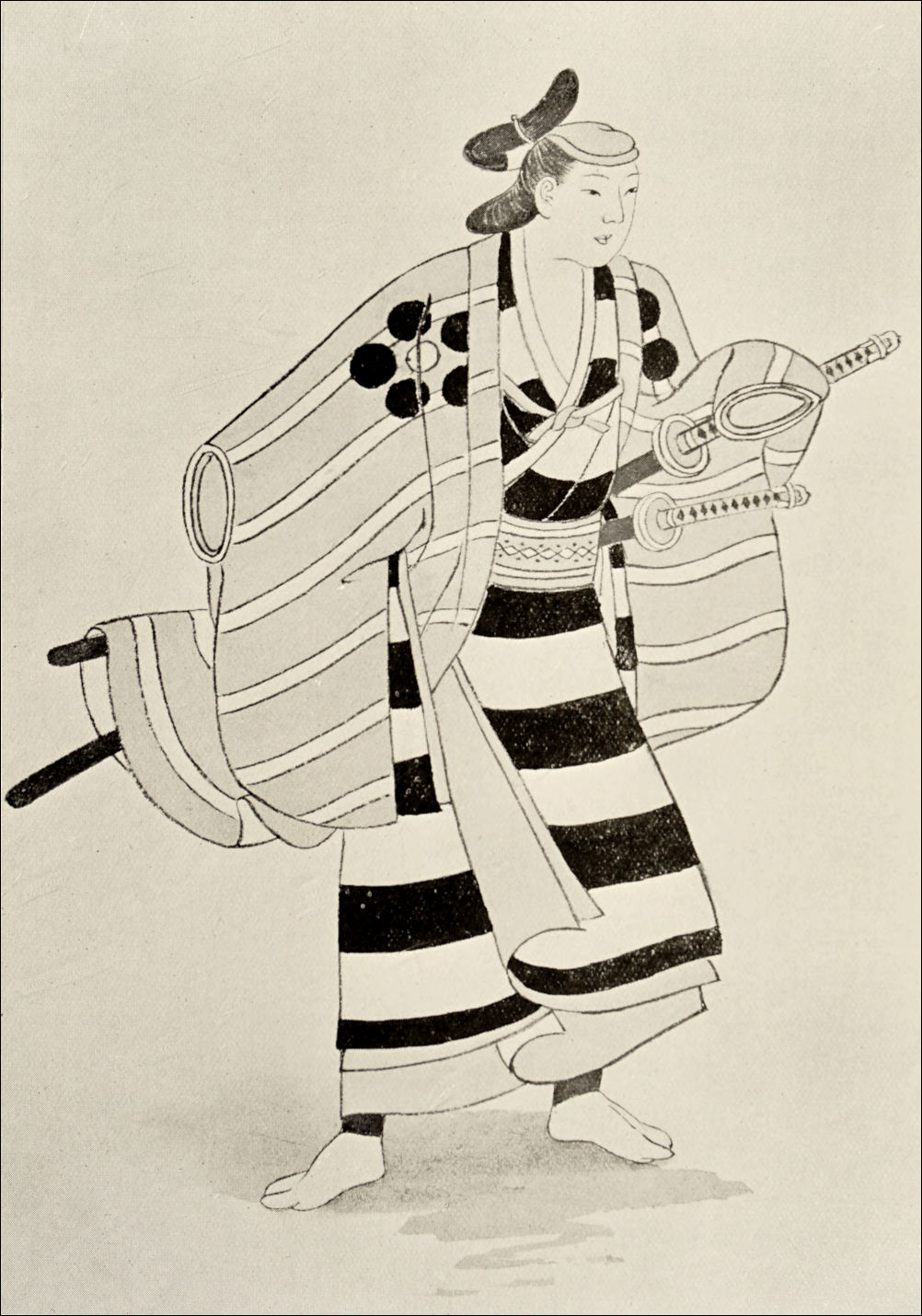
“
Yarō.
”
Warned by experience, and in order to prevent the recurrence of the vicious practice, the authorities caused all actors to shave the hair above their foreheads, and the cognomen of “wakashu” (“lad”) was officially changed into that of yarō (“a low fellow”). To circumvent the law and nullify its operation, actors who took the part of women wore towels arranged so as to conceal their shaven pates, and, hitting upon a further expedient, wore hats made of floss silk or purple crêpe. The prepossessing appearance of these men so greatly outrivalled the beauty of real women that, far from the regulations effecting any reform, the habit of enjoying unnatural pleasure spread through the city. Following the trend of prevailing tastes, games known as “yaro-karuta” (cards with figures of yarō upon them), and yarō-sugoroku (yarō backgammon) were invented and hawked around for sale, while some enterprising people manufactured pictures of yarō for sale and others published a hyōban-ki (Notes and criticism) about them. To such an extreme did the craze run that some insensate fanatics even went so far as to present votive tablets to shrines and temples bearing representations of these disgusting yarō!
The resorts of this vile fraternity were in Yedo (Tōkyō), Negimachi; in Kyōto, Miyagawa-machi; and in Ōsaka, Dōtonbori. The houses in which yarō were kept were colloquially known as “Kodomo-ya” (children’s houses). These establishments hired and offered to their patrons the services of attractive boys much in the same manner as the regular brothels dealt in women. The youths were taught various accomplishments, and after they had become proficient as actors they were placed on the stage. Those who performed in plays were styled butai-ko (stage children), those who only waited at entertainments were called kagema, and those who travelled about the country were known as tobi-ko (jumping or “flying” children).
It was chiefly members of the military class and priests who came to houses of assignation (age-ya) and engaged these young men, but their services were also requisitioned by not a few women. At first the lads only appeared at banquets as pages in waiting on the guests, danced for the amusement of the company, and were engaged by enthusiastic patrons in the ordinary way, but eventually their exclusive business led them to become as familiar with their guests as ordinary female prostitutes. They aped the style of females, blackened their teeth with ohaguro (like the women of those times), and gave themselves languid effeminate airs in imitation of the fair sex. Originally they dressed in a distinctive costume, and their get-up was known as wakashu-sugata (young man style), but gradually their mode of dress underwent a change, and in the Meiwa and An-ei periods (1704 to 1780) they attired themselves in graceful garments dyed in rich designs, adopted long flowing sleeves such as were worn by females, wore wide girdles around their waists, and did their hair up woman-fashion.
In the Genroku period (1688 to 1703) the common practice of the vice had declined, but the custom of hiring yarō was as popular as that of hiring courtesans, and in the Meiwa and An-ei periods (1704 to 1780) it had reached its zenith. At that time there were as many as ten places in Yedo where yarō could be hired—namely in Yoshi-chō, Kobiki-chō, Hatehō-bori in Kanda, in the grounds of the Shrine of Yushima Tenjin (!), in front of the Shimmei Shrine (!) in Shiba near the Hirakawa Tenjin Shrine (!) in Kōjimachi, near the Hachiman Shrine (!) at Ichi-ga-ya, etc. The number of yarō carrying on their infamous calling in the city was two hundred and thirty at this period.
Before long, nature either began to assert itself or the laws against the vice passed in Kwansei period (1789 to 1800) were severely applied, for in the Tempō period (1830 to 1843) only four places remained where yarō could be found.68 Of these Yushima was patronized most extensively, but only twenty-two lads were kept there. In the 13th year of Tempō (1842), in the time of Ieyoshi, the 12th Tokugawa Shogun, the vice was utterly rooted out in consequence of searching reforms instituted by Midzuno Tadakuni, Lord of Ichizen, and from that year unnatural sexuality ceased almost entirely in Yedo. In the Kwan-ei period (1624 to 1643) a number of so-called “incense-dealers” (Kōgu-uri) appeared in Yedo who offered unnatural services to their customers, and by the era of Genroku (1688 to 1703) the business was firmly established and the practice prevailed far and wide. Beautifully dressed, handsome, and effeminate looking young men wandered through the city carrying about with them various kinds of incense in kiri-wood boxes wrapped in light-blue silk cloths, and, under the guise of selling incense, wormed their way into the mansions of the nobility and gentry, but in course of time the custom was abolished. In those days it was quite general for lewd and abandoned women to hire actors and indulge in immoral pleasure. Such women, when they attended a play, would call actors to the tea-houses and there enjoy themselves with the players in the same way that male libertines were wont to call courtesans.
The above description of yarō is condensed from the Nikon-Fuzoku-Shi (日本風俗史), but the writer desires to add that the literature of the Genroku period, as typified in several ancient volumes in his possession, clearly reveal the fact that the vice was practised quite openly, and apparently without any sense of shame, in the 17th century. Curious readers are referred to the Danshoku Ō-kagami (published in 1687) and the Danshoku Ki-no-me-dzuke (published in 1703) as specimens of this precious literature.69
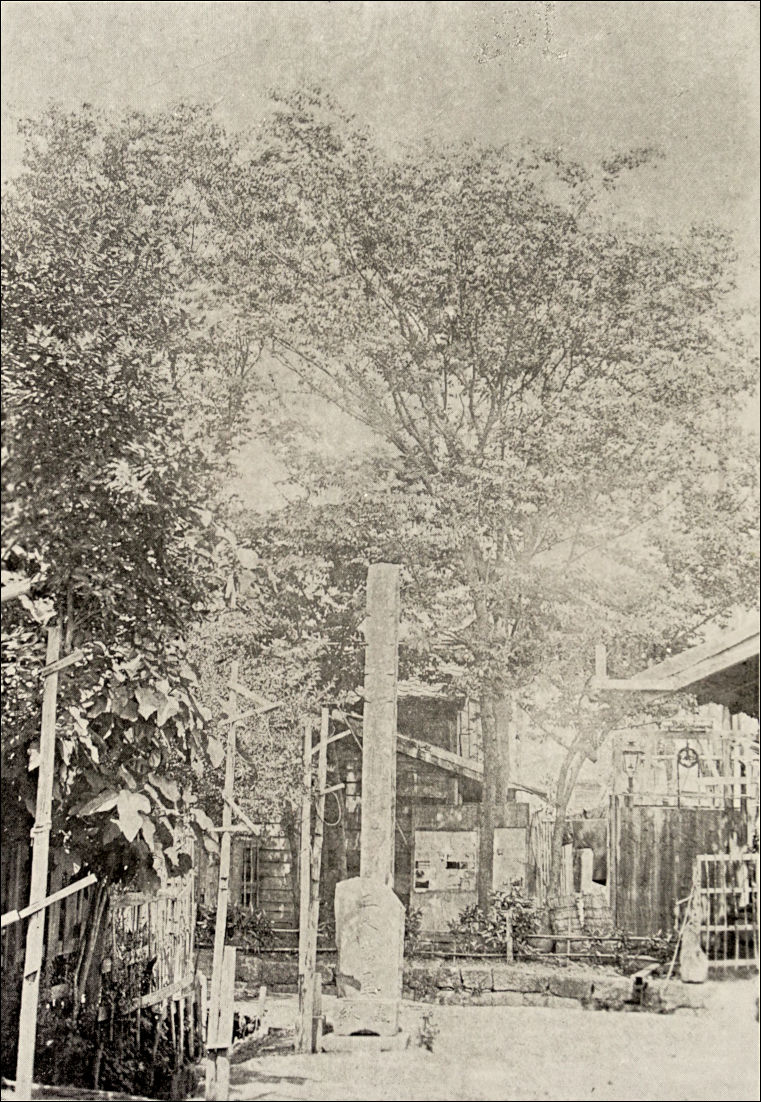
The Grave of a Courtesan.

Golgatha.
The following sad description of the last hours, death, and burial of an inmate of the Yoshiwara is gleaned from the “Yūkwaku no Rimen” (遊廓の裏面) published in 1903:—
“Even in the case of a courtesan who for a time has been famous as the star of her brothel, and who has become so skilful that she has robbed many men of their very souls, what will her ultimate fate probably be when suddenly attacked by a serious disease? I believe that there is no fate more piteous than that of a courtesan whose body has been sold to this prostitute quarter from a distant province, and who finds herself, sad and lonely, without a single acquaintance or relative, and with none to whom she can look for aid!
“Now that she is sick and has given up her business for one or two months, the myriads of guests, who formerly came crowding to see her in a never-ending stream while she was yet elegantly attired and beautiful to behold with her comely face and perfectly pencilled eyebrows, do not send her even a single letter. The servants who called her ‘Oiran, Oiran’70 when she was in the zenith of her pride and popularity, and who served her obsequiously in consideration of the many gifts she lavished upon them, gradually become unaccommodating and churlish. But that is by no means all, for they even speak ill of her and backbite her. Then she falls into low spirits, and alone by herself she writhes in solitary agony. Her debit account for medicine increases. There is no one to soothe or comfort her, and indeed it is impossible to imagine how great is her misery as she dozes uneasily upon her pillow, in this unhappy place, among things hard to bear and painful to hear.
“In this manner her sickness increases in severity, and finally, falling into a state which offers no hope of recovery, she can only await the awful approach of death. Our imaginations fails to picture the unhappy state of the wretched courtesan who is about to draw her last breath, lying on a cold hard thin mattress in a miserable and lonely little room beneath the back staircase of the brothel, without a soul in the world to help the absolutely forsaken creature. When death is about to enter through the torn paper-covered windows of her room, there is no light in the chamber, and all is dark as pitch. In the upper portion of the house singing girls are probably playing merrily upon their samisen (banjo), while dancing-girls are dancing and frisking to the music. The sounds of boisterous laughter, music, and cheerful voices pierce the ears of the sick woman and grate upon her nerves, and she, lying in misery at the very point of death, with none to attend or nurse her, totters on the brink of the grave writhing and struggling in pain and anguish, and when she breathes her last she is mocked in the hour of her mortal agony by the babel of voices telling of licentious joy and happiness and voluptuous pleasure. Her limbs grow cold and rigid, her eyes, which have lost the light of life, become dull and glazed, and, remaining wide open, stare horribly into the darkness. Just at this moment some courtesan who has come down the stairs for a sitz-bath, or a brothel hag (yarite) coming along the passage, noticing that the faint noise of breathing has ceased, and wondering if anything has happened, may open the door and look in and exclaim—‘Ah! all is over.’ That is about all the expression of astonishment which will be ejaculated, and although perchance two or three of her courtesan friends may shed a few tears of sympathy and pity, this ends the matter. The brothel keeper immediately states that there is no one to take delivery of the corpse, and, without even waiting for the dawn, the mortal remains are hurriedly born away to the crematorium and disappear forever in the smoke of the furnace. Ah! what a fearful and cruel thing this is to contemplate!
“And to where are the calcined bones carried, and where are they interred?
“If there be any person who desires to know where the white bones of the miserable courtesan are going, and who wishes to follow the unhappy woman to the end of her terrible fate, I beg that he will go out of the great gateway of the Yoshiwara—where the flower has withered and fallen—past the Go-jikken-dōri road, up the Emon-zaka hill, and grope his way along to the left of the dike at Dote-Hatchō.
“Before the eyes of the traveller spreads out on both sides of the dike a vista of beautiful fields and gardens. On the right, so far as the eye can see, separated by vast stretches of irrigated rice-fields, rise to varying heights the rows of the roofs of the brothels of Kotsugappara and Senju. Passing by this cluster of habitations, there are clumps of green trees and bamboo groves. Further on, if the weather be clear and fair, the white sails of craft on the upper part of the stream of the Sumida river can be faintly discerned, and, of course, the purple mountain of Tsukuba-yama can be seen among the clouds. Glancing around to the left of the dike, there will be noticed towns composed of tenant houses lately erected on ground reclaimed from the fields. Between the trees may be seen here and there the high roofs of various temples. The sight of the forest which crowns the high ridge of land reaching from Ueno to Higurashi and on to Dōkwan-yama creates a pleasing sensation in the mind. As one goes on among this beautiful scenery, he at length nears the gate of the slaughter-houses, and his nostrils are assailed by the scent of blood borne on the breeze. Going on a little further beyond the dike, a road commences which forms an old fashioned avenue with rows of trees on both sides. Having arrived at this point, if one turns round and glances back he will be able to see, between the trees, just the numerous roofs of the Yoshiwara prostitute-quarter stretching out all over. The lofty buildings of the quarter, such as the clock-tower of the “Ebi-ya,” “Hikota,” and the “Shinagawa” rise up in such conspicuous majesty that one imagines that he is looking at some great castle-town. Quickening one’s steps, and going on one or two chō more, the dike disappears, and you see the railway embankment crossing diagonally in front. Beneath this railroad line stands a temple, and this temple is indeed the place where the unfortunate courtesan is doomed to have her bones decay and rot! By the left side of the bank oozes a little dirty ditch-like stream, spanned by a small old-fashioned stone bridge. This stream skirts the temple grounds, and, washing the luxuriant growth of wild bamboo grass which overgrows into boundaries, disappears at the back of the railway track. Pleased with the extreme quietness and privacy of the place, you cross the little bridge and come to a black gateway which you recognize as that of the Jō-Kan-ji temple. Ah! the Jo-Kan-ji at Minowa! Men of the world with their loves and hates, even if they have not already explored the actual place itself, have probably become acquainted with its name through the various books they have read.
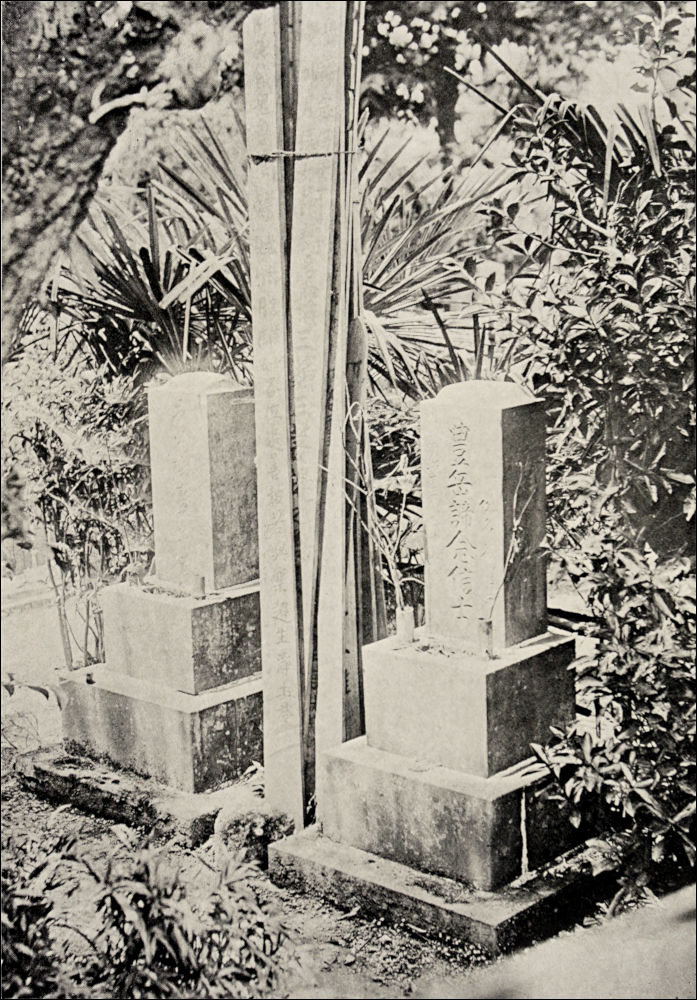
Tombs of Courtesan and Guest who Committed Suicide together on the 1st October, 1880.
“Having entered the gate, you will see a little hut where flowers are sold. Proceeding to the rear of the not very large hondō (main temple) by the left side of the building, you will come to a place thickly studded with numberless graves, tombstones and sotoba (stûpa). Near the thicket-like hedge, and here and there between the tombstones, stand clumps of gnarled and ancient e-no-ki trees whose branches quiver sadly and mournfully as the wind soughs through them with a plaintive sobbing sound like the burthen of a requiem. Glancing at the well-nigh undecipherable inscription carved on the first tombstone that meets the eye, we can trace a posthumous name such as 柳生院花容童女之墓 (Ryū-sho-in Kwayō-dōjō no haka,) or the words ◻◻樓代々の墓 (the family grave of the _______ brothel). Or we may even see stones on which two names are carved together, one name being that of a man and one that of a woman. None of these stones are more than two or three feet in height—they are all small and dirty—and for a very long period of time no incense has been burned or flowers offered before them.
“Going on into the heart of this lonesome place one at length arrives behind the main temple. Here the whole surface of the earth is damp and humid, and a dismal grave-like smell of mouldy earth pervades the locality. Probably the sunshine has never penetrated to this spot for centuries. The dead leaves of the e-no-ki trees have been allowed to lie as they have fallen year after year, so they have piled up, crumbled, mouldered, and rotted on the dark ground, and from the purulent mildewed soil have sprung into being myriads of weird uncanny poisonous toadstools and foul fungi fearful and horrid in shape and strangely ghastly in colour. Ah!, what a desolate uncanny appearance the place has; persons visiting it soon experience a deep sense of commiseration and sympathy, and feel as if they had entered a chilly underground vault. In this gloomy dismal place lie the bones of the courtesan who only up to yesterday resembled a beautiful butterfly or lovely blossom when seen in all the glory of her gorgeous apparel, with her glossy black hair ornamented with gold and her snowy-white body clad in rich brocade robes now exchanged for the cerements of death.
“And look! at the rear of two great e-no-ki trees rises a high stone wall. Upon it stands a stone column bearing the six Chinese characters 新吉原無緣墓 (Shin Yoshiwara Mu-en-dzuka) “The tomb of those of the Shin Yoshiwara who are without kith or kin.” Around it is a rank growth of various weeds and grasses, and near by still stands undecayed a huge stûpa which was erected as an offering to the spirits of the dead at the time of the great earthquake of the 2nd year of the Ansei period (1855).
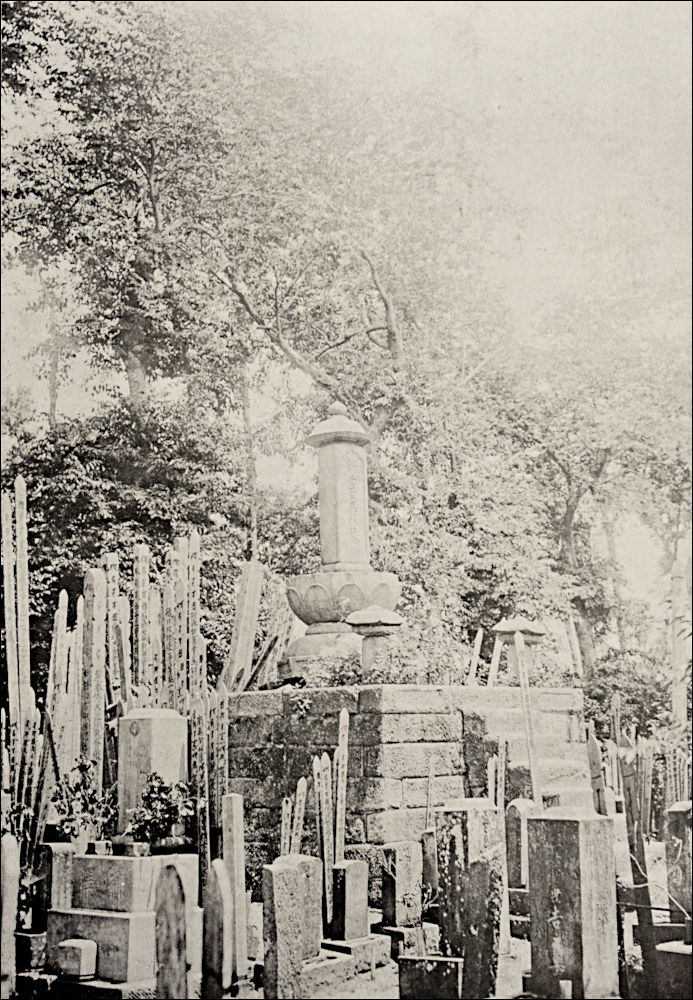
The “
Mu-en-dzuka
” in the “
Jō-kan-ji
” temple at Minowa.
“As a matter of fact such things really do occur, but the courtesan who is thus buried in the Mu-en-dzuka must be counted as the most truly unfortunate, because most of the women are given burial in the family burying places of the brothel-keepers, while the bodies of those who cannot obtain even this latter consideration, who are from a far country and without a friend to take delivery of their remains, are carried stealthily out of the back entrance of the brothels in the grey light of the dawn, and here transformed into a heap of grisly bones. In any case the end of these brothel women is very sad and lamentable, and looked at from this point of view there is indeed nothing so miserable or so awful as the brothel quarter.”
Five Curious Legal Documents actually used in the Yoshiwara in 1902.
(No. 1.)
Agreement.
Whereas I _______________, being unable to maintain myself, have consented to _______________’s practising prostitution in your establishment for the purpose of aiding in my support, it is hereby agreed as follows:—
Art. 1.—I acknowledge and confirm the fact that I have consented to _______________’s practising prostitution in your house for a period of _______________.
Art. 2.—I hereby acknowledge the receipt of the sum of Yen _______________ which you have advanced to me at the rate of _______________ per annum as regards interest.
Art. 3.—The principal and interest mentioned in the proceeding Article shall be repaid out of _______________’s income derived by her in her practice of prostitution. Provided that her entertainment fee per head shall be fixed at ____, whereof _______________ is to be given to her as pocket-money, and the balance of _______________ is to be applied to the repayment of principal and interest.
With regard to the “entertainment fee” mentioned in the proceeding paragraph, it is agreed that you may, at your convenience, either increase or decrease the rate, and that even in such case the money is to be applied according to the same proportion as that mentioned in the said preceding paragraph.
The portion of her earnings hereinbefore mentioned as yours is to be applied for the expenses of maintaining the Yoshiwara Hospital and other fixed expenses; but the cost of board while in the hospital is to be paid by herself.
If at any future time further advances are made by you, or if you kindly disburse for us the cost of medicine and the expenses of board in the hospital, such monies shall be repaid in the following order and manner:—
(1) Cost of medicine.
(2) Board in hospital.
(3) Interest on all loans.
(4) Principal of further loans.
(5) Principal of original loan.
Art. 4.—It is further agreed that she will, of course, lodge in your house and practice the business faithfully during the term of the agreement, that she will strictly observe the regulations relating to the business, and any other Articles or customs which should be respected for the regulation of the brothel-quarters; and further that, no matter what be the circumstances, she will neither relinquish or suspend the business nor change her lodging place until both the principal and interest of the liability towards yourself are finally cleared off. Provided, however, that in case you should, at your convenience, alienate your brothel-keeping business, or require us to change the lodging-place, your directions will be respected and no objection to the change will be raised against your wishes, except for proper and valid reasons.
Art. 5.—My portion of the profit being determined according to the rate specified in paragraph 1 of Article 3 hereof, I shall not be interested or concerned in respect to any other income derived in connection with your brothel-keeping business.
Art. 6.—With regard to any personal property belonging to _____________ it is agreed that the same is pledged as security for the loan mentioned in Article 2 hereof, irrespective as to whether it is now actually in existence or may be acquired at any future time in the course of practising the business; and the said property shall be neither taken out, delivered to others, pledged, sold, nor otherwise alienated.
Art. 7.—In case _______________ falls ill before the loan from you is cleared off and consequently cannot practice the business, she shall undergo a medical examination by a physician at the Yoshiwara Hospital; and if his diagnosis shows that there is no prospect of her being able to resume her calling, it is agreed that the pledged articles belonging to the said _______________ shall be sold by you in the presence of one of the guarantors, and that the proceeds of the sale shall be applied to the repayment of the principal and interest of the loan. In case any deficiency arises, the liability in respect thereto will be undertaken and fulfilled jointly and severally by the guarantors and the principal, the said guarantors assuming joint and several liability among themselves.
Art. 8.—Should the principal party abscond, conceal her whereabouts, etc., the guarantors will forthwith enquire after her and bring her back to resume her business; and as to the time which has elapsed during the period of her desertion, application will be made forthwith to the Police Station for the purpose of having the term of agreement mentioned in her license extended by the number of days during which she was absent, and of procuring renewal of the said license. If her whereabouts cannot be ascertained, or if she dies, the pledged articles belonging to her are to be sold by you in the presence of one of her guarantors and the proceeds to be applied to the repayment of the principal, and interest of the loan. Any deficiency will be made good by the guarantors and the principal all being jointly and severally responsible, and the guarantors undertaking the liability jointly and severally among themselves. In case of the death of the principal, the guarantors will take delivery of her corpse.
Art. 9.—Should there be any portion of the loan standing unpaid at the time of the maturity of the term of the agreement, you are at liberty to sell the pledged articles belonging to the said _______________ and to apply the proceeds towards the repayment of such unpaid portion of the loan. Any deficiency arising will be made good by the guarantors themselves, and you will be protected against any loss or annoyance.
Art. 10.—It is specially agreed that in case any of these Articles should be infringed, or should any other dispute arise between the parties, the case shall be considered as within the jurisdiction of either the Tōkyō Local or District Court.
The above Articles of Agreement being duly accepted by the parties, we hereby undertake not to infringe the provisions thereof; and in order to avoid future misunderstanding and trouble, we have drawn up this document and signed and sealed the same hereunder.
Dated _______________
(Signatures) _______________
(No. 2.)
Deed of Loan.
The sum of Yen _______________ together with interest at the rate of _______________ per annum.
We hereby acknowledge that the above sum of money has been borrowed from you to meet the requirements for ____________’s carrying on of the business of a prostitute. Repayment of the money will be made according to the provisions of an agreement dated ________________, and we have therefore no objection to your treating the matter accordingly.
In order to avoid future misunderstanding and trouble, we have drawn up this document and signed and sealed it hereunder.
Dated _______________
(Signatures) _______________
(No. 3.)
Power of Attorney.
I, _______________, being about to commence business as a prostitute at _______________ in the Urban Prefecture of Tōkyō, hereby give and grant unto _______________ the following powers:—
1.—To manage all matters connected with the application for a license for practising as a prostitute, and to sign and seal as attorney for me all necessary papers and documents.
2.—To contract any further loan or loans from the brothel-keeper, while I am practising as a prostitute, to the actual amount of Yen ___________, and to sign and seal as my attorney the documents relative to such loan or loans.
3.—In case of the alteration of the lodging-place at the convenience of the brothel-keeper, to borrow money from the new brothel-keeper, to determine the manner in which the money is to be repaid, to enter into any other agreement or contract in connection with the practice of the business of a prostitute, to sign and seal as my attorney various papers and documents, and to perform any other acts or deeds.
4.—To manage all my personal affairs while I am practicing prostitution.
5.—To appoint a substitute to manage or perform any of the matters entrusted to you.
I hereby certify that the above matters are duly entrusted to you, and beg that you will manage everything in accordance with the regulations; I pledge you my word that I will not raise any objection at any future time to anything which may have been done by you in the premises; and it is further specially agreed that this power of attorney will not be cancelled unless with your consent.
In witness whereof, I have drawn up this power of attorney and signed and sealed the same hereunder.
Dated _______________
(Signature) _______________
(No. 4.)
Resolution of the Family Council.
Resolved:—
Art 1.—That permission is given to _______________ to practice as a prostitute in the Urban Prefecture of Tōkyō.
Art. 2.—That _______________ may borrow the sum of __________ from _______________, a brothel-keeper, contract any further loans not exceeding the actual amount of _______________, and enter into an agreement (as per draft) hereto attached.
Art. 3.—That in case the brothel-keeper ______________ alienates the brothel-keeping business at his convenience, or causes ______________, change her lodging place, ___________ may borrow from the new brothel-keeper the sum of Yen _______ or contract any further loan not exceeding the amount of Yen ______________, he may determine in the exercise of his discretion the manner in which the repayment of the loans are to be paid, enter into further various agreements relating to the practice of the business of a prostitute, and do any and all other acts and deeds in connection therewith.
Art. 4.—That for the purpose of performing any acts or deeds in relation to Articles 2 and 3, ____________________ may appoint any substitute under him and give to such substitute power to perform all such acts and deeds.
Date _______________
(Signatures) _______________
(No. 5.)
Letter of Request.
________________ being now prepared to practice as a prostitute, I am very much obliged to you for your kind consent to my request to guarantee the agreement. Under these circumstances, I promise that I will respect and observe the said agreement and not cause you any trouble whatsoever. When it is necessary to sign and seal papers filed with the proper authorities in connection with the practice of prostitution, I beg that you will kindly sign and seal the same, and that you will, when necessary, sign and seal the documents re additional loans as attorney for ___________, and kindly guarantee the repayment of the said loans. I further request that you will look after her in all matters affecting her interests while engaged in the business of prostitution. If you act as above, the principal party will never act contrary to your directions, and ___________ too will raise no objections.
In witness whereof, I have hereby drawn up this letter of request and signed and sealed the same hereunder.
Dated _______________
(Signature) _______________
明治三十二年六月三十日初版發行 明治三十八年十二月一日再版印刷 明治三十八年十二月五日再版發行
著作權所有
發行者 著作兼 小林米珂 横濱市山下町七拾番地
印刷者 チヤールス、ジェー、ブヲンハム 横濱市山下町て六抬壹番地
印刷所 ボックス、オブ、キウリヲス印刷所 横濱市山下町て六拾壹番地