Daijin-mai no koto. (Dancing of millionaires.)
Reading edition
This style of dancing was most popular in the Yoshiwara during the Shōtoku era (1711–1715). The songs which were sung as a kind of accompaniment to this dancing are said to have been composed by a comic actor named Nakamura Kichibei (commonly known as Nishiban). Kichibei, being an expert singer of ko-uta (light songs), was present at many saké parties given by rich people, and entertained the guests so well with his singing and dancing that he became very popular. According to a certain book of songs, however, it is claimed that the songs were composed by a man named Seisai, but as the same book states the songs were composed during Gembun era (1736–1739) the identity of the composer is extremely doubtful. If these ballads were really written during the Genroku (1688–1703) and Shōtoku (1711–1715) eras, it is inconsistent that the names of Kibun (紀文) and Naramo (奈良茂)43 should appear in the verses!
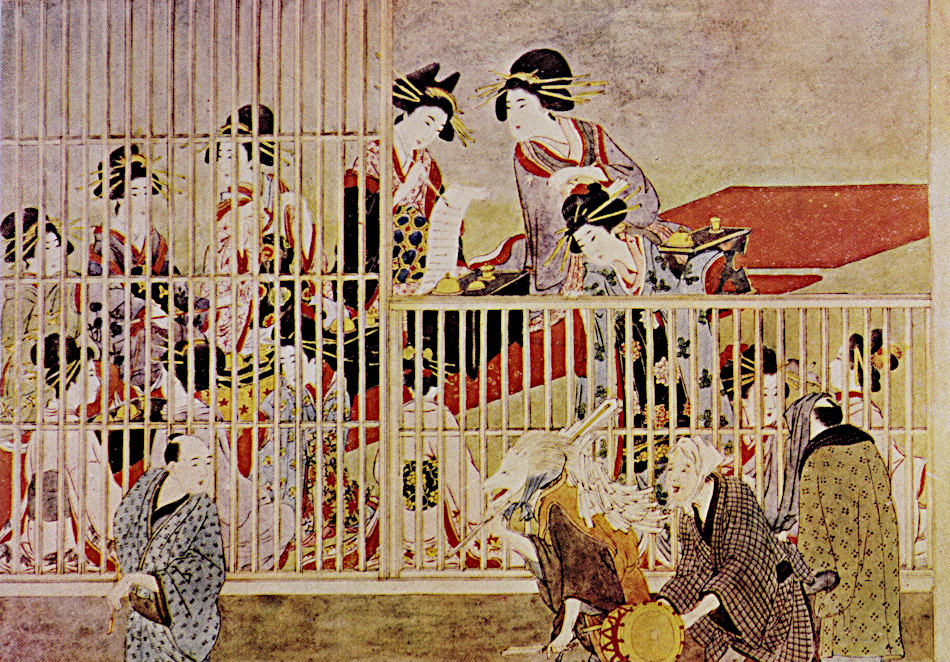
A Street Scene in the Yoshiwara a hundred years ago.
Copied from a drawing by Kitagawa Utamaro.
Some people allege that the ballads were the result of literary efforts on the part of Kibun himself, but this seems rather apocryphal inasmuch that the name of Kibun is mentioned in them, and he would hardly compose songs about himself!
However, we may be well content to leave various antiquarians to quarrel over musty documents and ancient books, and content ourselves with knowing that the ballads did eventuate in some way or other, and that somebody did compose them. The following extracts are made from the “Dai-jin-mai Kō-shō” (大盡舞考證) and will give an idea of the songs, but it must be borne in mind that the translation is very free owing to the crudeness and vague character of the original text and the virtual impossibility of reducing the words into intelligible English.
The treasures of the Shin-Yoshiwara are hidden by the back of a palanquin. Passing through Shim-machi, Ageya-chō, Uki-hashi, Komura, and Yatsuhashi, one comes out into the Shitaya streets, sees the small cherry temple of Tōyeizan (Uyeno park) and the Toraren temple of Kinryū-zan (Asakusa temple). The thing which is praised and admired here is the long flowing haori of Kōhei-bō. Then you know Confucius said, ha! ha! whosoever worships us, ha! ha! will certainly be dragged to the wicked place, ho! ho! (Chorus:—“Ho-ho-hon, ho-ho-hon-non, ho-hon-yo ho-hon-yo no notamawaku wa, soto senya soto senya ariya chin na.)
Ha ha! ho ho! It is a felicitous omen of this tranquil reign that the waves of the four seas are undisturbed ha! ha! ho! ho! Look at the Daijin-mai (dance).
(Next “Daijin”): The origin of the kuruwa (prostitute quarters) is that Yuge no Dōkyō, by Imperial command, founded a kuruwa. On account of guests flocking in (kuru 來) and their hearts being softened (wa 和) it has been named “kuruwa.” Ha-a! ho-ho! Look at the Daijin-mai (dance).
(Next “Daijin”): The five streets of the Yoshiwara have been named because Yedo-chō has “en” (affinity) with Yedo city: Fushimi-chō has affinity with fushin (fushin suru = to build); all difficulties having been overcome Sumi-chō was built, Shimmachi opened, and the bustling Kyō-machi established.
(Next Daijin): The title of tayū originated when the first Emperor of Shin was out a hunting and encountered a heavy rainstorm. His Majesty then sought shelter under a small pine-tree, when the branches of that tree miraculously extended and the leaves spread out and locked together so closely that the Emperor was completely protected from the elements. For such virtues the pine and the bamboo are felicitous. Ha-a! ho-ho! Look at the Daijin-mia (dance).
(Next Daijin): As to the beginning of guests, though the people may know nothing about Corea or China, everywhere in Japan they know the name of Kinokuni-ya Bunzaemon (Kinokuni Bunza). The Donsu Daijin (“Damask” millionaire) rivals him and redeems Kichō of Miuraya. Five rolls of red damask together with the cost of cotton-wool lining he sends to Ogiya Hanshi. He also presents a dagger valued at 25 ry which is still preserved as a treasure by Hanshi. Ha-a! ho-ho! Look at the Daijin-mai (dance).
(Next Daijin): As the next daijin we must mention Master Naramo. He redeemed Ura-zato who was well-known at Shimmachi as the leading belle of the Kagaya. He placed her in a mansion specially built for her reception at Kuroe-chō, Fukagawa, and the name of the mansion was “Mokusan Goten”. The hōkan (jesters) in attendance on her were Itchō, Mimbu, and Kakuchō, while her female servants were O Man, O Kin, and O Yō. Koshirō, Zenroku, Kichibei, and Seigorō attend her in various capacities. But oh! what a change of taste, however, that this daijin should again redeem Arashi Kiyoji! Ha-a! ho-ho! Look at the Daijin-mai (dance).
(Next Daijin): The day-break on a Spring morning as sung by Seishōnagon (noted poetress) is interesting. Being attracted by the tinkling notes of sugagaki, crowds flock into the Yoshiwara dressed in their holiday clothes, to visit the girls for the first time in the New Year: so the kuruwa becomes lively, and men walk about stretching their necks like herons.
The tayū and kōshi prosper and the sancha and baicha also become popular, their voices echoing like the twittering of singing birds. The great houses of Yamaguchi and Miura are famed for their wealth and prosperity, and indeed they are the famous things of Sumichō. Ha-a! ho-ho! Look at the Daijin-mai (dance.)
(Next Daijin): Yamamoto no Hōjun is a well-known resident of Shimmachi, Kago-guke (the feat of passing though a hollow cylinder of basket-work) of Tsunokuni is the famous thing of Sumi-chō, the Tosa smoked bonito sold by Temmaya is that of Ni-chō-me, and Hishidaya Matayemon is said to be a descendant of Shōji Jimbei. Look at the Daijin-mai (dance.)
(Next Daijin): The beginning of Sin-goza must be attributed to Iseya Jūbei. He redeemed a well-known yūjo—Katsuyama—belonging to Ōmatsu-ya of Ni-chōme. Yukata-mono (people belonging to respectable samurai families) is the commencement of Shin-goza. Ha-a! ho-ho! Look at the Daijin-mai (dance.)
(Next Daijin): As to the beginning of yubi-kiri (finger-cutting) it first took place between the leading yūjo of Tsuta-ya, named Fujishiro, and Totsuno Yohei, and then the practice gradually spread until it took place between Hana-Murasaki of Ōbishiya and Takayasu Hikotarō. Ha-a! ho-ho! Look at the Daijin-mai (dance).
(Next Daijin). [Here the text is so obscure that nothing can be made of it.]
As to the tunes played when the Dai-jin-mai was danced, these have been explained by Mr. Ōtsuki Jōden and by the widow of the late noted painter Naga-aki Anshun. (This lady was formerly a geisha in the Yoshiwara called O-Hata, and is well versed in music as well as the ancient customs of the Yoshiwara: she lives at 42 Shōden-chō, Yokochō, Asakusa, Tōkyō). These songs are said to have usually been sung and danced by the hōkan before guests during the New Year holidays.