Yoshiwara-gayoi no Jinrikisha. (The jinrikisha traffic of the Yoshiwara.)
Reading edition
The use of tsuji-kago (palanquin) by the general public was permitted from the Genroku era (1688–1703), but the number of these conveyances in Yedo was limited to one hundred only! People, therefore, were in the habit of visiting the Yoshiwara on horseback. [The name of a street in the Yoshiwara—Uma-michi (Horse-street)—testifies to the fact that horses used to pass to and from the quarter.] Later on the palanquin traffic increased, but with the appearance of the Meiji (present) period, kago dropped out of fashion.
The jinrikisha-men who ply between the Yoshiwara and Uma-michi are called among themselves “yonashi” (an abbreviation of yonabe-shi = night-workers), owing to the fact that they sleep during the day-time and go to work at night. The best known jinrikisha houses (“Ban” 番) in the neighbourhood of the Yoshiwara are called:—“Tatsu-shin,” “Hage-gumi,” “Honchō-ban,” “Dote-gumi,” “Misawa,” etc. The men belonging to these houses come out to pick up fares about dusk, and fortified with a “helmet of saké” chase after any likely pedestrian, accosting him with the words:—“Danna, naka madé ikaga desu?” (“Master, how would you like to go as far as the Yoshiwara?”). At first these knights of the jinrikisha demand an exorbitant fare, but reduce the same, after some haggling on the part of the would-be riders, to about 15 sen per ri. As soon as the man has settled terms, he will probably exclaim “oi kita! hora yo!” (almost untranslatable) and picking up the shafts of the vehicle start off as fast as his legs can carry him, brandishing his lantern (they call it a “kamban” among the jinrikisha fraternity) as he speeds along. A coolie who aims to secure a tip will probably ask his customer “Danna, dochira ye tsukemasu?” (“Master, to which house shall I take you?”) and if the reply is “Nani, ō-mon de yoroshii” (“Oh, just put me down at the great gate”) the rider is probably only bent on a stroll through the Yoshiwara for the purpose of sight-seeing. If, on the contrary, a fare replies “Emon-zaka de orosé” (“Put me down at Emon-zaka”), he is generally a cowardly fellow who is desirous of protecting himself from the jinrikisha-puller’s demand for additional payment by means of the close vicinity of the police-box on the hill.
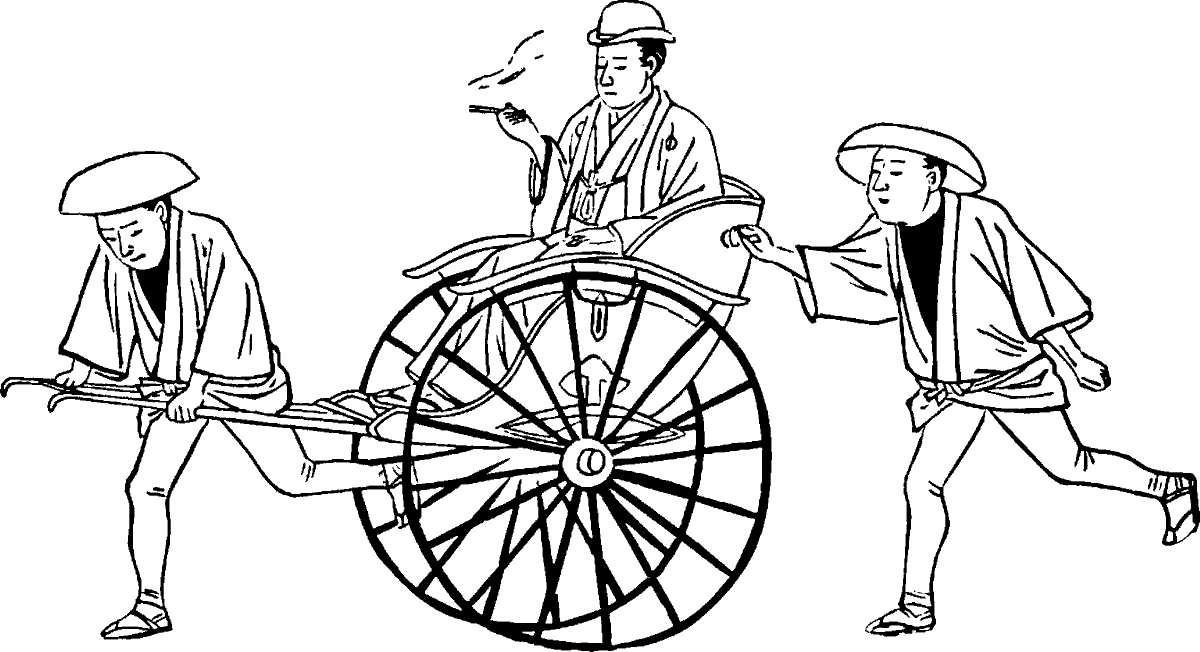
Jinrikisha
(“
Kuruma
”) with puller and pusher (
atōshi
).
When two kuruma-ya are employed—one as an atōshi (pusher) or tsunappiki (extra puller in front)—three times the single fare is usually demanded because one of the men must return without a vehicle, and cannot therefore pick up a fare on his way back. The atōshi or tsunappiki has to waste his time in going home, whereas the man who has his jinrikisha with him can generally earn something by picking up a fare on his return journey.
When a jinrikisha-man has brought a guest to a brothel or tea-house he is usually given a tip of from 20 to 30 sen, which is paid by the house and afterwards charged to the guest. There is also a body of jinrikisha-coolies known as “mōrō-shafu” (“shady” jinrikisha-men) who are invariably very bad characters. Sometimes these rascals have an arrangement with certain of the lower-class brothels (bori-ya=greedy and covetous houses) to inveigle country-folk into their dens and thus make improper gains. Among the mōrō-shafu there have been desperate scoundrels who even dared to go the length of taking fares to lonely places and there robbing them of valuables and money after the fashion of highwaymen, but, owing to the stringent police system, as well as the control exercised by the jinrikisha-men’s guild, these evils have been greatly diminished. As regards the slang used by the Yoshiwara jinrikisha coolies, there seems to be but little difference between it and that employed by outside jinrikisha-men.
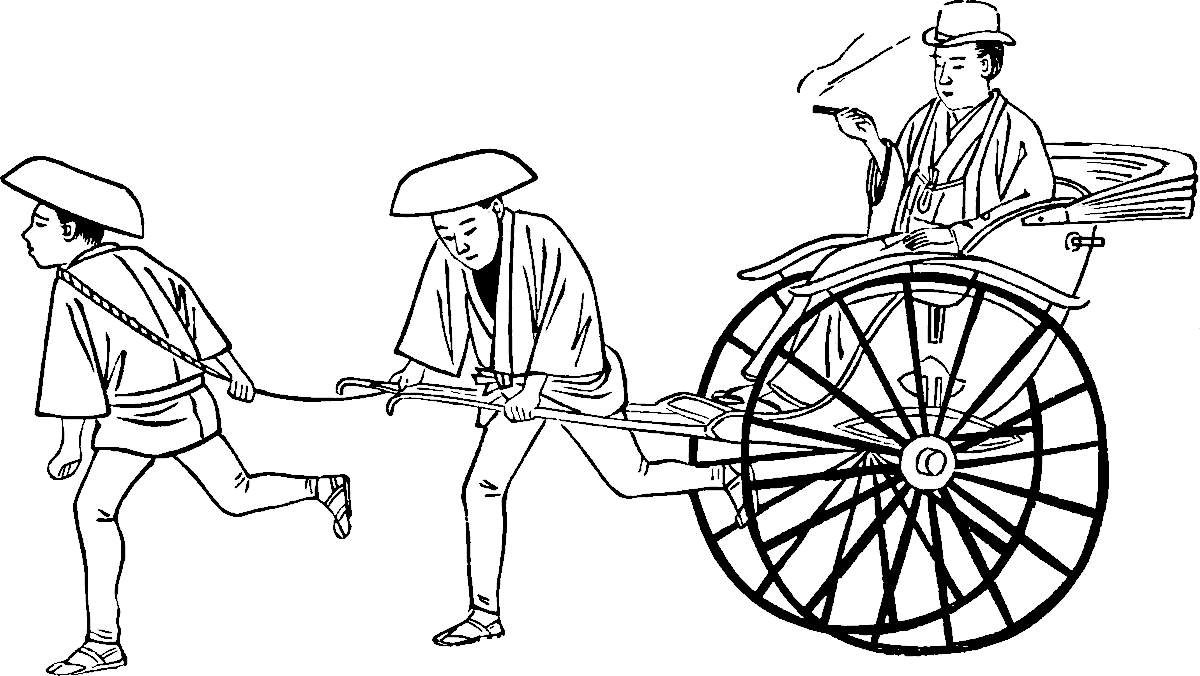
Jinrikisha
(“
Kuruma
”) with puller and “
tsunappiki
.”
Their method of counting is as follows:—
Yoshiwara Slang. Ordinary Japanese. Meaning.
Oji Is-sen 1 sen.
Jiba Ni sen 2 “
Yami San sen 3 “
Dari Shi sen 4 “
Genko Go sen 5 “
Ronji Roku sen 6 “
Seinan Shichi sen 7 “
Bando Has-sen 8 “
Kiwa Ku sen 9 “
Dote Jis-sen 10 “
Furikan Ni-jis-sen 20 “
Yari Ni-jū-go-sen 25 “
Furi or “Hansuke” Go-jis-sen 50 “
Ō-yari or Ensuke Ichi yen or Ichi mai 1 yen.
Other slang words abound, but we have not space enough to give more than a few examples:—
Yaka. Being in a hurry (Isogu koto.)
Yanagi. Not being in a hurry (Isoganai-koto.)
Kaidashi. This word is used to express the idea of a jinrikisha-man taking a fare to a certain place at a very cheap rate with the object of securing a better fare on his return journey.
Aibako. (Ni-nin-nori no kuruma) A jinrikisha to seat two fares.
Monde-yuku. The act of changing half-way when two jinrikisha are being pulled in company and one contains two people and the other only one person.
Terashi. (Rōsoka) A candle.
There is a funny story told relative to the introduction of jinrikishas, and the consequent falling into desuetude of palanquins. A certain guest asked his “lady friend” in a brothel if she could tell him what sign was most used on the lanterns of jinrikisha-men: she promptly replied “Yamagata ni ka no ji ga ō gozaimasu” (“Mostly the shape of a mountain Ʌ with the katakana syllable “ka”—カ—”). She was thinking of the signs used to denote the different classes of prostitutes (vide page 123) and mistook the characters 人力 (jinriki) for the sign and the syllable カ. It appears that in those early days the names of districts or guilds were not painted on the lanterns, but merely the two characters 人力 (jinriki), and hence the comical error!
