Sanya-uma da-chin-dzuké. (The cost of hiring horses to and from the Yoshiwara.)
Reading edition
The “Kinsei Kisekikō” (新世奇跡考) says that in the olden days young bloods who frequented the Yoshiwara used to travel to and fro on horse-back. It was also a fashion of the period to consider everything white to be tasteful. Thus the craze went so far that people fancied white horses, white sword-hilts, white leather hakama (loose pantaloons), white sleeves, and white everything else. In a book called the “Ko-uta Sō-makuri” (小唄總まくり)—published in the second year of the Kwambun (1661–1372) era—the following scale of charges for horse-hire is given:—
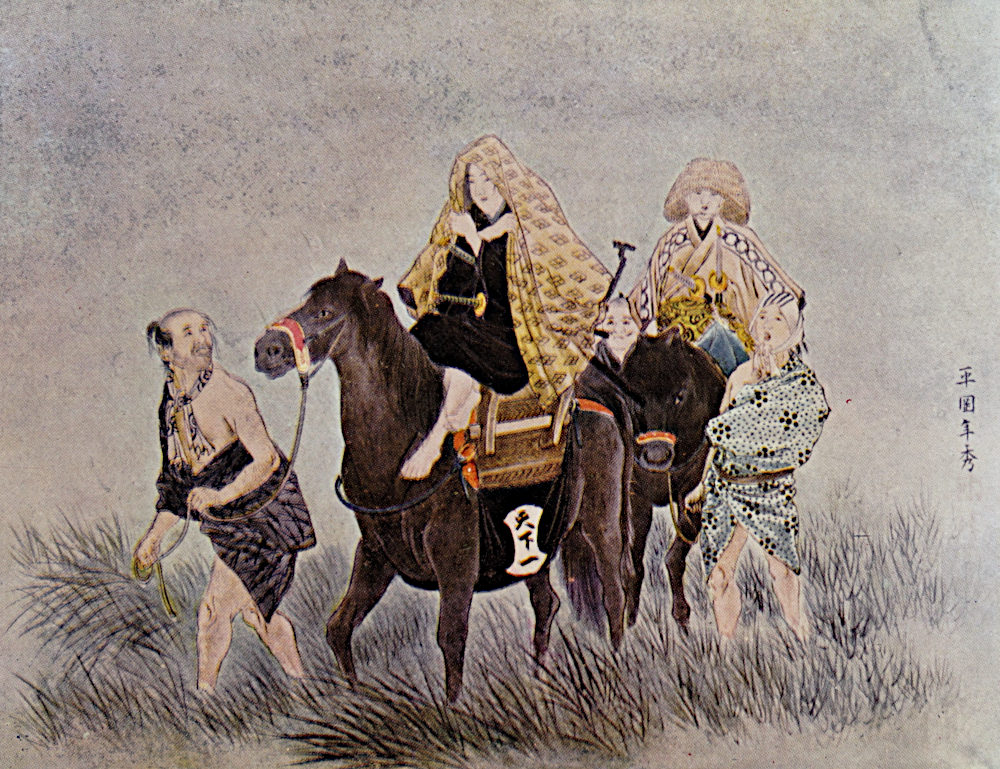
The “
Sanya-uma
.”
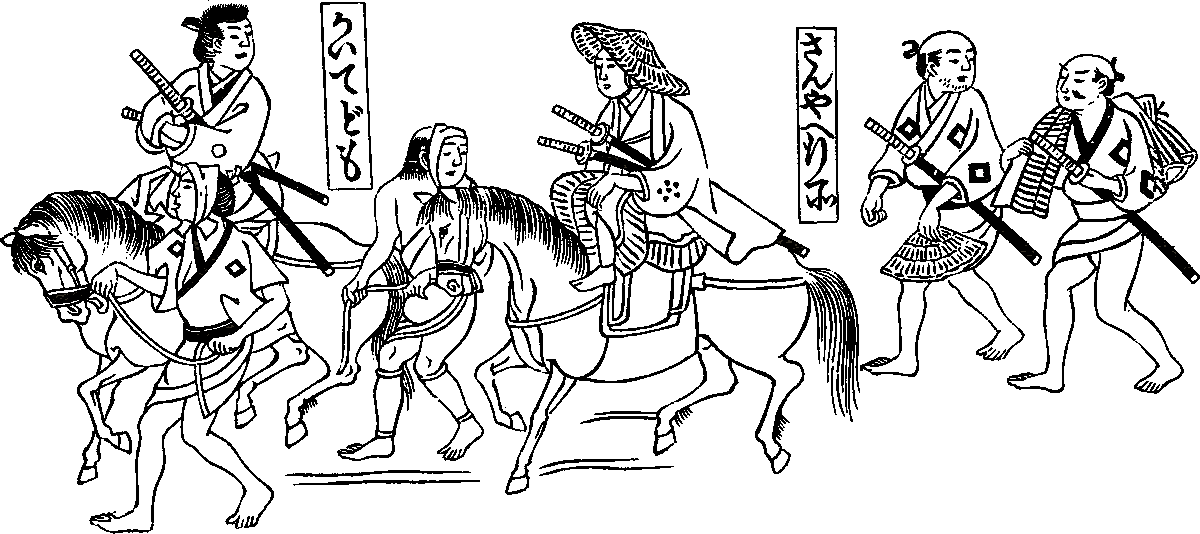
Guests going to the Yoshiwara (
From an old print.
)
From Nihon-bashi to the gate of the Yoshiwara. Ordinary charge. 200 mon (20 sen)
Ditto, with a caparisoned white horse, and two footmen singing the “Komuro-bushi” song. 348 mon (34 sen 8 rin)
From Iida-machi to the gate of the Yoshiwara. Ordinary charge. 200 mon (20 sen)
Ditto, with a caparisoned white horse, and two footmen singing the “Komuro-bushi” song. 348 mon (34 sen 8 rin)
From the Asakusa gate to the gate of the Yoshiwara. Ordinary charge. 132 mon (13 sen 2 rin)
Ditto, with a caparisoned white horse, and two footmen singing the “Komuro-bushi” song. 248 mon (24 sen 8 rin)
The above proves the taste of the period for white horses, and besides this there was a song in vogue in the Meireki era (1655–1657) which described the graceful appearance of a man of rank visiting the Yoshiwara on the back of a white steed.