Shiki-zome no soba-burumai no koto. (Presentation of buck-wheat macaroni to celebrate the first use of night-clothes.)
Reading edition
It appears to be a universal rule to present soba to all the inmates of the house whenever a yūjo uses her newly-made night-clothes for the first time. This custom is binding on all classes of women from the proud oiran down to the nagaya-jōro, but, practically, the lower class women are debarred from making an exhibition of night-clothes (either on their own account or by the assistance of guests) by reason of the expense involved: it may therefore be said that this ceremony is performed by women belonging to first (ō-misé) and second-class (chū-misé) houses exclusively. Originally this ceremony was only performed when the tsumi-yagu was used for the first time, but later it became a rule that when any new night-clothes began to be used—generally on New Year’s day—buckwheat macaroni was to be presented to the inmates of her house by the yūjo to whom they belonged. This custom, which still survives, is called “shiki-zome no soba-burumai.” In the houses of ordinary people the spreading out of bedding and night-clothes in the day time is greatly disliked as unlucky, therefore, when a sick person recovers, the occasion is one of rejoicing and congratulation and is called toko-agé (removal of bed-clothes). In brothels, however, just the reverse idea obtains, the keepers rejoice to see the night-clothes used even in the day-time, their fervent wish being to have the bedding employed as much as possible because it bears an important relation to the prosperity of their “trade.”
In different brothels different devices are adopted for the purpose of determining who shall be considered the “leading lady” of the house (o shoku). Some take the number of guests as a standard, others the number of najimi-kyaku (that is “regular guests”) while others adopt the rather disgusting method of fixing the order of precedence according to the total amount of money spent by the guests of the respective women. In first-class establishments no such methods as the above are employed, and the rank of the women is determined by the number and value of their own night-clothes and those given by them to the servants of their own and other houses. The idea may be attributed to the great esteem in which night-clothes are held by both men and women in the Yoshiwara.
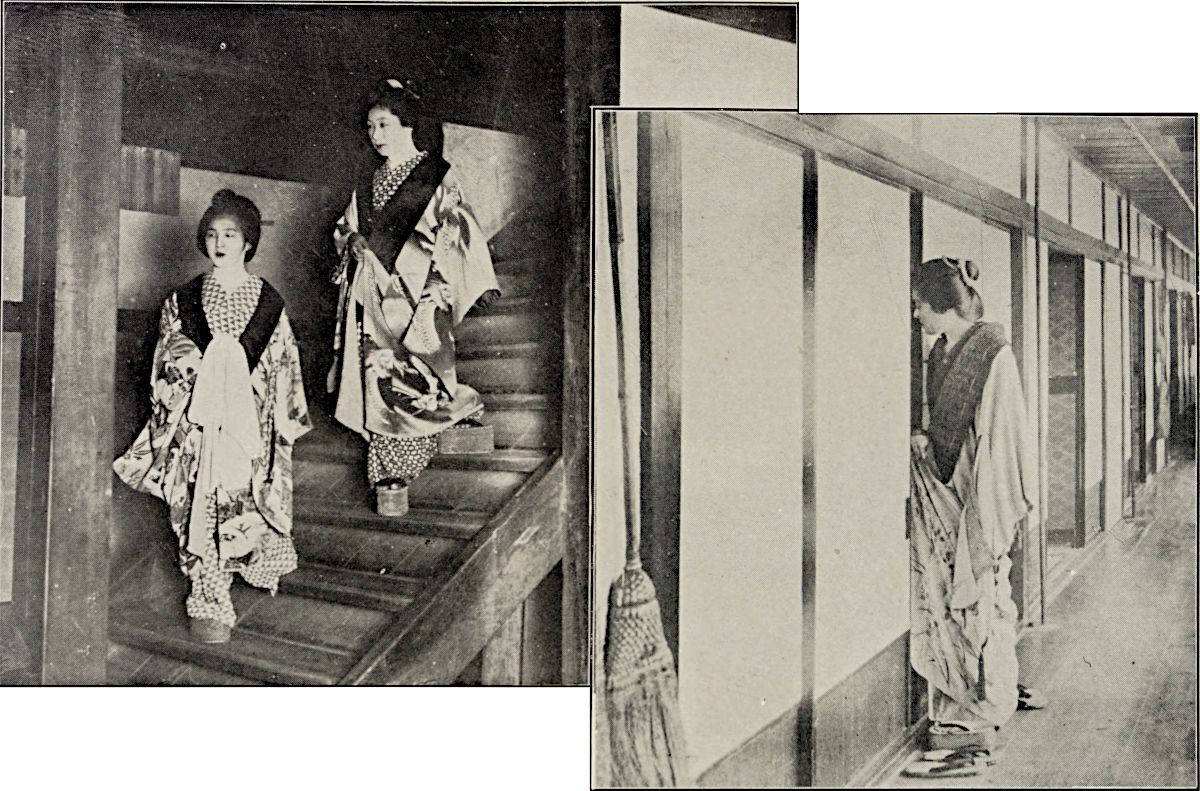
Courtesans on their “Rounds” visiting Various Guests at Night. Courtesan entering a Guest’s Room.