“O cha wo hiku” to iū koto. (“Tea powdering.”)
Reading edition
It is remarked in the “Dōbō Go-yen” (洞房語園) that the term o-cha wo hiku, as applied to women of ill-fame who have no guests, is of ancient origin and should be considered as one of the peculiar idiomatic expressions of the Yoshiwara dialect: everywhere in prostitute quarters some special dialect is exclusively used, and this is more especially true of the Yoshiwara of Tōkyō. In the era of Keichō (1596–1614) the servants of the various tea-houses at Uji (near Kyōto) were practically unlicensed courtesans, and were in the habit of carrying on illicit intercourse with guests who patronized their establishments. These women employed their leisure time in pulverizing tea (o-cha wo hiku) for the tea-drinking ceremony, and in course of time this expression “o-cha wo hiku” came to be applied (as a slang phrase) to a courtesan who had no guests in consequence of her unpopularity. By and bye this phrase was brought up to Tōkyō by natives of Uji and Kyōto and became one of the idiomatic expressions of the Yoshiwara. It is now used throughout the entire Empire.
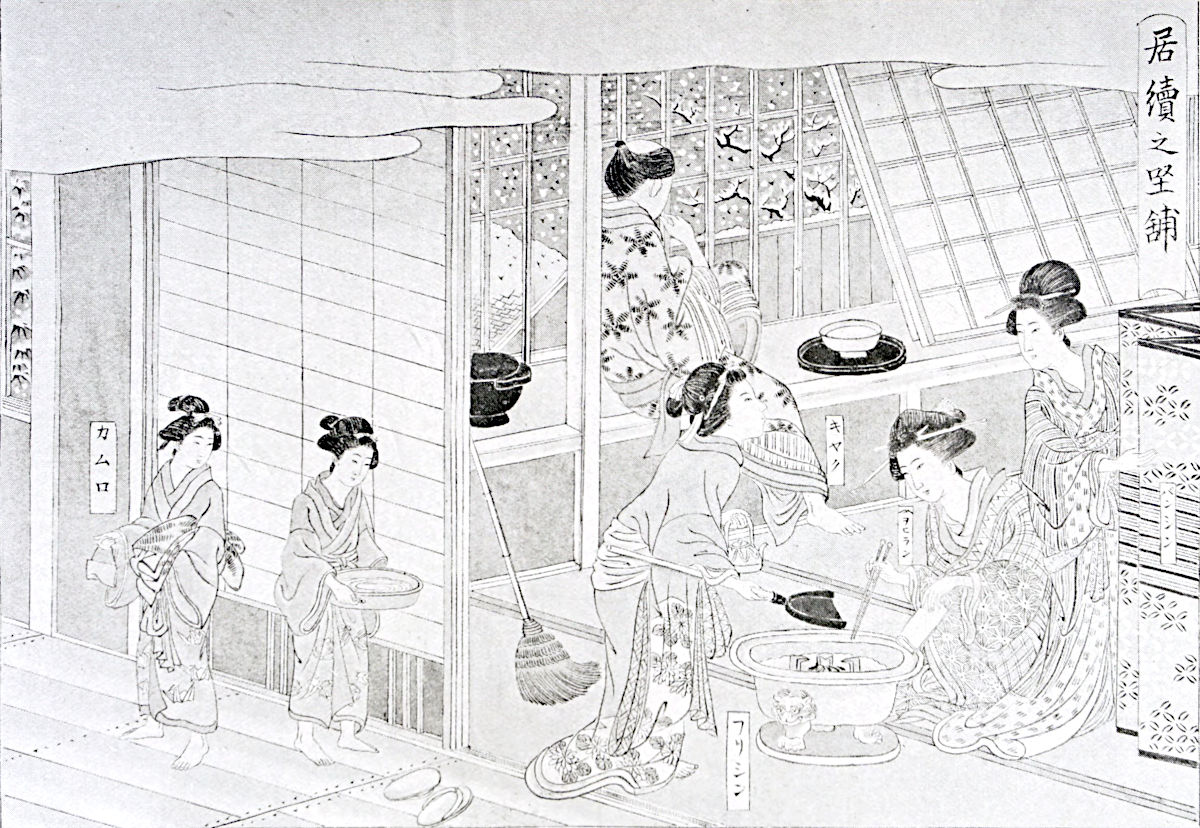
居瀆之㘴舖
Guest Detained by “Love and Stress of Weather.” Kiōwa period (1801 to 1803).
(
After the Picture by Kitagawa Utamaro.
)