Classes of Prostitutes.
Reading edition
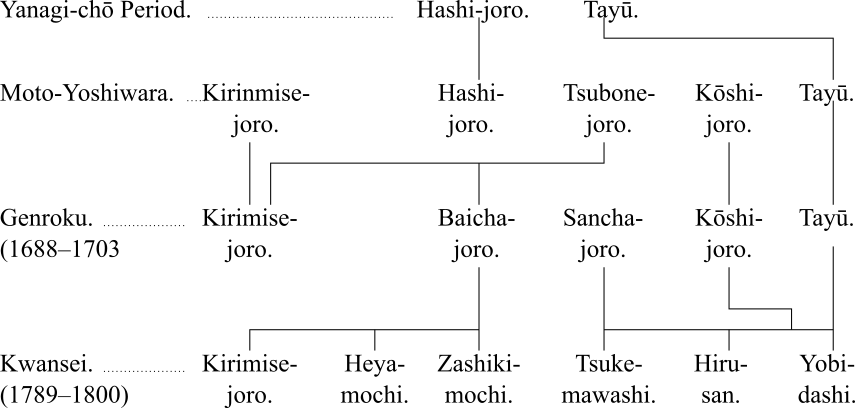
The custom of dividing courtesans into higher and lower classes had already sprung into existence while the Yoshiwara was situated at Yanagi-machi (close by the present Tokiwa-bashi). They were then classified as Tayū and Hashi-jōro.22 During the period of the Yoshiwara three classes were added, viz:—Kōshi-jōro, Tsubone-jōro, and Kirimise-jōro. After the opening of the new (Shin) Yoshiwara, Hashi-jōro and Tsubone-jōro ceased to exist, while at the same period (Genroku = 1688–1703) Sancha-jōro and Umecha-jōro came into existence. After the era of Kwansei (1789–1800) the classes in existence were:—Yobi-dashi, Chūsan, Tsuke-mawashi, Zashiki-mochi, Heya-mochi, and Kirimise-jōro. Particulars of these changes are mentioned in various old books and can also be gathered from the lists of courtesans published in those times. As to the origin of the names Tayū, Kōshi, Tsubone, etc., these terms appear to have been derived from a similar classification in vogue in Kyōto, and if my readers are curious to trace these derivations they will do well to refer to a book called the Dōbō-Goyen (洞房語園) for further information.
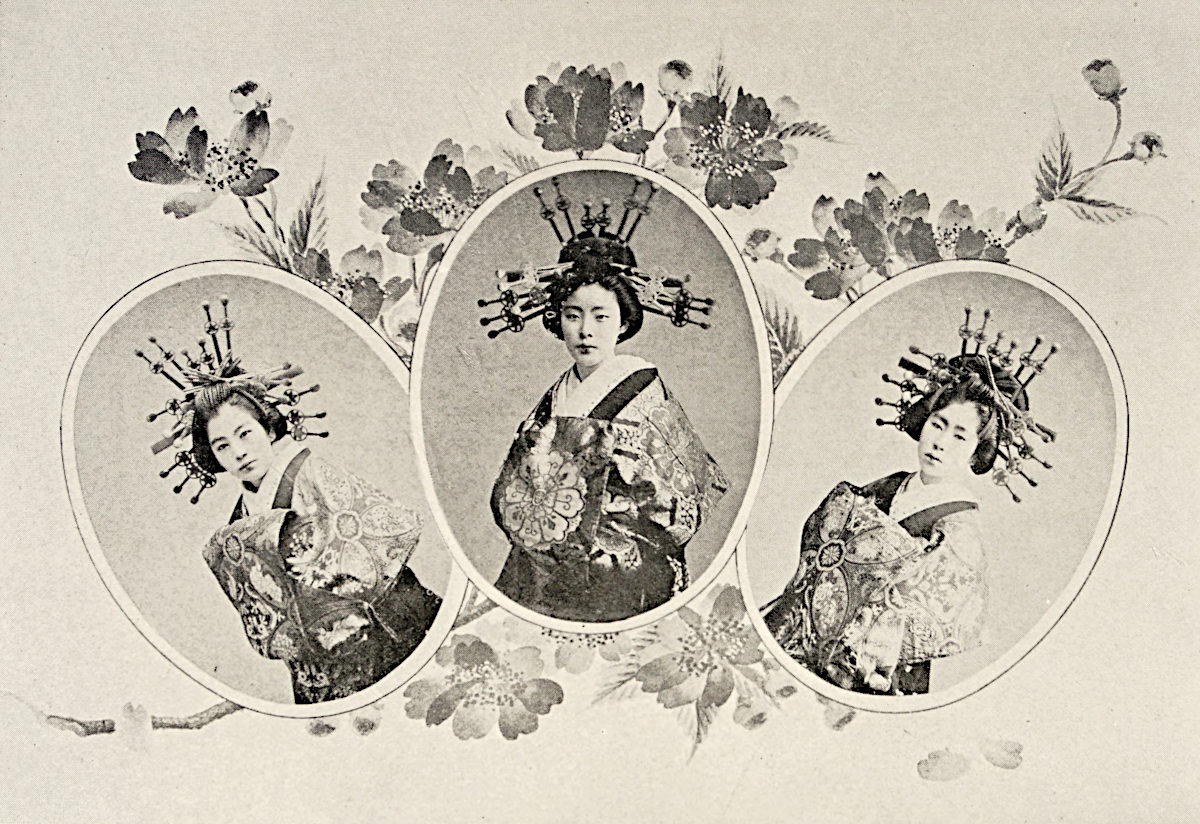
Types of Modern Courtesans.
The Tayū was a courtesan of the highest class, excelling her unfortunate sisters both in respect to her beauty and accomplishments, and, as previously mentioned, this appellation had come into existence while the kuruwa was yet in Yanagi-chō. In the 20th year of Kwan-ei (1642) there were 18 tayū, in the era of Manji (1658–1660) 19, and in the 2nd year of Kyōhō (1718) 14, but between the 21st year of Kyōhō (1736) and the 1st year of En-kyō (1744) the number of tayū decreased to 5. In the 4th year of Kwan-en (1751) we only find one tayū in the whole Yoshiwara, and by the end of the Hōreki era (1751–1763) the class had entirely disappeared. The age-dai-kin (fee) of a tayū was at first fixed at 37 momme (about Yen 6.14), but by the era of Teikyō (1684–1687) it had been doubled. In the era of Kwampō it appears to have been 97 momme of silver (about Yen 16.00). At that period the class of courtesans styled Hashi-jōro was a very low one, and no reliable record is extant from which we can obtain particulars of their fees.
The Kōshi-jōro were similar to those known as Tenjin in Kyōto. These women had their rooms within the ō-gōshi (great lattice doors or bars) and the Dōbō-Goyen (洞房語園) states that these women had the prefix of Kōshi placed before the word jōro (courtesan) to distinguish them from Tsubone-jōro. Kōshi-jōro were next in position to the Tayū, and their fee was at first 25 momme (Yen 4.15), but in the era of Kwampō (1741–1743) it rose to 60 momme of silver (about Yen 10.00). It is mentioned in the Naniwa Seirōshi (浪花青樓誌) published in the 10th year of Hōreki (1760) that the term Tenjin was in use not only in Kyōto but in Shim-machi, Ōsaka city. Next to the Kōshi-jōro came the Tsubone-jōro,23 and their fee was originally 20 momme silver (about Yen 3.32), but, after the appearance of the Sancha-jōro, competition reduced it to 15 momme (about Yen 2.49).
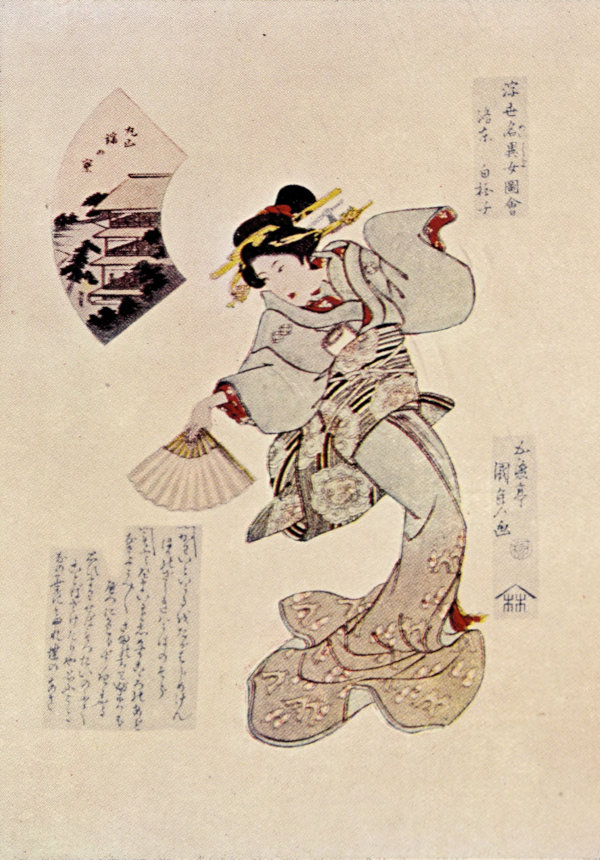
An Ancient “
Shirabyōshi
.”
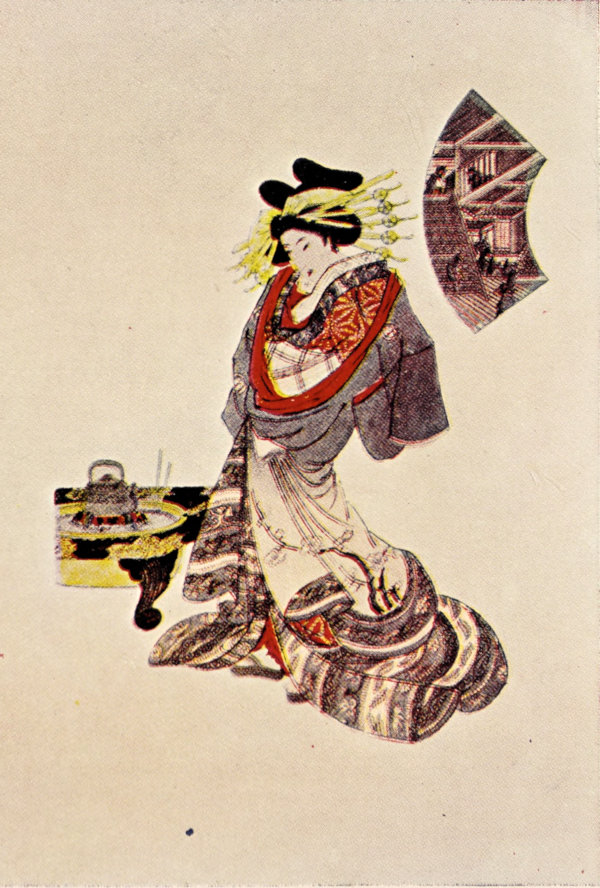
A “
Yobidashi
” of the Yoshiwara.
In the front of the houses where Tsubone-jōro resided, wooden lattice work screens, cut in a “figure of eight” all over pattern, of six feet in height were erected, presenting a most curious spectacle. This class of courtesans were in their turn ousted from popularity by the Umecha-jōro about the era of Genroku (1688–1703). It is true that after the era of Temmei (1781–1788) a class of prostitutes bearing a similar name came into existence, but these latter-day Tsubone-jōro were the lowest of low women and are not to be confounded with their predecessors.
Kirimise-jōro were the predecessors of the present Ko-mise-jōro (“small-shop-courtesans”) to be found by the creek. These women lived in naga-ya (barrack-like tenement houses) and offered their services for the modest sum of 100 mon (10 sen): in consequence of this latter fact they were described as hyaku-zō (or freely rendered—“100 mon women”).
At the beginning of Kwambun (1661–1672) a still lower class of harlot, called Kendon, arose, and later on another lower grade of strumpets came into existence under the euphonious name of Teppō (a gun). The Teppō charged 2 shu (about Yen 1.25) for a day and night, but after 10 o’clock at night even this sum was reduced, on strictly business principles, to 400 mon (40 sen).
Sancha-jōro was the name of a class of women which sprang up when a raid was made on the jigoku (“Hell women”) of Yedo and the furo-ya (bath-house) women were brought into the Yoshiwara in the 5th year of Kwambun (1665). The derivation of the word Sancha is very curious, and its explanation lies in a phonetically evolved pun. Sancha was the old time word for powdered tea, nowadays known as matcha or hikicha. In ancient times ordinary leaf tea was infused by placing it in a bag, and shaking this bag about in boiling water until the liquor was extracted. In the Japanese the verb “to shake” is furū, but this word is also used (especially by courtesans) to mean—“to repel” or “manifest dislike to” a guest. Ground tea (Sancha)—on the contrary—was not placed in a bag, but put right into the water, and therefore it required no shaking. The negative form of the word furū is furazu, and furazu has the sense not only of “not to shake” but “not to repel.” In the Dōbō-Goyen it is stated that many of the better class courtesans were proud as peacocks, and in the zenith of their prosperity they would at times display marked antipathy to some of their guests, going so far as to repel (furū) the visitor altogether. The newly arrived courtesans who had been brought into the Yoshiwara from all parts of Yedo City were quite tractable and docile and did not attempt to rebuff (furazu) would-be guests and hence the name Sancha-jōro (“Ground-tea harlots”). The fee of the Sancha-jōro was at first 1 Bu (gold) (about Yen 2.50). This class of women became very popular in course of time, and by the era of An-yei (1772–1780) and Temmei (1781–1788) this popularity had become so marked that the number and value of Tayū and Kōshi began to decrease. By the end of Hōreki (1763) the last-named classes disappeared, and as soon as they ceased to exist the Sancha-jōro succeeded in monopolizing the whole field. About that time, however, there arose a superior class called the Yobi-dashi, and these again were divided into two grades, distinguished in the Yoshiwara Saiken (list of prostitutes) of the period by the marks and respectively. Those marked corresponded in all respects to the tayū. Their age-dai for 24 hours was 1 ryō 1 bu (about Yen 12.50) while those bearing the sign were similar to the Kōshi-jōro, their age-dai for a day and a night being 1 ryō (about 10.00 Yen).


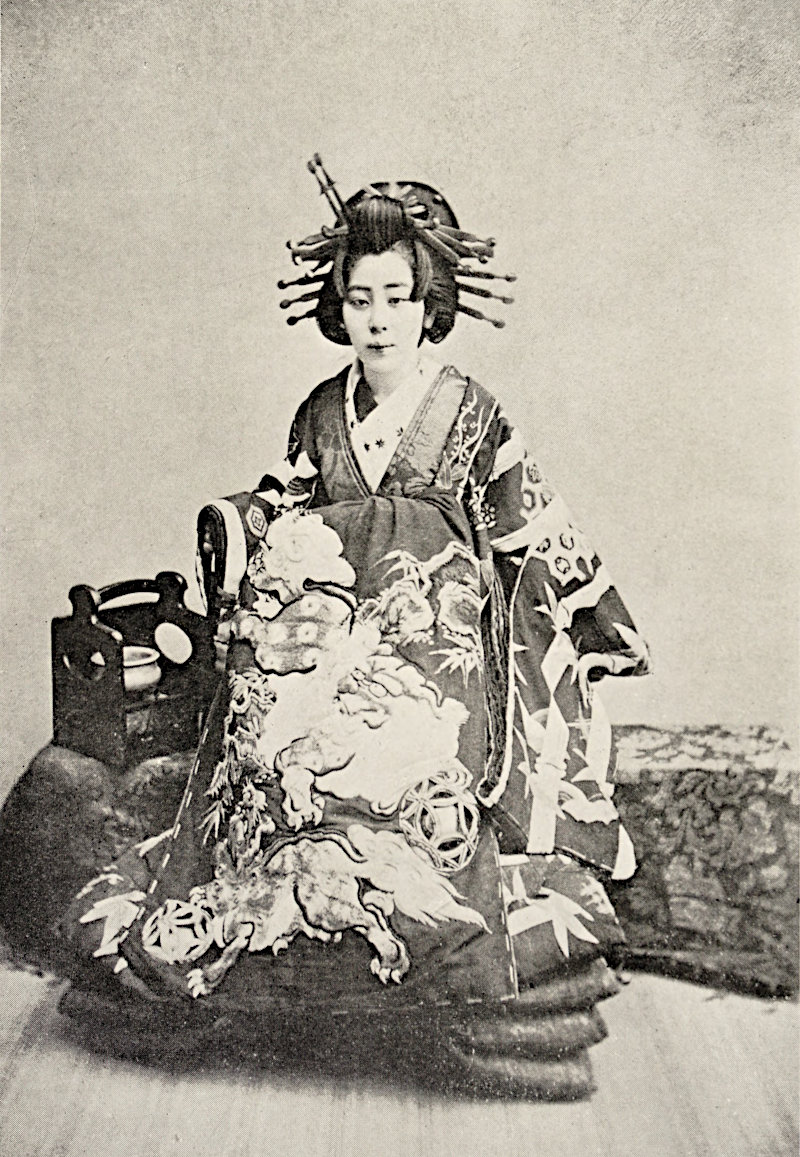
Type of Modern Courtesan in “State” Costume.
The Sancha were divided into Chūsan (or Hirusan) and Tsuke-mawashi, their charges being 3 bu (about Yen 7.50) and 2 bu (silver) (about Yen 5.00) respectively. Both the Yobi-dashi and Chūsan walked about the Naka-no-chō on hachimonji geta (clogs) whereas the other women, with the exception of the Tsuke-mawashi, appeared in the hari-mise (or cage-like enclosure where the courtesans sat on exhibition). About the era of Genroku (1688–1703) a class of women named Baicha-jōro came into existence and entered into competition with the San-cha, but failed to maintain their footing. The fee of these Bai-cha was originally 10 momme (silver) (about Yen 1.66) but it was raised to 15 momme (about Yen 2.50) afterwards. By the era of Kwampō (1741–1743) the Baicha had well-nigh disappeared. The Zashiki-mochi and Heya-mochi who existed up to the time of the Restoration are said to have been the remnants of the Baicha-jōro.
Since the Restoration (I-shin) the different classes of prostitutes have not been distinguished by any special names, but their age-dai varies according to the position of the brothels to which they belong. At present (1899) the fees charged run from 20 sen to 1 Yen 20 sen, and the women are divided into nine classes. The fees of the women in ō-mise (large brothels) and naka-mise (medium brothels) are Yen 1.20 and 90 sen respectively. These large and medium-sized establishments must be visited through the agency of hikite-jaya, and the latter receive a commission of 10 per cent, on the business introduced by them.
In passing, it may be of interest to readers to peruse the following extracts from the “Kōshoku-Shūgyō-Shokoku-Monogatari,” (好色修行諸國物語), written by the well-known novelist Kyōden (京傳) under the nom de plume of Shōzan (笑山). In this work elaborate descriptions of Yobi-dashi, Zashiki-mochi, and Heya-mochi are given, and they portray a vivid picture of the lives and customs of those women between the era of Temmei (1781–1788) and Bunsei (1818–1829).
△ Yobidashi. (Fee from 1 Ryō 1 Bu to 1 Ryō 3 Bu: about Yen 12.50 to Yen 17.50). The gorgeousness of her wearing apparel almost defies description. Her dress consists of a long robe of richly embroidered silk brocade. Her head is ornamented by a dazzling glory of hair-pins (made of the finest tortoise-shell) which glitter around her head like the lambent aureole of a saint, while her ravishing beauty is such that the mere sight of her face will steal away one’s very soul. * * * * * From this description, the neatness of her apartments, the tasteful arrangement of her furniture, and the dainty elegance of her personal effects may well be imagined. Every oiran of the Yobidashi class goes out walking in the Naka-no-chō as soon as it is dusk. She is attended by two kamuro (young female pages), two grown up female attendants (shinzō), a man bearing a box-lantern (hakojōchin), a footman holding an open long-handled umbrella, and an old woman (yarite) who acts as her chaperone.
△ Zashiki-mochi. (Fee 1 Bu about Yen 2.50). These women belong to the ham-magaki brothels. Their “business hours” in the day-time are from 12 o’clock at noon to 4 o’clock in the afternoon; and in the evening from sunset until 12 o’clock (midnight). * * * * * Their garments are made chiefly of velvet, crêpe, satin, figured satin, or habutaye, and their girdles (obi) of gold brocade, velvet, damask, etc. A couple of rooms of eight mats each are generally placed at the disposal of each courtesan.
Their futon (a kind of soft mattress) are of velvet or damask (heavily wadded to a thickness of about nine inches) covered on the surface with a specially woven crêpe, and each woman possesses two such futon. The coverlets used at night are of black velvet lined with red crêpe.
△ Heyamochi. (Fee 2 shu: about Yen 1.25).
Although these belong to the smaller establishments, there are many fine looking women among them. * * * * * Velvets, crêpes, and other silken fabrics are employed in making their garments and bedding.
△ Tsubone-jōro. (Fee 100 mon—about 10 sen—or 200 mon—about 20 sen for a day and night).
These are an exceedingly low class of women and their houses are frequented by the riff-raff and scum of the neighbourhood exclusively.
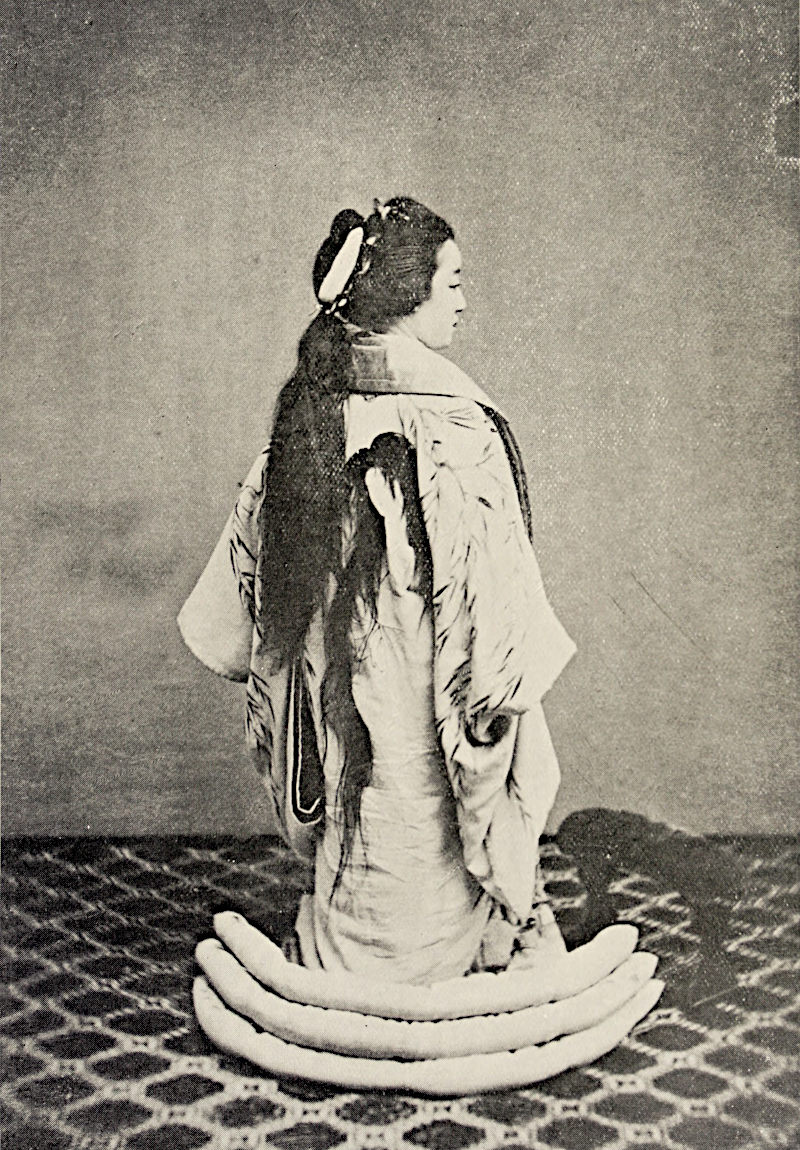
Type of Dress worn by a Courtesan.
In this neighbourhood there is some strange slang employed. A samurai—for example—is called “Yama San;” a priest “Gen San;” a merchant “Chōnin San;” a young man “Musuko San;” and other queer nicknames are given to the various classes of people who visit the locality. These women used to lie in wait for passers-by, and pulling in any likely patron they could find would slam to the door. A few minutes afterwards the door would reopen and the guest depart, and this process would be repeated ad infinitum.
In a humorous work by Ikku called the “Sato Kanoko Shina Sadame” (里鹿子品定) the tayū, kōshi, sancha, zashiki-mochi and heya-mochi are wittily compared to flowers, as follows:—Tayū being scarce nowadays may be compared to the cherry-blossom, for as no other flowers can equal the cherry in point of colour and fragrance, in like manner the beauty and loveliness of the tayū surpasses that of all courtesans. Kōshi-jōro, being mild and gentle, are like the single-petaled cherry-flower booming luxuriantly, for they impose no sense of restraint on anyone. The prosperity of the Sancha and Zashiki-mochi may be likened to the red plum blossom (kōbai) because its colour is so deep (by means of a double entendre this means that the amours of these women are very numerous).
The heya-mochi are like the white plum-blossom, pale in colour but very odoriferous. (!!!).
The following is a chronological table of the various changes of class and nomenclature of the joro:—