Kamuro. (Young Female Pages.)
Reading edition
It is mentioned in the “Yoshiwara Daizen” (吉原大全) that Kaburo (or Kamuro) was the name of young females in the Imperial Court who had the greater part of their head shaven and only a long kind of scalp-lock left hanging. The little girls who attended to the courtesans in ancient times were dressed in imitation of the child attendants formerly attached to the Court, and were styled Kiri-Kamuro. Their portraits are often seen in pictures of the Tosa and Hishikawa ukiyō-e (realistic pictures) schools. The clothes of the Kamuro were cha-jōro named Miyakoji, belonging to the Naka-Ōmiya in chiefly made of white bleached linen, on which was dyed a pinetree pattern (waka-matsu no some-moyō), or of dyed calico.
The Tayū and Kōshi-jōro were entitled to two and three Kamuro attending upon them respectively while the Sancha-jōro had only one; this system of limiting the number of the Kamuro of a courtesan was instituted to distinguish the class to which she belonged. The wearing of a kind of clothes, made of material called ōgiya-zome, by the Kamuro was considered fashionable. In the era of Hōyei (1704–1710) a San-Sim-machi, was attended by two Kamuro when she walked through the quarter, and this excited a good deal of comment, the elders of the place claiming that it was contrary to established custom. The matter, however, was settled when Miyakoji explained that one of the little maids who had accompanied her was the servant of a sister courtesan. This precedent once established, it became a custom for Sancha-jōro to sometimes walk out attended by two Kamuro under the pretext that one of these girls was not her own servant. It is said that this Miyakoji was a very popular woman, and that in the house of Naka Ōmiya, to which she belonged, her memory was preserved for several generations by means of calling her successors by a similar name. Since then Wakashu-Kamuro and Bōzu-Kamuro came into fashion, and of later years it became the custom for Kamuro to wear the same kind of beautiful clothes as the courtesan on whom she was in attendance. Even at the present day it is the custom for the Kamuro to wear cotton clothes, dyed with a pine-tree pattern, during the first week in January, a period which is known by the Japanese as matsu no uchi.
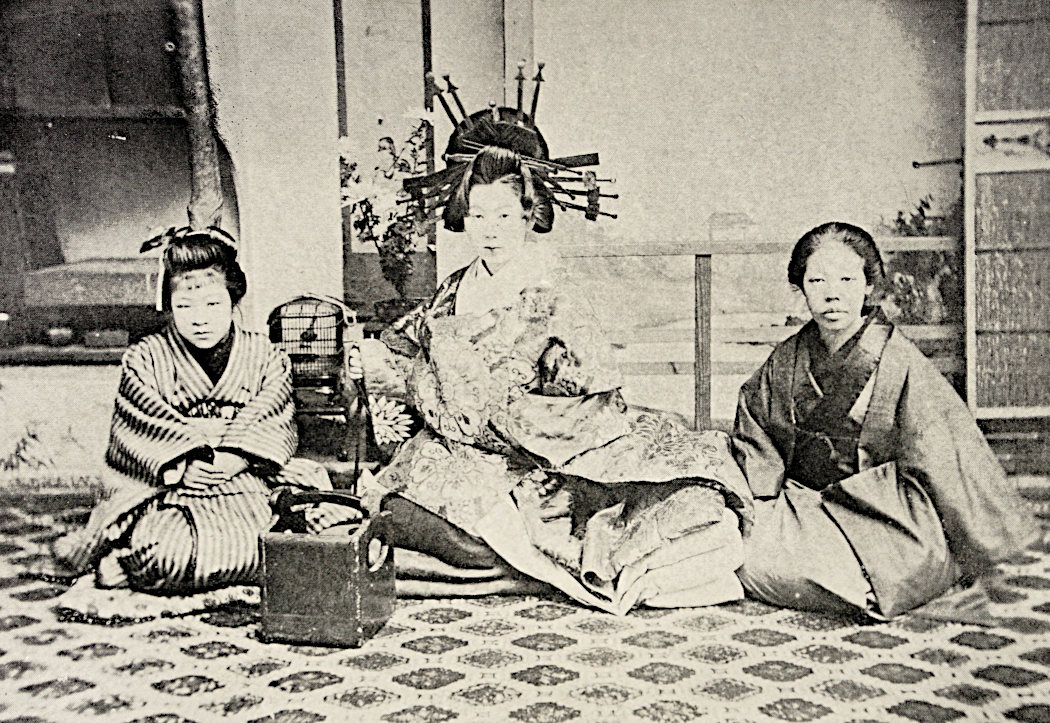
Modern Courtesan and Her Attendants.
The “Yedo Kwagai-Enkwaku-Shi” (江戶花街沿革誌) says:—When a young girl was brought to a brothel as a Kamuro, it was usual for the keeper of the house to see and name her. In the selection of these names high-flown cognomens such as were bestowed on courtesans were carefully avoided, and pretty innocent names were chosen. These names rarely exceeded three syllables, and never four in any case. In the event of two Kamuro being attached to one courtesan, names were given them to match: e.g. one being called “Namiji” (waves) the other would be named “Chidori” (plover), or if one was called Kureha (吳織 was one of the weavers who came from Go—a kingdom of China—in ancient times) the other would receive the name of Ayaha (a weaver from another kingdom in China.) The courtesan to whom the Kamuro belonged was called her “ane-jōro” and this ane-jōro found the Kamuro in clothes and paid all other expenses in connection with the child. The keeper of the brothel watched the behaviour and disposition of all the Kamuro in his houses, and if any promised to become famous courtesans he had them instructed in every branch of deportment, and taught the banjo (samisen), harp (koto), floral arrangement (ikebana), incense-burning (senkō 燃香), tea ceremonial (cha-no-yu), and other accomplishments which were considered necessary in aspirants for the “profession.” The behaviour of Kamuro towards their ane-jōro was generally gentle and submissive, and they waited on her most assiduously. They attended to all her wants, waited on her at meals, lit her pipe when she desired to smoke, accompanied her when she promenaded in the Naka-no-chō, and ran all her errands in the neighbourhood. The Kamuro would also perform trifling services for the guests of her ane-jōro such as bringing water for washing their hands, etc. It was the custom originally that no Kamuro should assist at a wine party, as she was expected to remain sitting by the side of her mistress in the same manner as the page of a feudal lord sat behind his master, but later on this custom was changed and now the Kamuro wait on guests and pour out the saké. When there was no available ane-jōro the Kamuro used to wait on the master of the house, and if the latter found her smart, beautiful, and likely to become a popular courtesan, he took her himself as a sort of adopted daughter, and had her educated at his own expense so as to fit her for the calling. On the other hand, girls who gave no promise of turning out well in the business were left without any education whatever, became household drudges pure and simple, and ended their days in dismal ignorance: under the most favourable circumstances, this latter class of Kamuro would not be able to attain to reading characters other than hiragana (an easy form of native script) and to a slight smattering of samisen playing. When a Kamuro attached to a courtesan was sick, her place was taken by one of the girls attending on the master, and it was also a custom for one brothel to make a loan of Kamuro to a neighbouring house whose keeper was short of these children. There were no particular rooms assigned to the Kamuro but they generally slept in a room next to that of their ane-jōro. They took their meals in the kitchen together with Shinzō (see chapter headed thus) and Wakaimono (see that heading) and in the day-time were allowed to romp about the galleries of the brothels and play together.
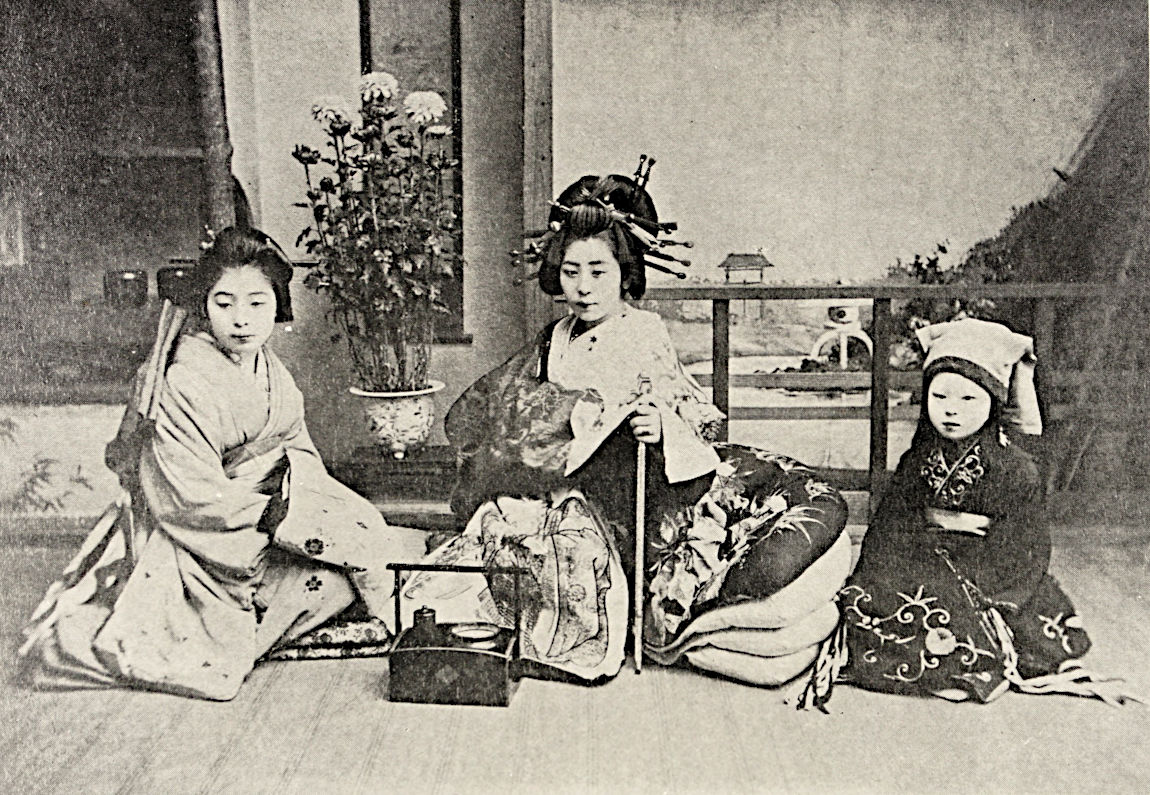
Modern Courtesan, Attendant, and
Kamuro
.
The term Kamuro has only been employed in the Yoshiwara, and in the Okabasho (which includes the prostitute quarters at Shinagawa, Shinjuku, Senju, etc.) young servant maids were either called mame-don or ko-shoku. Even in the Yoshiwara there was a rule limiting the number of kamuro to attend to a courtesan of a particular grade.