Shinzō.
Reading edition
In the “Yoshimura Daizen” (吉原大全) it is mentioned that the name of Shinzō (newly constructed) has been borrowed owing to the fact that a newly launched ship is so called. When kamuro (these girls generally entered service between the ages of five to seven years) had grown up to thirteen or fourteen they were made Shinzō, according to the discretion of the ane-jōro. About ten days prior to this event the girls obtained some ohaguro24 (collected from seven different friends of their ane-jōro) and blackened their teeth for the first time. On the actual day of the ceremony soba (buckwheat macaroni) was made and partaken of by all the inmates of the house, and presents of the same food were sent to every jōro-ya, tea-house, hikite-jaya, and funa-yado with which the brothel was acquainted and on friendly terms. Sometimes sekihan (rice boiled with red beans) was distributed instead of buckwheat macaroni. It was also the custom on these occasions to put out a large number of seirō (vessels for steaming food) ranged in a row in front of the brothel, and to place them on a long table of unpainted board measuring from 9 to 18 feet in length. On a table (also of unpainted wood) inside the brothel, in the room of the ane-jōro, were exhibited rolls of dress materials, tobacco-pouches, fans, towels, etc., which were to be given as congratulatory presents to friends of the house as souvenirs of the ceremony. In front of the tea-house or funa-yado, where the guest who was supposed to finance the ceremony was wont to come, a number of seirō were piled up, and to all the tea-houses and funa-yado presents of mushi-gwashi (steamed cakes) were distributed. On this day the interior decorations of the brothel were so magnificent and splendid that according to ancient writers the spectacle defies the power of language to adequately portray them. The shinzō, or imōto-jōro did not at once appear in the “mise”. For a week or more from the day of her initiation she promenaded the Naka-no-chō (clad each day in different garments) under the guidance of her ane-jōro, and in case of the latter having any imōto-jōro she would bring her along. When the week of introduction was past, the fellow-courtesans of the girl would “shimai-tsu-kawasu” her to their ranks by engaging her and paying her agedai every day in turn, and she would receive congratulatory presents from her friends. Sometimes two or more shinzō were initiated in one house at the same time. When a girl who had not been brought up in the Yoshiwara was made a shinzō she was technically termed a “tsuki-dashi” (one who is pushed out to the front) and as, in this case, there would be no ane-jōro to look after her interests, the kutsuwa (explained further on) provided her with the necessary bedding, wearing apparel, and furniture suited to a heya-mochi, chūsan (hirusan?), or tsuke-mawashi as the circumstances required. The amount of money spent greatly depended on the personal attractions and beauty of the girl. As in the case of a regularly trained fille de joie, she promenaded the Naka-no-chō, accompanied by another shinzō, for the space of a week from the day when she made her début, and, as a necessary accessory to this ceremony, a present of sakazuki (small saké cups), each bearing the name and crest of the debutante, was made to all the various tea-houses and funa-yado.
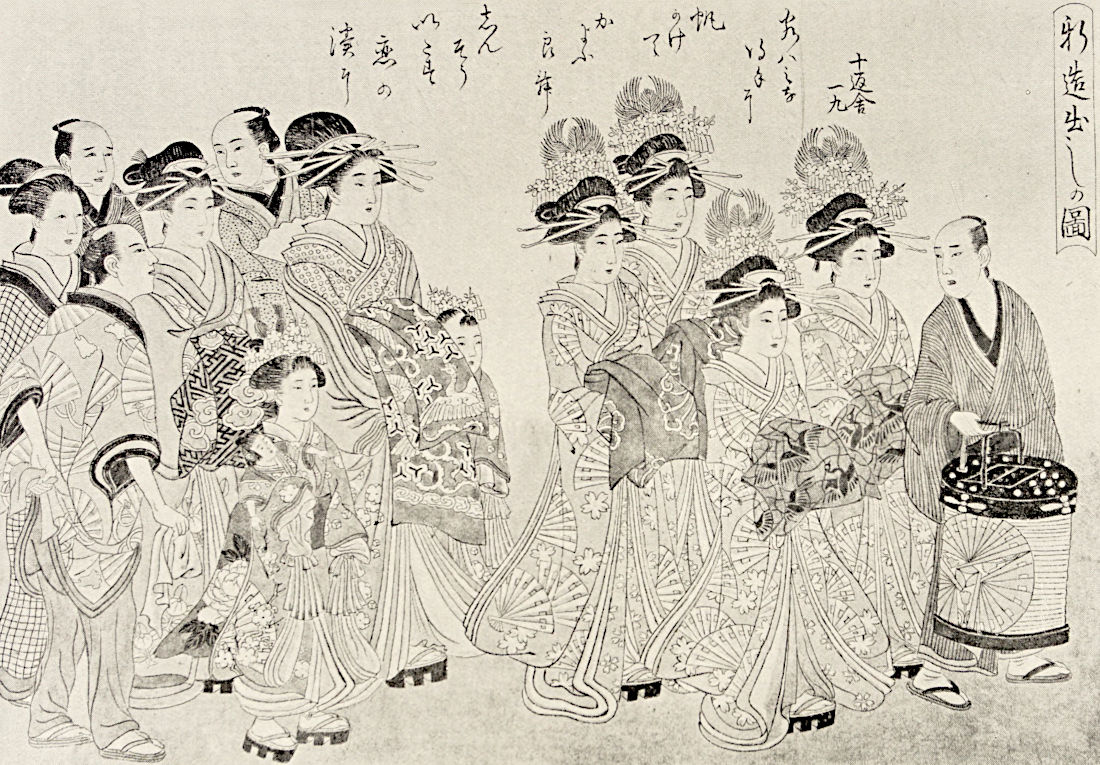
新造出しの圖
First début of a “
shinzō
” in the Kiōwa period (1801 to 1803).
(
After the Picture by Kitagawa Utamaro.
)
There was another class of prostitutes in the Yoshiwara called yakko which originally, it seems, was generally recruited from the ranks of samurai women. Every now and again a female of gentle birth would be guilty of a lapse from virtue, and, in order that the stern code of samurai honour might be vindicated, she would be sent to the public stews for a term of three, or even five, years as an exemplary punishment for her immoral behaviour. In later times all public women who were sold into the Yoshiwara from other quarters were similarly termed yakko.
In the “Yedo-Kwagai Enkakushi” (江戶花街沿革誌) it is stated that the shinzō were divided into two classes, viz—the furi-sode-shinzō and tome-sode-shinzō. For the sake of brevity, the former was sometimes called “Furi-sode” or “Furi-shin,” and the girls themselves were either recruited from among the kamuro who had attained the age of 13 or 14 years, or by outsiders specially engaged for the purpose. When the furi-shin had reached an age when furi-sode (long sleeves) were no longer suitable to them, they were attired in the same manner as their seniors. With the change of their garments came the change of the general name by which they were known, and they were now called “tome-shinzō” (short-sleeves shinzō) or more simply “tome-sode” (short-sleeves) or else “tome-shin.” When a kamuro was about to become a “furi-shin,” her master would first of all summon her parents and surety (shōnin) and hand over to them a baishū-shōmon (certificate of sale) in exchange for the ordinary hōkōnin shōsho (certificate of hire) which had been given them when the young kamuro was first engaged. The master would also hand over a certain sum of money to the parents, under the expressive name of mi-no-shiro-kin (money for the body), the amount of which depended on the beauty and accomplishments of the unfortunate girl. It would, however, sometimes happen that the astute parents of the girl had been in communication with a zegen (a professional procurer) prior to this event, and when they were summoned by the brothel-keeper they insisted on removing their daughter as the term of her engagement as a kamuro had expired: they then sold the girl, at a greatly advanced price, to another brothel through the agency of the zegen. This action of the girl’s parents meant some loss to the original master, as he had to go to the trouble and expense of training another courtesan in all the tricks of the profession, whereas, if he had secured the kamuro, he would have had a girl who knew every little point regarding the business routine, and who was already trained and ready to commence her new duties. As the original contract was to employ the girl as a kamuro, the master was powerless to resist the wishes of the parents when the term of apprenticeship was up, so, as a precautionary measure against either future disappointment or dunning, the brothel-keeper, in many instances, purchased the child outright, and demanded a certificate of sale when he first engaged her as a kamuro.