Yo-misé “Suga-gaki” no koto. (The night exhibition and the suga-gaki.)
Reading edition
In view of the approaching “mixed residence” of foreigners in the interior, it is said that the authorities are contemplating the advisability of interdicting the present custom of exposing yūjo in “cages” to public view; and that Susaki will be the first prostitute quarter to discontinue this somewhat scandalous practice. Even as it is, the exhibition of yūjo in cages is not openly recognized except in the Yoshiwara and a few other yūkwaku, so the probability is that is will be discontinued ere long, even without the interference of the local governments. While many have no sympathy with the “hai-shō-ron”42 movement which found a good many supporters in Japan a few years ago, it is their profound conviction that the prostitute quarters should not be made a show-place, that display for the purpose of the attracting attention should be discouraged, and that reverence for humanity and common chivalry should forbid even the semblance of anything approaching the public exhibition of unfortunate women, however low they may have fallen. At the present time, the majority of the Japanese public do not seem to see anything shocking or strange in the sight of hundreds of gaudily attired courtesans sitting in rows exposed to public view as living “samples,” and this tends to bridge over the sharp line of demarcation which should exist between the demi-monde and honest women. This again leads to a good deal of freedom and license of speech, and permits the doings of yūjo, and the libertines who support them, to be unblushingly chronicled in newspapers and indelicately alluded to in novels. Then again, at the time of the festival of the “Tori-no machi” the various yūkwaku are crowded by a vast multitude of sight-seers including thousands of young persons of both sexes: this means that very young and perfectly innocent boys and girls are so accustomed to the strange scene, that they see no indelicacy in it, and so they grow up knowing far more about these matters than is good for them. To Europeans and Americans it is a strange sight to see family parties, including modest young girls, wending their way through the crowded streets on the night of the Tori-no-machi, buying various knick-knacks and gazing at the painted beauties in their gorgeous dresses of glossy brocade and glittering gold. It is certainly opposed to foreign ideas to take one’s young daughter sight-seeing in a prostitute quarter!
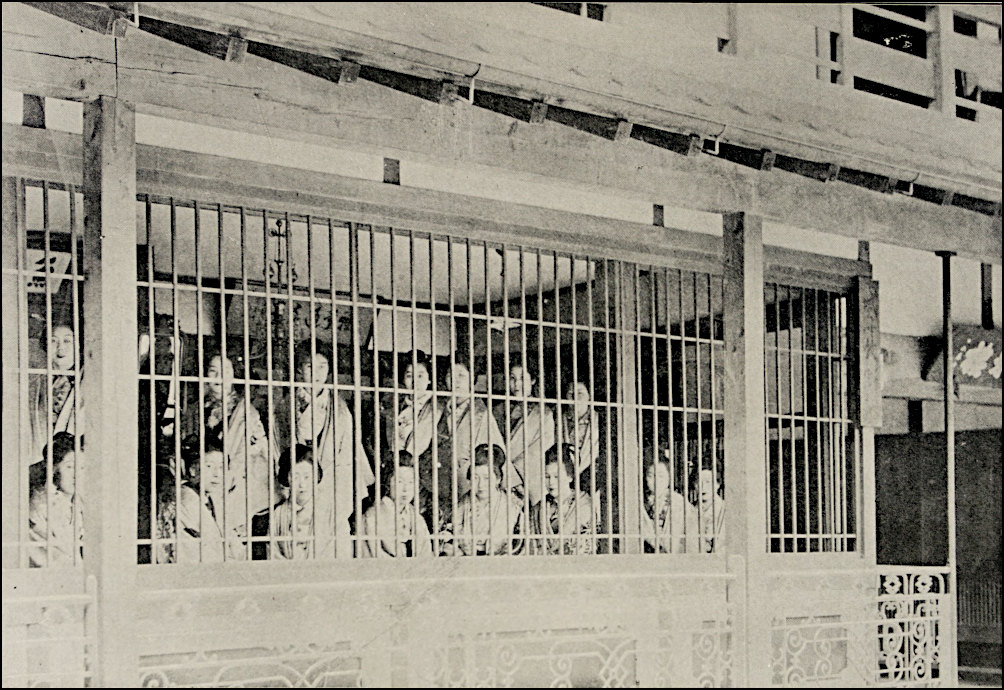
Modern Courtesans exposed “on view” in their cages.
The chief objection to the public exhibition of handsomely dressed women is that it tempts youths who might otherwise remain chaste, and attracts them to the brothel-quarters. It is true that it is a boy’s nature to wish to see all unusual spectacles and pageants, and so long as they exist he will certainly make it a point of going and feasting his eyes upon them. If the authorities decide to prohibit the present system of “showmanism” it will mean that men will be obliged to enter the houses in cold blood for a definite purpose, and not be exposed to the temptation of being drawn in by the sight of a pretty face exposed as “on sale.” The authorities would also be well advised to absolutely forbid any kind of public fête or festival from being held within the precincts of yūkwaku, to have the gates strictly guarded as of yore, and to refuse admittance to either women or boys unconnected with the brothels. This would be a blow to the “business” for a time, but it would result in a healthier moral tone among the rising generation, and do good in the direction of diminishing, if not preventing, the serious and far-reaching troubles and entanglements which occasionally involve young men in great distress and lead them on to commit actual crimes to gratify either their own salacious desires or the whims of the “scarlet women” with whom they are infatuated.
While the quarter was still situated at the Moto Yoshiwara the “profession” was carried on in the day-time exclusively, but when, on the 9th day of the 10th month of the 2nd year of Meireki (24th November, 1656), Ishitani Shōgen (the Machi-Bugyō) gave permission for the removal of the brothels to the present sites, the carrying on of business at night was also sanctioned.
This proving far more convenient for visitors who were not willing to be seen by others entering the quarter, the number of day-guests gradually dropped off, and at length nearly everybody came to visit the Yoshiwara after dark exclusively. In this manner, the brothels obtained the privilege of carrying on their “trade” both in the day and at night, and the fees of courtesans (age-dai) were divided into “night” and “day” fees. Each one of these fees was known as a kata-shimai (half engagement). When the “day” hours were over, a large lantern (andō) was hung out in front of every brothel, and thus a distinction was made between “day and night”. The Dōbō Gō-en I-hon-kōi (洞房語園異本考異) says that:—
The reason why the profession of brothels was prohibited at night during the era of Tenna (1681–1683) was because that period was immediately subsequent to great internecine strife. Later on, in the case of the Yoshiwara only, this restriction was removed, and since that period the occupation has everywhere been carried on at night. In the Yoshiwara for instance (as in other quarters), “day work” became merely nominal owing to the simple reason that there were but very few guests in the broad daylight.
The “Yoshiwara Taizen” (吉原大全) remarks:—
The “day” was from noon until 3 P.M. and the “night” from 5 to 10 to o’clock P.M. Apparently finding that 10 o’clock P.M. was too early to close up the “shops”, some genius hit on the pleasant fiction of causing the watchmen to strike their hyōshigi (wooden clappers) announcing the hour as 10 when in reality the temple bell was striking midnight. This originated the terms “real 10 o’clock” and “nominal 10 o’clock”.
At night-fall (about twilight) a small bell (suzu) was rung before the shrine (kami-dana) at the entrance of the house, and at the same time the yūjo appeared in the mise (cages) and the “shinzō” of the house struck up an air called “sugagaki” on the samisen. This performance seems to have been a relic of the times when harlots were skilled in singing and dancing.
It is stated in the Yoshiwara Taizen (吉原大全) that while the Moto-Yoshiwara was in existence some short songs were sung to the accompaniment of the playing of the sugagaki. The following are examples:—
“Willow tree—forked willow tree—on the road-side! Prithee tell me whither thou wilt incline thy drooping branches when swayed by the breeze? I trow ’twill be towards the gentleman you love!” “Who is he that breaketh off a branch of yon willow tree on a calm Spring day? He is a gallant who rideth on a white horse.”
The singing of these songs was continued even after the removal of the Yoshiwara, but was dropped after the era of Kwansei (1789–1800). It also appears that the songs varied according to the house, but that gradually matters became simplified until the songs ceased and the samisen was merely tinkled by the private geisha of each brothel, as a pure formality. Even the playing of samisen ceased prior to the advent of the Meiji era (1869–).
In the “Nishiki-no-Ura” (錦の裏) written by Kyōden, published in 1791, a “Furishin” is made to say:—
“Who was in charge of the samisen last night? The koshimoto (a little maid) is complaining that she can’t find the bachi (plectrum).”
This was because it was the duty of the shinzō to play the sugagaki every evening, and each one of them took charge of the samisen alternately. Up to the An-ei period (1772–1780) shinzō sung some naga-uta or Bungo-bushi and played the koto or samisen, and, when the shinzō happened to be a favorite, people came out in front of the neighbouring houses to hear her sing. This custom was of a comparatively later origin and was observed by some houses.
Now-a-days, just prior to the appearance of yūjo in their “cages”, the gyū strike a bundle of wooden clog-checks (gesoku-fuda) against the floor, and, while slapping the pillar of the entrance door with the palm of their open hand, imitate the squeaking of a rat. The hour this charm is performed corresponds to that at which sugagaki was played in former days. Sugagaki seems to have been evolved and developed from the tunes of koto music, because one authority states that “sugagaki” means the playing of certain koto airs without any accompanying song. In ancient times a blind musician made a departure in the direction of playing koto music on the samisen, and this was handed down in the Yoshiwara as “sugagaki”.
During the Genroku era (1688–1703) “Ni-agari suyagaki” “Yedo sugagaki” and “Sanya-sugagaki” came into vogue owing to their suiting the tastes of fashionable persons.
There is a kiyomoto song entitled “Hokushū” in which reference is made to the sugagaki, and the prosperity of the Yoshiwara at that time vividly described.