Yūjo no hiki-fuda. (Brothel advertisements.)
Reading edition
Up to the 20th year of Meiji, both brothels and hikite-jaya were in the habit of freely distributing hand-bills for the purpose of attracting guests, but since then all classes of advertisements, having for their object the enticing of visitors to prostitute quarters, have been strictly prohibited by the authorities. Under these circumstances, it may prove interesting to reproduce some specimens of the old hand-bills issued by enterprising brothel-keepers in past times, and accordingly they are printed below.
[Note.—The first of these two hand-bills is dated the 5th month of the 1st year of Kayei (1818), the second the 5th month of the 1st year of Ansei (May 1854) and the third the 8th year of Meiji (1875). The last-named, unlike the others, was neither “antique” nor “refined” and was printed on foreign paper with regular foreign-style type, showing that the resources of civilization are pressed into every kind of service in this go-ahead country!]
Specimen No. 1.
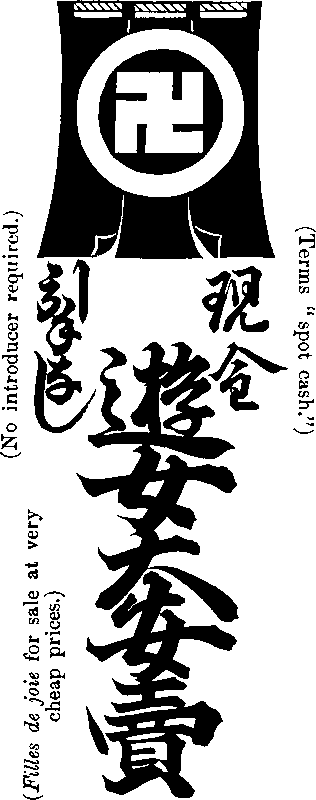
卍: (Manji)
引手なし: (No introducer required.)
現金: (Terms “spot cash.”)
遊女大安賣: (Filles de joie for sale at very cheap prices.)
It affords me much pleasure to know that my patrons are all doing well. By reason of your kind patronage and favour, for which I am extremely grateful, I have been enabled to continue the business of brothel-keeping for many years, but regret to observe that there are signs that the prosperity of the Yoshiwara is on the wane. The cause of this state of affairs may be attributed to the fact that evil practices have arisen in the houses of some of my confrères, who are carrying on their profession according to the dictates of their own fancies and entirely disregarding the regulations promulgated in the era of Kwansei (1789–1800). For instance, a custom has arisen of paying to hikite-jaya as much as 300 to 350 mon (about 30 to 35 sen) commission for each 2 shu (yen 1.25) spent by a guest, or even of equally dividing between tea-house and brothel the amount of money spent by him, the consequence being that more than three hundred hikite-jaya have sprung into existence within the past few years. Under these circumstances, it follows as an inevitable consequence that the food and drink served to guests is allowed to deteriorate in quality, thus causing a general depression in our “trade.” I have therefore hit upon a different plan of carrying on the profession, and decided not to receive any guests sent from tea-houses in future, but to conduct my business on cheap and expeditious lines at the “spot cash” prices mentioned below. Moreover I have engaged a large number of “filles de joie” who are guaranteed to afford satisfaction to guests in every respect, and I propose to pay scrupulous attention to the quality of saké, food, and bedding. I shall be greatly obliged if you will kindly inform your friends of these improvements introduced by me, and earnestly beg that you will favour me with a visit, either in the daytime or night-time, coming direct to my establishment without making your arrangement through a tea-house.
(Hitherto.) (Reduced price.)
1. Women possessing zashiki 1 Bu (Yen 2.50) 12 Momme (silver) (Yen 2.00)
2. Women possessing heya 2 Shu (Yen 1.25) 6 Momme ( “ ) (Yen 1.00)
3. Private geisha 2 Shu (Yen 1.25) 6 Momme ( “ ) (Yen 1.00)
N.B.—We supply the “Masamuné” brand of saké, and our cuisine is fully equal to that of the leading restaurants.
Tips and gratuities to “lady friends” and geisha may be given according to the discretion of guests.
Positively no guest sent through a tea-house will be received or entertained.
(Date)
(Signed) MANJI-YA MOKICHI,
Sumi-chō,
Shin Yoshiwara.
Should any woman be found unsatisfactory another may be substituted.
Specimen No. 2.
Verbal Message.
I am exceedingly glad to know that my patrons are all in good health. I am also thankful that, owing to the long period of continued tranquillity and peace we are enjoying, I have been enabled to pursue my occupation undisturbed for many years. Wishing to introduce some novelty for the amusement of my guests, I have devised a new style of dance which is performed by my yūjo to the accompaniment of popular songs. This dance is something like that anciently performed by shira-byōshi (a kind of singing girl of the Hetaira type) and I am confident that it will prove a source of pleasure to my august patrons. Persons coming to my establishment, either through the medium of tea-houses or direct, will be treated with all possible courtesy and attention, and as regards the question of expenses the aim of my house will be to make my prices as moderate as may be compatible with doing everything conducive to the entertainment of guests. I hope that this new departure may be made known to the public at large; the members of which are respectfully solicited to visit my house in an unceasing stream (in numbers).
Hire of yūjo, and cost of saké, soup, on-suzuributa (a tray of cooked foods), on-hachizakana (fish served in dishes), and mitsu-mono (a set of three procelain vessels containing food). 3 Bu. (Yen 7.50)
Hire of yūjo and cost of saké, soup, a tray of cooked food, and mitsumono. 2 Bu. (Yen 5.00)
Hire of yūjo and cost of saké, soup, kuchi-tori (a side dish), and mitsumono. 1 Bu 2 Shu. (Yen 3.75)
Hire of yūjo and cost of saké, soup, side-dish, and futatsu-mono. 1 Bu. (Yen 2.50)
Hire of yūjo and cost of soup, and futatsu-mono. 2 Shu. (Yen 1.25)
Per geisha and cost of one dish of food. 2 Shu. (Yen 1.25)
N.B.—For those who do not like saké, tea and kuchi-tori (a side dish of sweet food) will be served.
In force from the 10th day of the 5th month (cycle of the Tiger).
Daikoku-ya. Bunshirō.
Yedo-chō It-chō-me,
Shin Yoshiwara.
Specimen No. 3.
Notice.
At the time of the establishment of the Sangyō-kwaisha (office of the “three professions”) I was obliged, by reason of unavoidable circumstances, to transact the business of the office, and in consequence trouble arose between the brothel-keepers and owners of tea-houses. For a time it appeared as if the trouble had blown over, but apparently such is not the case, as I now learn that the tea-houses have combined and agreed not to send a single guest to my house. Far from being affected by their compact, my business is as brisk as ever, because, I depend on my patrons themselves and not on the tea-houses. Nor is this all, for when the three and twenty fair ladies (oiran) who belong to my house heard about the selfish decision of the tea-house keepers, they justly gave vent to their indignation at this attempt to interfere with their profession. They proposed that in future they and I should combine to increase the popularity of our house, and with this end in view I have been urged by the oiran to do all in my power to ensure the satisfaction of guests, while they on their part have promised to cooperate with me in order to convince the tea-house folk of the fact that the Yoshiwara would prosper without any hikite-jaya at all. What is meant by the resolution of the fair damsels it is for visitors to my house to explain. Accordingly I have decided on the following plan of action:—Firstly, to endeavour to curtail the expenses of guests to the lowest possible figure, and secondly, to see that every care is taken to ensure their pleasant entertainment. As to the females in waiting, their number will be further increased, and they will appear clad like the graceful nakai (waitresses) of Kyōto and Ōsaka. Care will also be exercised in the cuisine of my house, and certain dishes will be served without extra charge. These alterations will take effect on and after September 1st next, and it will then remain with you to test the truth of this announcement. I trust that these facts will become known far and wide, and hope to be favoured with your continued visits and patronage.
September, 1875.
Kimpei Daikoku.
(Kashi-zashiki keeper)
Yedo-chō It-chō-me,
Shin-Yoshiwara.