Tsumi-yagu no koto. (The piling up and exhibition of bedding.)
Reading edition
In the “Ume-no-haru” (by Kiyomoto) are the words:—
A pile of as many as twenty of the rich floral brocade futon and bedding which share the couch of Benten San.28
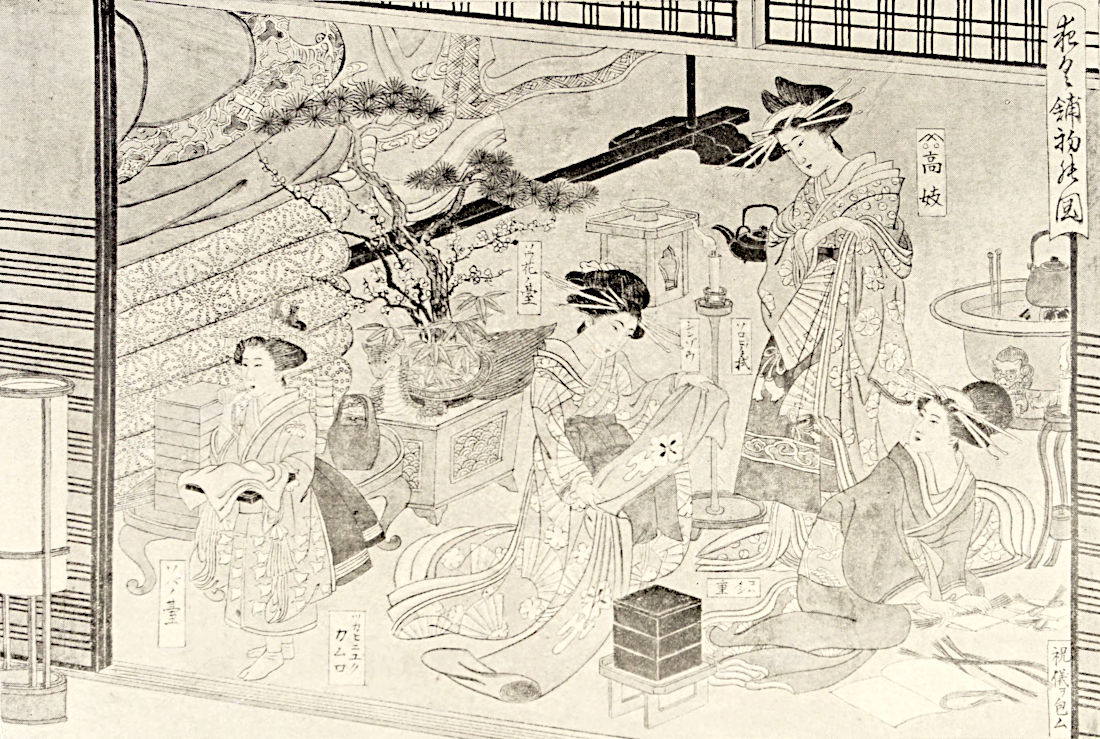
Arranging “
Tsumi-yagu
” (Exhibition of Bed-clothes) in the Kiōwa period (1801 to 1803).
(
After the Picture by Kitagawa Utamaro.
)
This passage refers to a custom known as “tsumi-yagu” which forms one of the leading features of the gay quarter: there are several songs and stanzas of poetry extant in which the splendid spectacle of a pile of magnificent brocade night-clothes and bedding is rapturously dilated upon in amorous language. Vanity is an inherent attribute of the fair sex, and among the class of women to whom the yūjo belong “the rage for competition, show and style” has no limits, consequently they all vie with each other in the attempt to outshine their sisters in the matter of obtaining, and placing on exhibition, piles of gorgeous bedding. It is a matter of professional pride for the girls to make as lavish a display as possible, and in former days, when the go-sekku were approaching the yūjo would persuade one of her most intimate guests to undertake the financing of this expensive function, and so well did they play their cards that they often succeeded in inducing their infatuated admirers to disburse several hundred dollars to gratify a passing whim. Nowadays, the holidays known as the go-sekku are not strictly observed, therefore exhibitions of tsumi-yagu are made either at the time of cherry-viewing in the spring, the lantern festival in the autumn, during the first week of the New Year (matsu-no-uchi) or at the time of the tori-no-machi (see description under that heading) when the Yoshiwara is most frequented by crowds of sight-seers. Generally speaking, this display of bedding is confined to the ō-mise (best houses) or chū-mise (medium houses), but occasionally the women in smaller houses endeavour to proclaim, by means of tsumi-yagu, that all the world does not belong to their prouder sisters in the better-class establishments. As I have previously mentioned, in ancient times gold and embroideries were used in making up this exhibition of bedding, but now damask and crêpe are mostly employed. The present cost (in 1899) of a set of tsumi-yagu is from 100 to 200 yen: by using yūzen crêpe the price may be kept as low as 100 yen, but damask will amount to 200 yen, and if a person is extravagantly inclined there are no limits to the cost. As the tsumi-yagu set would be charged at an exorbitant figure if purchased from an ordinary gofuku-ten (drapery store) they are usually ordered from one of the regular contractors in the Yoshiwara. There is generally a tremendous amount of bargaining done before the price of the tsumi-yagu is finally settled, and it is said that when the negotiations are made by the brothel-keeper, that astute gentleman invariably dovetails into the figure charged a commission of about 20% (twenty per cent.) as an honorarium presented to himself for “valuable services” rendered. A set of tsumi-yagu consists of three futon and a large coverlet or quilt: if it be summer a mosquito net is added, and if it be winter a lighter coverlet. As a rule the colours chosen are very loud indeed: the older women prefer pale-blue for the lining, but the younger girls usually have the coverlets lined with red. The futon are made like a mirror in a frame, the centre panels being of the same colour as the linings of the coverlets: the collars of the latter are made of velvet. On the coverlet is worked in gold thread the crest of the guest who has presented the set as well that of the yūjo who has received it. A small (light) coverlet (ko-yagu) is generally wadded with the best wata (cotton wool), but in large coverlets (ō-yagu) and futon an inferior quality of wadding is used. When the set is quite completed, it is placed on a stand and exhibited just inside the entrance of the brothel, facing the door-way, so that everybody who passes is bound to see the show: and in order to further attract attention, the tsumi-yagu is labelled with a paper on which is written in bold letters the name of the lucky yūjo who owns it. On the day of this ceremony it is usual for the guest concerned to give a “sō-bana” (a present made to all the inmates of a house) of 5 yen, and a further sum of 5 yen as “soba-dai” (cost of buckwheat macaroni) to be partaken of by all the yūjo in the establishment. As it is not considered to be conducive to the good reputation of a woman to continue this exhibition of tsumi-yagu for too great a length of time, there arises the necessity for another ceremony called “shiki-zome” (commencing the use of the yagu). On this occasion the lady in question plays the part of hostess, and she is bound by custom to entertain the guest who has presented her with the set by giving him a feast and engaging at least a couple of geisha to enliven the proceedings. When a guest undertakes to provide a set of tsumi-yagu for his innamorata he must be prepared to spend on tips, and for various sundries, at least 50 yen over and above the cost of the bedding, and if he makes a hikite-jaya a party to the arrangement this will cost him another 10% (per cent.) commission. An exhibition of tsumi-yagu being considered something to be proud of, women who have no guests rich enough to render them the necessary pecuniary assistance occasionally go so far as to even borrow funds from the brothel-keepers and order a set of bedding for themselves, thus securing a fine advertisement and enhancing their reputation. It however sometimes happens that the girls find themselves unable to refund money thus borrowed, and are therefore compelled to dispose of the bedding they once so earnestly coveted: these circumstances have tended to place a number of second-hand sets of tsumi-yagu on the market, and it is a said that certain women who are vain enough to love empty show, but too poor to afford it, borrow these relics of extravagance on hire and exhibit them to the public gaze! But here let us be merciful and draw a veil over the doings of these unfortunate women, for it would be boorish and unmanly to further expose the weakness of frail humanity. [As to the origin of this custom, it appears that a kōshi-jōro of the Miura-ya (kept by Magosaburō) named Utanami, first introduced it in the era of Kwampō (1741–1743)].