Rooms of the Yūjo.
Reading edition
There is but little difference between the modern apartments (kyo-shitsu) of the yūjo and those of ancient times. The room in which a yūjo receives her guests is called the “zashiki,” and generally contains about eight mats (hachi-jō-jiki), while the adjoining room (tsugi no ma) is a smaller private apartment containing perhaps three or four mats. Some women have a third room placed at their disposal in addition, but this consideration is mostly granted to the “o shoku” exclusively.
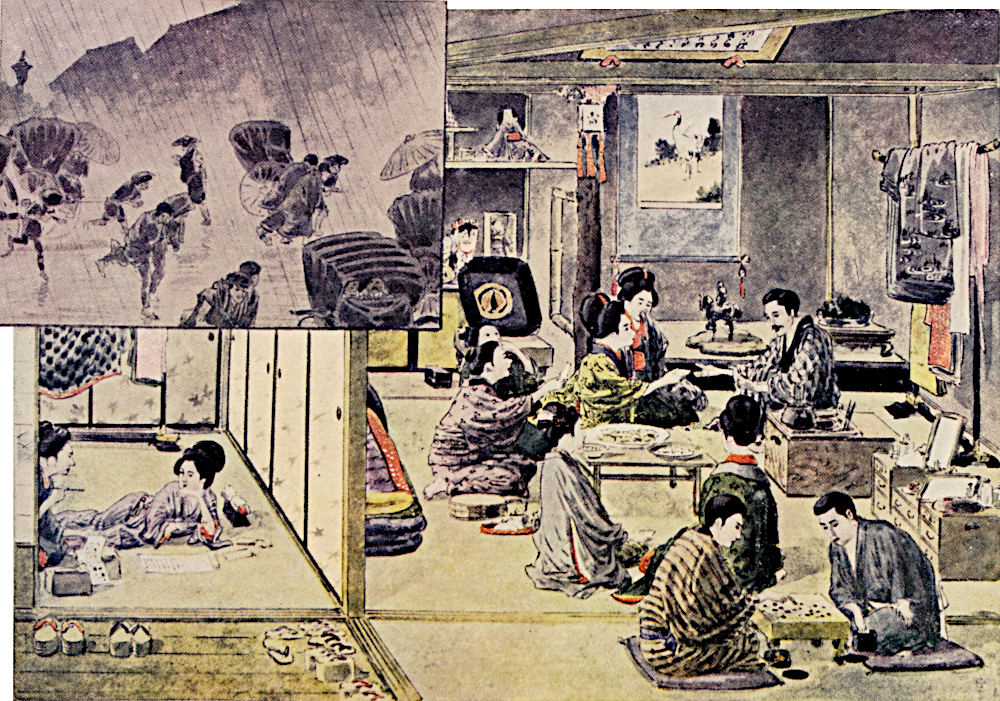
A Rainy Day in the Yoshiwara—within and without.
Typical zashiki are cosy rooms fitted with the usual toko-no-ma (alcove) and chigai-dana (a recess with two shelves, one a little lower than the other, and each only reaching about half way across the width of the wall-space involved); in the former hang either picture or specimens of calligraphy (not always genuine!) by such noted artists as Chosanshū, Tesshū, Zeshin, Keishū, and others.27 The rooms are prettily decorated, and furnished with cut flowers arranged in vases of Kutani porcelain; these flowers are changed according to the season. There will also be found musical instruments such as the koto (harp), samisen (banjo), gekkin (guitar), ni-genkin (a two-stringed musical instrument), etc.; numbers of sundry knicknacks, such as a shelf-ornament in the shape of a rabbit, made of imitation crystal, which is perched on a tiny cushion of daintily dyed crêpe; a hanging clock, a handsome mirror, a framed oil-painting; a small library of novels, magazines, theatrical notices, playbills, and other light reading matter designed to beguile the tedium of guests. On the chigai-dana (recess fitted with shelves by the side of the toko-no-ma) rests a deep lacquered tray (known as a midare-bako, in which are put the guests’ garments) and other objects, while the room invariably contains a clothes-horse (emon-kaké) and a six-fold screen (roku-mai-ori-no-byōbu). In the private apartment is a shelf on which the yūjo’s yagu (bed-clothes) are placed, and this is covered with a bright green furoshiki on which is dyed the ornamental figure of a vine (karakusa) and the name of the girl to whom it belongs. Below this yagu-dana (shelf) is a chest of drawers containing the wardrobe of the yūjo, while the other articles of furniture consist of a naga-hibachi (oblong brazier) on which is placed a kettle (tetsu-bin) a cupboard with a glass door (garasu-do-iri no nedzumi-irazu) within which yō-cha-ki (tea things) and inshoku-no-gu (eating and drinking utensils) are neatly arranged, a mirror-stand (kyō-dai), a cup used for gargling (ugai-jawan) a mimi-darai (a metallic or lacquer tub with a pair of handles or ears used for toilet purposes), cushions (zabuton), and various other paraphernalia of a courtesan’s room. The zashiki (rooms) are rented from the brothel-keeper by the yūjo, and are furnished at their own expense. The above is a description of a first-class house, and in the lower-grade establishments a girl (there called a heya-mochi) only possesses one room, or, at the most two rooms. In the better houses the rooms are known as zashiki (a “parlour”) and in the lower-class houses as merely heya (“room”). In ancient days the shinzō had no rooms of their own, and it was the custom for all of them to sleep in the ane-jōro’s room. There are also rooms called myōdai-beya (substitute rooms) which may be used by any of the women when they have more than one guest at the same time. In the lowest houses several guests and their girls are packed up together in one room, each couple being only sheltered from the gaze of the others by screens. This is known as wari-doko (割床 = “divided bed.”) When a yūjo has not sufficient means to defray the expenses of furnishing and decorating her room, it is paid for in instalments, but in some cases an intimate guest will assist her by paying these expenses himself. The expenses of repairs to her zashiki and of the daily cleaning are also borne by the girl; the sōji no chingin (wage for cleaning) is paid direct to the wakai-mono (man-servant) who performs this office. The expenses which yūjo have to bear in this direction are very heavy, and according to the official rules issued by the authorities in the 7th year of Kwansei (1795) the girls were exempted from these burdens; but an ancient custom is not easily broken up, and the evil, being by no means thoroughly eradicated, has survived to these days. Unfortunately, in this profession, a pernicious custom exists of spending money lavishly, and should the yūjo show herself mean or stingy (or even moderately prudent) in her expenditure, this will cause her unpopularity, raise up a host of enemies, and make trouble for her in a hundred different ways; thus old customs cling to the Yoshiwara and defy the many earnest efforts made to root them out. It would appear that at the time when yūjo used to receive guests in age-ya there was no need to pay much attention to beautifying their own rooms, but as a matter of fact they were made very pretty because the ki-jin (貴人 = “nobles” and “honourable persons”) would not enter age-ya and came direct to the brothels. The regular style of futon (mattress) used was a kagami-buton (i.e.—a futon the border of which is made of stuff different to that of the centre, making it look like a mirror in it’s frame). In the best houses the borders were made of black velvet and the panels of red crêpe. Three of such futon (mattresses) were laid one upon the other and the pile formed a nice soft bed, but in the lower houses only two were used and these were made of inferior material such as merensu (mousseline de laine) or kanakin (calico): in the very lowest establishments only one was provided. The night gowns also varied in richness according to the class of the house. By the official rules issued in the 7th year of Kwansei (1795) fabrics mixed with gold or silver threads, silk brocades, or velvets, were forbidden to be used in making futon, and the number used was limited to three: these sumptuary regulations soon became a dead letter and utterly failed to effectively check the luxurious habits of the time. During the Meiwa era (1746–1771) a woman named Hinadzuru, belonging to the Chōji-ya, used a pile of five futon made of silk brocade, but this was quite unprecedented. When yūjo used to be called to visit guests in an age-ya their night-clothes were carried with them on each and every occasion: these earlier futon, etc., are supposed to have been greatly inferior to the costly ones that came into fashion at a later period.
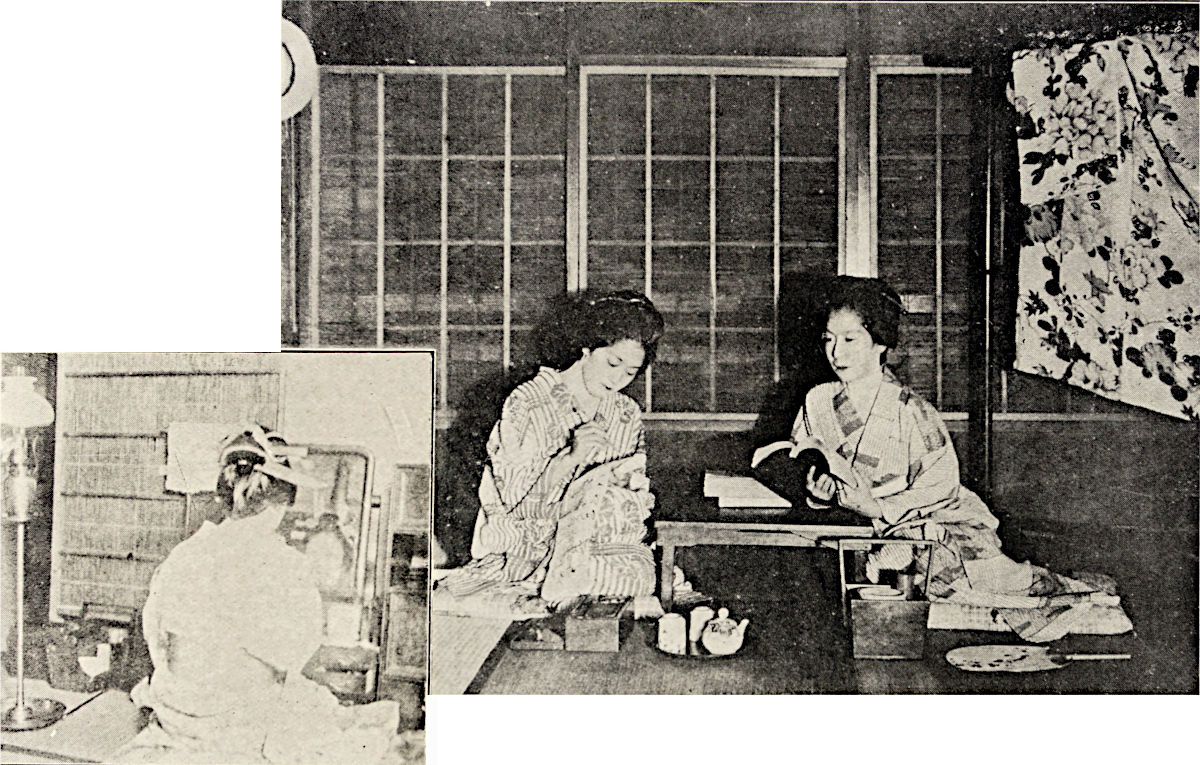
Courtesan making her Toilette.
Courtesan Composing Letters to their Guests.