“Shashin-mitate-chō.” (Photograph albums for facilitating the selection of women.)
Reading edition
In lower-class houses the women are exhibited after nightfall, when the lamps are lighted, in the long narrow cages of the brothels, where they sit with powdered faces and rouged lips looking for all the world like so many motionless wax figures, and are, to all intents and purposes, set out for sale like ordinary articles of merchandise. Under these conditions, a would-be guest has the opportunity of making his selection very easily, for he has only to indicate the woman he fancies to obtain her company immediately. In the first and second-class houses, however, there is no such thing as a hari-misé (a “dressed shop-front”) and persons who intend to visit them must be introduced by a hikite jaya: the selection of the particular girl to be engaged is usually left to the discretion of the mistress of the tea-house, who of course does her best to please her patrons by choosing for them women likely to prove satisfactory.
Until about 1882 (15th or 16th year of Meiji) the photographs of all the inmates of houses were displayed in frames in front of the respective brothels, but now this plan has been abandoned, and albums containing portraits of the women belonging to first and second-class houses are provided in the hikite-jaya for the convenience of guests. These books are called “Shashin Mitate-chō” (albums of photographs to facilitate the selection of women), and it is believed that the following specimens of prefaces will be interesting:—
Photograph-album of the O-hiko-rō:—
“The old saying ‘if you wish to see flowers go to Yoshino’ seems somewhat stupid considering that one can find any flower which he desires to see if he goes to the Yoshiwara. Nowadays, however, customs of ancient times are changing, and the flowers no longer parade the Naka-no-chō. The flowers which are shown to the public are limited to those which blossom on the small fences, while the oiran (who may be likened to the queen of all flowers) are concealed from the public view in the privacy of their own chambers, and may be compared to beautiful blossoms hidden from sight by a dense mist. However, the practice of promenading in the Naka-no-chō is too old a custom to be revived in these times, and so we have hit upon the plan of grouping a bevy of belles into the space of a small photograph-album, and leave our honourable guests to select the flowers their fancy may dictate, etc., etc.”
“This preface winds up with a poetical appeal—quite untranslatable owing to puns on words—that the patronage of guests “may not be as short as the dream of a spring night,” but as steady and constant as the bedding used in this house is thick and beautiful. [In Japanese the word “thick”—atsui—has a double meaning: it means “thick” as an antonym of “thin,” and also “plentiful, liberal, and bountiful.” It also has the sense of “excessively friendly” or “intimate,” and is sometimes used to express the idea of “in love with.”]
Photograph-album of the Kado-ebi-rō:—
“The Chinese character kōzen (紅髯 = red beard) may be also read kōzen (浩然 = resolute: firm) on account of the similarity of sound, and the characters kairō (海考 = a shrimp. These characters also sound as “ebi”) which is part of the name of this house and resemble in pronunciation the letter kairō (偕老 = becoming old together and being buried in the same spot undivided even by death.) In the letters in use from times immemorial are ideas not fully expressed. Individual selection may be left to individual taste.”
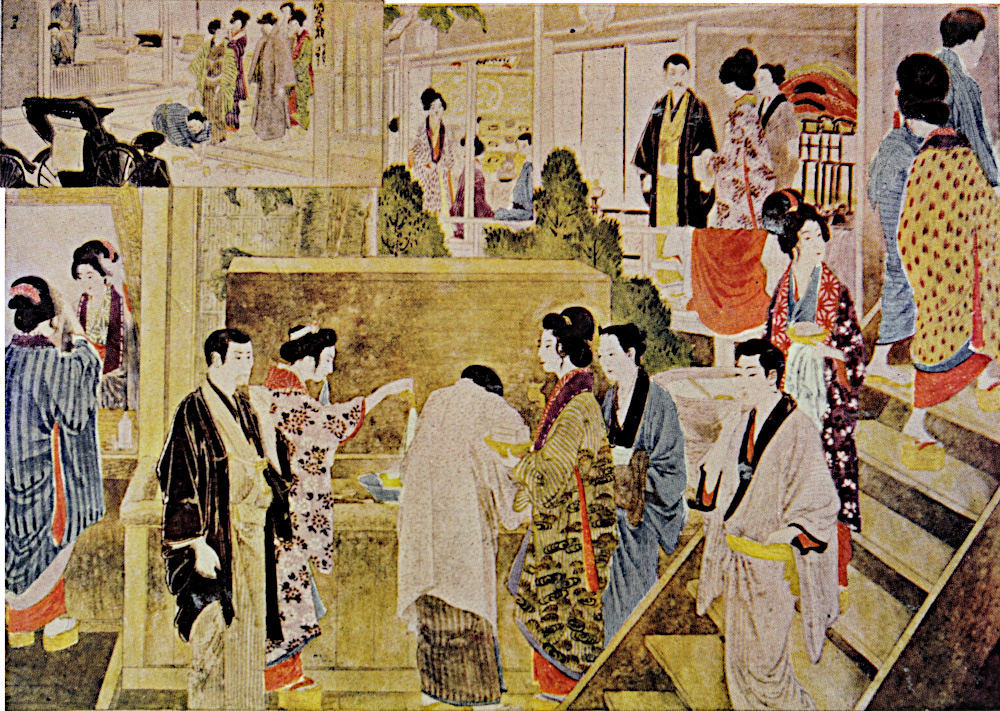
Guests making their toilettes preparatory to leaving the house.