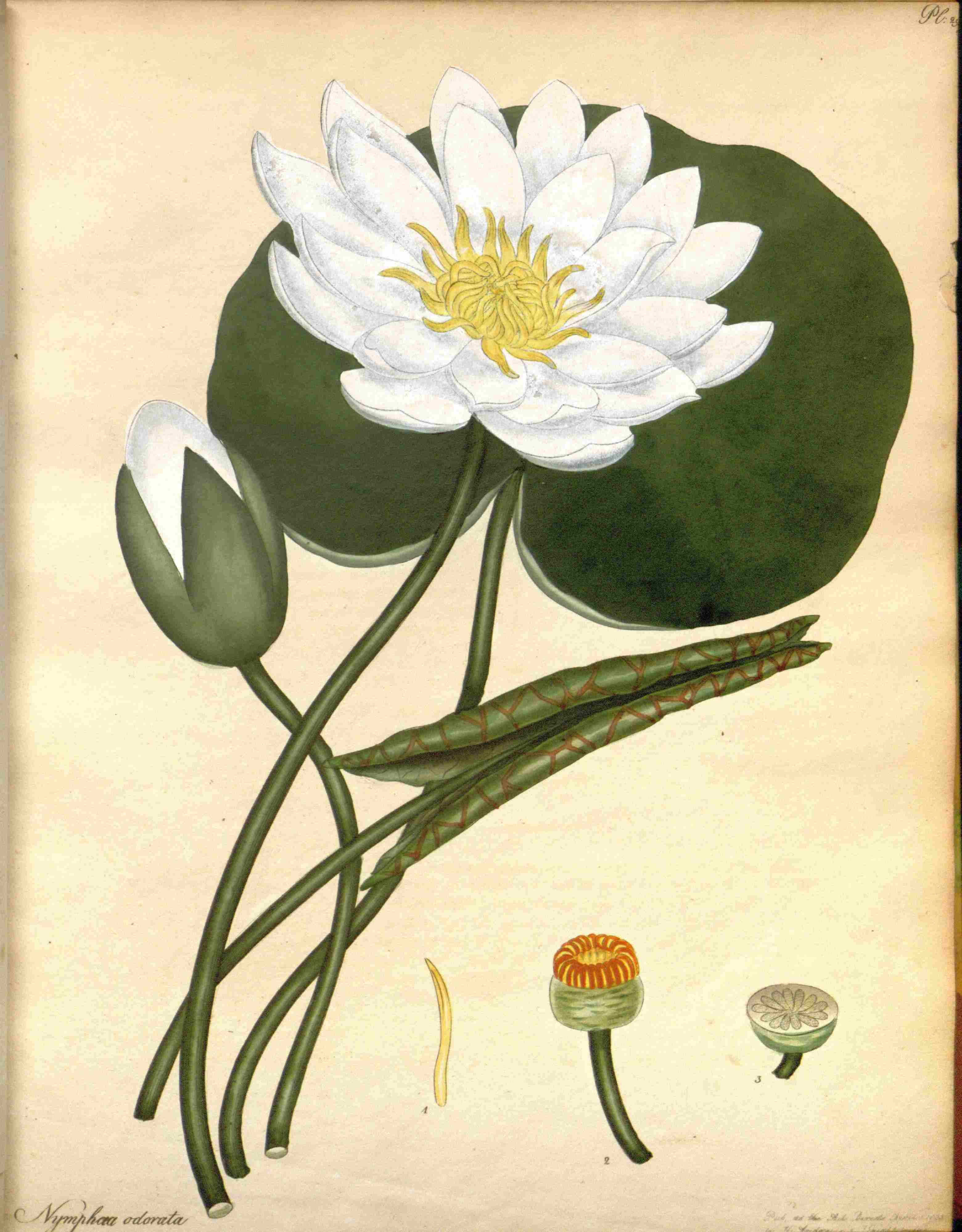
Volume 5 — PLATE CCXCVII.
Reading edition
NYMPHÆA ODORATA.
Sweet-scented Water-Lily.
CLASS XIII. ORDER I.
POLIANDRIA MONOGYNIA. Many Chives. One Pointal.
ESSENTIAL GENERIC CHARACTER.
Calyx 4, 5, seu 6-phyllus. Corolla polypetala. Bacca multi-locularis, truncata.
Cup 4, 5, or 6-leaved. Blossom many petals. Berry many-celled, appearing cut off at top.
See Nymphæa cærulea, Pl. CXCVII. Vol. III.
SPECIFIC CHARACTER.
Nymphæa foliis subrotundis, integris emarginatis, lobis divaricatis, obtusissimis, margine parum incurvatis; calyce tetraphyllo; flore albo.
Water Lily with almost round leaves, entire, and notched at the end; lobes straddling, very obtuse, and turned up slightly at the edge; cup four-leaved; flower white.
REFERENCE TO THE PLATE.
1. A Chive. 2. The Seed-bud and Summits. 3. The Seed-bud cut transversely.
This species of Water-Lily we should consider rather as a variety, than as a distinct species; it has every character of our common white Water-Lily, except the size and hardiness; it has the same powerful fragrance, but will not stand the severity of our winters. It is a native of Carolina and Virginia, North America; was introduced to us in the year 1786, by William Hamilton, Esq. of Philadelphia, and flowers during the summer months, if kept in the hot-house. Requires the same treatment as the blue species from the Cape of Good Hope. May be increased from the seed, or from the root. Our drawing was taken from a plant in the Clapham collection.