Volume 5 — PLATE CCCVI.
Reading edition
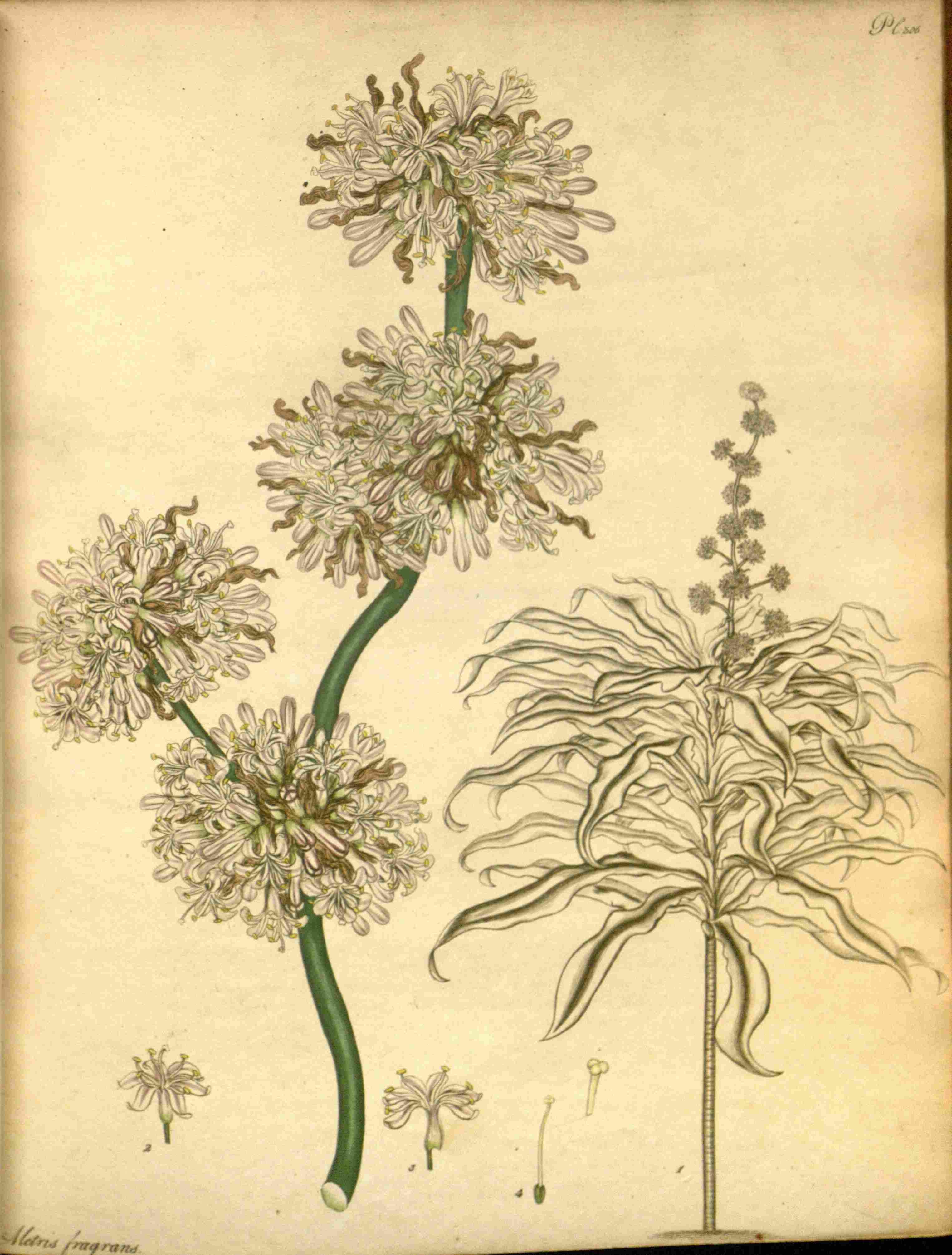
ALETRIS FRAGRANS.
Sweet-scented Aletris.
CLASS VI. ORDER I.
HEXANDRIA MONOGYNIA. Six Chives. One Pointal.
ESSENTIAL GENERIC CHARACTER.
Corolla infundibuliformis, rugosa. Stamina inserta laciniarum basi. Capsula trilocularis.
Blossom funnel-shaped, wrinkled. Chives inserted into the base of the segments. Capsule three-celled.
See Aletris sarmentosa, Pl. LIV.
SPECIFIC CHARACTER.
Aletris caulescens; foliis lanceolatis, laxis; floribus albicantibus, fragrantissimis.
Aletris with a woody stem; leaves lance-shaped, loose; flowers whitish, very sweet-scented.
REFERENCE TO THE PLATE.
1. A miniature representation of the whole plant. 2. A flower complete, natural size. 3. The blossom cut open, with the Chives in their place. 4. The Seed-bud, Shaft and Pointal; the summit detached, magnified.
The Sweet-scented Aletris, from the great height it attains before it flowers, which is, from 9 to 12 feet, and nearly two-thirds of the length of the stem, without leaves; takes off much from the merit of this grand plant as cultivated in our colder regions. It is a native of Africa, and must be kept in the hot-house, in the bark-bed, to have it blossom. The flowers are extremely fragrant, open in the evening and close again with the first rays of the morning sun. It is propagated either by suckers, which it sometimes produces, or by cutting off small portions from the roots; which will become plants in about three months, if placed in the heat of a strong hot-bed; these are likewise very sweet-scented, having the flavour of orris-root, or violets. Our figure was taken from a plant in the collection of J. Vere, Esq. Kensington Gore, this present month of May, 1803.
A schism has arisen on the subject of this genus among modern botanists; from whom we must, however, exclude the celebrated author of Miller’s New Gardeners’ Dictionary; who, in this instance, has preserved the genus entire. Three genera have, as usual, been made out of one; the Cape species are denominated Veltheimias; those known under the names of A. zeylanica and A. guineensis, are termed Sansevieras; A. farinosa and A. fragrans being the only remnants of the original genus. Such are the happy effects, of modern scrutiny, upon the works of the antiquated Linnæus! and such might be the answer of these illuminati, which poor Gradus, in the farce of Who’s the Dupe, gives to his mistress, when questioned upon the utility of his labours; alas, how else should our merit be discovered, but by elancing from the old track of plain sense and nature.