Volume 5 — PLATE CCCXXV.
Reading edition
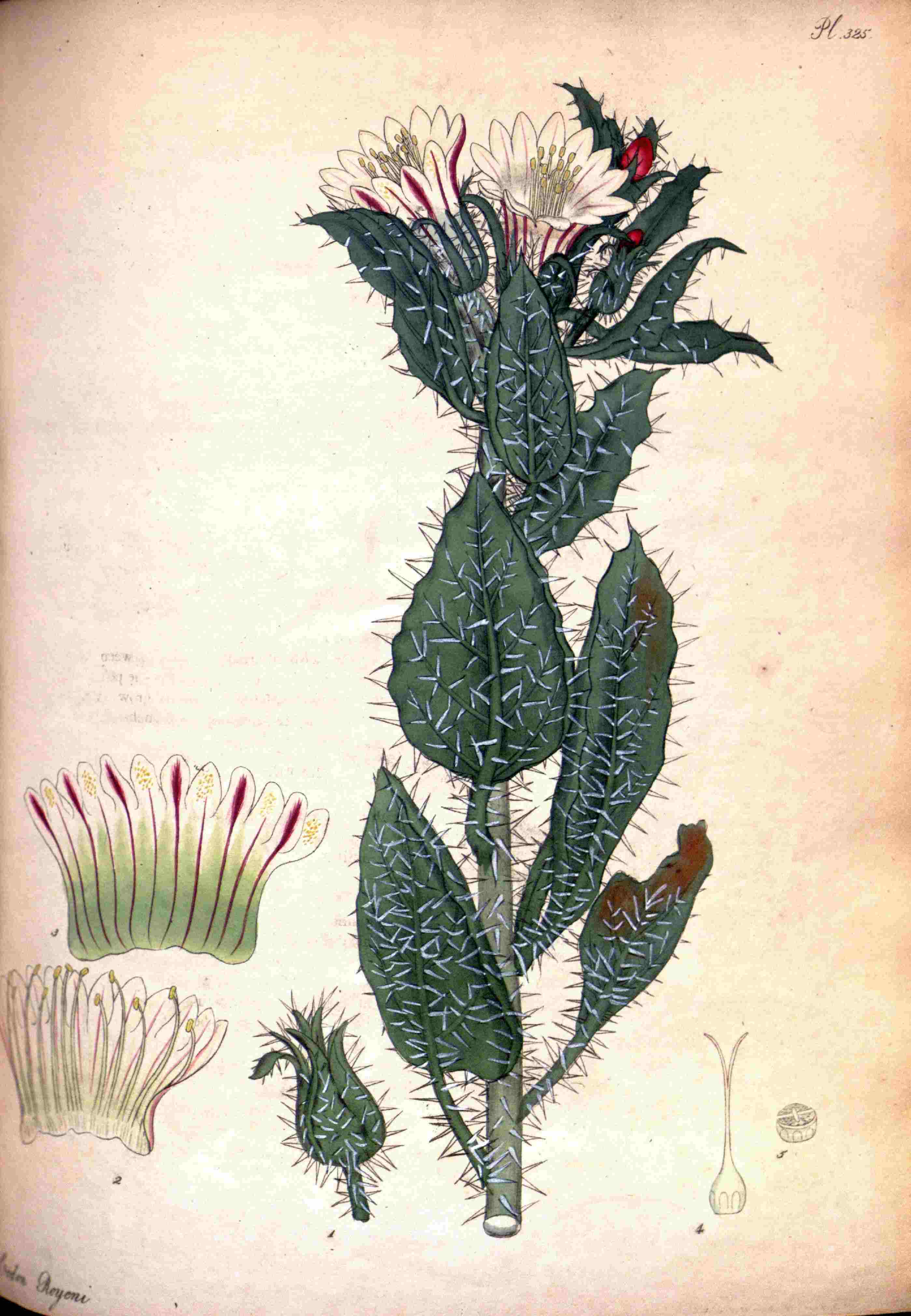
CODON ROYENI.
Prickly Codon.
CLASS XI. ORDER I.
DODECANDRIA MONOGYNIA. Twelve Chives. One Pointal.
GENERIC CHARACTER.
Calyx. Perianthium monophyllum, duodecempartitum; foliolis subulatis, persistentibus, erectis, alternis brevioribus.
Corolla monopetala, campanulata, basi torulosa; limbo duodecimpartito, aquali.
Nectarium duodecim loculare ex squamis 12, unguibus staminum insertis, conniventibus, receptaculum tegentibus.
Stamina. Filamenta duodecim, longitudine corollæ. Antheræ crassæ.
Pistillum. Germen superum, conicum. Stylus simplex, longitudine staminum. Stigmata duo, longa, setacea, divergentia.
Pericarpium. Capsula bilocularis.
Semina plurima, subrotunda, nigra.
Empalement. Cup one-leaf, twelve-divided; leaflets awl-shaped, remaining, upright, the alternate ones shorter.
Blossom one petal, bell-shaped, rather swelled at the base; border twelve-divided, equal.
Honey-cup twelve-celled, consisting of 12 scales, inserted into the claws of the chives, approaching, covering the receptacle.
Chives. Twelve threads, the length of the blossom. Tips thick.
Pointal. Seed-bud above, conical. Shaft simple, the length of the chives. Summits two, long, like bristles, straddling.
Seed Vessel. Capsule two-celled.
Seeds numerous, roundish, black,
SPECIFIC CHARACTER.
Codon foliis alternis, cordato-ovatis, acuminatis, setaceo-spinosis; floribus subcapitatis, terminalibus.
Codon with alternate leaves, between heart-shaped and oval, tapered to the point, with spine-like bristles; flowers grow nearly in heads, terminating the branches.
REFERENCE TO THE PLATE.
1. The Empalement. 2. A Blossom spread open, with the chives in their place. 3. The same shewn from the outside. 4. The Seed-bud, Shaft and Summits. 5. The Seed-bud, cut transversely.
As an interesting desideratum, this plant has stood long amongst botanical collectors; but till the year 1801, it was never seen, in a vegetating state, in Britain; at which period, it was introduced to our gardens, by Mr. Niven, from the Cape of Hope. It is not, we believe, (although considered hitherto as such,) an annual; but rather, a half woody shrub, easily destroyed by moisture. As the seed appears to ripen freely, although there seems no other mode of perpetuating the plant, we shall stand in no danger of losing it; its attractions are, indeed, not great as to beauty, but much so as to singularity; since we have no plant to which it affines in general habit. The seeds should be sown on a gentle hot-bed, in March, and transplanted when about two inches high, into pots, to flower, which they will do about September. Our drawing was made at the Hammersmith Nursery. Having had the opportunity of examining the flowers, of more than twenty plants; we are convinced it has been wrong placed by Van Royen to decandria; for although many flowers may be found, even on the same plant, some with eight, others with ten chives, yet at least 90 out of 100 have twelve; wherefore we have, without scruple, placed it to dodecandria.