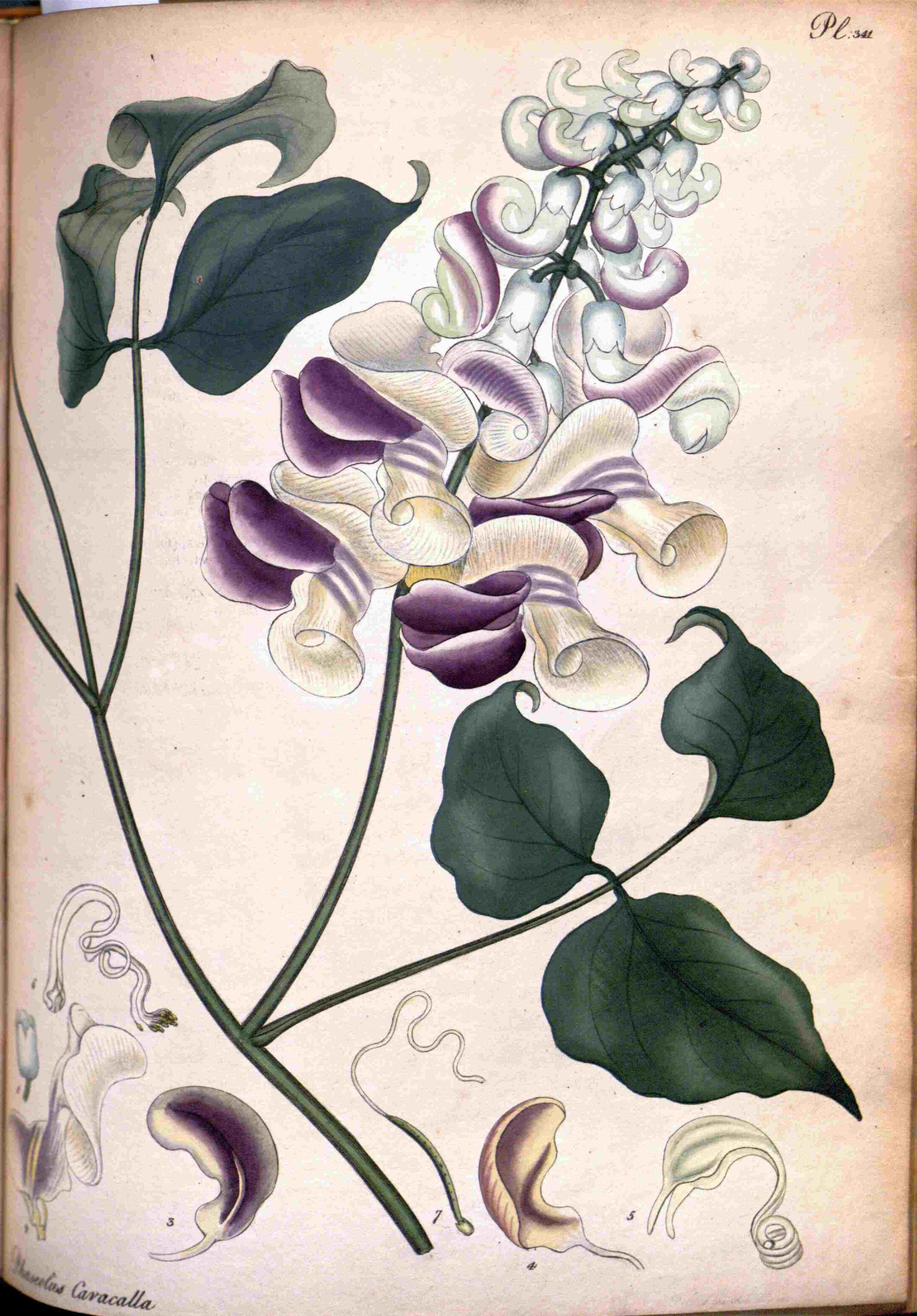
Volume 5 — PLATE CCCXLI.
Reading edition
PHASEOLUS CARACALLA.
Snail-Flower Kidney-Bean.
CLASS XVII. ORDER IV.
DIADELPHIA DECANDRIA. Chives in two sets. Ten Chives.
GENERIC CHARACTER.
Calyx. Perianthium monophyllum, bilabiatum; labio superiori emarginato, inferiore tridentato.
Corolla papillionacea.
Vexillum, cordatum, obtusum, emarginatum, reclinatum, lateribus reflexis.
Alæ, ovatæ, longitudine vexilli, unguibus longis insidentes.
Carina, angusta, spiraliter contra solem revoluta.
Stamina. Filamenta diadelpha, (simplex et novemfidum) intra carinam, spiralia. Antheræ decem, simplices.
Pistillum. Germen oblongum, compressum villosum. Stylus filiformis, spiraliter inflexus, superne pubescens. Stigma obtusum, crassiusculum, villosum.
Pericarpium. Legumen longum, rectum, coriaceum, obtusum cum acumine.
Semina reniformia, oblonga, compressa.
Empalement. Cup one leaf, two-lipped, upper lip notched at the end, lower three-toothed.
Blossom butterfly-shaped.
Standard, heart-shaped, blunt, notched at the top, reclined, reflexed at the sides.
Wings, egg-shaped, the length of the Standard, terminating in long claws.
Keel, narrow, twisted spirally contrary to the sun.
Chives. Threads in two sets, (simple and nine-cleft,) within the keel, spiral. Tips ten, simple.
Pointal. Seed-bud oblong, flattened, hairy. Shaft thread-shaped, spirally bent inwards, downy above. Summit blunt, thickish, hairy.
Seed vessel. A long pod, straight, leathery, blunt with a point.
Seeds kidney-shaped, oblong, flattened.
SPECIFIC CHARACTER.
Phaseolus caule volubili; vexillis, carinaque spiraliter convolutis.
Kidney-bean with a twining stem; standards and keel spirally twisted from the left to the right.
REFERENCE TO THE PLATE.
1. The Cup. 2. The Standard. 3. One of the wings, shewn from the outside. 4. One of the wings, shewn from the inside. 5. The Keel. 6. The Chives. 7. The Pointal.
As a singular vegetable production, we have given a specimen of this most curious flower, but not as a novelty, as it is, certainly, rather common, the seeds having frequently been brought to us from Portugal, (to which country it was first introduced from Brasil in South America), ever since the year 1690. It is a climbing plant and must be kept in the hot-house, is propagated by seeds or cuttings, grows to the height of 12 or 14 feet, and should be planted in rich earth. The flowers are produced about August; they are very fragrant, but have not much duration, and the plant has much the resemblance of the common scarlet kidney-bean.