Volume 5 — PLATE CCCXLIII.
Reading edition
BLANDFORDIA CORDATA.
Heart-shape-leaved Blandfordia.
CLASS V. ORDER I.
PENTANDRIA MONOGYNIA. Five Chives. One Pointal.
GENERIC CHARACTER.
Calyx. Perianthium monophyllum, semiquinquefidum; laciniis concavis, ovatis, obtusis, erectis; persistens.
Corolla. Petala quinque, oblongo-linearia, subtruncata, patentia, calyci inserta.
Nectarium urceolatum, membranaceum, germen cingens; limbo quinque-lobo, laciniis clavatis, capitatis.
Stamina. Filamenta nulla. Antheræ quinque, subrotundæ, didymæ; nectarii margini, inter lacinias limbi, affixæ.
Pistillum. Germen subrotundum. Stylus brevissimus, erectus. Stigma obsoletum.
Pericarpium. Capsula oblonga, unilocularis, bivalvis.
Semina plurima, minuta, glabra.
Empalement. Cup one leaf, half-five-cleft; Segments concave, egg-shaped, blunt, upright; remaining.
Blossom. Five petals, oblong-linear, appearing rather cut off at the ends, spreading, inserted into the cup.
Honey-cup pitcher-shaped, skinny, surrounding the seed-bud; border five-lobed, segments club-shaped, and headed.
Chives. Threads none. Tips five, roundish, double; fixed, between the segments of the border, upon the margin of the honey-cup.
Pointal. Seed-bud roundish. Shaft very short, upright. Summit obsolete.
Seed-vessel. Capsule oblong, one cell, two valves.
Seeds many, small, smooth.
SPECIFIC CHARACTER.
Blandfordia foliis cordatis, reticulatis, crenato-dentatis, floribus spicatis.
Blandfordia with leaves heart-shaped, netted, and between scolloped and toothed; flowers grow in spikes.
REFERENCE TO THE PLATE.
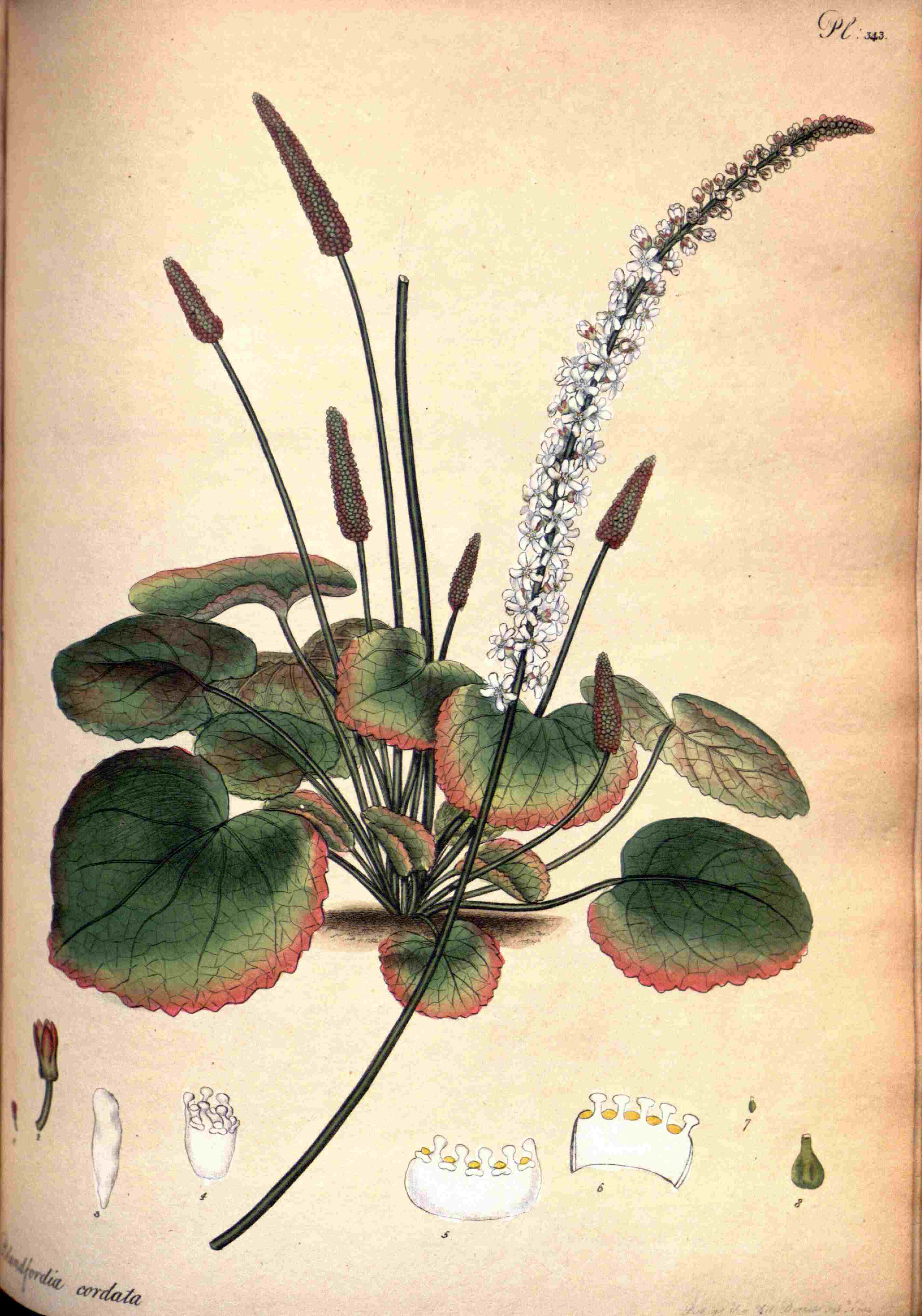
1. The Cup, natural size. 2. The same, magnified. 3. A Petal, magnified. 4. The Honey-cup, with the Chives, magnified. 5. The same, spread open, shewn from the outside. 6. The same, shewn from the inside. 7. The Seed-bud, natural size. 8. The same, magnified.
The Blandfordia cordata was first observed by Mr. J. Fraser, in the year 1786, on the banks of the Savannah river, near its source, in Georgia, North America; but was not introduced to us until the year 1800, when it was brought to England, amongst many other novelties, by that gentleman. It is, as are most of the plants of that country, rather too tender to resist the severity of our winters; and should be protected, either in the green-house, or in the coolest and shadiest part of the hot-house; where, if it is kept the year through, it will flourish, and flower about the month of June. It is increased by parting the roots about April; delights in moisture and shade; thriving most in a light peat soil, with a small mixture of sandy loam. This plant, from its general habit, would at first sight be taken for a species of Tiarella, or Heuchera, to both which it bears great resemblance, being all, likewise, natives of the same clime; but the strongly differing characters, in the parts of fructification, prevent its being placed to either of those genera. The honey-cup, it is true, might, perhaps, with reason, be considered as the connected threads of ten chives, and what we take to be the segments of its border, set down as so many sterile ones to make up this number. Thus, the plant would be transmuted to the XVI class; but, from our best judgment, we have placed it, as above, in the V.
Our figure is from a specimen communicated by the Right Hon. the Marquis of Blandford, from his magnificent gardens at White Knights, near Reading, Berks. Little need be urged for the propriety of our naming a plant from the Marquis of Blandford; and thus, dedicating this small part of our labours to his lordship; as few, at present, patronize the science, through all its branches, with so much vigour and liberality, or who have equal knowledge in its theory and practice.