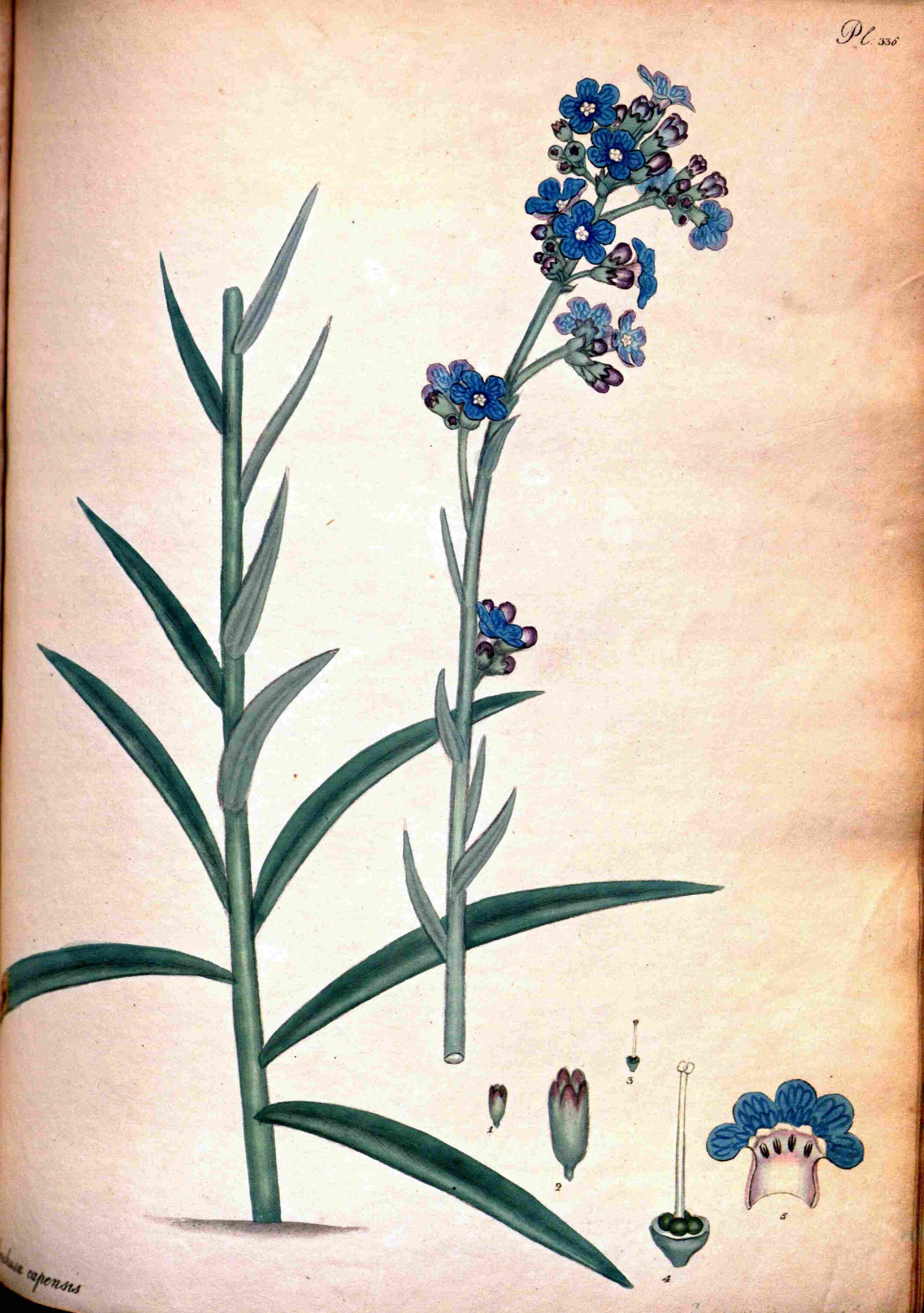
Volume 5 — PLATE CCCXXXVI.
Reading edition
ANCHUSA CAPENSIS.
Cape Alkanet.
CLASS V. ORDER I.
PENTANDRIA MONOGYNIA. Five Chives. One Pointal.
GENERIC CHARACTER.
Calyx. Perianthium quinquepartitum oblongum, teres, acutum, persistens.
Corolla monopetala, infundibuliformis; tubus cylindricus, longitudine calycis; limbus semiquinquefidus, obtusus, erecto-patens; faux clausa squamulis quinque, convexis, prominentibus, oblongis, conniventibus.
Stamina. Filamenta quinque, brevissima, in fauce corollæ. Antheræ oblongæ, incumbentes, tectæ.
Pistillum. Germina quatuor. Stylus filiformis, longitudine staminum. Stigma obtusum, emarginatum.
Pericarpium nullum; Calyx major, erectus, in sinu continens semina.
Semina quatuor, oblongiuscula, obtusa, gibba.
Empalement. Cup five-parted, oblong, cylindrical, pointed, remaining.
Blossom one petal, funnel-shape; tube cylindric, the length of the cup; border half-five-cleft, obtuse, from erect spreading; throat closed with five small scales, convex, prominent, oblong, converging.
Chives. Five very short threads in the throat of the blossom. Tips oblong, incumbent, covered.
Pointals. Seed-buds four. Shaft thread-shaped, the length of the chives. Summit blunt, notched at the end.
Seed-vessel none; the Cup larger and erect, containing the seeds in its bosom.
Seeds four, somewhat oblong, blunt, hunched.
SPECIFIC CHARACTER.
Anchusa foliis lanceolatis, villosis, callosis; floribus racemoso-paniculatis, cœruleis.
Alkanet with lance-shaped leaves, hairy, and callous; flowers grow in bunches nearly panicled, blue.
REFERENCE TO THE PLATE.
1. The Empalement, natural size. 2. The same, magnified. 3. The Seed-buds and pointal, natural size. 4. The same magnified. 5. A Blossom cut open, magnified, to shew the scales upon the mouth, with the situation of the chives.
This is the only species of the Genus we have yet seen from the Cape of Good Hope; and, as it appears that Thunberg discovered but this solitary instance, which he has given in his Prodromus Plantarum Capensium, under the specific title we have here adopted, from him; he, perhaps, thought himself warranted in so naming it; although naming plants from the country where they are first found requires but little reasoning to shew its impropriety. It is a hardy green-house plant, but from all appearance, like the most of this natural order, rather short-lived. It grows freely in a mixture of loam and sandy peat; and there is every appearance that the seeds will ripen, the only method by which there is any likelihood of its being perpetuated.
The plant, before flowering, does not grow above six inches high; but the flower-stem rises near eighteen inches. Our figure was taken from a plant in the Hibbertian Collection; where it flowered for the first time in England in the month of July 1803; having been sent home, by Mr. Niven, from the Cape, in 1800.