Volume 5 — PLATE CCCXXXI.
Reading edition
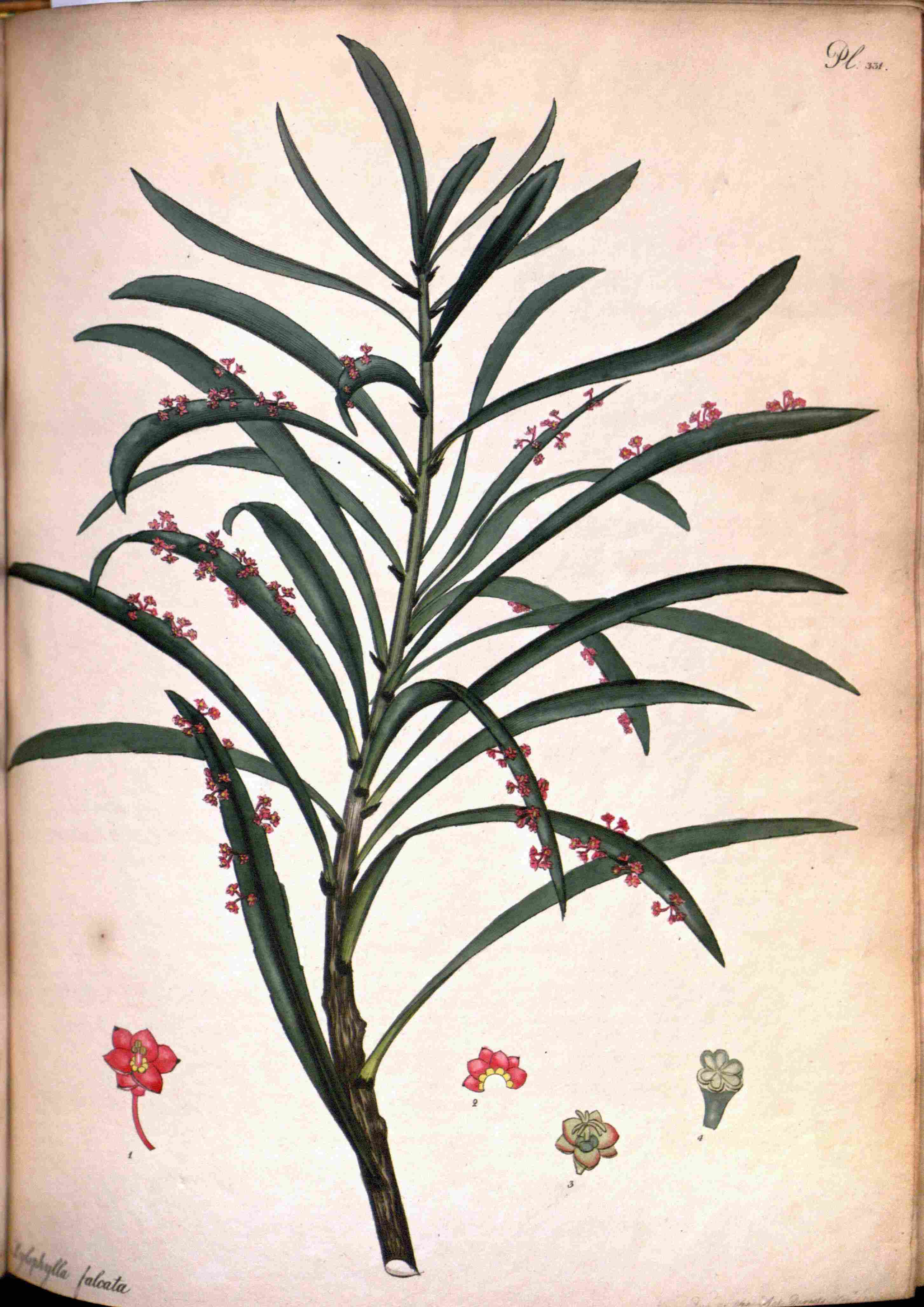
XYLOPHYLLA FALCATA.
Cymitar-shaped-leaved Xylophylla.
CLASS XXI. ORDER III.
MONŒCIA TRIANDRIA. Chives and Pointals separate. Three Chives.
GENERIC CHARACTER.
* Masculi flores.
Calyx. Perianthium monophyllum, tripartitum, coloratum; laciniis ovatis, patulis, ovatis.
Corolla. Petala tria, ovata, concava.
Stamina. Filamenta tria, brevissima, basi approximata. Antheræ subrotundæ, didymæ.
* Feminei flores in eodem fasciculo cum masculis.
Calyx. Perianthium ut in mare.
Corolla ut in mare.
Nectarium corpusculis glandulosis germen ambientibus.
Pistillum. Germen subrotundum, trisulcatum. Styli tres, patuli, bifidi. Stigmata obtusa.
Pericarpium. Capsula trigona, trisulca, trilocularis; loculis bivalvibus.
Semina solitaria.
* Male flowers.
Empalement. Cup one leaf, three divided, coloured; segments egg-shaped, spreading, oval.
Blossom. Petals three, egg-shaped, concave.
Chives. Threads three, very short, and approaching at the base. Tips roundish, double.
* Female flowers in the same tuft with the males.
Empalement. Cup as in the male.
Blossom as in the male.
Honey-cup is formed of small glandular bodies surrounding the seed-bud.
Pointal. Seed-bud roundish, three-furrowed. Shafts three, short. Summits blunt.
Seed-vessel. Capsule three-sided, three-furrowed, three cells; cells two-valved.
Seeds solitary.
SPECIFIC CHARACTER.
Xylophylla foliis sparsis, integris, falcatis, crenatis; crenis remotis, floriferis; floribus rubris.
Xylophylla with leaves scattered on the stem, entire, cymitar-shaped and scolloped; the scollops distant, and having the flowers on them; flowers red.
REFERENCE TO THE PLATE.
1. A male flower, magnified. 2. The blossom of male flowers, spread open, with the honey-cups. 3. A Female flower, magnified. 4. The Germ from a female flower, cut transversely, magnified.
It should seem that this Genus has not been observed with sufficient accuracy, at least those plants known to us, and which have been treated of as belonging to the class Pentandria. The present one, for instance, which is unquestionably the plant designed by Swartz, Commelin, Seba, &c. an is acknowledged by Swartz to be triandrous and monœcious, yet that it should be continued in the Kew Catalogue and by Willdenow, &c. to Pentandria, is astonishing. We have no hesitation in declaring our opinion that the whole genus as it now stands ought to be thrown to Phyllanthus. But, as the title Xylophylla is so well known for these plants; we have thought it more safe to give the Genus those characters the plants bear under their true Class and Order, than make any alteration in it. The Xylophylla falcata is a native of the West India Islands, and has been long cultivated in our hot-houses; so long ago as the year 1739. It is a tender plant, and will not flower without the assistance of the bark-bed; is easily propagated by cuttings; grows best in sandy peat, and flowers in August. Our drawing was made at the Hammersmith Nursery.