Volume 5 — PLATE CCCXX.
Reading edition
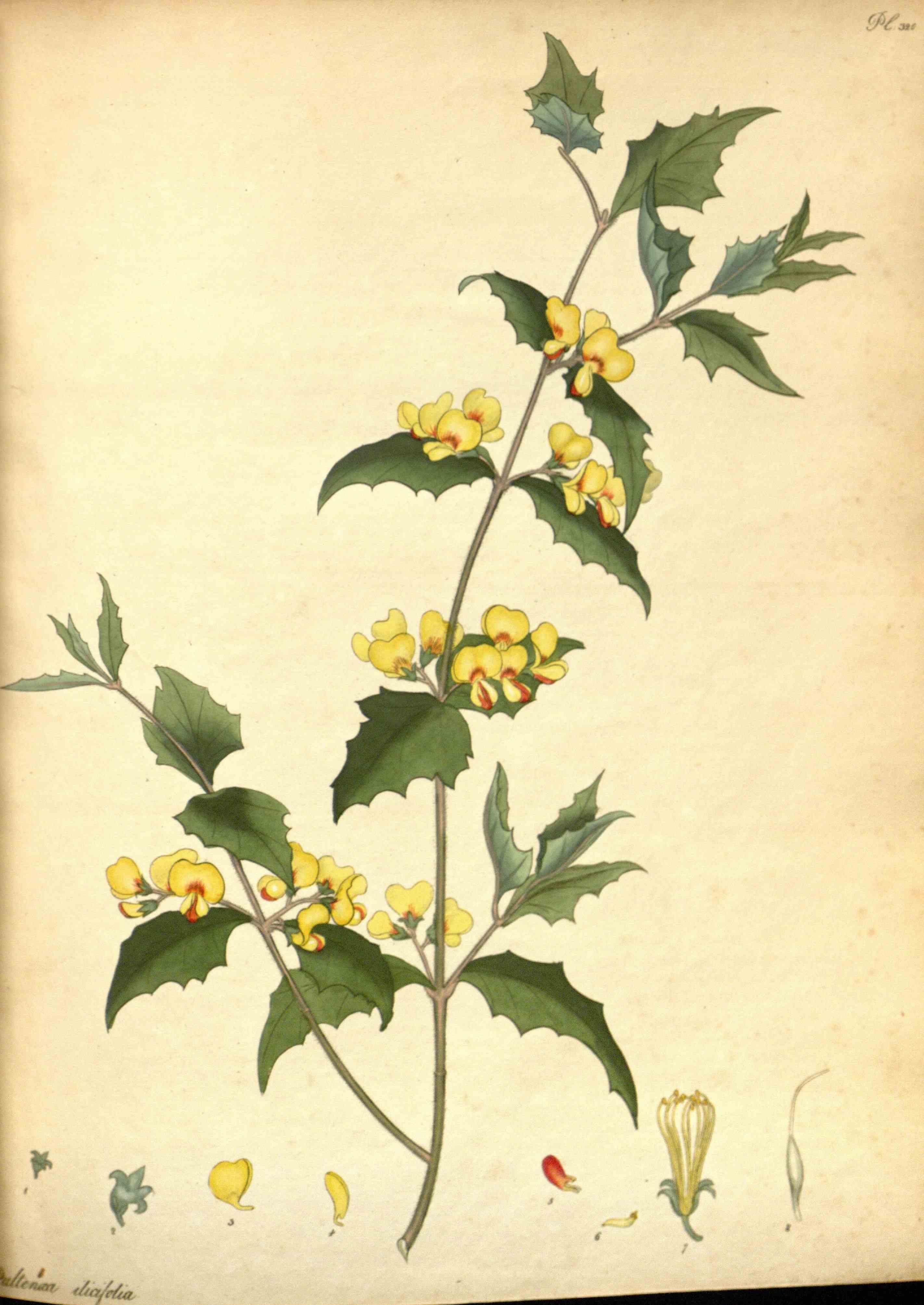
PULTENÆA ILICIFOLIA.
Holly-leaved Pultenæa.
CLASS X. ORDER I.
DECANDRIA MONOGYNIA. Ten Chives. One Pointal.
ESSENTIAL GENERIC CHARACTER.
Calyx quinque-dentatus, utrinque appendiculatus. Corolla papillionacea, alis vexillo brevioribus. Legumen uniloculare, dispermum.
Cup five-toothed, with an appendage on each side. Blossom butterfly-shaped, wings shorter than the standard. Pod one-celled, two seeded.
See Pultenæa daphnoides, Pl. XCVIII. Vol. II.
SPECIFIC CHARACTER.
Pultenæa foliis hastatis, serratis, rigidis; floribus axillaribus, racemosis.
Pultenæa with halbert-shaped leaves, sawed and harsh; flowers grow from the insertion of the leaves in long bunches.
REFERENCE TO THE PLATE.
1. The Cup, natural size. 2. The same, magnified. 3. The Standard, or upper petal of the blossom. 4. One of the Wings of the same. 5. The two petals of the keel of the same. 6. The Chives and Pointal. 7. The Chives, magnified. 8. The Seed-bud, Shaft and Summit, magnified.
This species of Pultenæa was introduced, from New Holland, about the year 1792, by Messrs. Lee and Kennedy, Hammersmith, and is undoubtedly one of the handsomest of the genus. It is difficult to increase as the seeds do not mature, and it is very rarely propagated by cuttings. It grows to the height of three or four feet; and, when in flower, makes a very brilliant appearance. It is not a long-liv’d plant; is very impatient of wet, and is easily hurt by the cold, so should be kept in a dry and warm part of the green-house, or even on a shelf in the hot-house, during the winter months. It thrives in very sandy peat earth without any mixture. Our drawing was made from a plant in the Hibbertian Collection, in the month of June, 1801.