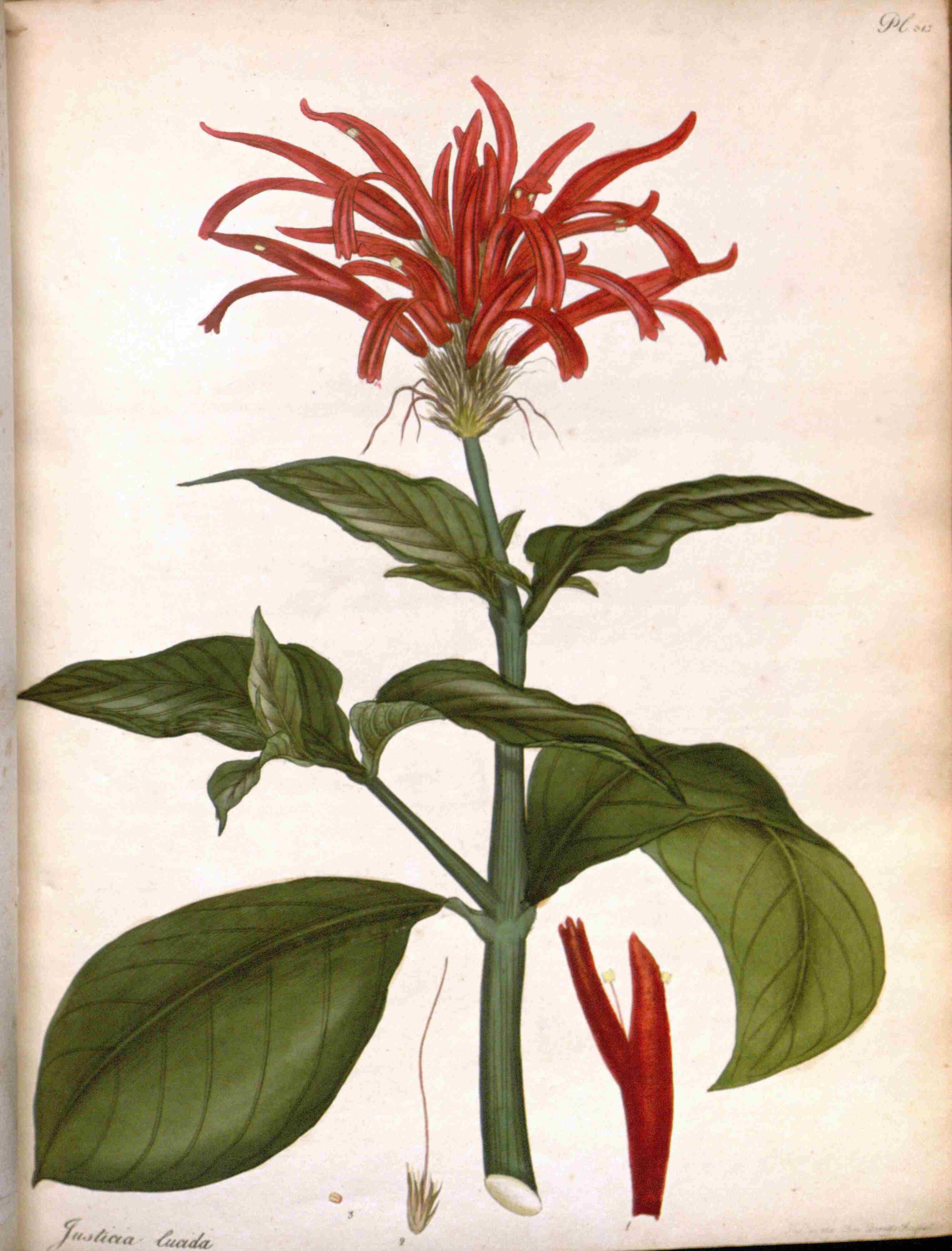
Volume 5 — PLATE CCCXIII.
Reading edition
JUSTICIA LUCIDA.
Shining-leaved Justicia.
CLASS II. ORDER I.
DIANDRIA MONOGYNIA. Two Chives. One Pointal.
GENERIC CHARACTER.
Calyx. Perianthium monophyllum, minimum, quinquepartitum, acutum, erectum, angustum.
Corolla monopetala, ringens; tubus gibbus; limbus bilabiatus, labium superius oblongum, emarginatum, labium inferius ejusdem longitudinis, reflexum, trifidum.
Stamina. Filamenta duo, subulata, sub labio superiore recondita. Antheræ erectæ, ad basin bifidæ.
Pistillum. Germen turbinatum. Stylus filiformis, longitudine et situ staminum. Stigma simplex.
Pericarpium. Capsula oblonga, obtusa, basi angustata, bilocularis, bivalvis; dissepimento valvulis contrario, ungue elastico dehiscens.
Semina subrotunda.
Empalement. Cup one-leaf, very small, five-divided, pointed, erect, narrow.
Blossom one petal, gaping; tube hunched; border two-lipped; the upper lip oblong, notched at the end; the under lip of the same length, reflexed, and three-cleft.
Chives. Two threads, awl-shaped, hid under the upper lip. Tips upright, two-cleft at the base.
Pointal. Seed-bud top-shaped. Shaft thread-shaped, the length and situation of the chives. Summit simple.
Seed-vessel. Capsule oblong, obtuse, narrowed at the base, two-celled, two valved; the partition opposite to the valves splitting from an elastic claw.
Seeds roundish.
SPECIFIC CHARACTER.
Justicia spicis terminalibus; floribus subcapitatis; foliis elipticis, nervosis, bullatis, lucidis; corollis bilabiatis, labio superiore lanceolato; caule fruticoso, glabro.
Justicia with terminal spikes; flowers grow nearly in heads; leaves elliptic, nerved, blistered, and shining; blossoms two-lipped, the upper lip lance-shaped; stem shrubby, smooth.
REFERENCE TO THE PLATE.
1. A Blossom cut open, with the Chives in their place. 2. The Cup and Pointal. 3. An unripe Seed.
Most of the species of this genus of plants have hitherto been considered of little value in our collections, as few of them have woody stems, and from that character have a weedy appearance. This plant however is an exception, and is well worthy a place in collections where ornament only, not variety, is studied. It grows to the height of three feet, flowers in the month of August, is easily increased from cuttings, and may be kept in the hot-house, out of the bark-bed. The Justicia coccinea and this plant approach in the appearance of their flowers and habit; but the leaves differ much as well as many other minuter parts. It is a native of the East Indies, and was introduced about the year 1794. Our figure was taken from a plant in the Collection of G. Hibbert, Esq. Clapham Common.