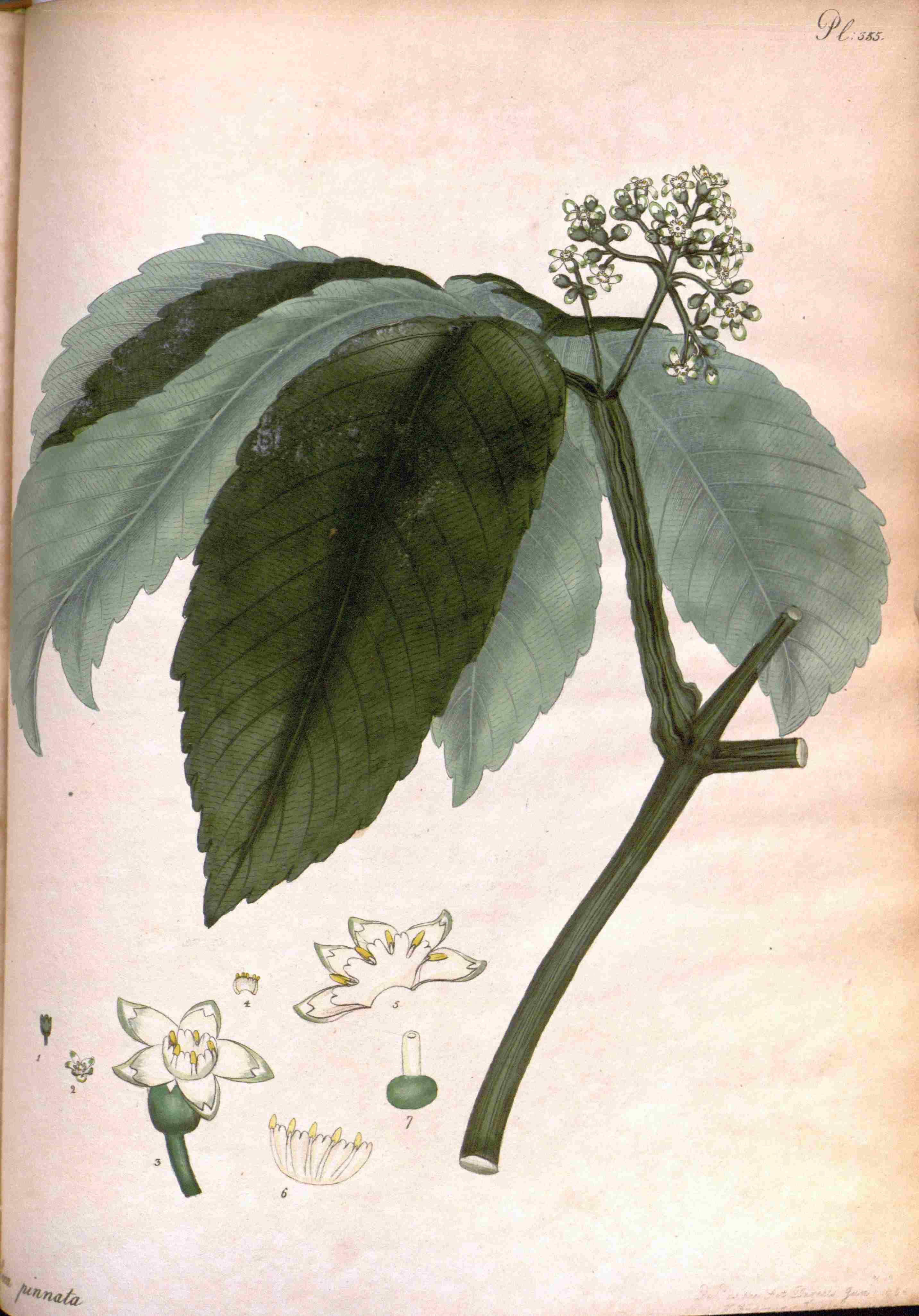
Volume 5 — PLATE CCCLV.
Reading edition
LEEA PINNATA.
Winged-leaved Leea.
CLASS V. ORDER I.
PENTANDRIA MONOGYNIA. Five Chives. One Pointal.
GENERIC CHARACTER.
Calyx. Perianthium monophyllum, campanulatum, coriaceum, quinquedentatum, persistens.
Corolla monopetala; tubus longitudine calycis; limbus quinquefidus, æqualis; laciniis saccatis.
Nectarium basi interioris corollæ adnatum, corolla dimidio brevius, erectum, urceolatum, quinquefidum; lobis emarginatis.
Stamina. Filamenta quinque, inserta basi exteriori nectarii. Antheræ ovatæ, versatiles.
Pistillum. Germen subglobosum. Stylus simplex, nectario brevior. Stigma obtusum.
Pericarpium. Bacca orbiculata, depressa, quinquelocularis.
Semina quinque, solitaria.
Empalement. Cup one leaf, bell-shaped, leathery, five-toothed, remaining.
Blossom one petal; tube the length of the cup; border five-cleft, equal; segments bagged.
Honey-cup fixed to the base of the inside of the blossom, by the half shorter than the blossom, erect, pitcher-shaped, five-cleft; lobes notched at the end.
Chives. Five threads inserted into the outside of the base of the honey-cup. Tips egg-shaped, versatile.
Pointal. Seed-bud almost globular. Shaft simple, shorter than the honey-cup. Summit blunt.
Seed-vessel. Berry orbicular, flattened, five-celled.
Seeds five, solitary.
SPECIFIC CHARACTER.
Leea foliis impari-pinnatis, oppositis; caule tereti, glabro; racemis angulatis, angulis undulatis.
Leea with winged leaves terminated by an odd one and opposite; stem round and smooth; branches angled; angles waved.
REFERENCE TO THE PLATE.
1. The Cup, natural size. 2. A Blossom. 3. A Flower complete, magnified. 4. The Honey-cup, shewn from the inside, cut open, a little magnified. 5. A Blossom, with the Honey-cup and Chives, magnified. 6. The Honey-cup and Chives shewn from the outside, magnified. 7. The Pointal, magnified.
Leea and Aquilicia have, of late, been considered as not possessing sufficient essentially differing characters to constitute two genera, and Aquilicia has been lost in Leea. Our present subject is a species of the former Aquilicias, is mentioned by Gaertner, who says, it approaches A. sambucina, now Leea sambucina; to which indeed it has much resemblance, but differs in having opposite, not alternate branches, being scentless, having the leaves rather rough and the stem smooth. It is a native of the East Indies, requiring the tan-bed to make it flower; is half shrubby, and is increased by cuttings. Flowers in August. Our figure is from a specimen communicated to us by Aylmer Bourke Lambert, Esq. who raised it from seeds received from Dr. Roxburg, in 1801, under the name of Leea crispa: which is a native of Africa, and has been long in most of our collections of hot house plants, but is in the highest state of cultivation, under the care of Mr. Hoy, in that of his Grace the Duke of Northumberland, Sion House, near Brentford.