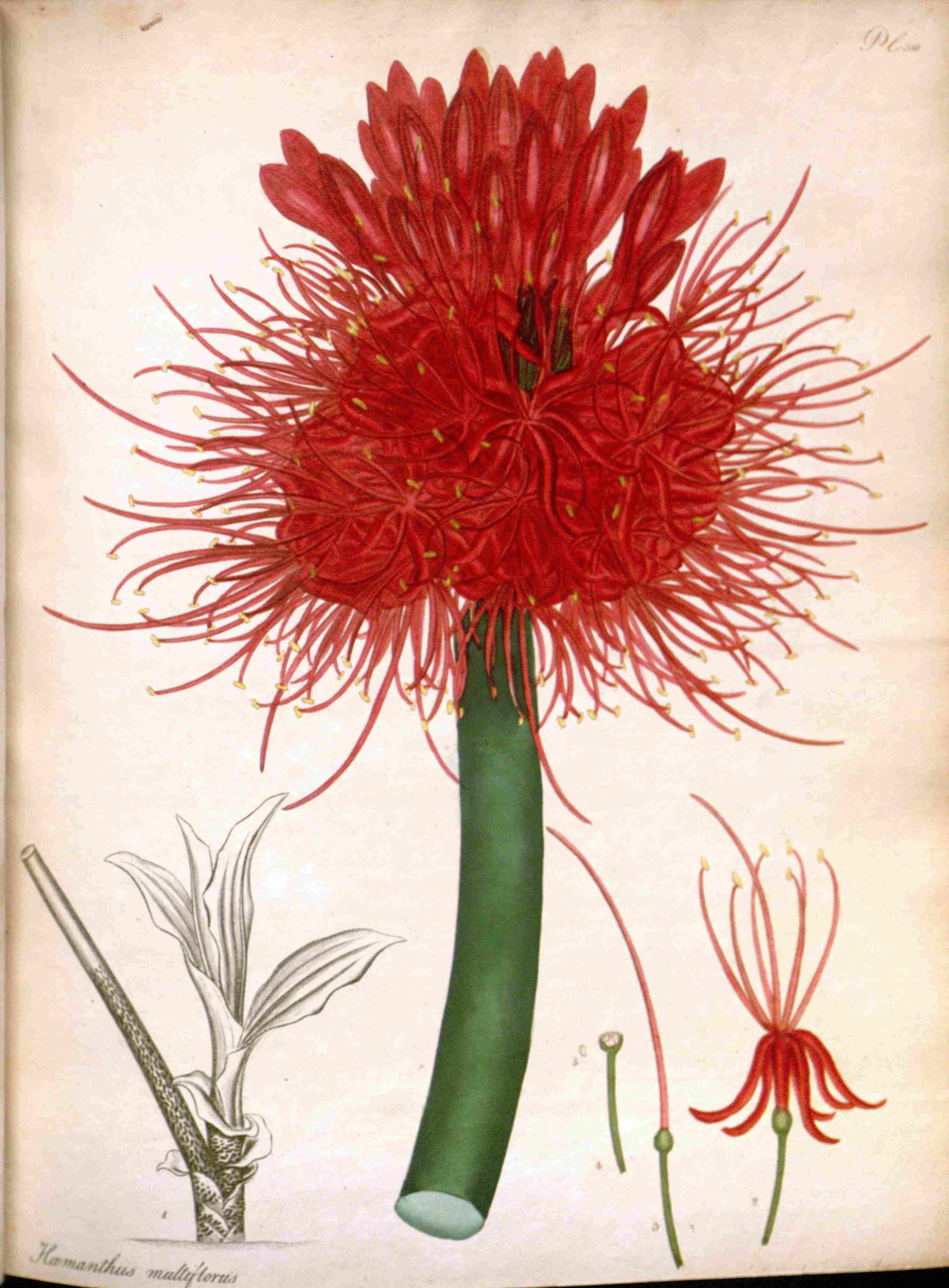
Volume 5 — PLATE CCCXVIII.
Reading edition
HÆMANTHUS MULTIFLORUS.
Many-flowered Blood-Flower.
CLASS VI. ORDER I.
HEXANDRIA MONOGYNIA. Six Chives. One Pointal.
GENERIC CHARACTER.
Calyx. Involucrum hexaphyllum, maximum, umbelluliferum; foliolis erectis, oblongis, persistentibus.
Corolla monopetala, erecta, sexpartita; laciniis erectis, linearibus; tubo brevissimo, angulato.
Stamina. Filamenta sex, subulata, tubo corollæ inserta, corolla longiora. Antheræ incumbentes, oblongæ.
Pistillum. Germen inferum. Stylus simplex, longitudine staminum. Stigma simplex.
Pericarpium. Bacca subrotunda, trilocularis.
Semina solitaria, triquetra.
Empalement. Fence six-leaved, large, bearing a small umbel; leaflets upright, oblong, permanent.
Blossom one petal, upright, six-parted; segments upright, linear; tube very short, angular.
Chives. Threads six, awl-shaped, inserted into the tube of the blossom, longer than the blossom. Tips laying on the threads, oblong.
Pointal. Seed-bud beneath. Shaft simple, the length of the chives. Summit simple.
Seed-vessel. Berry roundish, three-celled.
Seeds solitary, three-sided.
SPECIFIC CHARACTER.
Hæmanthus foliis plicatis, undulatis, erectis, lato-lanceolatis; umbella globosa; floribus confertis; petalis patentibus; scapo ad basin maculato.
Blood flower with plaited leaves, waved, upright and broad-lance shaped; umbel globular; flowers crowded; petals spreading; flower-stem spotted at the base.
REFERENCE TO THE PLATE.
1. The Leaves and part of the Flower-Stem, in miniature. 2. A Flower, complete, natural size. 3. The Seed-bud, Shaft, and Summit. 4. A Seed-bud, cut transversely. 5. The embryo of a Seed.
This plant is said to have been in our European gardens so long ago as the year 1603: having, at that time, been sent to Paris by the younger Robin from Guinea. But however this may be, as yet there is no figure of the plant by which it may be known from many of this beautiful tribe, except the one by the late Mr. Nodder. We are indebted for its last introduction to the honourable the Sierra Leone Company, who received, in 1792, the roots of this plant, amongst many others, from that settlement; which were by them presented to Messrs. Lee and Kennedy, at Hammersmith. Our figure was taken in June from a plant in flower this present year, 1803, in the collection of J. Vere, Esq. Kensington Gore, where, from particular management of Mr. Anderson, the same root has flowered several times; a circumstance that but rarely happens with these bulbs after the first year from importation. As a native of so hot a clime it must be kept in the bark bed of the hot-house; and, when the plant is not in flower, should be watered but sparingly. We as yet are unacquainted with any mode by which it may be propagated. It flourishes most in rich mould. Our figure represents the plant in a small specimen, as the head of flowers is frequently, in this country, of three times the size.