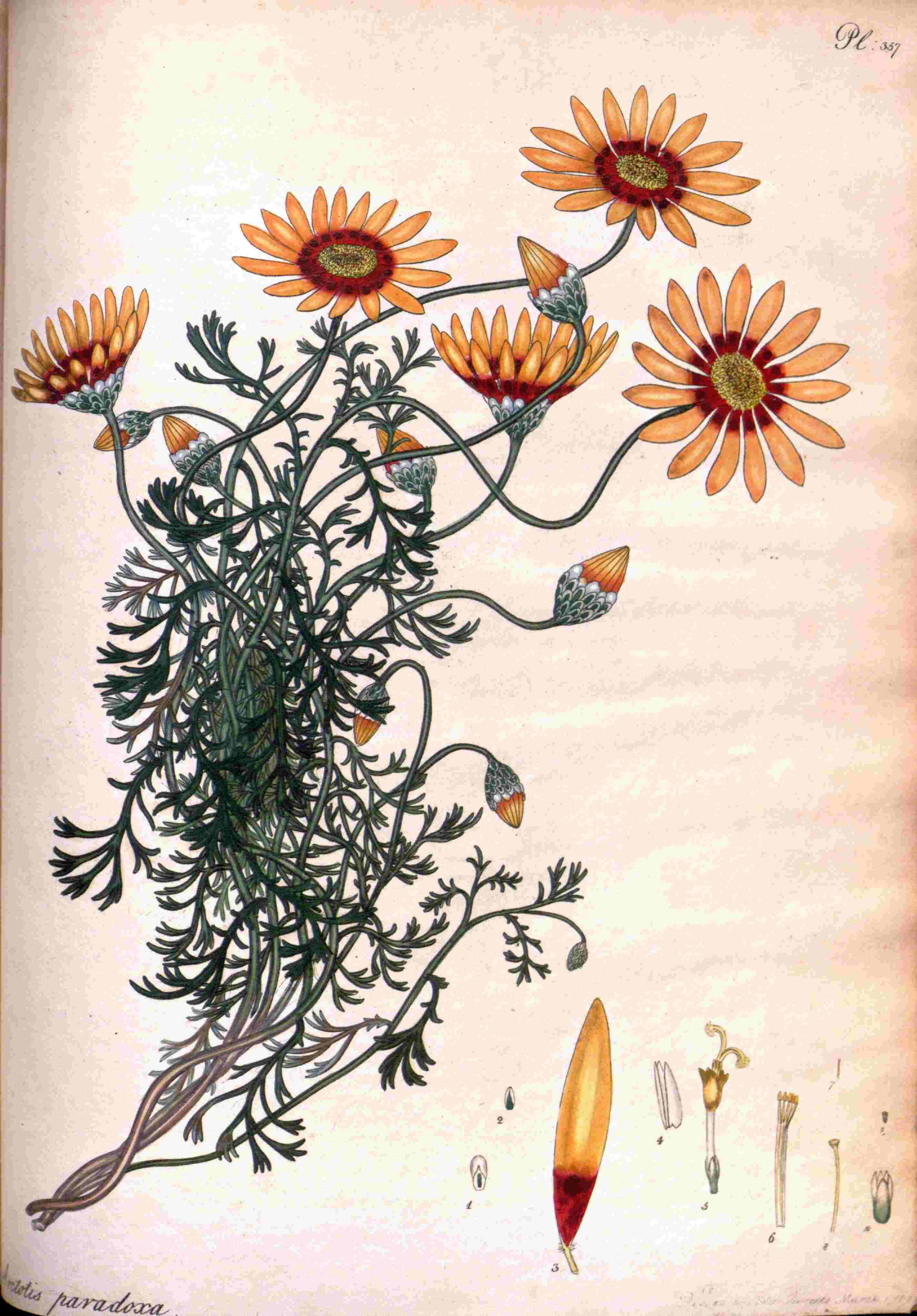
Volume 5 — PLATE CCCLVII.
Reading edition
ARCTOTIS PARADOXA.
Chamomile-leaved Arctotis.
CLASS XIX. ORDER IV.
SYNGENESIA POLYGAMIA NECESSARIA. Tips united. Necessary Pointals.
GENERIC CHARACTER.
Calyx communis subrotundus, imbricatus; squamis inferioribus laxioribus, subulatis; mediis ovatis; intimis oblongis; apice scarioso, rotundato, concavo.
Corolla composita radiata; corollulæ hermaphroditæ plurimæ in disco. Femininæ ligulatæ, fere viginti, disci diametro longiores.
Propria hermaphroditis infundibuliformis; limbo quinquefido, apicibus reflexis, æqualibus.
Femineis ligulata, lanceolata, tenuissime tridentata, tubo brevissimo.
Stamina hermaphroditis; filamenta quinque, capillaria, brevissima. Anthera cylindracea, quinquedentata, longitudine corollulæ.
Pistillum Hermaphroditis; germen vix manifestum. Stylus cylindraceus, corolla paulo longior. Stigma simplex.
Femineis germen ovato-tetragonum, villosum, coronatum calyculo proprio. Stylus filiformis. Stigmata duo, ovata-oblonga, crassiuscula, erecta.
Pericarpium nullum. Calyx immutatus. Semina Hermaphroditis nulla.
Femineis solitaria, subrotunda, villosa. Pappus perianthium proprium pentaphyllum; foliolis ovatis, patentibus, coronatus perianthii proprii foliolis ovatis in orbem positis.
Receptaculum pilosum seu paleaceum, planiusculum.
Empalement common roundish, tiled; lower scales more loose, awl shaped; middle ones egg-shaped; innermost oblong; harsh, rounded, concave at the point.
Blossom compound raied; hermaphrodite florets numerous in the center. Of the Females tongue-shaped, nearly twenty, longer than the diameter of the center.
Proper of the hermaphrodites funnel-shaped; border five-cleft, ends reflexed, equal.
Of the Females tongue-shaped, lance-shaped, slightly three-toothed; tube very short.
Chives of the Hermaphrodites; five threads hair-like, very short. Tip cylindric five-toothed, the length of the floret.
Pointal of the Hermaphrodites; seed-bud scarce visible. Shaft cylindric, a little longer than the blossom. Summit simple.
Of the Females seed-bud egg-shaped four-cornered, hairy, crowned by its proper cup. Shaft thread-shaped. Summits two, oblong-egg-shaped, thickish, upright.
Seed-vessel none. Empalement unchanged. Seeds in the Hermaphrodites none.
In the Females solitary roundish, hairy. Feather, proper cup five leaved; leaflets, egg-shaped, spreading, crowned by the proper cup with the leaflets placed in a round.
Receptacle hairy or chaffy, flattish.
SPECIFIC CHARACTER.
Arctotis flosculis radiantibus sterilibus; paleis disco longioribus coloratis; foliis bipinnatis, linearibus.
Arctotis with the florets of the circumference sterile; chaffs coloured and longer than the florets of the center; leaves doubly winged; linear.
REFERENCE TO THE PLATE.
1. An inner Scale of the cup. 2. An outer Scale of the cup. 3. A Petal of the circumference, with its tubular base, which is sterile. 4. A chalky division of the florets of the center, magnified. 5. A Female floret of the center, magnified. 6. The Chives of an Hermaphrodite floret, spread open and magnified. 7. The Pointal of an Hermaphrodite floret, natural size. 8. The same, magnified. 9. The Seed-bud of a female floret, natural size, with its feather. 10. The same, magnified.
Of all the plants, numerous as they are, composing this natural Class, we know of no one, the Virgilia (a native of Peru, and introduced to us from the Paris gardens by Mons. Thoin, about twenty years ago, but since lost to Europe,) excepted, which can rival our present subject. It is a native of the Cape of Good Hope, and is said, in the Kew Catalogue, to have been introduced to that collection, in 1774, by Mr. Masson. Whether this is the A. paradoxa of Linn. Sp. 1307. Vol. II, we are not certain, as the chaff, dividing the florets, is there described as of nearly the length of the ray, giving the flower an appearance of doubleness, and is there likewise marked as an annual. But, there is little doubt of its being the plant intended in the Kew Catalogue, under our title; it is there made biennial, which is its true character, as it does not flower the first year from seeds. It may be propagated by cuttings of the first year’s growth; delights in a light sandy loam, and flowers in July or August. Our drawing was made in 1802, from a plant in the Hibertian Collection; which had been raised from seeds, sent the preceding year, from the Cape, by Mr. Niven.