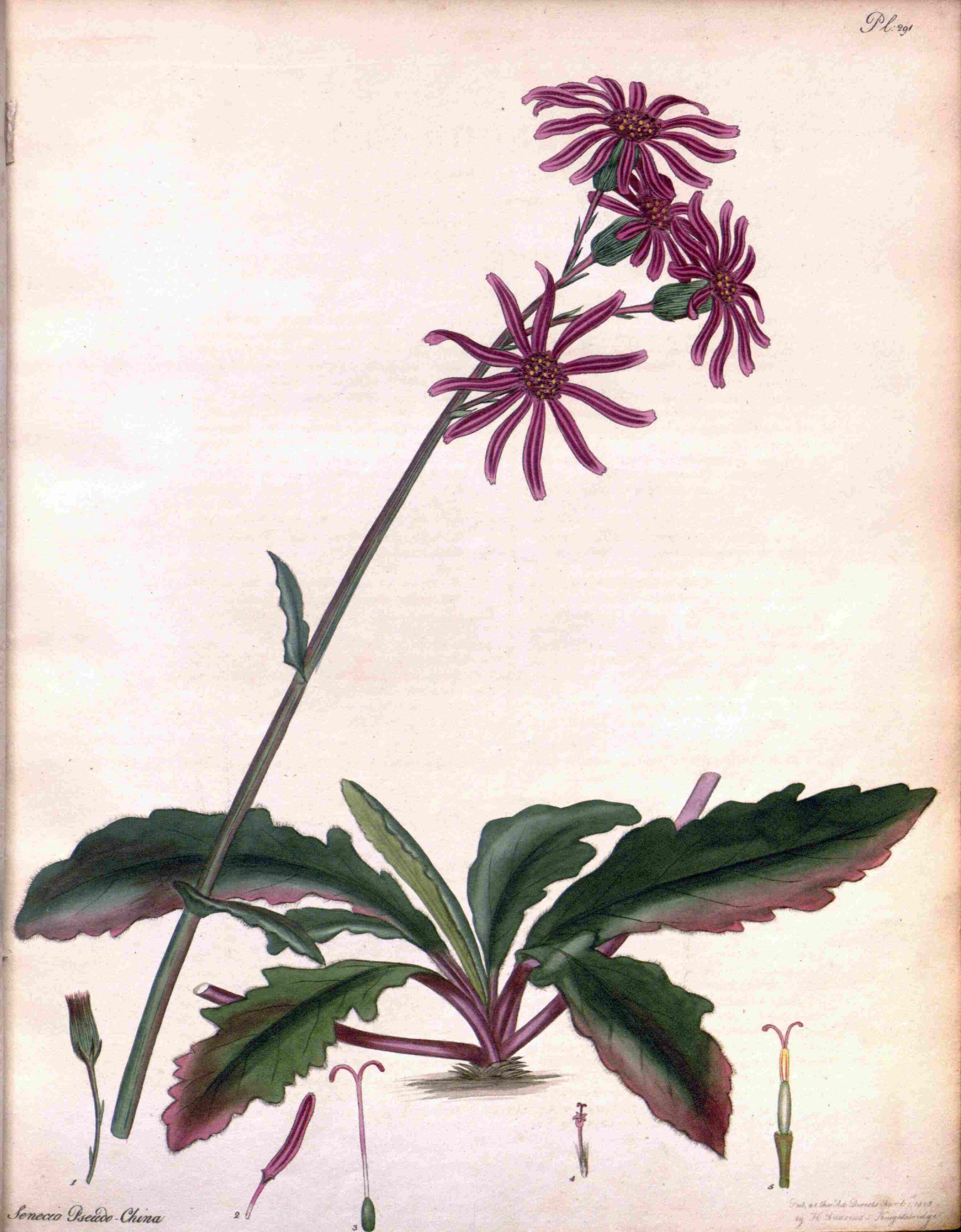
Volume 5 — PLATE CCXCI.
Reading edition
SENECIO PSEUDO-CHINA.
China-root Groundsel.
CLASS XIX. ORDER II.
SYNGENESIA POLYGAMIA SUPERFLUA. Tips united. Superfluous Pointals.
GENERIC CHARACTER.
Calyx. Communis calyculatus, conicus, truncatus; squamis subulatis, plurimis, in cylindrum superne contractum, parallelis, contiguis, æqualibus, paucioribus basin imbricatim tegentibus, apicibus emortuis.
Corolla. Composita, calyce altior; Corullulæ hermaphroditæ tubulosæ, numerosæ in disco; Femineæ ligulatæ in radio (si quæ adsint).
Propria hermaphroditi infundibuliformis; limbo reflexo, quinquefido.
Femineis (si quæ) oblonga, obsolete tridentata.
Stamina. Hermaphroditis; filamenta quinque, capillaria, minima. Anthera cylindracea, tubulosa.
Pistillum utrisque; germen ovatum. Stylus filiformis, longitudine staminum. Stigmata duo, oblonga, revoluta.
Pericarpium nullum. Calyx conico-connivens.
Semina hermaphroditis solitaria, ovata. Pappus crinitus, longus. Femineis similima hermaphroditis.
Receptaculum nudum, planum.
Empalement. Common, double, conical, appearing cut off; scales awl-shaped, numerous, contracted above into a cylinder, parallel, contiguous, equal, the base tiled by a few scales, dead at the ends.
Blossom. Compound, taller than the cup; Hermaphrodite florets tubular, numerous in the disk; Female florets (if there are any) tongue-shaped in the circumference.
Hermaphrodite florets funnel shaped, border reflexed, five-cleft.
Female florets (if any) oblong, obscurely three-toothed.
Chives. Of the hermaphrodite florets; five threads, hair-like, very small. Tips forming a tubular cylinder.
Pointal in either; Seed-bud egg-shaped. Shaft thread-shaped, the length of the chives. Summits two, oblong, rolled back.
Seed-vessel none. Empalement closing into a cone.
Seeds of hermaphrodite florets solitary, egg-shaped. Feather hairy, long. Females like the hermaphrodites.
Receptacle naked, flat.
SPECIFIC CHARACTER.
Senecio foliis sinuatis, integris, discoloribus; corollis purpureis; radice tuberosa.
Groundsel with obtusely indented leaves entire and two-coloured; blossoms purple; root tuberous.
REFERENCE TO THE PLATE.
1. The Cup. 2. A Female floret, of the ray or circumference. 3. A Pointal of the female floret magnified. 4. An Hermaphrodite floret of the disk or centre. 5. The Chives and Pointal of an Hermaphrodite floret, magnified.
The roots of this plant were received at the same time with the double Camellias, China Roses, &c. from China, by the late J. Slater, Esq. of Laytonstone, Essex; we have, nevertheless, good reason to believe it was known formerly in our gardens; but has been certainly lost, for many years, to us. It is said to have been cultivated by James Sherrard, M. D. in 1732, as copied from Dellinens’s Hortus Elthamensis, into the Kew Catalogue. Miller speaks of it as flowering freely, and perfecting its seeds; whereas, in the Hort. Kew. they omit its time of flowering, which, had it ever flowered there, would certainly have been noted. Our drawing was taken in the month of July last year, 1802, from a plant in the Hibbertian Collection, the first and only time we have ever seen it flower in England. It is propagated by the roots, which are large and fleshy; the plant is herbaceous, and should have but little water during the winter months, as the roots are very subject to rot; they are imported from India as a drug, under the name of China-root. Must be kept in the hot-house, and planted in rich earth.