Volume 5 — PLATE CCCXXXVII.
Reading edition
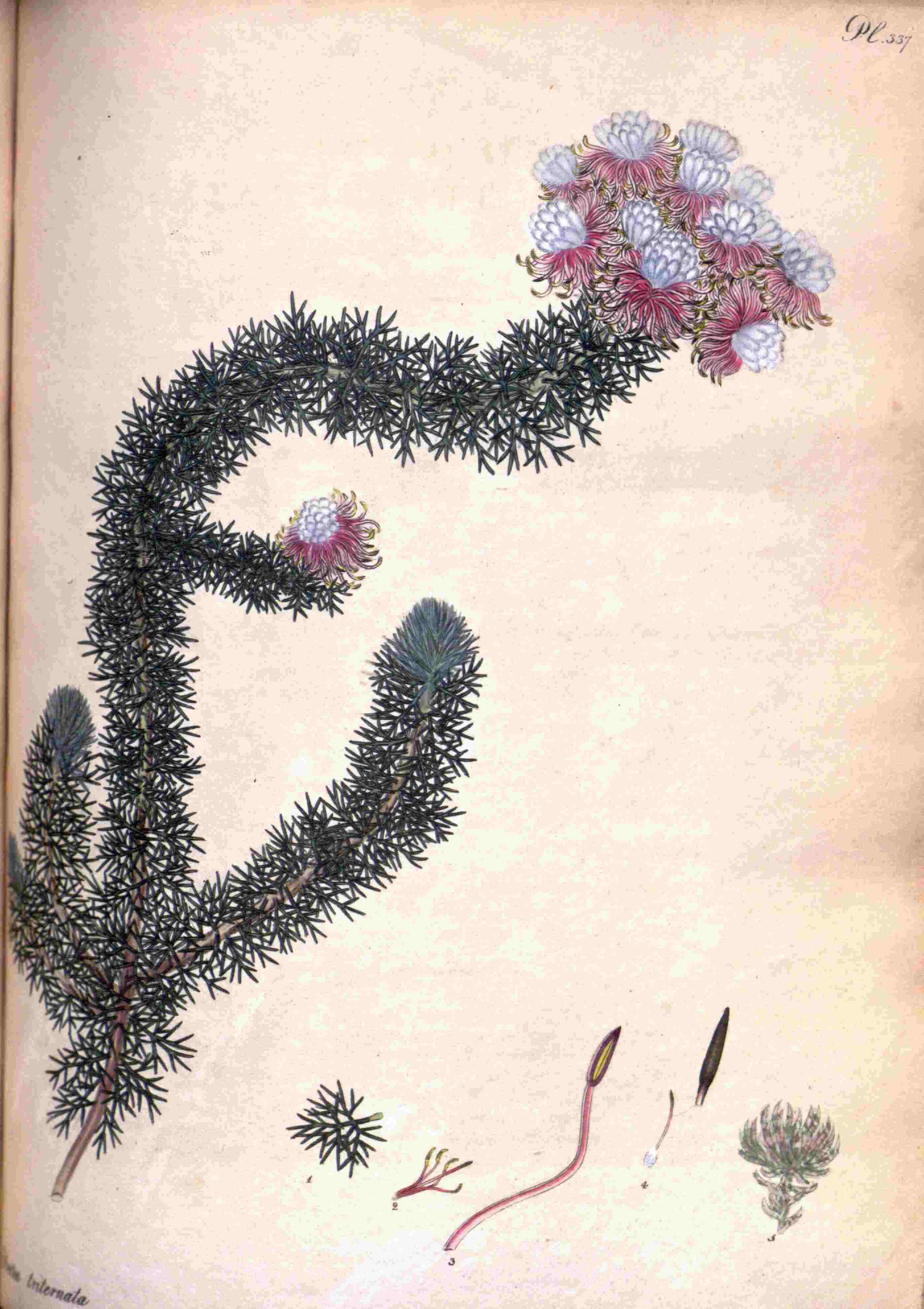
PROTEA TRITERNATA.
Cluster-headed Protea.
CLASS IV. ORDER I.
TETRANDRIA MONOGYNIA. Four Chives. One Pointal.
ESSENTIAL GENERIC CHARACTER.
Corolla quadrifida seu quadripetala. Antheræ lineares, insertæ petalis infra apicem. Calyx proprius nullus.
Semina solitaria.
Blossom four-cleft or four petals. Tips linear, inserted into the petals below the point. Empalement proper, none.
Seeds solitary.
See Protea formosa, Pl. XVII. Vol. I.
SPECIFIC CHARACTER.
Protea foliis bipinnatis, brevibus, filiformibus, confertis, glabris; floribus terminalibus, umbellatis; pedunculis bracteis, capitulis longioribus; squamis calycinis subulatis, hirtis.
Protea with doubly winged leaves, short, thread-shaped, crowded and smooth; flowers terminate the branches in umbels; fruit stalks with floral leaves, and longer than the small heads; scales of the cup awl-shaped and hairy.
REFERENCE TO THE PLATE.
1. A Leaf. 2. A Flower. 3. One of the Petals of the flower, magnified. 4. The Seed bud, Shaft and Summit, the Summit detached, magnified. 5. The common Cup of one of the small heads of flowers.
This beautiful divided leaved Protea has been named, as above, by Thunberg, in his Dissertatio de Protea, n. 7, and in his Prodromus plantarum capensium 25. It is rather a delicate plant, and subject to lose the lower leaves from the stem, which takes something from the beauty of its habit. The young leaves, when they first appear, have a downy character, which disappears as they grow firm. The stem has likewise, in its young state, a tendency to downiness, which is not discovered on the old wood; and is, where the leaves are extant, quite covered by them. It grows to the height of three feet, is propagated by cuttings, and flowers in the month of July. Our figure was taken from a plant in the Hibbertian Collection, which was raised from Cape seeds in 1800, sent from thence by Mr. Niven.