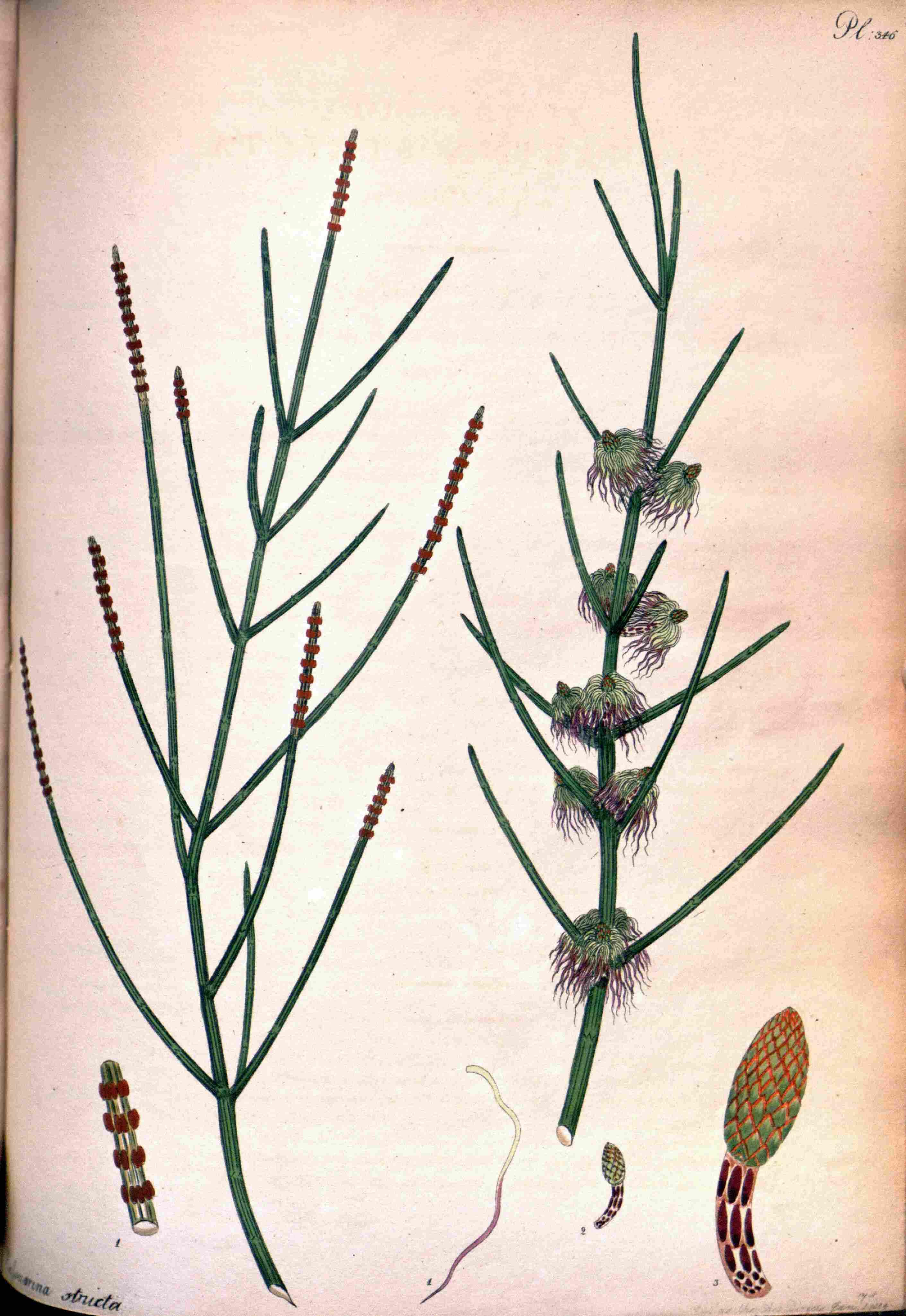
Volume 5 — PLATE CCCXLVI.
Reading edition
CASUARINA STRICTA.
Upright Casuarina.
CLASS XXI. ORDER I.
MONOECIA MONANDRIA. Chives and Pointal separate. One Chive.
GENERIC CHARACTER.
* Masculi flores.
Calyx. Amentum filiforme, imbricatum, squamis minutis, unifloris.
Corolla. Squamulæ bipartitæ, ovatæ, minutæ.
Stamina. Filamentum unicum, capillare, squama amenti longius. Anthera didyma.
* Feminei flores in eadem arbore.
Calyx. Amentum ovato-cylindricum; squamis ovatis, acutis, carinatis, ciliatis.
Corolla nulla.
Pistillum. Germen minutum. Stylus filiformis, longus, exsertus, bifidus. Stigmata duo.
Pericarpium. Strobilus squamis bivalvibus, perpendiculariter dehiscentibus.
Semina solitaria, conica, margine membranacea.
* Male flowers.
Empalement. Catkin thread-shape, tiled with small one-flowered scales.
Blossom. Scales two-parted, ovate, minute.
Chives. Thread one, hair-like, longer than the scale of the catkin. Tip double.
* Female flowers on the same plant.
Empalement. Catkin ovate-cylindric, with egg-shaped, acute, keeled, tiled scales.
Blossom none.
Pointal. Seed-bud minute. Shaft thread-shaped, long, without, two-cleft. Summits two.
Seed vessel. Cone with two-valved scales, splitting perpendicularly.
Seeds solitary, conical, with a skinny edge.
SPECIFIC CHARACTER.
Casuarina dioica ramulellis erectis; strobilorum squamis inermibus; vaginis masculis multi-fidis, glabris.
Casuarina with chives and pointals distinct, and upright branchlets; scales of the cones naked, male sheaths many-parted, smooth.
REFERENCE TO THE PLATE.
1. The Catkin, or terminal part of a male branchlet, magnified slightly. 2. The Shaft and Summit of a female floret. 3. The Cone, whilst yet in flower. 4. The same magnified.
The Casuarina stricta is a native of New South Wales, and was introduced, by Messrs. Kennedy and Lee, in the year 1775. It is a hardy green-house plant, grows to the height of ten or twelve feet before it flowers, which is in November. It is perfectly dioicous; the male and female blossoms, never coming on the same plant, and either have little to recommend them for beauty; their singularity is what should sooner attract our notice. The two figures, on the plate, which are the male and female, were taken from two plants, in flower, at the same time, in the collection of the Dowager Lady de Clifford, Paddington. All the species, hitherto discovered, since the first, upon which the genus was formed, the C. equisetifolia has, like this, the male and female parts of fructification on different plants; that only, being monoicous, or with the male and female parts on the same plant.