Volume 5 — PLATE CCCLVI.
Reading edition
ARUM ORIXENSIS.
Orixian Cuckow-pint.
CLASS XX. ORDER XI.
GYNANDRIA POLYANDRIA. Chives on the Pointal. Many Chives.
ESSENTIAL GENERIC CHARACTER.
Calyx. Spatha monophylla, maxima, oblonga, basi convoluta, apice connivens, ventre compressa, interne colorata.
Spadix clavatus, simplicissimus, spatha paulo brevior, coloratus, inferne germinibus obvallatus, marcescens supra germina.
Corolla nulla.
Stamina. Filamenta nulla, nisi nectaria basi crassa, desinentia in cirros filiformes, duorum ordinum e medio spadice egredientes. Antheræ plurimæ, sessiles, tetragonæ, cirrhorum duplici ordine interjectæ, spadici adnatæ.
Pistilla. Germina plurima, basin spadicis vestientia, infra stamina collocata, obovata. Styli nulli. Stigmata villis barbata.
Pericarpia. Baccæ totidem, globosæ, uniloculares.
Semina plura, subrotunda.
Empalement. Sheath one leaf, very large, oblong, convolute at the base, converging at the top, the belly compressed, coloured within.
Sheathed-Fruit-stalk club shaped quite simple, a little shorter than the sheath, coloured, set round with seed-buds on the lower part, withering above the seed-buds.
Blossom none.
Chives. Threads none except the honey-cups, which are thick at the base and terminated in thread-shaped tendrils, issuing in two rows from the middle of the sheathed fruit-stalk. Tips many, sitting, four sided, fixed to the fruit-stalk, and disposed between the two rows of tendrils.
Pointals. Seed-buds many, cloathing the base of the fruit-stalk, set below the chives, inversely egg-shaped. Shafts none. Summits bearded with soft hairs.
Seed-vessels. As many berries, globular, and one-celled.
Seeds. Many, roundish.
SPECIFIC CHARACTER.
Arum, acule; foliis ternatis, venosis, discoloribus; spatha declinata; flore atro-purpureo.
Cuckow-pint, stemless; leaves threefold, full of veins, two-coloured; sheath bent downward; flower of a deep purple.
REFERENCE TO THE PLATE.
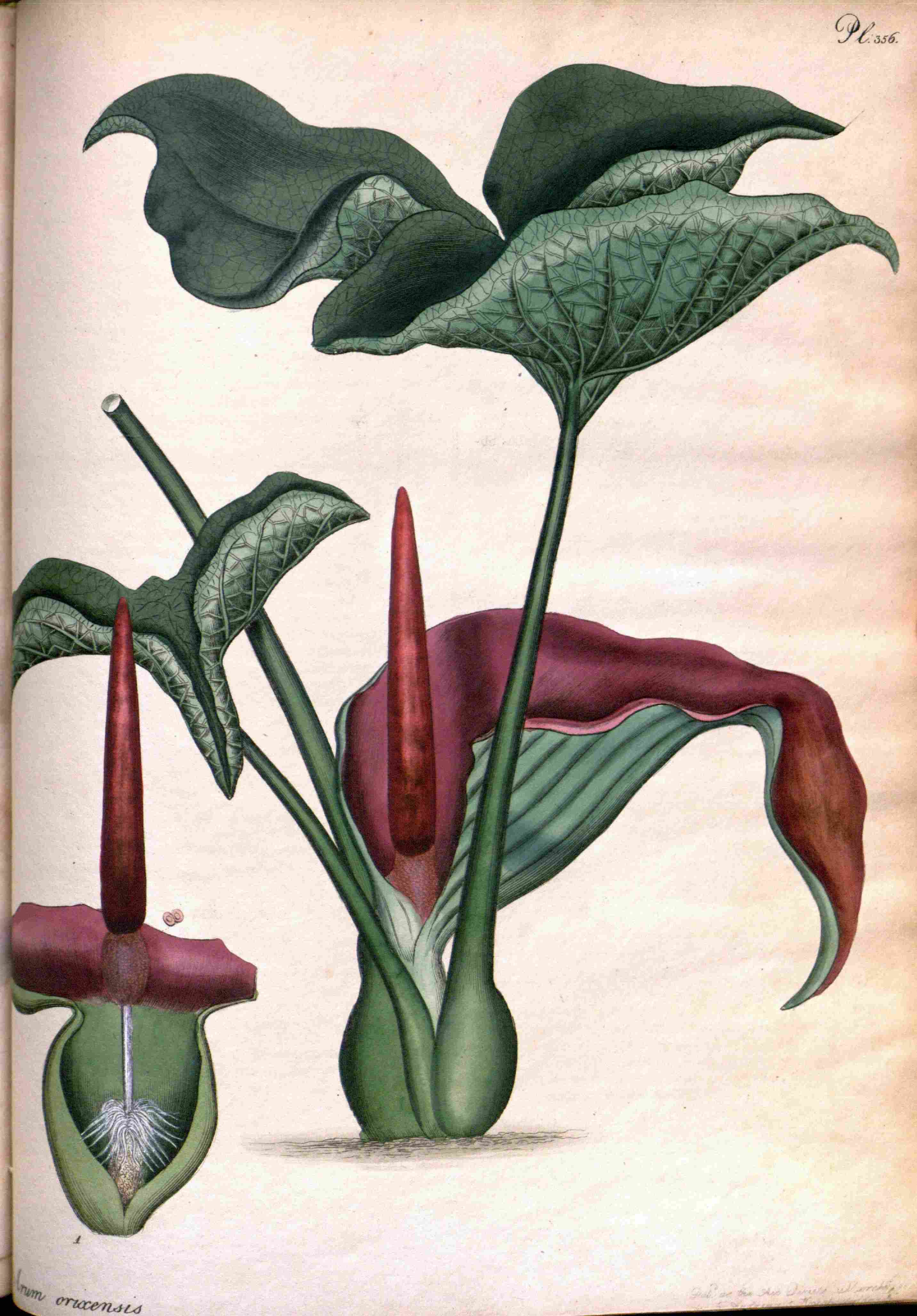
1. The whole flower, shewn from the front with the sheath opened, to expose the parts of fructification.
This pretty plant is a native of the East Indies, in that country from which it derives its specific title. It has much affinity with many others of the Genus, which at first sight appear rather as varieties, than meriting to be treated as species; but, in this instance, we submit our judgment to that of Dr. Roxburg, by whom it has been introduced to us under the name it here bears, in the year 1802. Our figure was taken, in the month of October 1803, from a plant in the collection of J. Vere, Esq. Kensington Gore. The flower is scentless.