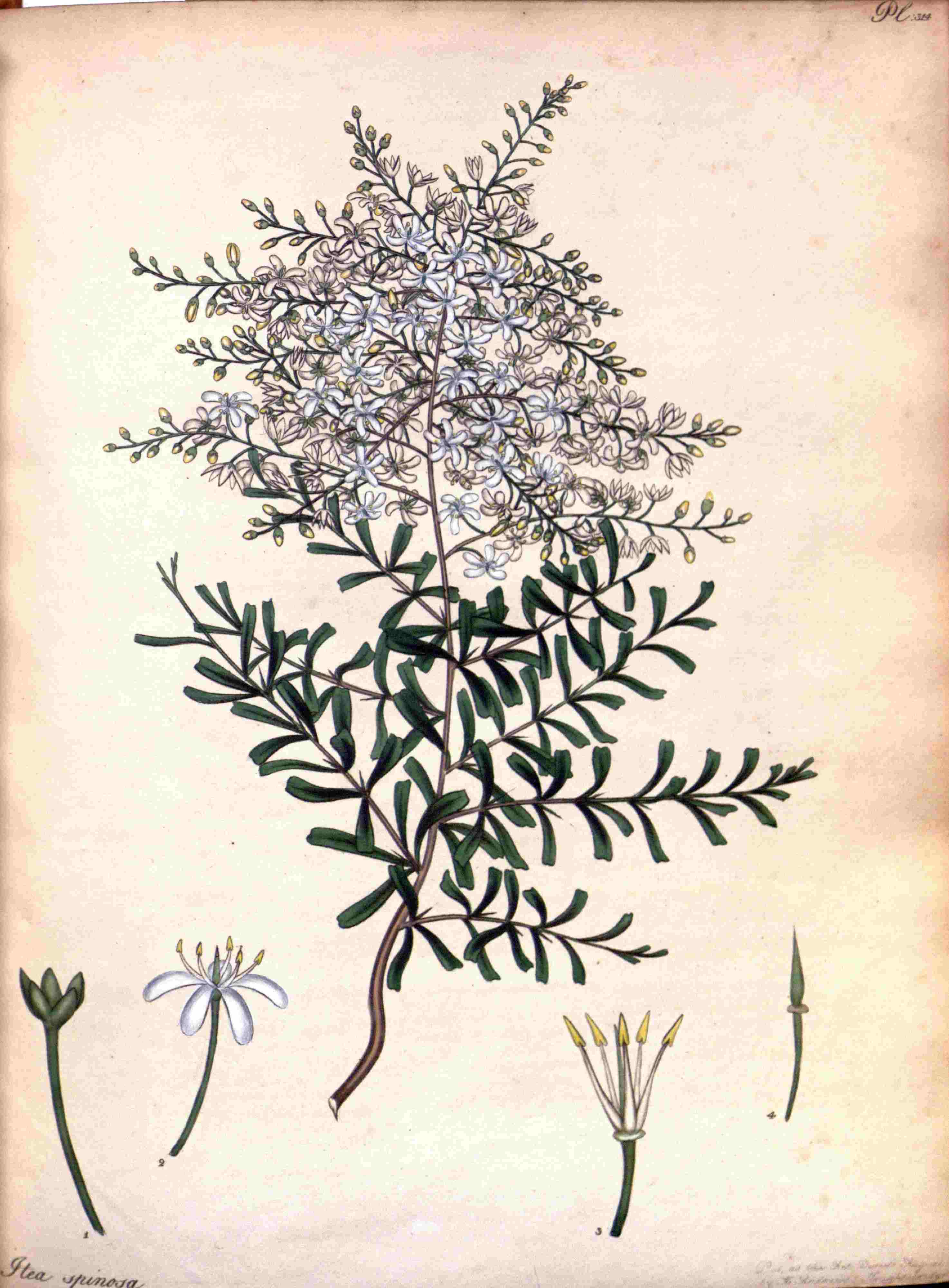
Volume 5 — PLATE CCCXIV.
Reading edition
ITEA SPINOSA.
Thorny Itea.
CLASS V. ORDER I.
PENTANDRIA MONOGYNIA. Five Chives. One Pointal.
GENERIC CHARACTER.
Calyx. Perianthium monophyllum, quinquefidum, erectum, acuminatum, minimum, persistens, laciniis acutis, coloratis.
Corolla. Petala quinque, lanceolata, longa, calyci inserta.
Stamina. Filamenta quinque, subulata, erecta, longitudine corollæ, calyci inserta. Antheræ subrotundæ, incumbentes.
Pistillum. Germen ovatum. Stylus cylindraceus, persistens, longitudine staminum. Stigma obtusum.
Pericarpium. Capsula ovata calyce multoties longior, stylo muconato, unilocularis, bivalvis ex duabus coalita apice dehiscens.
Semina numerosa, minima, oblonga, nitida.
Empalement. Cup one-leaf, five-cleft, upright, tapered, very small, remaining, segments pointed, coloured.
Blossom. Petals five, lance-shaped, long, inserted into the cup.
Chives. Five threads, awl-shaped, upright, the length of the blossom, inserted into the cup. Tips roundish, laying on the threads.
Pointal. Seed-bud egg-shaped. Shaft cylindrical, permanent, the length of the chives. Summit obtuse.
Seed-vessel. Capsule egg-shaped, much longer than the cup, tapering into the shaft, one-celled, two-valved of two joined, splitting at top.
Seeds numerous, very small, oblong, shining.
SPECIFIC CHARACTER.
Itea foliis cuneiformibus, emarginatis; spinis axillaribus.
Itea with wedge-shaped leaves, notched at the end; spines grow at the insertion of the leaves.
REFERENCE TO THE PLATE.
1. The Empalement, magnified. 2. A Flower complete, magnified. 3. The Chives and Pointal, magnified; part of the cup and the petals taken away, to shew the insertion of the Chives into the cup. 4. The Pointal, magnified.
This plant is a native of New Holland, and was introduced from thence by the Right Honourable the Marchioness of Rockingham, at the same time with the Bauera rubioides of this work; and from a specimen communicated by her Ladyship in September, 1801, our drawing was taken. It is a hardy green-house plant, continuing in flower from August till December; makes a very bushy handsome shrub, especially when planted in a conservatory. Is easily propagated by cuttings, made in the month of April, and kept on a gentle heat until they are rooted. It thrives most in sandy peat, with a small mixture of sandy loam.