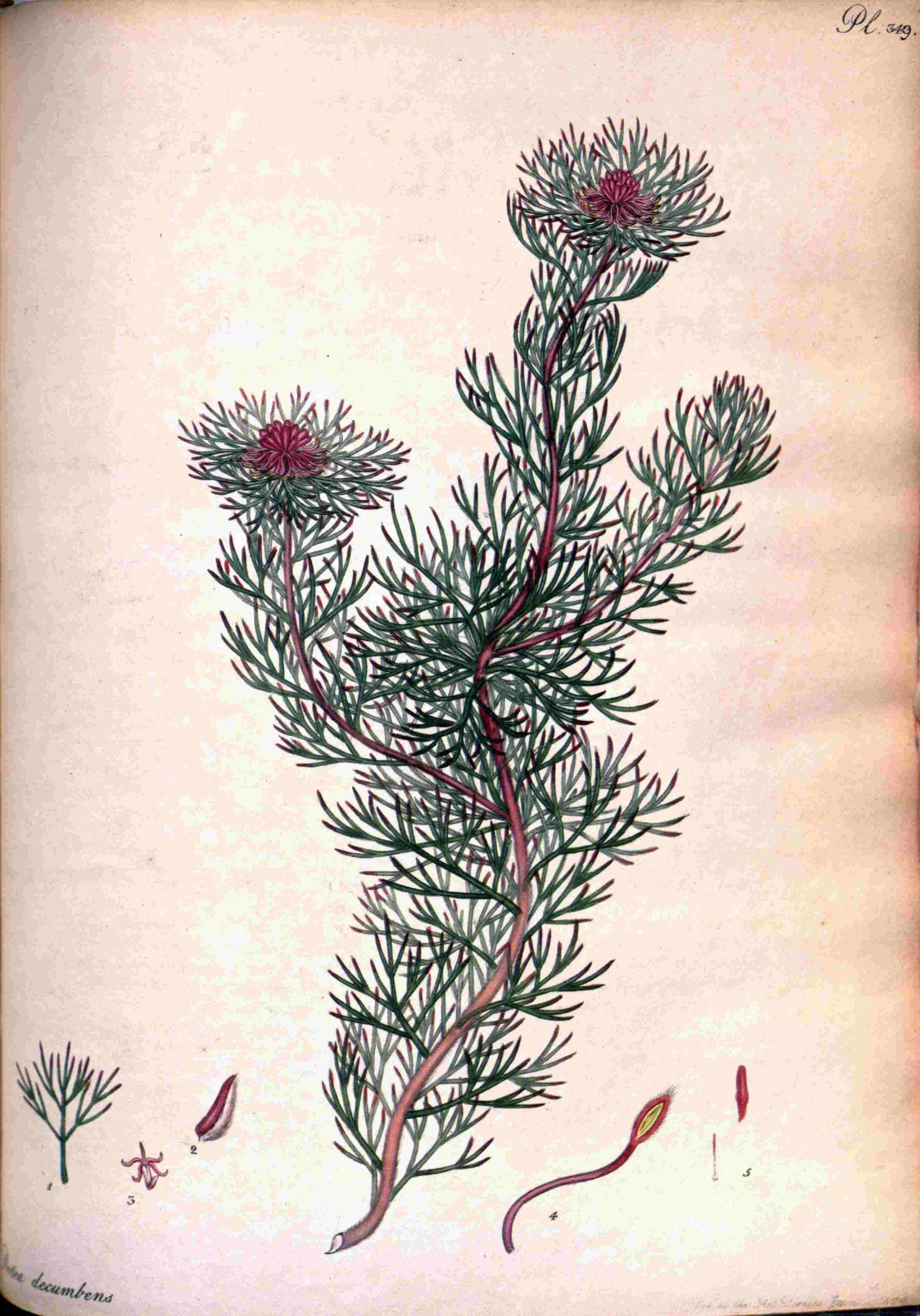
Volume 5 — PLATE CCCXLIX.
Reading edition
PROTEA DECUMBENS.
Slender-stemed Protea.
CLASS IV. ORDER I.
TETRANDRIA MONOGYNIA. Four Chives. One Pointal.
ESSENTIAL GENERIC CHARACTER.
Corolla 4-fida seu 4-petala. Antheræ lineares, insertæ petalis infra apicem.
Calyx proprius nullus. Semina solitaria.
Blossom 4-cleft or 4-petalled. Tips linear, inserted into the petals below the point.
Cup, proper, none. Seeds solitary.
See Protea formosa, Pl. XVII. Vol. I.
SPECIFIC CHARACTER.
Protea foliis bi-pinnatis, filiformibus; capitulis terminalibus, sessilibus; floribus incarnatis, bracteolatis; caule tenue, decumbente.
Protea with doubly winged leaves, thread-shaped; small heads of flowers sitting close on the ends of the branches; flowers flesh-coloured with small floral leaves; stem slender and bending downwards.
REFERENCE TO THE PLATE.
1. A Leaf. 2. One of the Floral Leaves, magnified. 3. A Floret, complete. 4. One of the Petals, with its Chive at the point, magnified. 5. The Pointal, with the Summit detached and magnified.
From the great number of new species of the divided leaved Proteas, we are led to conjecture, that they are as numerous as those with entire leaves. The P. decumbens, from the different specimens we have seen, appears to branch into many varieties; some with hairy leaves and stems, some with very close thick set leaves, and some, with both stems and leaves, quite smooth. They are all, nevertheless, very slender stemed; and, there is little doubt but, in their natural state, they rest on the ground; although in the fashion we train them here, they have the appearance of being erect. This species is found at a considerable distance from the Cape Town, on the summits of dry sandy hills; wherefore, it must be kept in the most airy part of the green-house, and watered but seldom. The stem does not grow more than eighteen inches long, and frequently flowers, as was the case in the present instance, when not more than twelve. It is propagated, readily, from cuttings made in the month of May, if treated in the method already directed for the increase of these plants. The earth in which it should be planted is, a light sandy bright loam. Our drawing was taken in the month of July, 1802, from a plant in the Hibbertian Collection, to which it was introduced by Mr. Niven, in the year 1800.