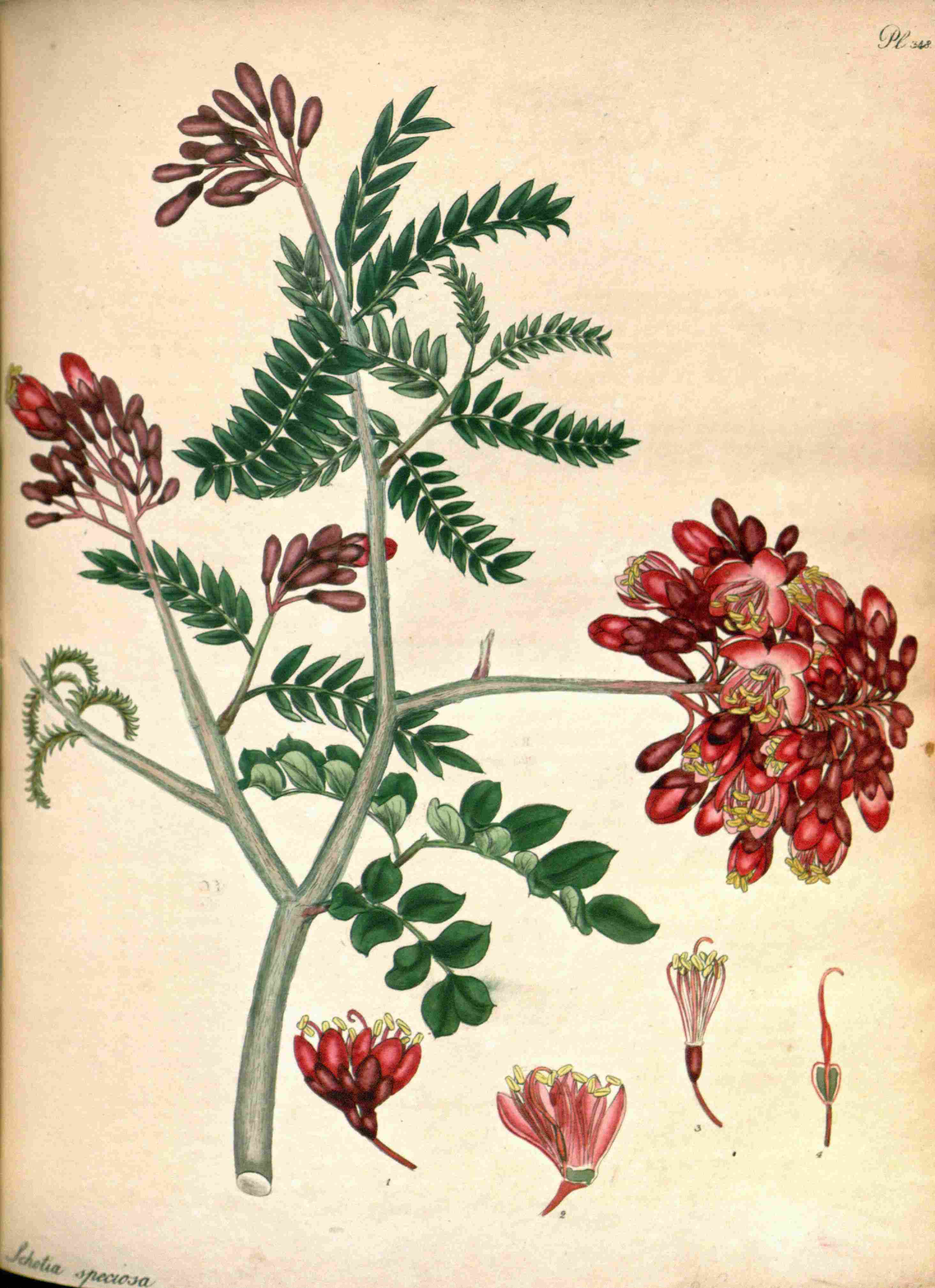
Volume 5 — PLATE CCCXLVIII.
Reading edition
SCHOTIA SPECIOSA.
Lentiscus leaved Schotia.
CLASS X. ORDER I.
DECANDRIA MONOGYNIA. Ten Chives. One Pointal.
GENERIC CHARACTER.
Calyx. Perianthium monophyllum, coloratum; tubus turbinatus, subcompressus, carnosus; persistens; limbus semiquinquefidus; laciniis ovatis, concavis, obtusis, erectis, æqualibus.
Corolla. Petala quinque, tubo calycis imposita, oblonga, concava, obtusa, erecta, æqualia, lateribus mutuò incumbentia, sessilia, laciniis calycinis duplo longiora.
Stamina. Filamenta decem, subulata, erecta, petalis paulo longiora, tubo calycis in orbem inserta. Antheræ oblongæ, incumbentes.
Pistillum. Germen oblongum, compressum, pedicellatum. Stylus filiformis, longitudine staminum. Stigma simplex, obtusum.
Pericarpium. Legumen pedicellatum.
Semina bina, ossea, subovata, magna.
Empalement. Cup one leaf, coloured; tube top-shaped, rather flattened, fleshy; permanent; border half five-cleft; segments egg-shaped, concave, blunt, upright, equal.
Blossom. Five petals, placed on the tube of the cup, oblong, concave, blunt, upright, equal, lying over each other at the sides, sitting, twice as long as the segments of the cup.
Chives. Ten threads, awl-shaped, upright, a little longer than the petals, inserted in a ring into the tube of the cup. Tips oblong, laying on the threads.
Pointal. Seed-bud oblong; flattened, with a foot-stalk. Shaft thread-shaped, the length of the chives. Summit simple, blunt.
Seed-vessel. A pod with a foot-stalk.
Seeds two, bony, a little egg-shaped, large.
SPECIFIC CHARACTER.
Schotia foliis pinnatis; foliolis ovatis, mucronatis; floribus cymosis, profundé carneis.
Schotia with winged leaves; leaflets egg-shaped, terminating in a point; flowers in tufts and of a deep flesh colour.
REFERENCE TO THE PLATE.
1. A Flower cut and spread open, shewn from the outside. 2. The same, shewn from the inside. 3. A Flower, with the petals, and border of the Cup removed, to shew the insertion of the Chives into the tube of the Cup. 4. The Seed-bud, Shaft and Summit, with the tube of the Cup cut in halves.
Our present subject stood formerly attached to the genus Guaiacum, under the title of G. affrum, and has been long cultivated in Britain and Holland, perhaps more than a century. Professor Jacquin, in his Collectanea ad Bot. &c. Vol. I. p. 93, thought fit to constitute it a new genus, naming it after his companion R. van der Schot. About the same time, the year 1786, a monograph on this plant was published at Manheim, by Fred. Casim. Medikus, under the name of Theodora Speciosa; but Jacquin’s title has universally obtained. To preserve this plant in good health, it should be kept in the coolest part of the hot-house, or in a dry stove, the warmth of a common green-house being insufficient to preserve its foliage through the winter months. It is a native of all that extent of the African coast from Senegal river, to the Cape of Good Hope, where it grows to the height of twenty feet and upwards. The seeds, which are frequently imported, keep many years in a vegetative state, and is, almost, the only method by which it can be propagated; for little success can be hoped, either from layers, or cuttings. It flowers from October till December, delighting in a light sandy loam. Perhaps, no plant which has been as long in cultivation with us, has so seldom been seen to flower; for, although the plants in the Kew gardens and elsewhere, are of a considerable size, yet have we few instances of its flowering, no mention being made of its time of inflorescence in the catalogue of that collection.
From a plant, still in flower, this present December 1803, which was literally covered with blossoms above two feet from its top, our drawing was taken; it is in the valuable and extensive collection of Isaac Swainson, Esq. Twickenham; which for scientific arrangement and richness in hardy shrubs and herbaceous plants, in particular, yields to no private or public collection we know of; and which, the extreme urbanity of the liberal proprietor, is at all times open, to every botanist or collector.