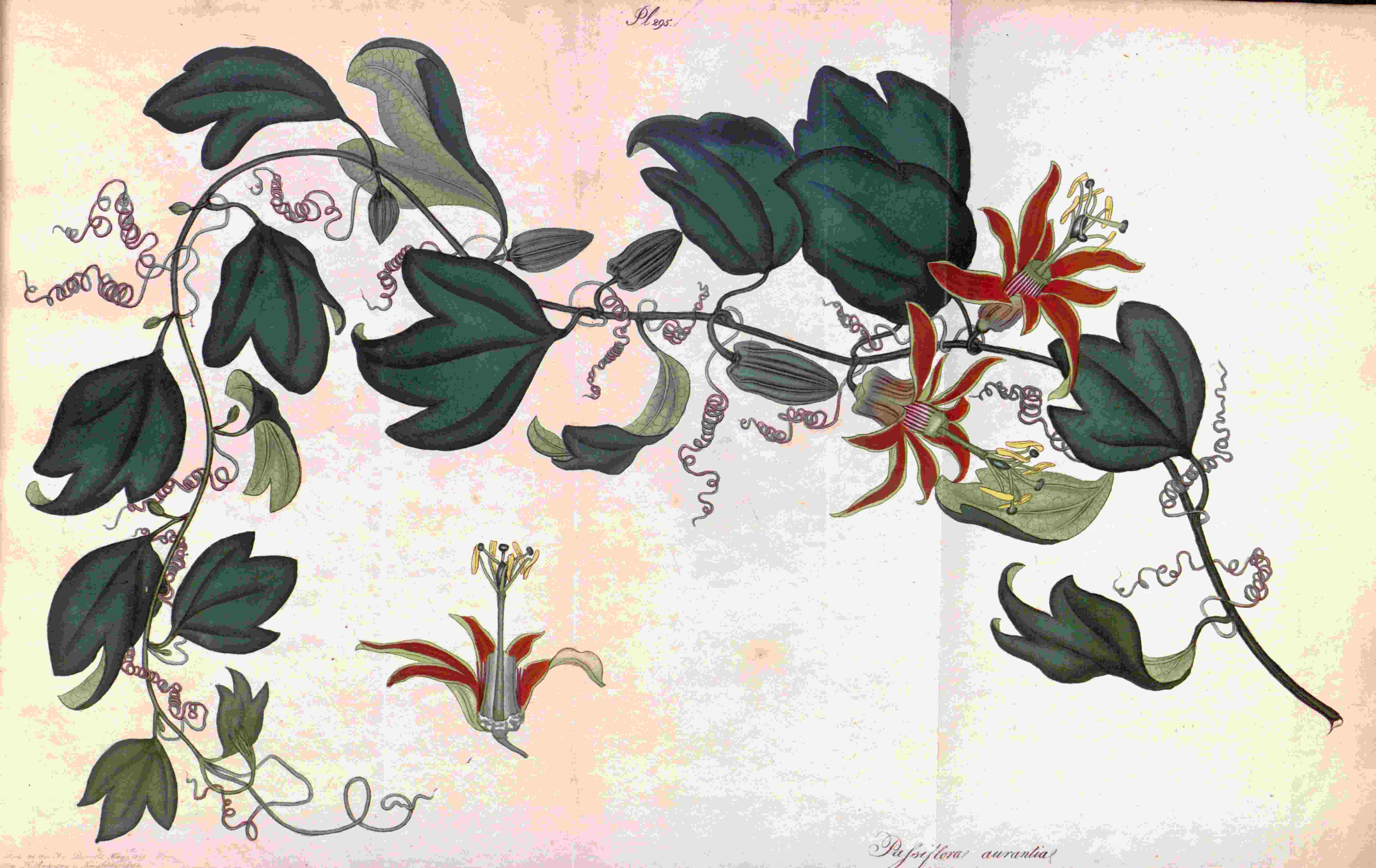
Volume 5 — PLATE CCXCV.
Reading edition
PASSIFLORA AURANTIA.
Norfolk Island Passion-Flower.
CLASS XX. ORDER IV.
GYNANDRIA PENTANDRIA. Chives on the Pointal. Five Chives.
ESSENTIAL GENERIC CHARACTER.
Trigyna. Calyx 5-phyllus. Petala 5. Nectarium corona. Bacca pedicellata.
Three styles. Cup 5-leaved. Petals 5. Honey-cup forming a crown. Berry standing on a foot-stalk.
See Pl. CCVII. Passiflora maliformis. Vol. IV.
SPECIFIC CHARACTER.
Passiflora foliis trilobis, lobis oblongis obtusis, medio longiore; petiolis biglandulosis; nectario cylindraceo, denticulato; corolla aurantia.
Passion-Flower with three-lobed leaves; lobes oblong, obtuse, the middle one the longest; foot-stalks with two glands; honey-cup cylindrical and toothletted; blossom orange-coloured.
REFERENCE TO THE PLATE.
1. Exhibits the half of a flower as cut perpendicularly through the middle, with the whole of the Pointal and Chives in their place.
This species of Passion Flower, from Norfolk Island, was introduced to Britain in the year 1792, and was first raised, from seeds, at the Hammersmith Nursery. It is a greenhouse plant, loving heat and drought, thrives in a light sandy soil, and is readily increased by cuttings; which should be placed in the heat of the bark-bed in the hothouse, or cucumber hot-bed, in the month of April.
In the young state of the plant, the leaves are less harsh, appear rather scolloped than lobed, and much resemble in shape those of the Maiden-hair Fern, or Adiantum Capillus-veneris; whence the trivial name, adiantifolia, which it bears in most collections. But, as there can be no doubt of our present plant being that designed by Forster, in his Prod. flor. insul. austral. No. 326; of Cavanilles in his Dissertationes classis Monadelphiæ, Diss. 10. p. 457; and as lastly quoted by Willdenow, in his new Sp. Plant. Tom. 3, Part 1, p. 620; we have, without hesitation, adopted the specific title it there bears. As an addition to the very few handsome climbing plants fit to decorate the trellis-work of our modern greenhouses, or conservatories, this plant must be considered as a great acquisition; as the growth is rapid, the foliage of a fine green, and the flowering abundant.
Our figure was taken from a plant in the conservatory of the Hibbertian collection, Clapham common.