Volume 5 — PLATE CCCXXI.
Reading edition
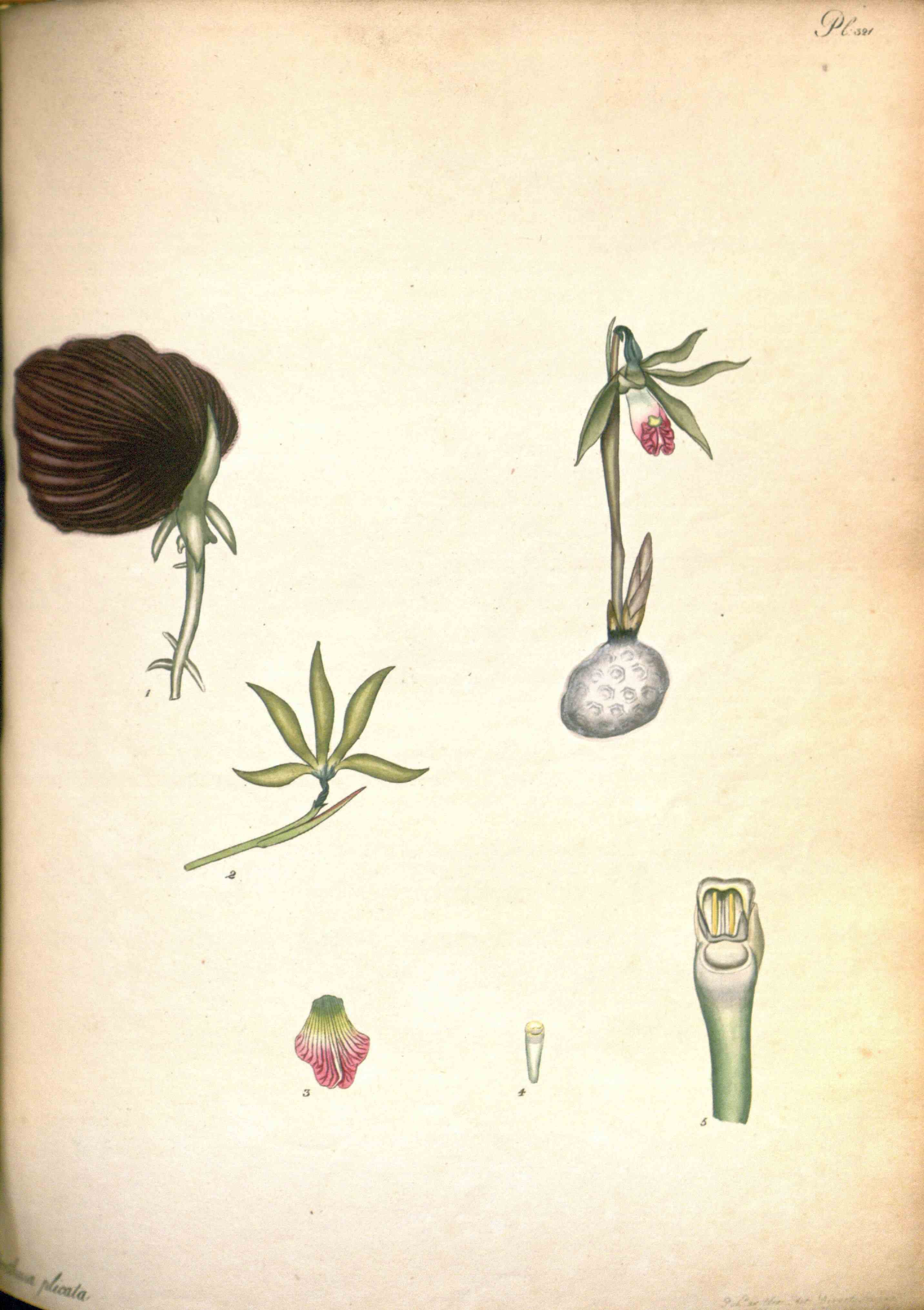
ARETHUSA PLICATA.
Plaited-leaved Arethusa.
CLASS XX. ORDER I.
GYNANDRIA DIANDRIA. Chives on the Pointal. Two Chives.
GENERIC CHARACTER.
Calyx. Spatha foliacea. Perianthium nullum.
Corolla, ringens; petala quinque, oblonga, subæqualia, duo exteriora, omnia conniventia in galeam.
Nectarium monophyllum, basi tubulosum, intra corollæ fundum, bipartitum; labio inferiore reflexo, lato, rugoso, longitudine petalorum, propendente; labio superiore lineari, tenerrimo, stylo adnato, apice lobato.
Stamina. Filamenta duo, brevissima, pistilli apici insidentia. Antheræ ovatæ, compressæ, tectæ duplicatura labii interioris nectarii.
Pistillum. Germen oblongum, inferum. Stylus oblongus, incurvus, labio interiore nectarii vestitus. Stigma infundibuliforme.
Pericarpium. Capsula oblongo-ovata, unilocularis, tri-valvis, angulis dehiscens.
Semina numerosa, acerosa.
Empalement. Sheath leafy. Cup none.
Blossom gaping. Five petals, oblong, nearly equal, two outer, all converging into a helmet.
Honey-cup one-leafed, tubular at the base, within the bottom of the blossom, two-parted; lower lip reflexed, broad, wrinkled, the length of the petals, hanging down forwards; upper lip linear, very delicate, fixed to the shaft, lobed at top.
Chives. Two threads, very short, sitting on the top of the pointal. Tips egg-shaped, flattened, covered by the folding of the inner lip of the honey-cup.
Pointal. Seed-bud oblong, beneath. Shaft oblong, incurved, cloathed by the inner lip of the honey-cup. Summit funnel-shaped.
Seed-vessel. Capsule oblong egg-shaped, one-celled, three-valved, splitting at the angles.
Seeds numerous, chaffy.
SPECIFIC CHARACTER.
Arethusa radice globosa; folio cordato, plicato, hirsuto.
Arethusa with a globular root; leaf heart-shaped, plaited and hairy.
REFERENCE TO THE PLATE.
1. The Plant, after the Flower has disappeared. 2. The Petals of the Flower, spread open. 3. The Honey-cup, spread open. 4. The Chives and Pointal. 5. The same, magnified; the hood, to which the chives are attached, lifted up.
This singular little bulbous rooted plant was received this year, 1803, in the month of April, amongst a number of other curious new seeds and bulbs, from the East-Indies, by Aylmer Bourke Lambert, Esq. by whom they have been communicated to different collections. Although the plant has considerable affinity with Arethusa, yet we entertain doubts whether it should not be placed to Limodorum, as it wants many of the generic characters of the former genus, and but few, and those but trivial in its correspondence, to the latter. We have, notwithstanding, given it the title under which it was sent, submitting our judgment to what we conceive better authority. There is little doubt but the plant will soon be lost in our collections, as but few of this natural order are either to be propagated or kept by any cultivation we are at present acquainted with. Our figure was taken from a plant which flowered in the hot-house of J. Vere, Esquire, Kensington Gore, in the month of July, before there was any appearance of either root or leaf from the bulb. It was in flower at the same time in the Collection of Sir Abraham Hume, Bart. Wormley-Bury, Herts.