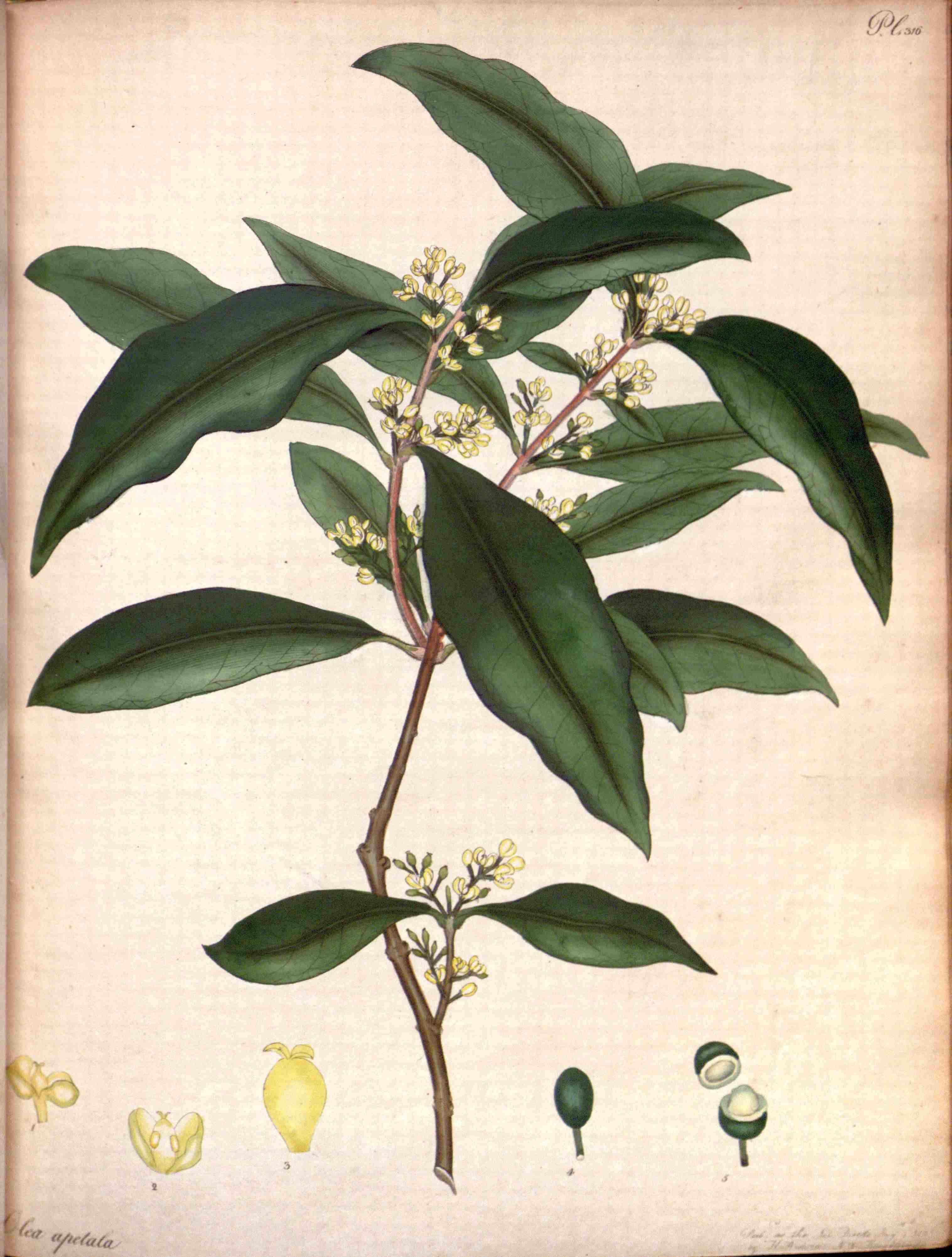
Volume 5 — PLATE CCCXVI.
Reading edition
OLEA APETALA.
Petal-less Olive.
CLASS II. ORDER I.
DIANDRIA MONOGYNIA. Two Chives. One Pointal.
GENERIC CHARACTER.
Calyx. Perianthium monophyllum, tubulatum, parvum; ore quadridentato, erecto, deciduum.
Corolla monopetala, infundibuliformis; tubus cylindraceus, longitudine calycis; limbus quadripartitus, planus; laciniis subovatis.
Stamina. Filamenta duo, opposita, subulata, brevia. Antheræ erectæ.
Pistillum. Germen subrotundum. Stylus simplex, brevissimus. Stigma bifidum, crassiusculum; laciniis emarginatis.
Pericarpium. Drupa subovata, glabra, unilocularis.
Semen. Nux ovato-oblonga, rugosa.
Empalement. Cup one-leafed, tabular, small; mouth four-toothed, erect, deciduous.
Blossom one petal, funnel-shaped; tube cylindrical, the length of the cup; border four-divided, flat; segments nearly egg-shaped.
Chives. Two threads, opposite, awl shaped, short. Tips upright.
Pointal. Seed-bud roundish. Shaft simple, very short. Summit two-cleft, thickish; clefts notched at the ends.
Seed-vessel. A pulpy berry, rather egg-shaped, smooth, one-celled.
Seed. A nut oblong-egg-shaped, rough.
SPECIFIC CHARACTER.
Olea foliis elipticis, floribus racemosis, apetalis.
Olive, with eliptically-shaped leaves, flowers in long bunches without petals.
REFERENCE TO THE PLATE.
1. A. Flower expanded, magnified. 2. The same with the Chives exposed, magnified. 3. The Seed-bud, Shaft, and Summit, magnified. 4. A half ripe Berry. 5. The same cut transversely.
Our present figure represents a plant a native of New Holland and New Zealand, in the Pacific Ocean; but, we have great reason to think, it has been referred, rather rashly, to the genus under which it is here named; and that it possesses a distinctive character sufficient on which to have formed a new one. We have, nevertheless, as usual, taken it up under the title it is in general known by, as published by Vahl, in his Symbolæ Botanicæ, Part III. p. 3, and quoted from him into Willdenow’s Sp. Plant. p. 46, and thence into Professor Martyn’s ed. of Miller’s Dict. article Olea, 5. Whether the fruit of this plant will ever turn to account, when cultivated, as an article of food, time must evince; but, certainly, it bears an appearance of much hope. It is a strong woody growing shrub, forming itself into a handsome round-headed plant; and, when in full flower, has a very pretty appearance, having all the necessary qualities of such plants as are fit for planting out in a conservatory. It is propagated by cuttings; should be planted in sandy peat earth, mixed with a small portion of loam; producing its flowers about February or March. Our drawing was made from a plant in the Hammersmith Collection, to which it was first added in the year 1791; having been raised from seeds communicated to Messrs. Lee and Kennedy by Colonel Paterson.