Volume 5 — PLATE CCCXXVI.
Reading edition
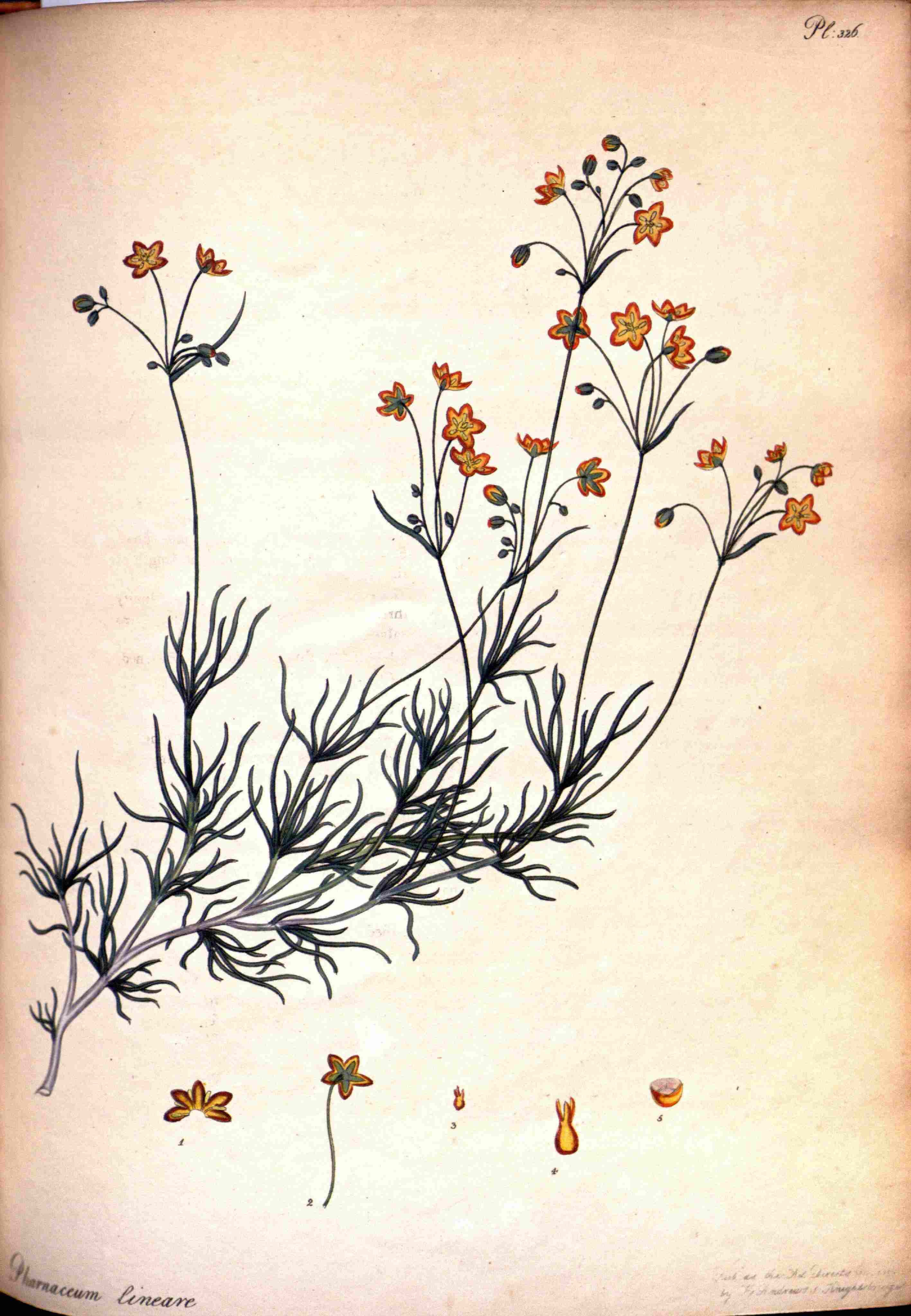
PHARNACEUM LINEARE.
Linear-leaved Pharnaceum.
CLASS V. ORDER III.
PENTANDRIA TRIGYNIA. Five Chives. Three Pointal.
GENERIC CHARACTER.
Calyx. Perianthium pentaphyllum; foliolis subovatis, concavis, patentibus, æqualibus, persistentibus, intus coloratus, margine tenui.
Corolla nulla; hinc calycis margo tenuis et calyx interne coloratus.
Stamina. Filamenta quinque, subulata, longitudine calycis. Antheræ basi bifidæ.
Pistilla. Germen ovatum, trigonum. Styli tres, filiformes, longitudine staminum. Stigmata obtusa.
Pericarpium. Capsula ovata, obsoletè trigona, tecta, trilocularis, trivalvis.
Semina numerosa, nitida, orbiculata, depressa, margine acuto cincta.
Empalement. Cup five-leaved; leaflets nearly egg-shaped, concave, spreading, equal, permanent, coloured within, with a thin edge.
Blossom none; hence the edge of the cup is thin and the inside of it is coloured.
Chives. Five-threads, awl-shaped, the length of the cup. Tips cleft at the base.
Pointals. Seed-bud egg-shaped, three-sided. Shafts three, thread-shaped, the length of the chives. Summits blunt.
Seed-vessel. Capsule egg-shaped, bluntly three-cornered, covered, three-celled, three valves.
Seeds numerous, shining, orbicular, flattened, surrounded by a sharp rim.
SPECIFIC CHARACTER.
Pharnaceum foliis linearibus, verticillatis; umbellis inequalibus; calycibus aurantiis; caule decumbente.
Pharnaceum with linear leaves, growing in whorls; umbels unequal; cups orange coloured; stem bending downwards.
REFERENCE TO THE PLATE.
1. The Cup, shewn from the front, with the chives. 2. The same, shewn from the hind part attached to the fruit-stalk. 3. The Seed-bud and Pointals, natural size. 4. The same, magnified. 5. The Seed-bud, cut transversely, magnified.
This little plant much resembles our Corn Spurry, or Spergula arvensis, at first sight. It is a native of the Cape of Good Hope, seldom grows more than six inches high, and is very apt to be destroyed by the damps of our winters. It should be placed in the airyest part of the greenhouse, and kept in light sandy loam. To propagate it, the cuttings should be put in, about the month of March, in the heat of a gentle hot-bed, or the bark-bed of the hot-house; the seeds are sometimes perfected. It has been often introduced to us, but as often lost; as it is not a plant of much shew, no great deal of pains has, hitherto, been taken for its preservation. Our drawing was taken from a plant in the Hibbertian Collection, in the month of July, 1802.