Chapter XI · Logistics and Civil Affairs
Reading edition
The old saw that for want of a horseshoe nail the kingdom was lost is applicable in some degree to the story of logistics on the island of Leyte. Fortunately the outcome in Leyte was less serious than that recounted in the proverb. But the cumulative effect of many unfavorable conditions, each capable of being overcome in itself but each entangled with the others, resulted in a protraction of the campaign and a slowing of the schedule for future operations in the Pacific.
Logistics
Scarcely had the assault troops landed when the gloomy predictions of Colonel Ely that conditions of soil and weather on the island would make it unfit for the establishment of major bases began to be realized. Nevertheless, the necessity for early establishment of land-based air forces to support the operation made it imperative that the engineers start work immediately on rehabilitation of existing airfields. Before this task could be carried out, however, it would be necessary to strengthen and widen the roads in order to move heavy construction equipment to the airfields. A breakdown of the transportation system for even a few days could affect adversely all aspects of the Leyte operation. Because of the shortage of engineer troops, the lack of road metal, and the continuous traffic, the construction and maintenance of roads presented a critical and continuing problem.
Road Construction
By utilizing a narrow road leading inland to Highway 1, egress from the 1st Cavalry Division beachhead area was accomplished. Since the road forked near the beach and ran north to Cataisan Point it became an access road to the Tacloban airfield. All supplies were routed along Highway 1 into the interior. When this road went to pieces under the heavy rains of 25 October, no means remained of getting overland from the area of the 24th Division to that of the 1st Cavalry Division. The open country back of the Dulag area made the road problems of the XXIV Corps zone a little more manageable than those in the X Corps area. Dulag itself offered graveled streets for traffic, but unfortunately only one very narrow road, with deep ditches on both sides, led west toward the mountains. With the coming of heavy rains, this road was chewed to bits by heavy traffic.
Airfields
The condition of the airstrips produced an even more perplexing problem than the roads. Immediately upon their arrival, engineer reconnaissance parties followed the assault infantry and examined the various sites which had been selected during the planning for airfields. By 22 October they reported that all the proposed airdrome sites except Tacloban were unfit for use during the rainy season.
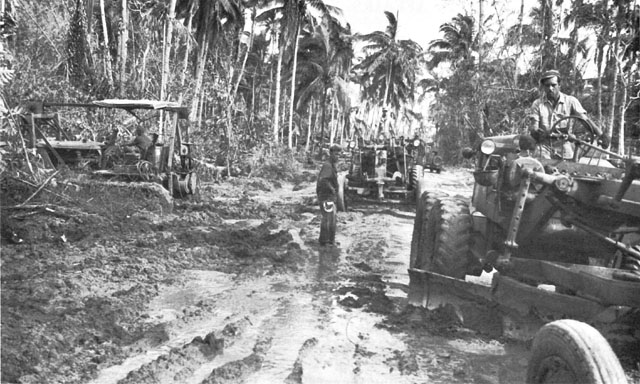
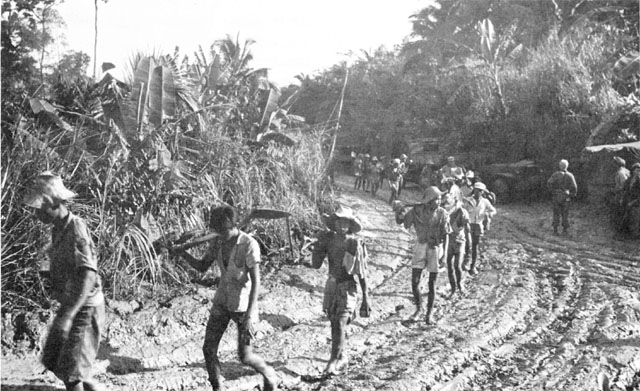
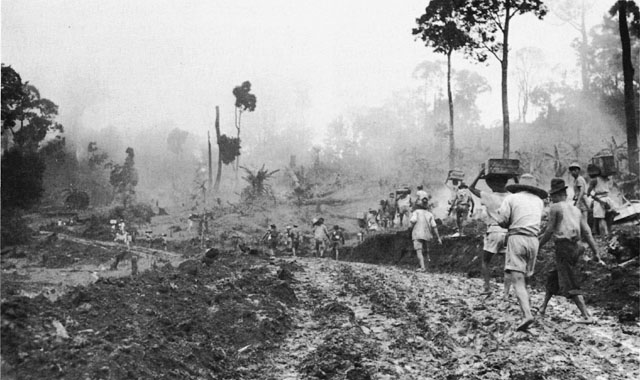
ACCESS ROAD FROM WHITE BEACH under repair (above). Filipino road workers on Route 2 (below).
Despite constant work on the morasses that constituted the San Pablo and Buri airfields, these strips continued to be in a generally unusable condition. Finally, on 25 November, ASCOM dropped all construction work on them. The Fifth Air Force, however, felt that it was necessary to continue using the Bayug airfield, and at least one aviation battalion remained at work on that strip.
Although his engineers, before the opening of the campaign, had protested vigorously to General Headquarters against the establishment of a major base upon Leyte, General Krueger felt constrained to take the responsibility. Said he:
Base Construction
After the assault troops had cleared the beach areas, a perplexing problem came to the fore. In the plans for the Leyte operation General Krueger had assigned to the various commands areas for such facilities as their supply dumps and hospitals. Upon arrival on Leyte, the Army Service Command discovered that many of the sites were swamps; the tactical situation delayed reconnaissance for others.
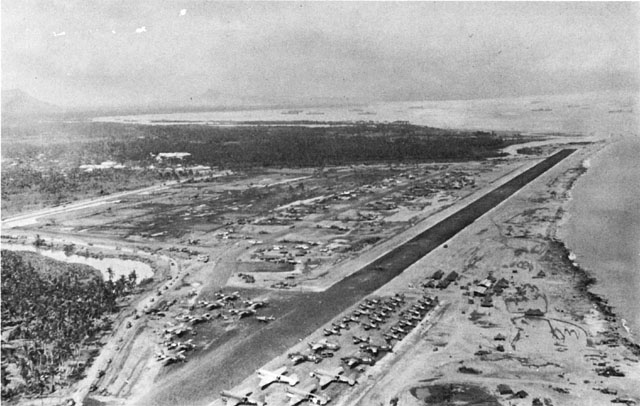
TANAUAN AIRSTRIP built to replace San Pablo and Buri airfields.
Supplies
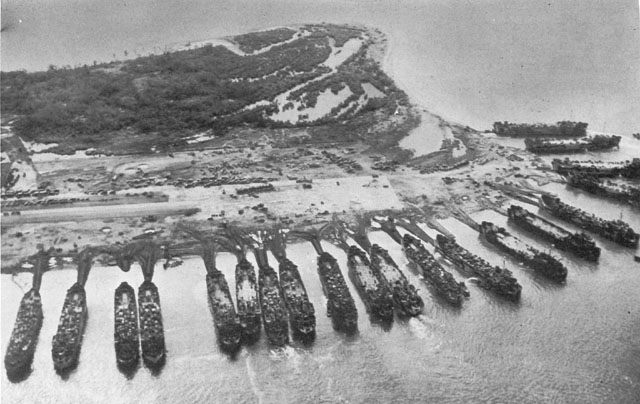
LST’S UNLOADING AT TACLOBAN AIRFIELD. The causeways leading from the beach to the ships were built by bulldozers scraping sand and earth to each ship as it landed.
After the supplies were ashore and stored, the problem of getting them to the divisions and thence to the front-line troops presented tremendous difficulties. Nearly all types of transportation were utilized. As the roads disintegrated, more and more dependence was placed upon water transportation. Naval vessels and amphibian vehicles were used to carry the supplies as close as possible to the front-line troops, and motor vehicles transported them for the remaining distance whenever feasible. At other times the troops and Filipino civilians often had to hand-carry supplies to the assault forces. In addition there were many airdrops to troops who were otherwise completely cut off from the rest of the Sixth Army.
Medical Support
Evacuation of Casualties
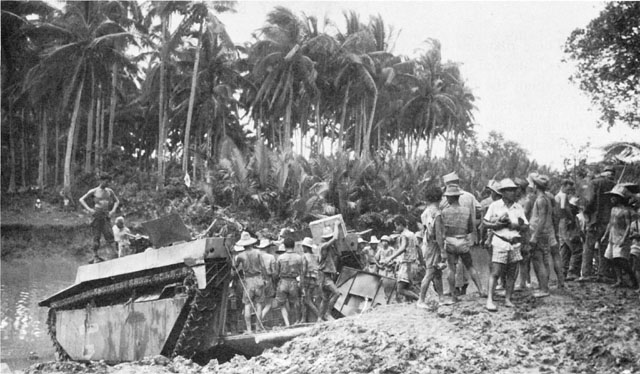
ROAD CONDITIONS. Disintegration of the roads greatly increased the supply problem. Filipino carriers unload an amphibious LVT(4) (above); carriers for the 1st Cavalry Division near Carigara (below).
Medical Treatment
Medical Supply
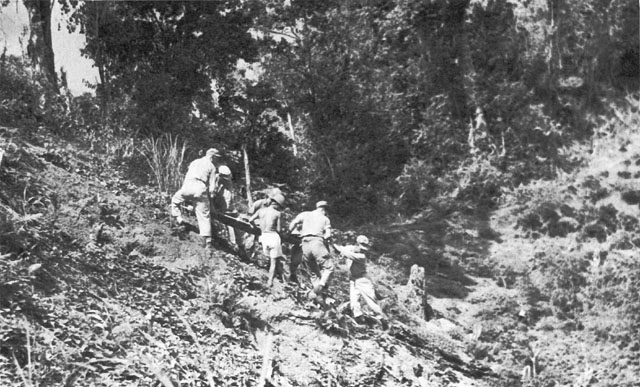
A LITTER SQUAD EVACUATES A CASUALTY in mountainous terrain.
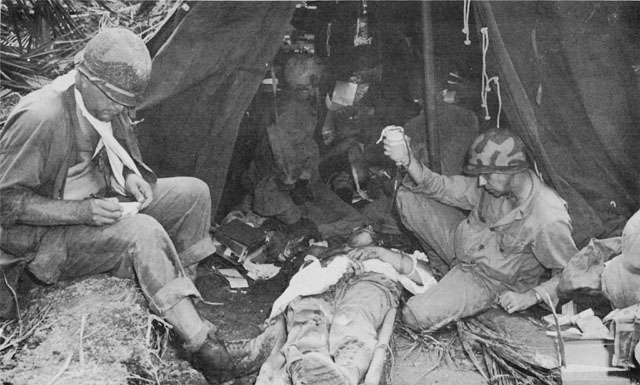
A CASUALTY RECEIVES TREATMENT at a forward aid station.
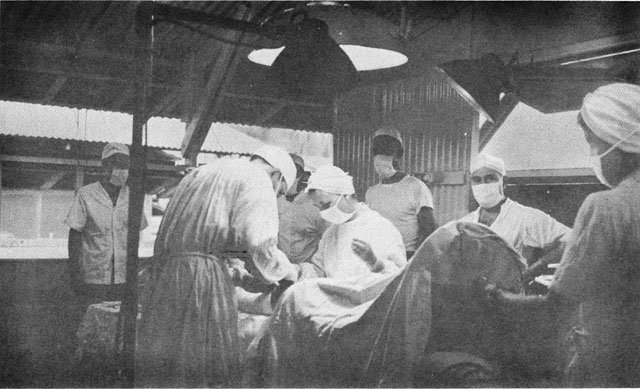
AN OPERATING ROOM AT THE STATION HOSPITAL, TANAUAN
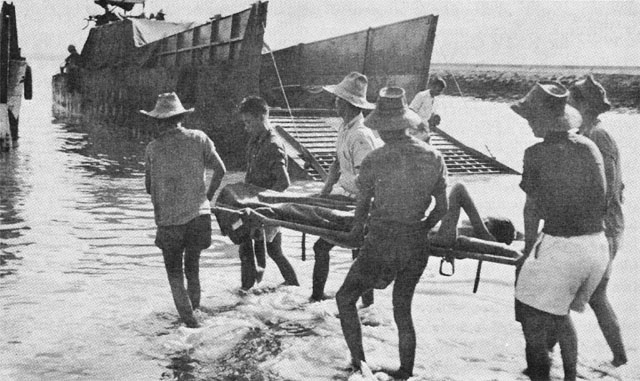
A CASUALTY IS EVACUATED BY SHIP TO A REAR AREA
Civil Affairs
During the combat stage General Krueger, the senior tactical commander, was to be responsible for such civil administration and relief as would be possible under the existing tactical situation. General MacArthur would delegate the administration of civil affairs and relief in the liberated areas as promptly as possible to the authorized representatives of the Commonwealth Government. The only restrictions placed upon the Filipino people were to be those required by military necessity. By arrangement with General MacArthur the Philippine Commonwealth was, in general, to determine the guilt or innocence of suspected collaborationists, though the U. S. Army commanders were to retain complete authority to deal with the suspects if necessary.
General MacArthur also established the financial policies to be followed. A new series of Philippine Treasury certificates called “Victory Pesos” would be introduced in the liberated areas. The exchange rate would be two for an American dollar. All prewar currency and all emergency currency officially determined to be bona fide would be accepted at face value. All other Philippine or enemy currency would be worthless. Wage rates to be paid Filipino labor were established and ceiling prices consistent with the approved wage scale were set.
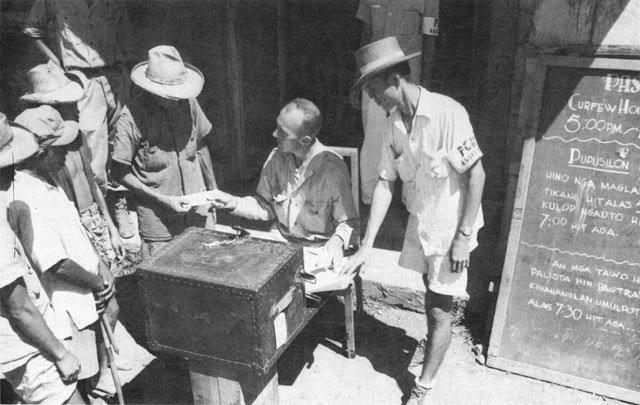
AN OFFICER OF A CIVIL AFFAIRS UNIT pays off civilian workers with the new “Victory Pesos.”
As soon as the conflict had passed by an area, a civil affairs unit of the Sixth Army stepped in and started to restore the normal community life. Temporary appointments of Filipino officials were made, such appointments going to men who had been screened by the Counter Intelligence Corps or who were sponsored by Filipinos whose loyalty was unquestioned. In nearly every case the Philippine Commonwealth ratified these appointments. In every area reached by the Sixth Army, civil officials were appointed as soon as the tide of battle passed, and without exception cordial relations were established. The civil affairs officers of the Sixth Army did not attempt to interfere with civil operations unless requested to do so, or unless the military situation made it necessary.
Relations With Filipino Refugees
Many refugees who had been driven from their homes by the naval bombardment came into the American lines on the beaches seeking comfort and aid. These Filipinos had been without food or water for a considerable time, some of them for as long as twenty-four hours. Many of those who had remained in foxholes during the naval shelling were badly shaken up.
Palo Sector
Wells were dug to provide water for washing. During 21 October between 1,500 and 2,000 refugees crowded into the area. By 22 October the congestion had become so great that a larger site was imperative. General Sibert decided to move the civilians to Palo, even though the town had not yet been cleared of Japanese. After an Army chaplain had said Mass, the refugees proceeded on foot, in single file, to Palo. The Army adopted this mode of advance in order to minimize interference with troops, supplies, and equipment and also to protect the refugees from mines and booby traps which the Japanese had placed on the shoulders of the road. Many of the civilians carried all of their effects with them; children, as young as three or four years, were impressed into carrying their share of the family’s meager possessions.
Because of the inpouring of refugees from surrounding districts, Palo suddenly grew from a normal population of about 6,000 to one estimated at 12,000 to 15,000. Nearly 5,000 people with their animals crowded into a church and its adjacent compound. Sanitary conditions were very bad.
The Army fed these refugees from captured stocks of rice and appointed a force of civilian police. After a survey of the area, the Army instituted sanitary measures for cleaning up the church and its compound, with removal and burial of the dead animals. Civilian laborers who had been checked for their loyalty undertook the burial of American and Japanese dead and the unloading of ships in the harbor. The Army disarmed all Filipinos except guerrillas and enforced security regulations, which prohibited civilians from appearing on the streets after dark. As more military units entered the town, 5,000 of the refugees were moved to its outskirts. The Army set up a hospital in the compound and surgeries in the schoolhouses, with separate wards for men and women. Teachers and other qualified women assisted as practical nurses. Within one week the Army had organized the town and begun work toward rehabilitation.
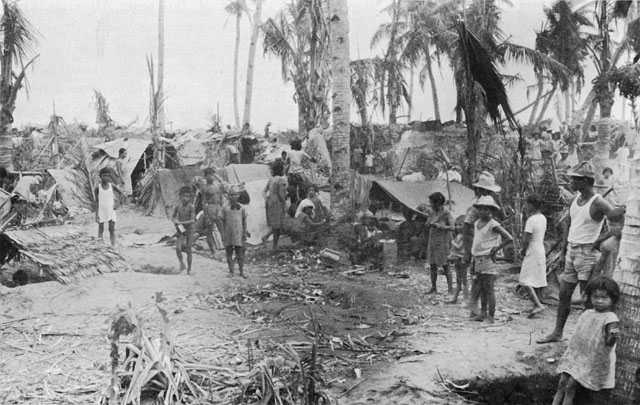
REFUGEE AREA ON ORANGE BEACH NEAR DULAG
Dulag Sector
The military police assisted in control of the civilian population and procured and distributed food and water. A medical officer and several enlisted men from the 7th Division gave medical aid to large numbers of civilians who were treated for minor wounds, injuries, tropical ulcers, and other ailments. By 22 October the medical officer had referred at least 100 of the more serious cases to an Army field hospital near by. Fifteen unclaimed and unidentified civilian dead were buried in the Filipino cemetery.
By the morning of 22 October, since the civilian population of Dulag had grown to approximately 10,000, General Hodge issued orders to move the refugees to a new location. By 23 October, when a suitable place had been found, the number of refugees had risen to approximately 30,000. The mass migration to the new location, which was two miles from Dulag, was most difficult, and not until the civil affairs officers had sent food and water to the new site could civilians be persuaded to move. The selected area measured about 1,000 by 600 yards and consisted of a coconut grove and a beach. Except for its inadequate size and its infringement upon military installations, it was completely satisfactory. After 24 October the civilians were removed from camp and sent back to their home villages as soon as the latter were declared secure.
Issuing of Supplies
By the morning of 24 October the Sixth Army was taking care of some 45,000 people, most of the population of about fifty-six communities. Although at first there was a shortage of food and water, by 24 October there was an adequate supply. Before that time the Army supplied the civilians with C and K rations, since it could not locate an appreciable quantity of the civilian food supplies. Seventy percent of these supplies, consisting of fish, rice, and meat, were later found and distributed by the civil affairs officers.
The Army originally distributed food to individuals but later made distribution through leaders in the barrios until it could establish a general store. The civil affairs officers distributed 28,700 full rations, fifty cases of condensed milk for infant use, and five tons of captured Japanese rice. About 5,000 full rations were stolen or not accounted for. An Army purification unit set up a 3,000-gallon canvas water tank and furnished water to the area.
The civil affairs units of the Sixth Army opened about 500 schools in the principal barrios, those in Tacloban being the first to open. Many school buildings were either rebuilt or repaired under the direction of civil affairs officers and with funds furnished by them. Since there were no primary textbooks, in one instance the civil affairs units mimeographed a series of three schoolbooks which were illustrated by an Army artist. The teachers of Leyte not only provided excellent service in school work but also acted as relief workers, sanitarians, and assistants in the dispensaries and hospitals.
At first, a number of improvised hospitals were opened up. When the civilian hospital supplies arrived, however, modern hospitals were established at Tacloban, Baybay, and Carigara. These were staffed by local doctors and nurses, but the civil affairs unit continued to furnish food and supervision. Twenty-seven permanent dispensaries were also established. These were greatly needed, since the Japanese had not given the people any medical aid and had stopped all preventive medical measures. Dental treatment was given to more than 2,000 Filipinos, and smallpox inoculations were administered to more than 8,000. Also, when they seemed to be required, inoculations were given for typhoid, typhus, and cholera.
Recruitment of Filipinos
General Krueger made the guerrillas a part of his armed forces, and they became a source of additional strength to the Sixth Army. These men frequently operated and patrolled in enemy-held territory and brought the Americans valuable information on Japanese movements and dispositions; the unit commanders of Sixth Army, however, tended to discount reports from such sources with regard to the size of Japanese forces. The guerrillas also guarded supply dumps and depots, bridges, and other installations in the rear areas.
Throughout November the logistical situation on Leyte remained bad. Work on roads, together with that on airfields and other installations, consisted largely of temporary expedients. The difficult problem of getting supplies ashore and to the troops had not been completely solved, a situation which hampered the progress of the tactical troops. The lag in construction of airdromes made it impossible for land-based air forces to give adequate close air support to the ground forces. This lack of support was another handicap to General Krueger’s men as they fought their way into the mountains.