Chapter XIII · The Mountain Barrier: Part Two
Reading edition
By the middle of November both the Americans and the Japanese realized that the struggle for the island of Leyte was going to be long and costly—far longer and costlier than either had anticipated.
Reinforcements
At the same time General Krueger was anxious to complete the third phase of the American campaign, the two-pronged drive toward the port of Ormoc. He felt, however, that there were insufficient troops to both protect the mountain passes into Leyte Valley and make the drives toward Ormoc.
Table 1—Sixth Army Daily Strength Reports, 12 November-25 December 1944
Date Authorized strength Difference Between Effective and Authorized Strength
Officers Enlisted Men Officers Enlisted Men
12 Nov 1944 6,978 107,461 -1,050 -11,754
19 Nov 1944 9,290 147,497 -1,099 -15,058
26 Nov 1944 11,977 185,462 -1,603 -17,977
2 Dec 1944 11,637 191,060 -1,819 -19,012
9 Dec 1944 10,721 174,148 -1,194 -18,261
16 Dec 1944 10,905 176,466 -1,361 -21,059
25 Dec 1944 11,019 176,628 -1,228 -22,536
Source: Sixth Army Operations Report Leyte, 20 October–25 December 1944, p. 153.
As the fighting extended into the mountains, the lack of sufficient replacements began to be greatly felt. At no time did General Krueger know when replacements would arrive, or whether they would be combat or service troops, or what their individual specialties would be. During the course of the operation he received only 336 officers and 4,953 enlisted men as replacements.
32d Division Assumes the Offensive
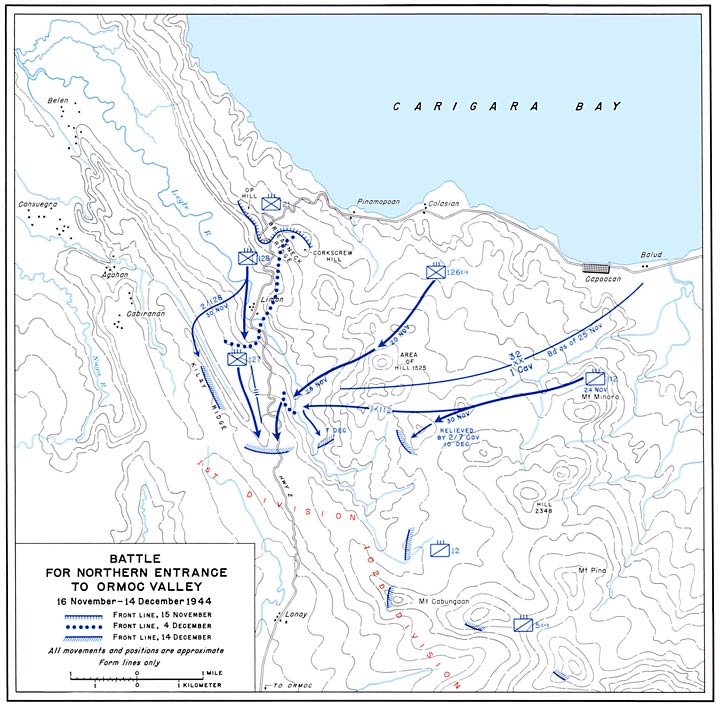
MAP 14
BATTLE FOR NORTHERN ENTRANCE TO ORMOC VALLEY
16 November–14 December 1944
On the following morning Colonel Hettinger ordered the 3d Battalion to hold its position until the 1st Battalion could come abreast. The 3d Battalion therefore limited its activities to sending out patrols. The 1st Battalion again attacked Corkscrew Ridge but made very limited gains.
The Japanese had failed in their attempt to block off Highway 2 at the northern entrance to Ormoc Valley. In no small measure, the establishment and maintenance of a roadblock south of Limon by the 2d Battalion, 19th Infantry, and the defense of Kilay Ridge in the rear of the Japanese front lines by the 1st Battalion, 34th Infantry, had made this achievement possible. (See Map 13.) Under constant fire and greatly outnumbered, these units had prevented General Suzuki from sending additional troops into Limon. From 12 to 23 November the 2d Battalion, 19th Infantry, had defended the roadblock under extremely difficult conditions. The operations report of the 24th Division graphically summarizes the deeds for which the battalion received a presidential citation:
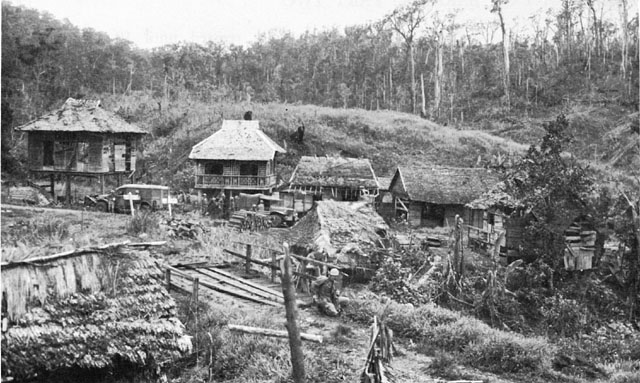
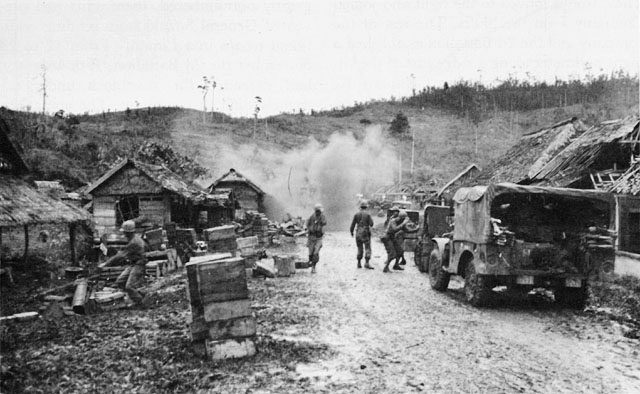
AMERICAN TROOPS IN LIMON (above), and taking cover there as enemy shells hit the area (below).
Battle of Kilay Ridge
When General Krueger told General Sibert to push the X Corps south with all possible speed down Highway 2 toward Ormoc, the latter had selected the 24th Division to make the drive. General Irving wished to protect the sides of the road and prevent the Japanese from sending reinforcements north up the highway. On 9 November he therefore ordered the 34th Infantry to send a battalion around the Japanese west flank to harass the enemy’s rear and thus relieve the pressure that was holding up the frontal attack of the 21st Infantry on Breakneck Ridge.
Nipponese Caught Napping
At 0700 the battalion, under Colonel Clifford, moved out, taking every available man on the mission and leaving only a minimum of cooks and drivers behind. Since the troops had to hand-carry their equipment the Headquarters Company left the antitank guns behind, and Company D took only one section of heavy machine guns and one section of 81-mm. mortars. Colonel Clifford used the men thus released to carry other weapons and ammunition. Because of the scant time allowed by the orders, the battalion left without sufficient rations.
At 0750 Clifford’s battalion went aboard the LVT’s and at 0930 arrived at its destination. Debarking without opposition it pushed rapidly inland and at 1145 reached a hill approximately one mile from the landing area. At dusk the 1st Battalion reached a ridge in the vicinity of Belen and about 2,000 yards north of Agahang. There it set up a night perimeter. Since his maps were inaccurate, Colonel Clifford relied upon the services of Filipino guides from this time until the end of the mission. The rugged and muddy hillsides, made considerably worse by almost constant rain and fog, were similar to those encountered by other units fighting in the area.
At 0850 on the following day Colonel Clifford’s men received their first airdrop of rations. Ten minutes later the commanding officer of the 1st Battalion of the guerrilla 96th Infantry made contact with Colonel Clifford and gave him a résumé of the enemy situation. (The guerrillas rendered invaluable aid to the 1st Battalion, 34th Infantry, throughout the Kilay Ridge episode by furnishing intelligence and protecting the rear of the unit.) The battalion moved out at 1200 for Consuegra near the Naga River and entered the town at 1240. At 1310 Colonel Clifford outlined to the officers the plan for the next two days. For the rest of the day, the battalion was to advance to Cabiranan and bivouac for the night. On the morning of 13 November it was to split into two columns and make a fast advance by separate routes to Kilay Ridge, where it would reorganize. As Colonel Clifford was briefing his officers, LVT’s entered Consuegra with rations for the troops. The LVT’s had left Carigara Bay, passed through Biliran Strait, gone down Leyte Bay and into the Naga River, and then proceeded up the river to the vicinity of Consuegra.
Kilay Ridge ran from southeast to northwest, with its northern tip about 2,500 yards directly west of Limon and its southern end about 3,000 yards south and slightly west of the same point. The ridge was approximately 900 feet high and though narrow in some places in others it widened to 400 yards. The summit was broken into a series of high knolls from which the entire Limon area and some parts of the Ormoc road could be observed. A view of the latter feature was obstructed to some extent by a ridge, hereafter called Ridge Number 2, between Kilay and the road. Kilay Ridge was about 3,900 yards southwest of Breakneck Ridge. It would be necessary to maintain control of Kilay Ridge and deny its use to the enemy in order to give complete support to units advancing south from Breakneck Ridge.
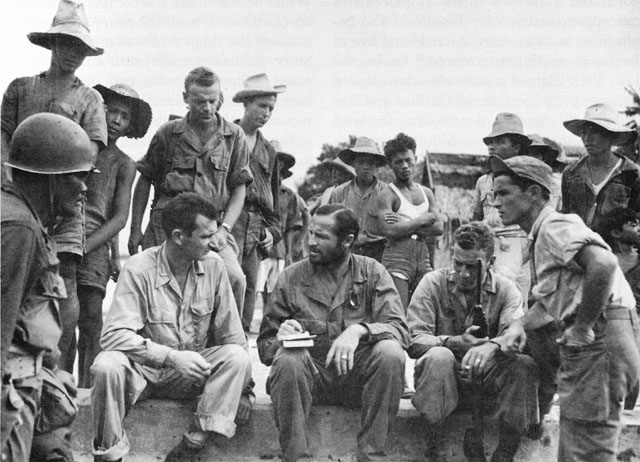
LT. COL. THOMAS E. CLIFFORD, JR., discusses plans with his staff as Filipino guerrillas look on.
Preliminary Attack
At 1125 enemy artillery shelled the southern end of the ridge and twenty minutes later shifted its fire to the Limon area. The battalion did not succeed in establishing physical contact with the 2d Battalion, 19th Infantry, which was operating east of the road, but it was able to make radio contact. Throughout the day, patrols of the battalion were active in searching out enemy positions.
A platoon from Company B, on 17 November, carried on a running fire fight with the Japanese and forced its way past Ridge Number 2. It crossed the Ormoc road and made contact with the 2d Battalion, 19th Infantry, at its roadblock. A line of communication between the battalions could not be established because of the strong enemy forces between them. At the same time parts of Companies B and D engaged the enemy on Ridge Number 3, six hundred yards south of Ridge Number 2 and slightly lower. Approximately 200 of the enemy with rifles, machine guns, mortars, and artillery were entrenched on Ridge Number 3. The American fire killed at least fifty Japanese. A patrol from Company D probed the Japanese defensive position but was forced to retire with two men missing and one wounded. Then Company B entered the fray, and the fire fight grew in intensity. The Japanese directed fire from at least three automatic weapons as well as strong rifle fire against the Americans.
Red Badge of Courage
In the meantime the enemy began to deliver heavy fire against Company B, which had moved to the south flank of the battalion on Kilay Ridge. Colonel Clifford estimated the Japanese assault force to be one reinforced company well equipped with mortars and light machine guns. By 0905 on 19 November the Japanese had destroyed one heavy machine gun and had begun a flanking movement to the east of the southernmost outpost of Company B.
The rains persisted during the night and the next day, 22 November. Throughout the morning, patrols probed the area. At 1130 the battalion received an airdrop of ammunition, medical supplies, and ponchos. The main perimeter lines were comparatively quiet until 1430 when the enemy pinned down Company B with heavy fire and assaulted Company A. These attacks rapidly grew in intensity. The Japanese with fixed bayonets charged against the perimeters and almost completely surrounded both companies.
At 2000, since the enemy completely surrounded Company B, Colonel Clifford ordered the company to break through and withdraw through Company A to the rear of the battalion command post. Under cover of machine gun and artillery fire, the company withdrew. When a litter train of the wounded was ambushed, one of the bearers was killed by enemy fire.
Within the new perimeter of Company B, 750 yards north of the battalion command post, Colonel Clifford established a rear command post and all communications moved to it. From this new location the mortars from Company D began to fire in front of Company A, the most advanced company. The battalion cached all supplies and ammunition in case the enemy should suddenly break through. The rains continued.
Fortunately the Japanese did not follow up the attacks on 23 November, but there was scattered automatic weapons and artillery fire. Next day American artillery and mortar fire repulsed a small enemy attack at 0830. A platoon from the battalion slipped through the enemy lines and brought information on the situation to General Gill. It returned with orders that the battalion was to hold fast. Two airdrops of supplies, although they drew enemy fire, were successfully recovered.
The Main Effort
At 1000 on 28 November the battalion repulsed a small party of the enemy that attacked from the south. There was a lull until 1930 when the Japanese unleashed a strong effort to drive the defenders from Kilay Ridge and recapture it. The opening was marked by 90-mm. mortar fire upon the outposts of the battalion. Heavy weapons from the ridge on the east then began firing as at least two machine guns and many small arms began to rain lead from the west. The enemy fire rose to a crescendo as the mortars joined in and directed their heaviest fire at a platoon of Company C on the southwestern end of the ridge. The Japanese began to deploy troops, apparently in an attempt to reach a gulch to the west of the battalion’s positions. A heavy assault was launched from the south against Company C.
At dawn on 29 November the Japanese forces were still on the ridge in strength and their automatic weapons began to fire anew. All forward elements of the battalion were under attack and Company C was still separated from the rest of the battalion. A reinforced platoon from Company B, at 0730, was able to break through to Company C, kill six of the enemy, and seize two machine guns en route. As Company C’s ammunition was practically exhausted, Colonel Clifford immediately sent a carrying party forward. Since the Japanese had blocked off the trail immediately after the passage of the platoon from Company B, the carrying party was pinned down.
Colonel Clifford urgently requested General Gill to send reinforcements. At 1325 Gill told Clifford that he had ordered the 2d Battalion, 128th Infantry, 32d Division, to proceed to Kilay Ridge immediately and come under Clifford’s control. Colonel Clifford forcibly reopened the trail to Company C and had food and ammunition brought into the forward position. A short time later, Company G, 128th Infantry, arrived and Clifford immediately committed it to reinforce Company C. The remainder of the 2d Battalion, 128th Infantry, arrived at 1835 and was held in reserve. (See Map 14.)
The action for 1 December began at 0800 when a patrol from Company B proceeded down a draw to the west of Kilay Ridge. The patrol was to swing wide and approach the right rear almost directly south of the enemy-held knolls on Kilay Ridge. These were thought to be the Japanese strong points and were the objectives for the day. A preparatory concentration from supporting artillery and from mortars of both battalions was first laid. The heavy machine gun section of the 128th Infantry moved into the draw to the west and set up its guns on the right flank of the ridge in order to be in a position to fire across the face of the ridge when the main assault began. Company E of the 128th Infantry then passed through Company C and launched an attack against the Japanese-held knolls on the southeastern end of the ridge. Heavy and light machine gun fire from Company C protected the flanks of Company E.
At 0925 on 2 December, Company E, 128th Infantry, attacked the knolls at the south tip of Kilay Ridge, while Company F moved down the ridge and swung to the right to attack the ridge to the south—the objective of the two-battalion assault. The 1st Battalion, 34th Infantry, withdrew one unit, but at 1245 Colonel Clifford received orders to halt all further withdrawals pending orders from the commanding officer, 128th Infantry. By then Company E had taken its objective but Company F had encountered determined resistance fifty yards from the top of the ridge. It doggedly advanced and by 1625 reached the crest and dug in, though still receiving hostile mortar fire.
The next day examination of the battlefield where the two battalions had been fighting revealed numerous enemy dead and the following abandoned equipment: three 70-mm. mountain guns, four heavy machine guns, seventeen light machine guns, one 90-mm. mortar, and many rifles, pistols, sabers, and field glasses. Documents containing valuable intelligence were also found. On 4 December the 1st Battalion, 34th Infantry, started to withdraw. During the next two days elements of the battalion moved through Consuegra and Calubian to Pinamopoan. The battalion had lost 26 men killed, 2 missing, and 101 wounded, but it estimated that it had killed 900 men of the 1st Infantry Regiment. The 1st Battalion, 34th Infantry, had acquitted itself well. It had prevented the Japanese from reinforcing the Limon forces and imperiling the 32d Division. For its work the battalion received the presidential unit citation.
Central Mountain Range
1st Cavalry Division
The northern mountains between Ormoc and Leyte Valleys were high and rugged, with precipitous sides. The area was heavily forested, and there were many ground pockets which constituted natural, heavily wooded fortresses for the Japanese. The very few trails in the sector were scarcely better than pig trails. The area had not been properly mapped and at all times the troops were seriously handicapped by insufficient knowledge of the terrain. The nearly constant rainfall bogged down supply and made the sides of the hills slippery and treacherous. From 5 November through 2 December, elements of the 1st Cavalry Division extensively patrolled the central mountain area and had many encounters with small forces of the enemy. At all times the supply situation was precarious.
The 1st Cavalry Division utilized motor transport, LVT’s, tractors and trailers, native carriers, and airdrops to get supplies to forward troops. Motor transport hauled supplies from the warehouses in Tacloban to Carigara, a distance of thirty miles. At this point LVT’s of the 826th Amphibian Tractor Battalion hauled the supplies, through rice paddies churned into waist-deep morasses, to Sugud, three miles south of Carigara. The supplies were manhandled from the LVT’s into one-ton two-wheeled cargo and ammunition trailers, which were towed by the tractors of the artillery battalions that fired in support of the division. The tractors wound their way laboriously into the foothills through boulder-strewn streams and up steep inclines that made it necessary for the tractors to be arranged in tandem. There was always mud, which made traction difficult, and the LVT’s were better able than the tractors to navigate through slick, soft mud which had little body texture.
The 12th Cavalry established high in the foothills, at the entrance to the passes through the mountains, a supply base that was also a native camp, a hospital, and a rest camp. About 300 Filipino carriers were kept here under the protection of the guerrillas. The carriers had been hired for six days at a time and were not allowed to leave without a pass from their Filipino leader. This precaution was necessary, since the ration-carrying assignment was extremely arduous.
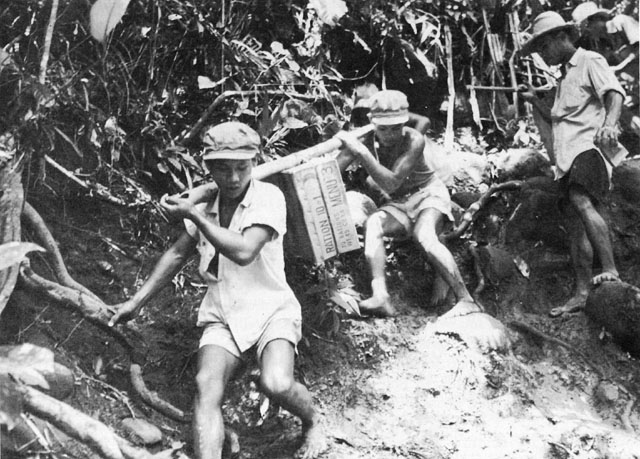
FILIPINO CARRIERS HAUL SUPPLIES over slippery mountain trails for the 12th Cavalry.
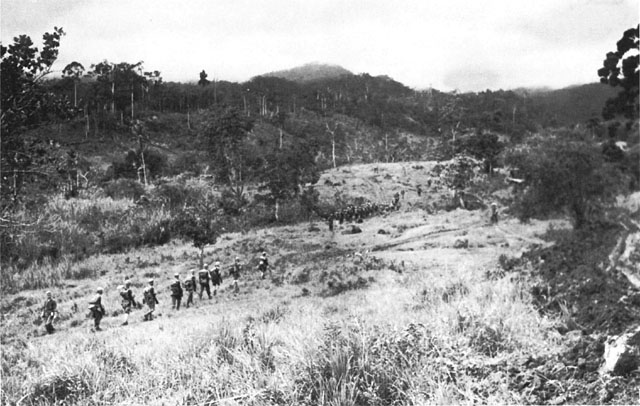
FOOTHILLS OF CENTRAL MOUNTAIN RANGE are patrolled by elements of the 1st Cavalry Division.
The 2d Squadron, 7th Cavalry, spent 11 December in sending out patrols on both sides of the enemy-held ridge. The Japanese let the patrols through and then fired, wounding two of the men. The patrols then returned. An artillery concentration was placed upon the enemy position, and at 1245 the 2d Squadron, 7th Cavalry, moved out behind a barrage which lifted twenty-five yards at a time. One platoon attacked frontally while the other platoons attempted to flank the Japanese. The platoon on the right flank suffered three casualties and was immediately pinned down. After the other platoons got to within fifty yards of a Japanese machine gun position, they also were pinned down. At 1600 they dug in for the night at the base of the hill.
During the engagement fifteen to twenty enemy bunkers were observed on each side of the ridge and four machine guns were definitely spotted. A night infiltration party armed with hand grenades, rifles, and knives was sent to knock out these bunkers. It destroyed two machine guns and killed four Japanese.
At 0730 on the morning of 13 December, the 2d Squadron, 7th Cavalry, moved out and came under fire from two Japanese machine guns well emplaced on a cliff. The ridge narrowed to ten feet with sixty-degree slopes, making forward passage almost impossible. The troops were pinned down. In the meantime, Troop F of the squadron worked south in an attempt to envelop the rear of the enemy force but was unable to do so and returned. The 2d Squadron established night perimeters near the same positions it had held the previous night.
The 96th Division
General Suzuki was desirous of pushing through to Leyte Valley, one of the best entrances to which was through the Dagami sector. At the foot of the central mountain range, Dagami was the center of a network of roads that led to all parts of Leyte Valley and to the airfields. Since it was one of the key positions for control of the valley, its recapture would be of great advantage to the 35th Army. Just west of Dagami, the central mountain range served as a natural fortification. The mountains consisted of a series of ridges separated by deep gorges which were usually covered with a dense tropical growth. At key points in the area, the 16th Division had built coconut-log and concrete pillboxes.
Elements of the 16th Division were entrenched on “Bloody Ridge,” a small promontory on the left side of the road west of Dagami just short of Hitomnog in front of the 382d Infantry. A waist-deep swampy rice paddy was between the ridge and the road. The 1st Battalion, 382d Infantry, after moving into this area engaged the enemy, but at nightfall it broke off the fight and established its night perimeter.
At 0805, the 1st Battalion renewed the attack and met increased heavy resistance as it advanced through the rice paddy. The companies came under mortar and automatic weapons fire at 1445 as they came into the open.
The night of 4–5 November was not quiet. The Japanese delivered harassing fire on the 1st Battalion, and at 2205 elements of the 16th Division launched a heavy assault against the perimeter of the 2d Battalion. An artillery concentration immediately stopped the attack, and the Japanese fled, leaving 254 dead and wounded behind them.
The 96th Division moved to the mountains northwest of Dagami and sent extensive patrols into the central mountain range along a ten-mile line that extended from Dagami to Jaro. Constant small contacts with the enemy continued until the end of the campaign. The 7th Division patrolled the Burauen area.
The Sixth Army had prevented the Japanese from debouching into Leyte Valley. The X Corps had secured Limon, the entrance to Ormoc Valley, and was in a position to drive south down the valley to the port of Ormoc. Although General Krueger’s troops had performed well, they had made mistakes which gave their commander serious concern.