← Table of contents
Leyte

Chapter XII · The Mountain Barrier: Part One

Reading edition

The successful completion of the campaign for the entire Leyte Valley on 2 November enabled General Krueger to embark on the next phase of his plan for the liberation of Leyte.
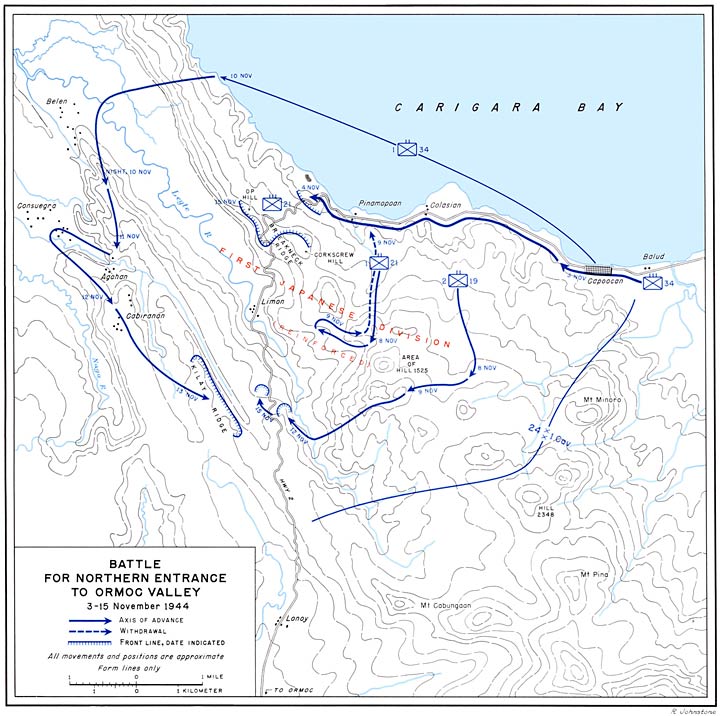
BATTLE FOR NORTHERN ENTRANCE TO ORMOC VALLEY

MAP 13 R. Johnstone

BATTLE FOR NORTHERN ENTRANCE TO ORMOC VALLEY

3–15 November 1944

The Coastal Corridor

Capoocan and Pinamopoan

At 0830 the battalion moved out and continued west along the coastal road to Pinamopoan. After an advance of about 1,000 yards, Company B, the point, encountered an enemy force, estimated at about 100 men, entrenched on the west bank of a stream. The column halted and placed mortar fire on the Japanese but failed to dislodge them. The company then withdrew while the howitzers of the 63d Field Artillery Battalion pounded the enemy position.

In the meantime a platoon of Company B moved south to secure a ridge which paralleled the road. When the platoon located some Japanese dug in on the reverse slope Colonel Clifford sent Company A to its assistance. The guides took Company A over the wrong trail and the troops ran into the strong enemy entrenchments well concealed by underbrush on the western bank of the stream. Company A launched a frontal assault, but after the first platoon had passed the hidden positions the Japanese opened fire and forced the company to withdraw. Colonel Clifford rushed Company C to the assistance of Company A, ordering it to deploy around the left flank of Company A and onto the next ridge. The platoon from Company B returned to its morning position.

Defense of the Coastal Corridor

The bringing in of reinforcements by the Japanese brought into sharp focus the lack of American aerial strength on Leyte. Although the Fifth Air Force had numerous aircraft in the rear areas, these could not be brought forward because of the very poor condition of the available airstrips. The few aircraft based on Leyte could not prevent the flow of additional enemy forces into the island or give direct support to the ground troops of Sixth Army.

Since the Japanese had been able to send without difficulty about 13,500 troops into the Ormoc area, General Krueger recognized that they were capable also of landing troops on the shores of Carigara Bay. This landing, if successful, would isolate the American forces in the Carigara area. To meet this threat, several courses of action were open to General Krueger: he could devote the full energy of the X Corps to preparing a defense against a sea force attack; he could disregard the threat and have the X Corps push vigorously south and secure a position on ground south of Limon, which was about two and a half miles southwest of Pinamopoan, before the Japanese could build defensive positions; or, finally, he could advance south with some elements, leaving others to guard the Carigara area.

If the Japanese Navy and amphibious assault forces entered Carigara Bay, the possibilities for effective countermeasures were not very promising. The escort carriers of the Seventh Fleet, greatly weakened by the Battle of Leyte Gulf, could not give support, and it was quite possible that any assistance that could be furnished by the Third Fleet might not arrive in time.

Battle of Breakneck Ridge

The Battle Begins

The 21st Infantry relieved the 34th Infantry in the vicinity of Pinamopoan without difficulty and sent out strong patrols to Breakneck Ridge. One of these patrols was led by Lt. Col. Frederick R. Weber, the regimental commander.
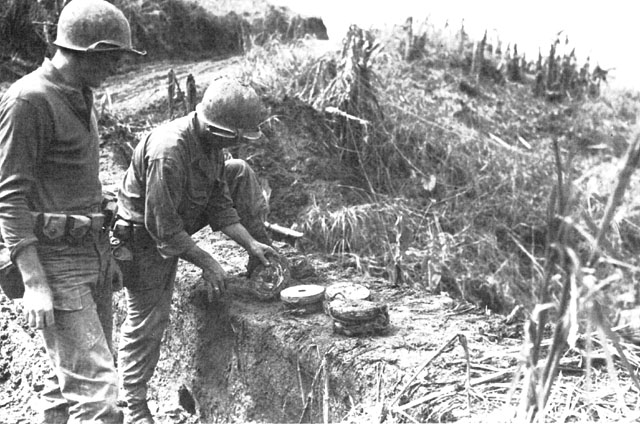
ENGINEERS REMOVE LAND MINES from a bridge on Breakneck Ridge.

ENGINEERS REMOVE LAND MINES from a bridge on Breakneck Ridge.

Through the night torrential rains fell. At dawn of 9 November two begrimed, soaked, and weary battalions of the 21st Infantry jumped off to the attack, the 2d Battalion, less Company F, on the west side of the road and the 3d Battalion on the east. Heavy artillery preparations had already pounded the Japanese front lines. As the attack progressed, mortars and artillery placed fires on targets of opportunity. In destroying pockets of resistance in the gulch, grenades, rifles, and flame throwers were used, together with heavy machine guns.

At 0930 Company I, 21st Infantry, reached the crest of the intermediate ridge on the east side of the road which ran southward toward the center of Breakneck Ridge. An hour later Company E, 21st Infantry, moved out from the perimeter it had held for two days. Its mission was to cut west of the road and secure the commanding high ground in the rear of the emplaced Japanese at the bridge site where the advance of the company had been stopped on the previous day. At the same time Company L, 21st Infantry, passed through Company I and attacked the center of Breakneck Ridge as Company G started a wide envelopment to the west from Company E’s position to assault OP Hill from the west. Artillery forward observer parties went with the companies and called artillery fires on targets of opportunity.

At 1150 Company L encountered determined opposition from enemy rifle and mortar fire but doggedly pushed ahead for several hours and secured the top of the ridge. Company G reached its objective, but upon receiving intense enemy fire was forced to retire to the eastern slopes of a ridge 300 yards to the north, where it reorganized. Company E also reached its objective and then formed its night perimeter. At 1815 the Japanese launched a counterattack against the perimeter of Company G but the attack was repulsed. For the night a platoon of heavy machine guns was attached to each rifle company to protect its perimeter.

Information that the 1st Battalion, 21st Infantry, was being attacked on Hill 1525 reached the 2d Battalion, 19th Infantry, shortly after noon as it was on its way to relieve the 1st Battalion. Colonel Spragins pushed forward immediately with two companies, hoping to reach the 1st Battalion by 1500, but progress was slowed by steep, slippery slopes that were often blocked by huge fallen trees. At 1630, without having heard any sounds of battle, which they had hoped would guide them to the 1st Battalion’s position, the troops reached what they believed to be the western slopes of Hill 1525. Patrols reported no contact either with friendly or enemy units and the 2d Battalion set up its night perimeter.
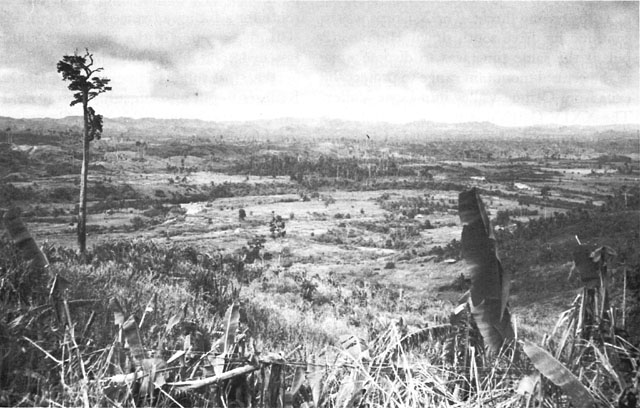
VIEW FROM THE RIDGES LOOKING NORTH UP THE LIMON VALLEY

VIEW FROM THE RIDGES LOOKING NORTH UP THE LIMON VALLEY

Breakneck Ridge: Second Phase

The rains continued to pour down upon the troops, and the thick mud was slippery and treacherous underfoot. After the artillery had fired a ten-minute concentration on Breakneck Ridge, the 21st Infantry attacked at 0945. Company A, the lead company, passed through Company E and pushed south. At 0955 Company G seized OP Hill. Simultaneously, Company I moved to the site of the destroyed bridge 300 yards east of OP Hill. Company L moved toward the high ground 300 yards southeast of its position and at 1120 secured this ground.

The 21st Infantry resumed the attack at 0900 with the 1st and 2d Battalions abreast, the 1st Battalion to the north of OP Hill and the 2d Battalion south and west of the parts of Breakneck Ridge previously captured.

Notes in this chapter

Note 1 · Sixth Army FO 28, 3 Nov 44. ↑Note 2 · X Corps FO 6, 3 Nov 44. ↑Note 3 · Sixth Army FO 27, 30 Oct 44. ↑Note 4 · 1st Bn, 34th Inf, Unit Jnl, 3 Nov 44. ↑Note 5 · 1st Bn, 34th Inf, Unit Jnl, 3 Nov 44. ↑Note 6 · 1st Bn, 34th Inf, Unit Jnl, 3 Nov 44. ↑Note 7 · 24th Div Opns Rpt Leyte, pp. 39–40. ↑Note 8 · Ibid., p. 40. ↑Note 9 · Tomochika, True Facts of Leyte Opn, p. 18. ↑Note 10 · 10th I&HS, Eighth Army, Stf Study of Opns of Japanese 35th Army on Leyte, Part I, p. 5. ↑Note 11 · Ibid., Part I, pp. 5–6. ↑Note 12 · Ibid., Part IV, p. 2, interrog of Col Junkichi Okabayashi, CofS 1st Div. Colonel Okabayashi makes the following statement about Japanese plaNote 13 · Rpt of Sixth Army G-3 Liaison Sec, 3 Nov 44, Sixth Army G-3 Jnl, 3 Nov 44. ↑Note 14 · Sixth Army Opns Rpt Leyte, p. 38. ↑Note 15 · Memo, Maj Reppert for Col Clyde D. Eddleman, Rpt of Conf with Rear Adm William M. Fechteler, 5 Nov 44, Sixth Army G-3 Jnl, 5 Nov 44. ↑Note 16 · Ltr of Instns, CG Sixth Army to CG X Corps, 4 Nov 44, Sixth Army Opns Rpt Leyte, p. 199. ↑Note 17 · Ltr, CG X Corps to CG’s 24th Div and 1st Cav Div, 4 Nov 44; X Corps G-3 Jnl, 5 Nov 44. ↑Note 18 · 1st Cav Div FO 7, 4 Nov 44. ↑Note 19 · 24th Div Opns Rpt Leyte, p. 103. ↑Note 20 · X Corps Opn Plan, 5 Nov 44, Sixth Army G-3 Jnl, 5 Nov 44. ↑Note 21 · 24th Div Opns Sum, 5 Nov 44, X Corps G-3 Jnl, 5 Nov 44. ↑Note 22 · Msg, G-2 X Corps to G-3 Sixth Army, 5 Nov 44, Sixth Army G-3 Jnl, 6 Nov 44. ↑Note 23 · Sixth Army FO 29, Nov 44. ↑Note 24 · X Corps Amendment to FO 6, 5 Nov 44. ↑Note 25 · 24th Div FO 7, 5 Nov 44. ↑Note 26 · Col William J. Verbeck, A Regiment in Action (n. p., n. d., copy in OCMH), p. 16; 24th Div Opns Rpt Leyte, p. 42. ↑Note 27 · 24th Div Opns Rpt Leyte, p. 42. ↑Note 28 · 24th Div G-3 Jnl, 5 Nov 44. ↑Note 29 · 24th Div G-2 Jnl, 6 Nov 44. ↑Note 30 · Rad, Maj Clark, X Corps, to G-2 Sixth Army, BA 669, Sixth Army G-3 Jnl, 6 Nov 44. ↑Note 31 · Msg, S-2 21st Inf to CG 24th Div, 6 Nov 44, 24th Div G-2 Jnl, 6 Nov 44. ↑Note 32 · 24th Div Opns Rpt Leyte, p. 42. ↑Note 33 · Sixth Army G-3 Jnl, 7 Nov 44. ↑Note 34 · Msg, S-2 21st Inf to G-2 24th Div, 7 Nov 44, 24th Div G-2 Jnl, 7 Nov 44. ↑Note 35 · 21st Inf FO 19, 7 Nov 44, 24th Div G-3 Jnl, 8 Nov 44. ↑Note 36 · Msg, 308th Bombardment Wing to Sixth Army, 7 Nov 44, Sixth Army G-3 Jnl, 7 Nov 44. ↑Note 37 · Msg, CO 21st Inf to CG 24th Div, 7 Nov 44, 24th Div G-3 Jnl, 7 Nov 44; 35th Army Opns, p. 57. ↑Note 38 · Msg, S-3 21st Inf to CG 24th Div, 7 Nov 44, 24th Div G-2 Jnl, 7 Nov 44. ↑Note 39 · Interv with Col Verbeck, 26 Sep 51. Colonel Verbeck stated that for the remainder of the campaign Colonel Weber was an excellent and loyal eNote 40 · Msg, S-3 21st Inf to G-3 24th Div, 7 Nov 44, 24th Div G-3 Jnl, 7 Nov 44; 24th Div Opns Rpt Leyte, p. 43. ↑Note 41 · 24th Div Opns Rpt Leyte, p. 43. ↑Note 42 · 24th Div G-3 Jnl, 7 Nov 44. ↑Note 43 · Jan Valtin [Richard J. Krebs], Children of Yesterday (New York, The Readers Press, Inc., 1946), p. 187. ↑Note 44 · 24th Div G-3 Jnl, 8 Nov 44. ↑Note 45 · 24th Div G-2 Periodic Rpt 20, 8 Nov 44. ↑Note 46 · 24th Div Opns Rpt Leyte, p. 45. ↑Note 47 · Msg, CO 21st Inf to CofS 24th Div, 8 Nov 44, 24th Div G-2 Jnl, 8 Nov 44. ↑Note 48 · Msg, G-3 24th Div to G-2 24th Div, 9 Nov 44, 24th Div G-2 Jnl, 9 Nov 44. ↑Note 49 · 24th Div G-3 Periodic Rpt 21, 9 Nov 44. ↑Note 50 · 24th Div Opns Rpt Leyte, p. 47. ↑Note 51 · Ibid., p. 48. ↑Note 52 · 35th Army Opns, p. 59. ↑Note 53 · Ibid.; Sixth Army Opns Rpt Leyte, p. 50; Sixth Army G-3 Jnl, 9 Nov 44. ↑Note 54 · Sixth Army FO 30, 11 Nov 44. ↑Note 55 · X Corps FO 12, 12 Nov 44. ↑Note 56 · XXIV Corps FO 23, 10 Nov 44. ↑Note 57 · Sixth Army Opns Rpt Leyte, p. 57. ↑Note 58 · 24th Div FO 8, 9 Nov 44. ↑Note 59 · 24th Div G-3 Periodic Rpt 22, 10 Nov 44. ↑Note 60 · 24th Div Opns Rpt Leyte, p. 49. ↑Note 61 · 24th Div G-2 Jnl, 10 Nov 44. ↑Note 62 · Ibid., pp. 53, 61. ↑Note 63 · 35th Army Opns, p. 60. ↑Note 64 · 24th Div Opns Rpt Leyte, p. 49. ↑Note 65 · 24th Div G-3 Jnl, 11 Nov 44. ↑Note 66 · 24th Div Opns Rpt Leyte, p. 50; 44th Tank Bn Opns Rpt Leyte, p. 2. ↑Note 67 · Msg, 308th Bombardment Wing to Sixth Army, 11 Nov 44, Sixth Army G-3 Jnl, 11 Nov 44. ↑Note 68 · X Corps Arty S-3 Periodic Rpt 22, 12 Nov 44. ↑Note 69 · 24th Div G-3 Jnl, 12 Nov 44; 24th Div Opns Rpt Leyte, p. 50. ↑Note 70 · 24th Div G-3 Periodic Rpt 24, 12 Nov 44; 35th Army Opns, p. 62. ↑Note 71 · 24th Div Opns Rpt Leyte, p. 51. ↑Note 72 · This action was to consist of two drives converging on Ormoc: one south through Ormoc Valley by X Corps and the other north from Baybay by XNote 73 · General Sibert ordered elements of the 1st Cavalry Division to occupy Carigara while the 24th Division secured the coastal corridor that ranNote 74 · Since the 21st Infantry had encountered virtually no opposition in the vicinity of Panaon Strait and since it was desirable that the regimenNote 75 · At 0700 on 3 November the 34th Infantry moved west from its perimeter at Balaud in a column of battalions, with the 1st Battalion, under ColNote 76 · Companies A and C then started against the Japanese emplacements on the opposite bank of the stream.6 The leader of the advance squad of ComNote 77 · At 1530 Colonel Clifford withdrew Company A. After the 63d Field Artillery Battalion had blasted the ridge parallel to the road, Company B aNote 78 · Earlier, at 1430, Company K had made a reconnaissance in amphibian tractors from Capoocan to a point just west of Pinamopoan. Since it encouNote 79 · During the night the 11th and 63d Field Artillery Battalions massed their fires and laid interdiction fire up and down the highway. Under coNote 80 · Some elements of the 26th Division had arrived on Leyte during the naval battle, and on 1 November most of the 1st Division and the 12th IndNote 81 · The arrival of these troops was in accord with a plan devised after the Battle of Leyte Gulf. The 102d Division, coming from Panay, and the Note 82 · When General Suzuki received information that the Americans had secured Carigara, he realized that it would be impossible to drive toward SaNote 83 · The lack of defense at Carigara had come as a surprise to General Krueger, since the Americans had observed the Japanese reinforcing the areNote 84 · Ranking officers of the Seventh Fleet, however, did not believe it likely that the Japanese would launch an amphibious assault through CarigNote 85 · Although General Krueger realized that the high ground in the Limon area was the key to operations farther south, he decided that the threatNote 86 · General Sibert immediately told General Irving to defer until further orders the advance south by the 24th Division. At the same time he dirNote 87 · General Mudge thereupon ordered the 1st Cavalry Brigade to patrol the Carigara-Jaro road and to protect the movement of supplies and troops Note 88 · General Irving, also, redisposed his forces. All the field artillery battalions had been at Carigara but, with the issuance of the order to Note 89 · On 5 November General Sibert returned the 21st Infantry to the 24th Division and recommended that General Irving send the regiment to PinamoNote 90 · The American aircraft made two strikes at the convoy of the 1st Division as it moved north up Highway 2. The first one at about 1430 destroyNote 91 · By 6 November, since the X Corps had disposed its force to protect the seaward approaches and since the Navy had given assurance that an ampNote 92 · On 5 November General Sibert instructed the 24th Division to complete the relief of the 34th Infantry and at the same time to push strong, aNote 93 · Accordingly, General Irving ordered the 21st Infantry, after the completion of its relief of the 34th Infantry, to reconnoiter Breakneck RidNote 94 · Breakneck Ridge, over which Highway 2 corkscrewed its way between Pinamopoan and Limon for about 7,200 yards, was actually a hill mass with Note 95 · On 5 November, before the relief of the 34th Infantry, Maj. Kemuel K. Blacker, leading an artillery forward observer’s party from the 52d FiNote 96 · Both companies were so far in advance of the rest of the 21st Infantry that only limited supplies of ammunition and rations could reach themNote 97 · During the day the 1st Battalion tried unsuccessfully to secure positions to support the attack through Breakneck Ridge. At the close of 6 NNote 98 · The 2d Battalion, 21st Infantry, was the object of a night attack that started at 2000 and lasted for two hours. The enemy used mortars and Note 99 · At 0940 the 308th Bombardment Wing bombed the headquarters of General Suzuki at Ormoc and strafed the highway near by. Ormoc had also been uNote 100 · The troops moved out as scheduled. Company E, on the west of the road, reached the branch ridge at 0915 and came under fire from enemy automNote 101 · General Sibert was dissatisfied with the progress of the 21st Infantry and felt that Colonel Weber was not sufficiently aggressive. AccompanNote 102 · Colonel Verbeck ordered Company L, in support of the 2d Battalion, to make a wide flanking movement to the east and secure the ridge which hNote 103 · On the same day Colonel Chapman, commander of the 19th Infantry, ordered his 2d Battalion to send a reinforced rifle company to Hill 1525 abNote 104 · As the 2d Battalion, 21st Infantry, had failed to secure the ridge 400 yards to its front, Colonel Verbeck that night ordered the battalion,Note 105 · On the morning of 8 November a typhoon, moving in from the west, swept over the entire island. Jan Valtin, a member of the 24th Division, grNote 106 · The 2d Battalion, 21st Infantry, effectively used flame throwers to drive the enemy troops out of spider holes and caves.45 Although shelledNote 107 · When the consolidation of the battalion was made, Colonel Spragins determined that he was east of Hill 1525 as shown on the maps. Although tNote 108 · Immediately in front of the 21st Infantry was a Japanese force estimated to be of battalion strength. To the east was an undetermined numberNote 109 · Since the position of the 2d Battalion, 19th Infantry, had by this time become clear, Colonel Verbeck ordered the battalion to move from theNote 110 · The 1st Battalion, less Company A, jumped off at 0730. After it had advanced about one and a half miles and was within sight of Highway 2, tNote 111 · “At this time,” states the 24th Infantry Division operations report on Leyte, “it began to dawn on all concerned that Hill 1525, as shown onNote 112 · On 9 November the Japanese 26th Division arrived at Ormoc in three large transports with a destroyer escort. The troops landed without theirNote 113 · The arrival of these troops was in accord with a plan embodied in the order which had been taken from the dead Japanese officer on the previNote 114 · General Krueger was quick to realize the significance of this order. Since General Suzuki apparently wished to make the mountains of northerNote 115 · General Sibert then ordered the 24th Division to continue its attack south. The 112th Cavalry Regimental Combat Team, under Brig. Gen. JuliaNote 116 · General Hodge at the same time ordered the 96th Division to seize the high ground between Jaro and Dagami, secure all routes of exit from thNote 117 · If the attention of the Japanese could be fastened upon the X Corps in the north and northeast, it might be possible for General Krueger to Note 118 · On 9 November General Irving ordered the 24th Division to launch a co-ordinated assault on the following day to drive the 1st Division from Note 119 · By the morning of 10 November the 1st Battalion, 21st Infantry, had reorganized and re-equipped itself. The 2d and 3d Battalions of the regiNote 120 · Colonel Verbeck then ordered the 1st Battalion to attack a ridge 200 yards to its front by maneuvering through the defiles on each side of tNote 121 · The ten guns of the 2d Battalion, 1st Artillery Regiment of the 1st Division, were moved to a position east of Limon where they could be useNote 122 · That night the American artillery fired heavy interdiction fires, and before 0900 on 11 November it delivered preparations, including white Note 123 · Strong elements of the 57th Infantry from the south and from positions in the wooded ridges east of Corkscrew Ridge immediately fired upon tNote 124 · The tanks proceeded along Highway 2 up Breakneck Ridge and down its reverse slope. They destroyed an estimated twenty-five enemy positions wNote 125 · At 1600 the 308th Bombardment Wing dropped twenty-eight 500-pound bombs on the Valencia airfield in the middle of Ormoc Valley and twenty-foNote 126 · At nightfall the 1st Battalion had secured its objective, a ridge 300 yards to the southwest of OP Hill, and all positions were consolidatedNote 127 · On the morning of 12 November the 3d Battalion, supported by six tanks and a platoon from the 632d Tank Destroyer Battalion, moved out alongNote 128 · On 13 November the 1st and 2d Battalions took up the fight, with machine guns from the vicinity of OP Hill firing in support. The 1st and 2d
Explore with AITake your curiosity a little further.

Reading settings