Chapter XIX · The Entrances to Ormoc Valley
Reading edition
With the seizure of Ormoc, General Krueger’s Sixth Army had driven the main elements of the Japanese 35th Army into Ormoc Valley. The Japanese were caught in the jaws of a trap—the 1st Cavalry Division and the 32d Infantry Division were closing in from the north and the 77th Infantry Division from the south. General Krueger ordered the X and XXIV Corps to close this trap upon the Japanese.
Southern Entrance to Ormoc Valley
Japanese Plans
When General Suzuki, the commander of the Japanese 35th Army, ordered the action against the Burauen airfields, his anticipations had been high. Accompanied by his chief of staff and six other staff officers, he had gone to the headquarters of the 26th Division, in the mountains near Lubi, in order to supervise the operation personally. General Tomochika, the deputy chief of staff, remained at Ormoc because of the advance of the Americans up the west coast, and took command of operations in the area.
At the same time, “in order to ease the difficult Leyte Island Operation,” General Yamashita dispatched from Luzon to assist the troops in the Ormoc sector the Takahashi Detachment, composed of the 5th Infantry Regiment of the 8th Division, an artillery battalion, a company of engineers, a transportation company, and a Special Naval Landing Force of 400 men with four light tanks and sixteen trench mortars. In order to suppress the guerrillas, who were active in the Camotes Islands off the west coast of Leyte and who were guarding the entrance to Ormoc Bay, the area army commander ordered a detachment, known as the Camotes Detachment, to those islands. This detachment was composed of one battalion (less two companies) of the 58th Independent Mixed Brigade, an artillery battery, and an engineering platoon.
The transports carrying the troops to the Ormoc area underwent a severe aerial bombardment from American aircraft. As a consequence, only the Special Naval Landing Force arrived at its target. On the same day the transports carrying the Takahashi and Camotes Detachments were forced to put in at Palompon on the west coast. The subsequent advance of these detachments toward Ormoc was greatly delayed.
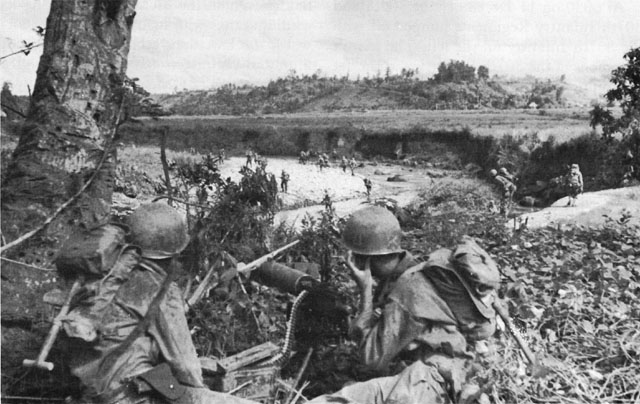
HEAVY MACHINE GUNS COVER CROSSING of the Antilao River by men of the 77th Division at Ormoc.
Cogon Defenses
By nightfall of 10 December the 77th Division had cleared Ormoc. (See Map 19.) The front lines of the 307th Infantry were on the western outskirts of the town along the bank of the Antilao River, a stream which flows past the entire western side of Ormoc. At the city’s northern edge the river is crossed by Highway 2, which then proceeds directly north about 300 yards west of the river and parallel to it for a distance of about 1,000 yards. The 306th Infantry on the right of the 307th Infantry had come abreast of that regiment at twilight.
At 0930 on 11 December the 306th and 307th Infantry Regiments jumped off with the 307th Infantry on the left. The assault battalions of the 307th Infantry and the 1st Battalion, 306th Infantry, attempted to cross the Antilao River but came under heavy fire and were pinned down.
The fire came from a well-fortified position of the 12th Independent Infantry Regiment on the north bank of the river at Cogon, a small barrio on Highway 2 just north of Ormoc. The enemy position was on a small elevated plateau, adjacent to Highway 2, overlooking the river to the south and rice paddies to the east and west. Innumerable spider holes had been constructed throughout the area. The principal defensive position, slightly east of Cogon, was in the vicinity of a three-story reinforced concrete building that had been converted into a blockhouse. The well-camouflaged positions, with the exception of the fortress, were so situated in the underbrush and the waist-high cogon grass that it was impossible to detect them at a distance of more than ten feet. From these positions the Japanese could command the bridge over the Antilao River and deny the U. S. troops the use of Highway 2 to the north. An estimated reinforced battalion with machine guns, antitank guns, and field pieces, together with small arms, defended the area.
The artillery fired on the enemy front lines, which were only twenty-five yards in front of the American assault troops, but failed to dislodge the Japanese. The assault battalions of the 307th Infantry and the 1st Battalion, 306th Infantry, thereupon delivered point-blank fire from their tank destroyer guns, amphibian tank guns, light and medium machine guns, and infantry weapons on the Japanese position but still could not overcome it. The lack of shipping had prevented the division from taking its medium tanks with it. Unable to move forward, the battalions established their front lines and perimeters for the night along a line just north of Ormoc.
Enemy Night Landings
At 2330 on 11 December the 77th Division beach defense units observed a Japanese convoy, which was transporting the Special Naval Landing Force, steaming into Ormoc Bay with the apparent intention of landing at Ormoc. The Japanese evidently thought that Ormoc was still in their hands. The first craft noticed by the U.S. forces was a landing barge with about fifty men, heading directly for the Ormoc pier. By the time the barge came within range of the shore weapons, all shore units were alert and waited with guns trained upon it. They withheld their fire until the barge was within fifty yards of the pier and then all weapons converged their fires upon the craft. The first rounds squarely hit the barge, which immediately burst into flames. The Japanese clambered atop the gunwales and are reported to have screamed, “Don’t shoot,” under the mistaken notion that their forces still occupied Ormoc.
The harbor was lit up by the burning barge and 60-mm. illuminating shells. During the night the Americans discovered that another enemy vessel, about the size of an LST, had pulled into shore northwest of the town under cover of darkness and was busily engaged in discharging troops and equipment. The tank destroyer guns of the 307th Infantry, emplaced along the beach within 1,000 yards of the vessel, opened fire on it while forward observers from the 902d Field Artillery Battalion directed artillery fire upon the landing area and inland. The enemy vessel attempted to pull out to sea, but after proceeding less than fifty yards it burst into flames and sank. About 150 men, two tanks, a number of rifles, mortars, and machine guns, and a quantity of ammunition had been unloaded before the vessel sank, but most of the supplies, including four ammunition trucks, had been destroyed by American fire while the vessel was unloading.
The early dawn of 12 December revealed another ship of the same type farther west near Linao. The artillery, mortars, and tank destroyer guns opened up against this vessel as it fled along the shores of Ormoc Bay, and their fire followed until it was out of range. Before the fire ceased, heavy clouds of smoke billowed from the vessel as it moved at a snail’s pace. During the night the American fire had to be closely co-ordinated, since American vessels, including a resupply convoy, were in the bay. Not a single U. S. craft was damaged.
Battle of the Blockhouse
The 902d and 305th Field Artillery Battalions, two batteries of the 304th Field Artillery Battalion, and one battery of 155-mm. howitzers from the 306th Field Artillery Battalion fired continuously for five minutes on the morning of 13 December at the enemy position in front of the 305th Infantry. So intense was the fire that the enemy soldiers were bewildered and streamed toward the front lines of the division where they were cut down in great numbers by machine gun and small arms fire. The Japanese in and around the concrete building, however, lay low and weathered the barrage.
General Bruce attached Col. Paul L. Freeman, an observer from the War Department General Staff, to the 305th Infantry. Colonel Freeman was made the commander of a special attack force, consisting of Companies E and L, which was to storm the blockhouse. The 305th Infantry, which was to make the main effort, had the 3d Battalion on the right of Highway 2 and the 2d and 1st Battalions on the left of the road. The 3d Battalion in a column of companies moved out at 0830. In support of the 305th Infantry, the 2d Platoon, Company A, 88th Chemical Battalion, fired on and silenced two enemy machine guns. The Japanese held their fire until the infantrymen were upon them, making it necessary for the artillery to fire at very close range. The fire from the 305th Field Artillery Battalion came to within fifty yards of the American front lines.
After Company I, the lead company, reached the ridge at 0925, K Company moved up and attempted to consolidate the 3d Battalion’s position by making an oblique turn to the right flank of Company I. It was hit at 1155 by the first of five counterattacks by the 12th Independent Infantry Regiment. The enemy preceded the infantry assault by artillery, mortar, and automatic weapons fire. The 3d Battalion estimated the enemy force to be a reinforced battalion. All of the counterattacks were driven off with heavy casualties on both sides.
During the night of 13–14 December the artillery of the 77th Division delivered harassing and interdiction fires to the front, the principal target being the concrete house that had withstood the onslaught of the previous two days. The 1st Battalion, 305th Infantry, received enemy mortar fire during the night, and both it and the 2d Battalion received light machine gun fire in the early morning hours. The 2d Battalion destroyed one machine gun with mortar fire.
On 15 December the 77th Division consolidated its lines and sent out small patrols. The enemy continued to be very active in the sector of the 305th Infantry. During the night the artillery operating in the 1st Battalion sector knocked out four 2½-ton trucks and killed seventeen of the enemy, while the 2d Battalion beat off two Japanese counterattacks. In the 3d Battalion sector all was quiet.
The Mountain Passage
As a result of General Suzuki’s abortive attempt to seize the Burauen airfields, a number of Japanese soldiers remained in the mountains west of Burauen. Most of these were from the 26th Division and they were trying to rejoin the main part of the 35th Army in Ormoc Valley. Earlier, the 11th Airborne Division had started out over the mountains from Burauen in order to relieve enemy pressure on the eastern flank of the XXIV Corps in its drive toward Ormoc. (Map 21)
Mahonag
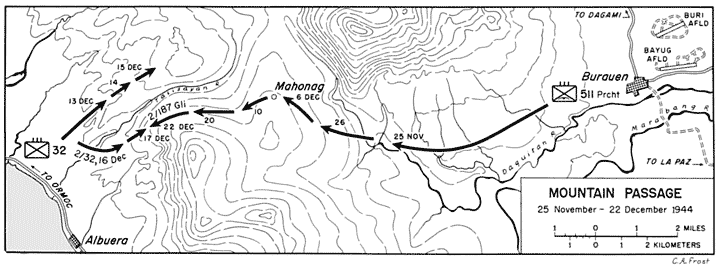
MAP 21 C. A. Frost
MOUNTAIN PASSAGE
25 November–22 December 1944
On 9 December the 2d Battalion, though encountering heavy fire from enemy machine guns, mortars, and rifles, pushed steadily forward and established contact with the other units of the 511th Parachute Infantry Regiment at Mahonag. For several days thereafter, this regiment was busily engaged in sending out patrols. Company G, patrolling in force for two miles to the front, was cut off from the rest of the regiment, which was held down because of strong enemy action. On 13 December the 32d Infantry pushed northeast from Ormoc Bay in an effort to make juncture with the 11th Airborne Division and assist it in moving out of the mountains.
Drive of 32d Infantry
The 32d Infantry also encountered very precipitous hills and its advance was bitterly contested by the Japanese. By the evening of 14 December the regiment had considerably reduced the distance between itself and the 511th Parachute Infantry.
At 0700 on 15 December, as the 3d Battalion was moving out, a patrol of six men from Company G, 511th Parachute Infantry, entered the battalion’s lines. The rest of Company G was only 700 yards east of the ridge. The patrol reported that Company G had been cut off from the rest of the regiment for four days and was without food.
The 3d Battalion encountered only slight resistance and at 0950 was on top of the ridge. A platoon moved out to make contact with Company G of the 511th Parachute Infantry. The platoon reached the company, and at 1855 Company G entered the lines of the 3d Battalion, which fed and sheltered its men for the night.
The Drive South
Regrouping of Japanese Forces
The onslaught of the X Corps had forced General Suzuki to abandon the earlier plan of advancing the 35th Army north along three widely separated routes. Instead he had to concentrate the main strength of the 1st Division along the highway to check the American advance. The plan to use the 1st Division as a strong offensive force had to be discarded in favor of using it in a strictly defensive role.
By this time communications between the 1st Division and other units had broken down. Telephonic and telegraphic communications between the division and 35th Army headquarters were out for long periods of time, and liaison between the division headquarters and front-line units was carried out by messengers moving on foot. The supply lines had also broken down. The 1st Division Transport Regiment found it virtually impossible to supply food and ammunition to the 1st and 57th Infantry Regiments and the 1st Artillery Regiment.
Drive of the 32d Division
The 127th Infantry had pushed past the 3d Battalion, 128th Infantry, which was south of the Leyte River and west of Limon. The 127th encountered very determined resistance from the Japanese entrenched on the high ground 1,000 yards south of the Leyte River bridge. The well-camouflaged enemy defenses consisted of numerous foxholes and ten-foot-deep spider holes, many of which were connected by interlacing communication trenches.
The terrain that the troops traversed was adapted to defensive fighting, and the 1st Division took full advantage of this fact. There were deep ravines and steep hills where the enemy had dug in on both the forward and reverse slopes. The entire area was covered by heavy rain forest with dense underbrush. The nearly constant rainfall made observation difficult and the maps for the area were very inaccurate.
During the night of 12–13 December the artillery battalions of the 32d Division fired harassing missions near the perimeters of the 126th and 127th Infantry Regiments and southward on Highway 2 as far as the vicinity of Lonoy.
The 14th Area Army had planned to land the 39th Infantry Regiment and an artillery company from the 10th Division near Carigara on 16 December, but in view of the American 77th Division’s advance to Ormoc the plan was canceled on 11 December. On 13 December General Suzuki attached an infantry company of about 100 men from the 102d Division to the 1st Division in order to strengthen the latter’s lines.
On the morning of 13 December the 2d Battalion, 126th Infantry, with the assistance of its tanks and heavy mortars, pushed past the Japanese who had held up its advance. In the face of most determined opposition the battalion moved south, destroying the pockets of resistance which had been bypassed. At the end of the day the 2d Battalion had advanced 400 yards to a position 200 yards north of a roadblock set up by the 3d Battalion, 126th Infantry. The 3d Battalion, less Company L, which was to remain on the high ground overlooking the road, was to attack south on the east side of Highway 2 and come abreast of the 1st Battalion, 126th Infantry.
At 1521 the 3d Battalion reported that six enemy tanks were coming up the highway. After heavy fighting, the Japanese tanks withdrew at nightfall and returned to the south. The 1st Battalion, 126th Infantry, the southernmost unit of the division, made plans to dislodge the enemy force between it and the 3d Battalion. The contested ground consisted of an open space 600 to 700 yards long and 200 to 300 yards wide, at the southern end of which were two knolls. The 1st Battalion had men on both knolls but did not control the northern end of the sector where the Japanese had dug in and were using machine guns, mortars, and rifles. The 1st Battalion charged against the Japanese and rooted them out with grenades and mortar fire. Except for this action, only slight gains were registered during the day. The men of the battalion were hungry, having been without food since the previous afternoon. The commanding officer of the battalion renewed a request for additional rations and ammunition, since the one-third ration that had been received the day before was insufficient.
The 1st and 2d Battalions of the 127th Infantry received orders from the regimental commander to advance south with the 1st Battalion on the left, pinch out the 3d Battalion, 126th Infantry, and link up with the 1st Battalion, 126th Infantry. The 1st Battalion, 127th Infantry, moved out in a column of companies and had advanced 400 yards when it encountered forty to fifty Japanese on a ridge to its front, about 150 yards west of the road. The enemy threw blocks of TNT and grenades against the battalion, effectively pinning down the troops. A night perimeter was established.
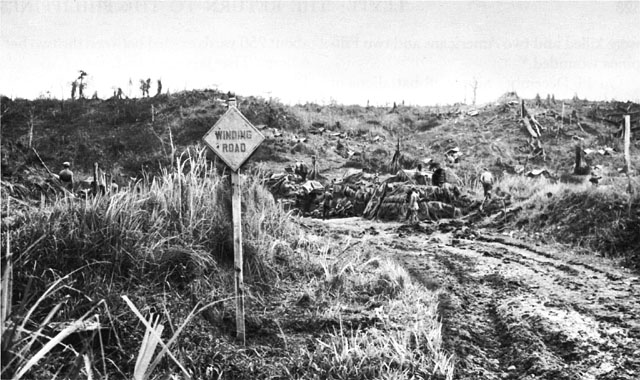
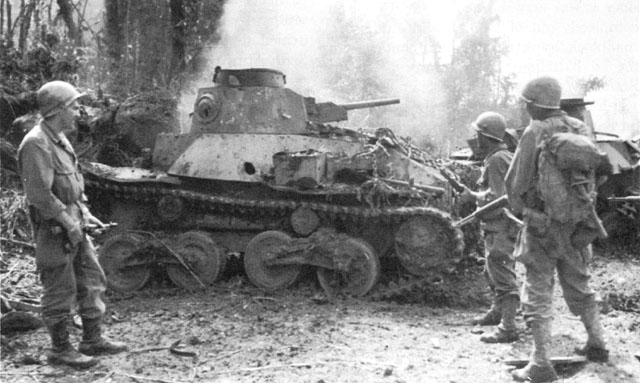
U.S. AND JAPANESE TANKS. Camouflaged U.S. tanks are shown (above) on Highway 2, between Limon and Lonoy. Burning Japanese tanks (below) are checked by 127th Infantry troops north of Lonoy.
The 126th Infantry, on the same day, moved forward in a column of battalions. The 1st Battalion made a limited advance, since it was very short of ammunition and completely out of food. It did establish a roadblock, however, and made contact with the 2d Battalion, 127th Infantry. The 2d Battalion, the northernmost unit of the 126th Infantry, moved slowly behind the 3d Battalion of the regiment. An interval of about 250 yards existed between the two battalions. The Japanese in front of the 32d Division, especially in the sector of the 3d Battalion, had strongly entrenched themselves and resisted the 3d Battalion from both sides of the highway.
The main Japanese defensive line had been reached. By 14 December the 32d Division had advanced more than two miles south of Limon. The 77th Division had crushed the Cogon defenses and was in a position to drive north and make juncture with elements of the X Corps. The northern and southern entrances to Ormoc Valley were denied to the Japanese. The jaws of the Sixth Army trap were starting to close.