Chapter V · A Day: 20 October 1944
Reading edition
Bombardment of the Shores of Leyte
The waters of Leyte Gulf were glassy calm as the convoys bearing the assault forces steamed into their appointed positions off the shores of Leyte in the very early morning hours of 20 October 1944.
Gray smoke plumes are rising from the shores. Battleship Mississippi is now working on the northern beaches. She is joined by the Maryland whose fire has apparently caused a large shore explosion. Jap ack-ack is fired at spotting planes but the performance is weak.
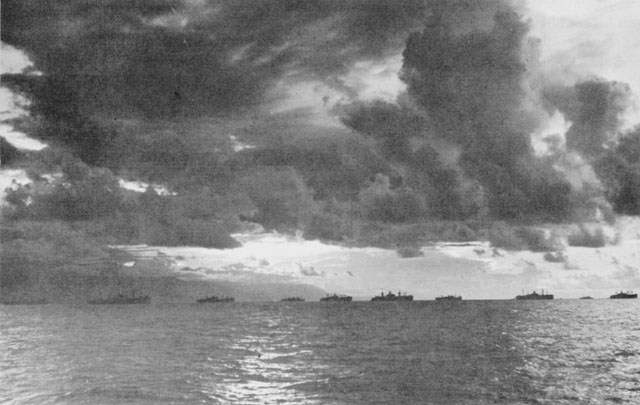
CONVOY OFF LEYTE at dawn on A Day.
X Corps Goes Ashore
Missions of Sixth Army Summarized
1st Cavalry Division
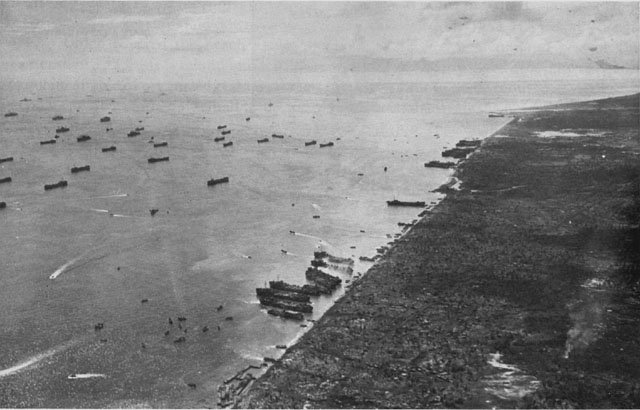
LANDING BEACHES. White Beach is in the foreground, with Red Beach, bounded by the Palo River, beyond.
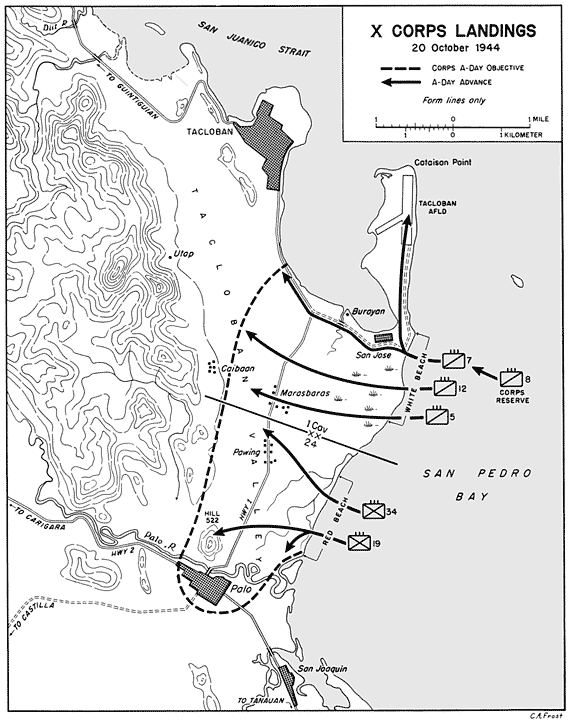
MAP 5 C. A. Frost
X CORPS LANDINGS
20 October 1944
The 1st Squadron of the 7th Cavalry was to land north of the 2d Squadron on the northern end of White Beach, which at this point coincided with the narrow neck of land connecting the Cataisan Peninsula to the rest of the island, and then go directly north to secure the entire peninsula and the airstrip. On its left the 2d Squadron, 7th Cavalry, was to land on the right flank of White Beach, push inland, capture San Jose and a bridge across the Burayan River northwest of the town, and seize a beachhead line a thousand yards west of Highway 1 and three thousand yards from White Beach. The Cataisan Peninsula would then be sealed off.
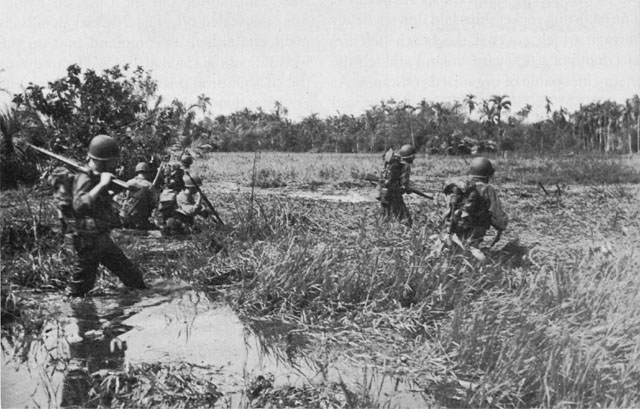
TROOPS OF THE 1ST CAVALRY DIVISION wade through a swamp to their A-Day objective.
From the beach a single deeply rutted and muddy exit road ran south to the Palo River, where it turned westward to Highway 1. The river was just north of the town of Palo and roughly paralleled Highway 2, which ran in a northwesterly direction from Palo into the interior, between the hills dominating this entrance to Leyte Valley.
Among the vessels hit by Japanese artillery were four LST’s, one of which was set on fire. Of the five remaining, two were driven away and three did not get in until much later. The enemy fired upon the retiring LST’s, which carried with them the artillery and most of the tanks. The commanding officer of Headquarters Company and the division quartermaster, together with the latter’s executive officer, were wounded. Many of the division headquarters personnel were killed or wounded.
Company I was able to advance, but Company K ran into a defensive position of five pillboxes along a stream about seventy-five yards from the beach. It successfully stormed these pillboxes with rifles, BAR’s, and hand grenades. The 3d Battalion then halted for reorganization. Company L, the reserve company, moved into the line south of Company K to close the gap between the 19th and 34th Infantry Regiments, a gap created when part of the 34th landed too far north.
By 1215 the 34th Infantry had cleared the beach area of the enemy, and the 3d Battalion was ready to advance across an open swamp to a line of trees 150 yards away. A preparatory concentration by 81-mm. mortars, tanks, and heavy machine guns was first laid down. At 1230 the 3d Battalion moved in. Although the going was rough and the mud waist deep, the troops reached the trees at 1300 and waited for the mortars and machine guns to arrive. The 3d Battalion then pushed on an additional 250 yards.
The 34th Infantry established contact with the 1st Cavalry Division on the right and the 19th Infantry on the left. The 1st Battalion, 34th Infantry, remained in the beachhead area.
To the south the 19th Infantry, with the 3d Battalion in the lead, had also struck heavy opposition on its sector of the beach. Through error the first waves of the regiment landed almost directly behind the 34th Infantry and 800 yards north of the proposed landing point. The later waves landed at the planned spot.
Company K did not land on schedule, because its command boat broke down. Going in under heavy fire, the company had all its officers except one killed or wounded. One of its platoons was unable to make contact with the rest of the company until the following day.
The 1st Battalion, 19th Infantry, had come in under intense fire in which several boats were hit, and numerous casualties occurred. The battalion landed 300 yards north of its selected area, moved in 200 yards, and then made a left, oblique turn in order to reach its predetermined assembly area. Company B suffered several casualties when it ran into strong rifle and pillbox fire, which pinned it down. The company was ordered to break off fighting and move to the northern edge of the Japanese positions. Lt. Col. Frederick R. Zierath, the commanding officer of the battalion, ordered the self-propelled guns to be brought up. They successfully neutralized the pillbox and a supporting position behind it. Company C, landing on the left flank of the battalion, was immediately pinned down by hostile fire. Zierath ordered it to disengage and proceed to the designated assembly area. Company A, which was split by enemy fire, regrouped inland and reached the assembly area just ahead of Company C.
The 2d Battalion, 19th Infantry, arrived at the beach just as the 1st Battalion was bypassing the initial resistance. By noon its first defense was formed around the beachhead. At 1245 Company E, with a rocket launcher, silenced a 75-mm. gun which had been firing on the LST’s. In its advance the company located two more 75-mm. guns which had been abandoned. Company G relieved Company E and prepared to move along the beach road southwest toward Palo. As the point started to move out at 1300 it was attacked by approximately a platoon from the 33d Infantry Regiment which attempted to retake the gun positions. The Japanese were repulsed by rifle fire, leaving eleven dead.
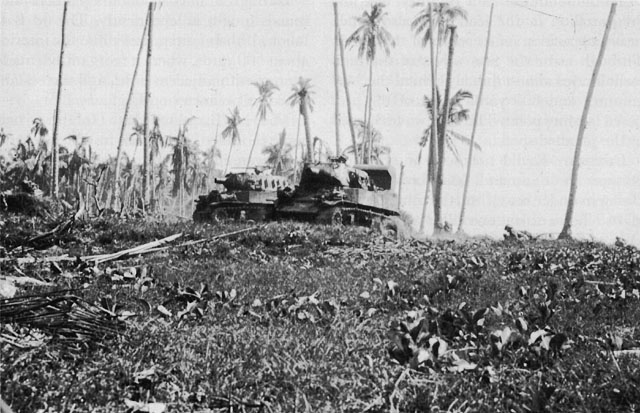
75-MM. M8 SELF-PROPELLED HOWITZERS move in to support the infantrymen in their advance from the beach.
At 1430 Company G, in resuming its advance, ran at once into a series of mutually supporting pillboxes about 500 yards inland, where the beach road turns to meet Highway 1. A stiff rifle fire fight followed, in which the Americans suffered fifteen casualties. Since darkness was approaching, the battalion broke off the action and dug in along the road for the night.
While the 2d Battalion, 19th Infantry, was proceeding cautiously forward the 1st Battalion was working toward Hill 522. This hill, which rose directly from the river’s edge north of Palo, overlooked the landing beaches and its upward trails were steep and winding. Hill 522 presented the most significant terrain feature which would have to be overcome before the American forces could push into the interior from Palo and it constituted one of the chief objectives for A Day. Three months earlier General Makino had started to fortify it, impressing nearly all of the male population of Palo for the work. By A Day they had constructed five well-camouflaged pillboxes of rocks, planking, and logs, covered with earth. Numerous tunnels honeycombed the hill; the communications trenches were seven feet deep.
During the preliminary bombardments the Navy had delivered some of its heaviest blows on the hill, and the bombardment was continued by Battery B of the 13th Field Artillery Battalion and Battery A of the 63d Field Artillery Battalion. The 1st Battalion of the 19th Infantry sent reconnaissance parties to locate a northern route to the hill. The plan had been to move inland from the extreme south of the beachhead, but that area was still in Japanese hands. At 1430, when scouts reported finding a covered route on the northern side of the hill, the 1st Battalion immediately moved out in a column of companies. The column had barely started when Company A, in the lead, was held up by enemy fire from the five pillboxes. The remainder of the battalion moved north around Company A, and, skirting the woods, attacked Hill 522 from the northeast, with Company C on the right and Company B on the left.
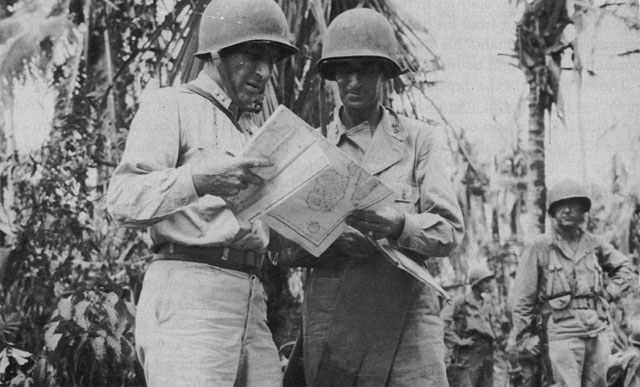
MAJ. GEN. FRANKLIN C. SIBERT
(left), X Corps commander, confers with Maj. Gen. Frederick A. Irving, commander of the 24th Division, at a forward command post.
The men, although tired from the day’s activity and strain, made steady progress up the slope. As the troops moved upward, American mortars started to shell the crest of the hill. It was thought that this was artillery fire and a request was made that it be lifted. It came, however, from the chemical mortars. After a short delay the firing ceased. At dusk Company B reached the first crest of the hill and was halted by fire from two enemy bunkers. The company thereupon dug in.
At the same time scouts from Company C reached the central and highest crest of the hill and espied about two platoons of Japanese coming up the other side. They shouted for the remainder of the company to hurry. Company C got to the top of the hill barely ahead of the Japanese, and a sharp engagement took place in which about fifty Japanese were killed. Company C held the highest crest of the hill. During this attack, 1st Lt. Dallas Dick was struck in the leg and his carbine was shot from his hands, but he continued to command his unit until his evacuation forty-eight hours later.
During the night the Japanese made frequent but unsuccessful attempts to infiltrate the company area and in the darkness they carried away their dead and wounded. During the action to secure Hill 522, fourteen men of the 1st Battalion were killed and ninety-five wounded; thirty of the latter eventually rejoined their units. General Irving, who had assumed command of the 24th Division ashore at 1420, later said that if Hill 522 had not been secured when it was, the Americans might have suffered a thousand casualties in the assault.
By the end of A Day, the division had crossed Highway 1 and established physical contact with the 1st Cavalry Division on its right flank. In spite of strong opposition on its left flank, the 24th Division had secured Hill 522, which dominated the route into the interior and overlooked the town of Palo, the entrance point into Leyte Valley. Furthermore, the X Corps had now secured a firm beachhead area averaging a mile in depth and extending over five miles from the tip of the Cataisan Peninsula to the vicinity of Palo, and had captured the important Tacloban airstrip on the Cataisan Peninsula.
XXIV Corps Goes Ashore
While the X Corps was engaged in seizing a beachhead and capturing the Tacloban airfield, the XXIV Corps was carrying out its mission more than fourteen miles to the south. (Map 6) It was to land in the Dulag-San Jose area and establish a beachhead between Dulag and Tanauan. The Dulag airstrip was the primary objective. The 7th and 96th Divisions—the 7th on the left (south) and the 96th on the right (north)—made the landings. The most prominent terrain feature near the shore line is a short, finger-like hill range between the mouth of the Labiranan River and the village of Pikas. Ranging from 400 feet at its southern extremity, known as Labiranan Head, to 1400 feet at Catmon Hill, southeast of Pikas, this hill mass dominates the surrounding plain for miles around. (The entire hill mass will hereafter be referred to as Catmon Hill.)
96th Infantry Division
In the early morning hours of 20 October the Southern Attack Force moved to a location off the shores of Leyte near the town of Dulag. The 96th Division was to land with regiments abreast in the area between the Calbasag River and the town of San Jose—the 382d Infantry on the left (south) and the 383d Infantry on the right (north). The southern half of the division’s beachhead area was designated Blue Beaches 1 and 2, and the northern half was known as Orange Beaches 1 and 2. The beaches had an average length of about 525 yards. The northern extremity of Orange Beach was about ten miles from the southernmost beach of the 24th Division in the X Corps sector.
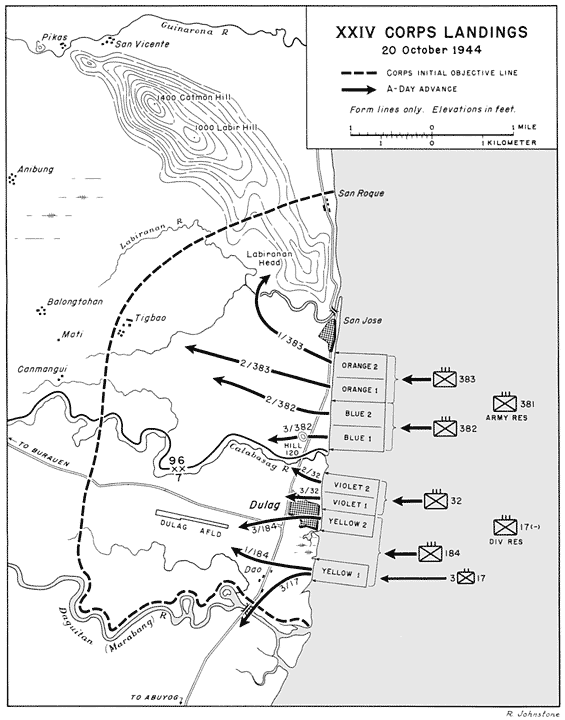
MAP 6 R. Johnstone
XXIV CORPS LANDINGS
20 October 1944
When the landing craft were within 100 yards of the shore, the LCI’s fired into the interior and to each side of the landing beaches. Thereupon the amphibian tanks began to fire directly beyond the beaches, in front of the advancing assault forces. The 382d Infantry under Col. Macey L. Dill landed at 0950 on Blue Beach, and the 383d Infantry under Col. Edwin T. May landed ten minutes later on Orange Beach.
The 1st Battalion, 383d Infantry, pushed northwest through the barrio of San Jose, which was on the beach, and along the marshy ground and swamps on the south bank of the Labiranan River for 2,200 yards. It crossed the river at 1610. Company C placed a roadblock at the point where Highway 1 crossed the Labiranan River. After advancing 400 yards farther northwest the battalion ran into fire from elements of the 9th Infantry Regiment. At 1900 the battalion, still under enemy fire, dug in for the night. At the close of the day’s action it was at the base of Labiranan Head in a position which would permit an attack to be launched on that terrain feature from the west.
As heavy enemy artillery and mortar fire fell on the beach, the 382d Infantry also landed with two battalions abreast—the 2d Battalion to the right (north) at Blue Beach 2 and the 3d Battalion to the left (south) at Blue Beach 1. The 2d Battalion, though momentarily stopped by debris on the shore, was able to advance quickly and by 1025 had penetrated 300 yards inland. This gain was increased to 700 yards by 1115. The battalion crossed Highway 1 before it encountered the first defensive positions of the 9th Infantry Regiment, a series of zigzag deserted trenches roughly paralleling the beach. Although the 2d Battalion met no enemy opposition, the intense heat and the swampy ground made progress slow. At 1630, when the battalion formed a perimeter for the night, it had pushed inland approximately 2,500 yards.
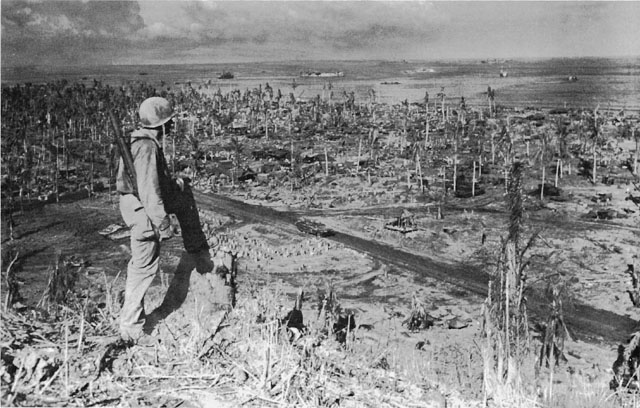
BEACH AREA as seen from Hill 120.
The 1st Battalion, 382d Infantry, which had been in floating reserve, landed on Blue Beach 1 and moved to the foot of Hill 120 to support the 3d Battalion. Immediately beyond the hill there was a small meadow rimmed by a deep swamp. The enemy fired upon the hill throughout the day but could not dislodge the 3d Battalion. This steady fire and the presence of the swamp limited the A-Day advance of the 3d Battalion to 1,300 yards inland from the landing beach.
Maj. Gen. James L. Bradley arrived ashore at 1750, and at 1800 he assumed command of the 96th Infantry Division. The three light artillery battalions of the division had landed and were in position by 1800.
7th Infantry Division
The 7th Division was to land on Violet and Yellow Beaches. Violet Beach extended 785 yards north from the northern edge of Dulag. The northern half of Yellow Beach, called Yellow Beach 2, which was south of Violet Beach and contiguous to it, was 400 yards long. Between the northern and southern halves of Yellow Beach was a swamp. The southern half of Yellow Beach, Yellow Beach 1, was approximately 425 yards in length and was located south of Dulag and north of the Daguitan River mouth.
The 7th Division was to go ashore between the Calbasag and Daguitan Rivers with regiments abreast—the 32d Infantry on the right (north) and the 184th Infantry on the left (south); the 17th Infantry, less its 3d Battalion, was in reserve. The principal A-Day objectives were the barrio of Dulag and its airstrip. The 3d Battalion, 17th Infantry, was to swing south and secure the bridge and the crossing of the Daguitan River at Dao and the crossing of the Talisay River.
The 32d Infantry, under Col. Marc J. Logie, was to land on the northern and southern portions of Violet Beach, drive into the interior, and protect the right flank of the division. The 184th Infantry, commanded by Col. Curtis D. O’Sullivan, was to land on Yellow Beach 1 and Yellow Beach 2 and then drive inland, directing its main effort toward an early seizure of the airfield west of Dulag. It was also to seize and secure the crossings of the Daguitan River.
Companies L and K of the 3d Battalion, 32d Infantry, landed abreast. Company L, on the left, ran into heavy fire from Japanese machine gunners who had waited until the leading elements of the company exposed themselves. The Japanese were entrenched in bunkers emplaced in hedgerows and banana groves. The pillboxes, which were mutually supporting, were located at the ends of the hedgerows and occasionally in the middle of an open field. Each pillbox had machine guns and antitank guns. Company L suffered a number of casualties and was pinned down. The enemy gunners then turned to Company K and stopped its forward movement. In the space of fifteen minutes two officers and six men of the 3d Battalion were killed, and one officer and eighteen men wounded. Of the medium tanks that had come ashore at 1030, three were sent to support Company L and two to support Company K. The latter two were knocked out before they could adjust their fire on the pillboxes. The leading tank sent in support of Company L was knocked out by a direct hit from an antitank gun. With two tanks remaining, it was decided to hit the flanks of the entrenched pillboxes at 1345. A platoon of Company K went to the right and another platoon from the company to the left. Simultaneously the remaining elements of the two companies, coordinating with the tanks, assaulted the pillboxes. The heavy volume of fire kept the enemy guns quiet until they could be finished off with grenades. The pillboxes were knocked out without further casualties.
The 17th Infantry, less its 3d Battalion, was kept in 7th Division reserve. The 3d Battalion of the 17th had come ashore at 1500 on the southern end of Yellow Beach. The battalion pushed west and south through light opposition, seizing the bridge over the Daguitan River at Dao, and by 2100 had established a bridgehead south of the river and made contact with the 184th Infantry on the right. At the end of the first day’s fighting the 7th Division had gained possession of the Leyte shore in its zone and penetrated inland 600 yards on the right and nearly 2,300 yards on the left. It had also reached the edge of the Dulag airstrip. By nightfall the XXIV Corps had established a firm beachhead line extending along the coast from San Jose on the north to just below Dao on the south.
Seventy miles to the south the 21st Infantry Regiment of the 24th Division, which was detailed to land in the vicinity of Panaon Strait on 20 October at 0930, half an hour before the launching of the great offensive, and to secure control of that entrance to Sogod Bay, successfully accomplished its mission. It encountered no Japanese.
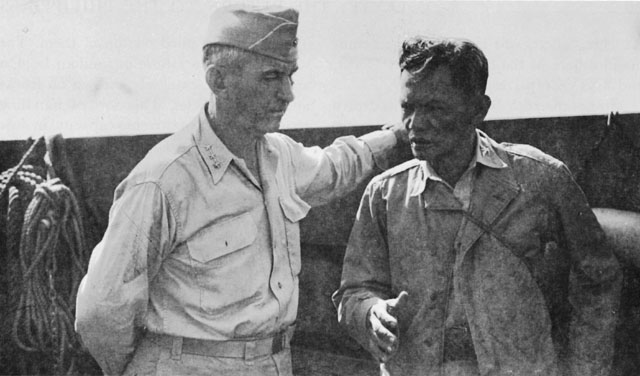
LT. GEN. WALTER KRUEGER AND COL. RUPERTO K. KANGLEON of the guerrilla forces head for the beach (above). Krueger talks with men of the 7th Division on the beach near Dulag (below).
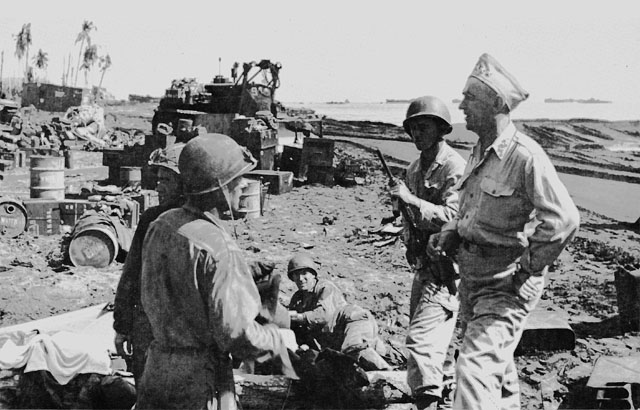
Most of the 16th Division had withdrawn during the naval and air bombardment which took place just prior to the landing. The immediate invasion of the troops after this pounding enabled the Americans to secure most of the coastal defenses before the enemy could regroup and return. As a consequence, the only Japanese forces encountered were those left behind to fight a delaying action. The meeting with the enemy in force was yet to come.
Bringing in Supplies
While the assault forces were securing the beaches of Leyte, supplies were being poured in to support the operation. Within an hour after the first assault wave hit the hostile shores, rations, equipment, and other supplies were being rushed to the beaches. Each man going ashore carried a change of clothing in his pack, two days’ supply of emergency rations, one day’s supply of D rations, and two filled canteens, in addition to his gas mask, weapons, and ammunition.
The Navy was responsible for transporting the troops and supplies to the target area. Ships’ companies unloaded the cargo from the cargo vessels and transported it in small craft to the beaches. Many of the ships had been improperly loaded for the journey to Leyte. The cargo should have been so loaded that articles first needed would be the last put on board; instead it had been stowed haphazardly, with little attention given to the problem of unloading.
As a result of the faulty stowage of supplies on the ships, many badly needed items were at the bottoms of the holds, and articles that would not be needed until later in the operation were piled on top of them. The supplies were set ashore in random fashion and then were carelessly thrown on trucks and other vehicles. This sort of handling resulted in a loss of carrying capacity, in slow removal of the loads, and in a consequent delay in the return of vehicles to the landing beaches.
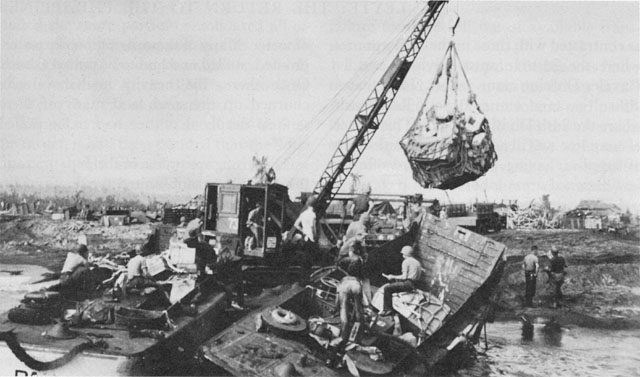
UNLOADING SUPPLIES AT DULAG on A Day (above), and (below) general view of the beach area on 22 October 1944.
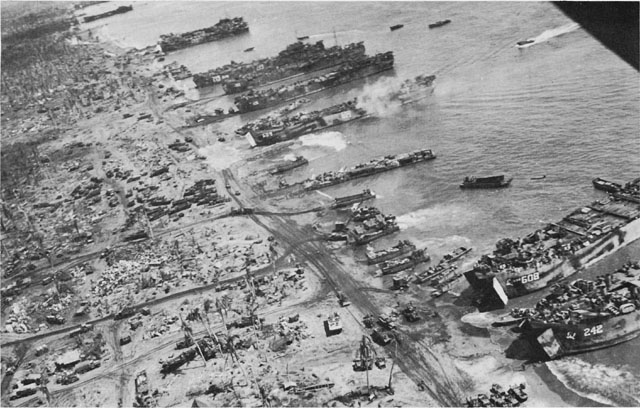
During the day a total of 107,450 tons of supplies and equipment were discharged over the beaches of the Sixth Army. Although the beaches in some instances were extremely congested, steps had been initiated to relieve the situation.